
Islamic studies for kids
Islamic Studies for Kids Online: A Parent's Guide by Age
Dar Ahlullah team 13 min read
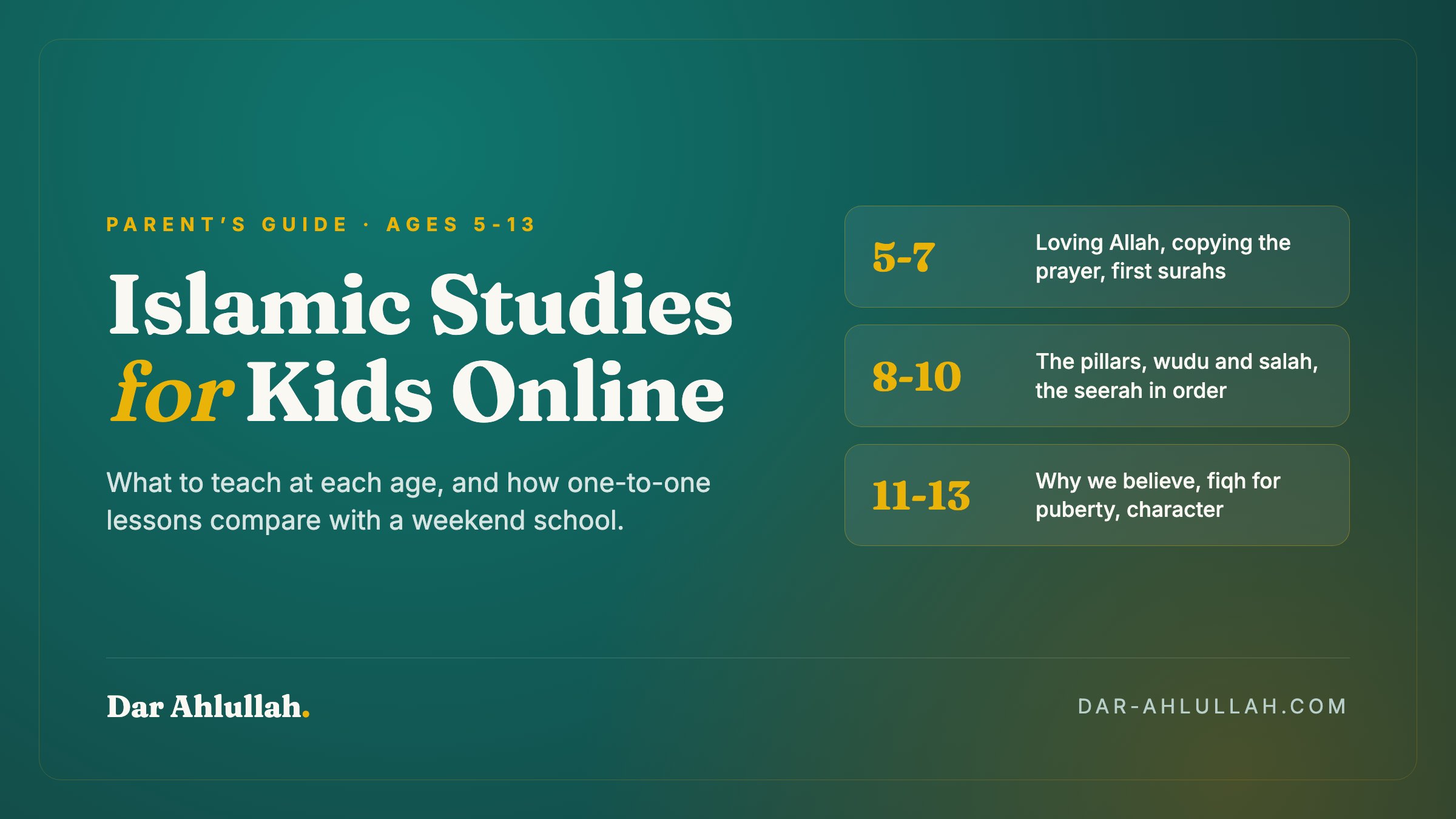
Table of Contents
- Can Children Really Learn Islamic Studies Online?
- What Should a Child Learn in Islamic Studies, by Age?
- My Kids’ Weekend School Is Too Crowded. What Is the Best Online Alternative?
- Is There a Weekend Islamic School Online?
- Is It Okay to Outsource Quran or Arabic, or Will It Break Our Homeschool Rhythm?
- How Many Sessions a Week Is Realistic Alongside School?
- How Do You Judge a Teacher and a Curriculum?
- How Do You Keep a Child Engaged and Safe Online?
- What Do Online Islamic Classes for Kids Cost?
- Where Does Dar Ahlullah Fit?
- Quick Answers for Parents
Can Children Really Learn Islamic Studies Online?
Yes. Islamic studies for kids online works well when the lesson is a live conversation with a teacher, in English, at the child’s own level, and when home carries the practice between lessons. It works poorly when “online” means a child alone with a playlist of videos. The format matters less than two things: how much of the lesson your child spends talking, and whether what they learn shows up in the house that week.
The Quran itself gives parents the outline of a syllabus. When Luqman counsels his son, he starts with belief: “O my son, do not associate [anything] with Allah” (Quran 31:13). Then worship: “O my son, establish prayer” (31:17). Then character: do not turn your cheek to people in contempt, walk moderately, lower your voice (31:18-19). Belief, worship, character. Every sound children’s curriculum is some arrangement of those three, with the life of the Prophet ﷺ running through them as the living example.
This guide covers what to teach at each age, how online one-to-one lessons compare with a weekend school and with teaching at home alone, how much time it realistically takes around a US or Canadian school week, and how to check a teacher before you trust them with your child.
What Should a Child Learn in Islamic Studies, by Age?
Between five and thirteen, a child can move from loving Allah and copying the prayer, to knowing the pillars and praying properly, to understanding why they believe and what becomes their own responsibility at puberty. The table below is a sensible teaching order, not a religious ruling, and a child who starts late simply starts at the first row.
| Area | Ages 5-7 | Ages 8-10 | Ages 11-13 |
|---|---|---|---|
| Belief (aqeedah) | Allah is One, He made us and He hears us. The shahadah by heart. | The five pillars of Islam and the six articles of faith, named and explained simply. | Why we believe: the child’s own questions, answered honestly. Trust in Allah’s decree. |
| Worship | Wudu and the prayer positions by copying a parent. No pressure. | Wudu done correctly, the five daily prayers, what is said in each position. | What breaks wudu and prayer, fasting, and what changes at puberty. |
| Seerah and stories | Short stories of the Prophet ﷺ and the earlier prophets. | The seerah in order, from Makkah to Madinah. | Lessons from the seerah and the Companions applied to real situations. |
| Manners (akhlaq) | Salam, bismillah, alhamdulillah, telling the truth, sharing. | Honesty, respect for parents and teachers, kindness to siblings and neighbors. | Character under peer pressure, at school and online. |
| Quran and duas | Al-Fatihah and the last short surahs. Duas for eating and sleeping. | More short surahs with their meanings. Daily duas. | Understanding what they recite in prayer. Making dua in their own words. |
A few of these rows have a direct source worth knowing. The five pillars come from the hadith of Ibn Umar (Sahih al-Bukhari 8), and the six articles of faith from the hadith of Jibril (Sahih Muslim 8a). The age of seven as the point where prayer is taught and expected comes from the Prophet’s ﷺ instruction to “command your children to pray when they become seven years old” (Sunan Abi Dawud 495); our guide on how to teach your child to pray walks through that hadith in full, age by age.
Children can also carry more belief than adults tend to assume. Ibn Abbas was a boy riding behind the Prophet ﷺ when he was told: “Be mindful of Allah and He will protect you. Be mindful of Allah and you will find Him before you. When you ask, ask Allah, and when you seek aid, seek Allah’s aid” (Jami at-Tirmidhi 2516). That is aqeedah taught to a child, in one sitting, in plain sentences.
For the detail behind each row, see aqeedah for beginners, the step-by-step wudu guide, how to study the seerah and which surahs to memorize first.
My Kids’ Weekend School Is Too Crowded. What Is the Best Online Alternative?
If the problem is attention, the closest online alternative is a live one-to-one lesson, because it is the only format where the teacher’s whole attention goes to one child. If the problem is something else, such as the drive or the schedule, a small live online group may be enough. Either way, weigh what the weekend school gives your child that a screen cannot before you leave it.
A crowded classroom is usually a sign of a masjid doing a lot with volunteer teachers and limited rooms, not of a bad school. Here is a fair comparison of the three common setups.
| Weekend Islamic school | Online one-to-one | Home only (parent-led) | |
|---|---|---|---|
| Individual attention | Shared across the class | All of the lesson | High, when the parent has time |
| Muslim friends and community | Its real strength: friends, the masjid, praying together | None built in | Depends on what the family arranges |
| Pace | Set by the class | Set by the child | Set by the child |
| Schedule | Fixed block, usually Saturday or Sunday | Short sessions on days you choose | Fully flexible, easy to skip |
| Travel | Drive both ways | None | None |
| Structure and sequence | Set curriculum by grade | Depends on the teacher; ask to see the plan | Depends on the parent’s preparation |
| Parent workload | Low | Low to moderate | High |
| Hardest part | A quiet child can go unheard | No classmates; needs a calm corner and a parent nearby | Consistency, and subjects the parent has not studied |
The honest reading of that table is that these formats do different jobs. A weekend school gives a child a Muslim peer group and a relationship with the masjid, and no online class replaces that. One-to-one lessons give a child a teacher who notices exactly what they have not understood. You do not have to choose one: keeping the weekend school for belonging and adding one short online lesson a week for depth is a reasonable combination. If that starts to feel like too much, drop the piece that is doing the least, not the piece that is easiest to cancel.
We have compared the two formats in more detail, for Quran specifically, in online Quran classes vs masjid classes.
Is There a Weekend Islamic School Online?
Yes, in two forms. Some programs run a live group class on Saturday or Sunday mornings that mirrors a weekend school timetable. The other form is one-to-one lessons that you simply book on weekend slots, which gives you the weekend schedule without the fixed classroom.
The group version keeps some classmates and usually costs less per child. The one-to-one version gives up classmates in exchange for pace and attention. When you look at a group program, ask how many children are in the live class and how often each one speaks; a class of fifteen on a screen has the same attention problem as a class of fifteen in a room. Our older guide to weekend Quran classes covers how weekend-only study works for Quran and tajweed.
Is It Okay to Outsource Quran or Arabic, or Will It Break Our Homeschool Rhythm?
It is fine. Quran recitation has always been passed from teacher to student. Handing Quran recitation or Arabic to someone trained in it is not stepping back from your child’s Islamic education. It protects your rhythm when the lesson is a fixed anchor in the week, and it disrupts your rhythm only when lesson times float.
The Prophet ﷺ said, “The best among you are those who learn the Quran and teach it” (Sahih al-Bukhari 5027). Teaching the Quran is an honored role in its own right, and using a teacher is taking part in that, not avoiding it.
A practical split:
- Outsource what needs a trained ear. Quran reading, tajweed and spoken Arabic depend on someone hearing your child and correcting them in the moment.
- Keep what is lived. Belief, manners, seerah stories and the daily prayers are learned mostly by watching you. A teacher can add order and depth, but home is where they become real.
- Fix the slot. Same days, same time, treated like any other block in your plan. Put it right before or after an existing anchor such as lunch or Asr.
- Ask for a short note after each lesson so you can fold the week’s topic into your own teaching.
The full picture, including what to keep in-house, is in our guide to Islamic homeschooling.
How Many Sessions a Week Is Realistic Alongside School?
For Islamic studies on its own, one or two 30-minute sessions a week is realistic for most school-age children. If your child is also learning to read the Quran, plan for two to three short sessions a week in total across both subjects. Short and regular beats long and occasional.
What makes it sustainable around a US or Canadian school week:
- Pick slots that already exist. A weekday slot after a snack and before homework, or a weekend morning, tends to survive. A slot squeezed in after sports practice usually does not.
- Keep under-tens to about thirty minutes. Older children can manage longer, but a focused half hour is plenty for one topic.
- Add five minutes at home. One question at dinner about this week’s story does more than an extra lesson.
- Plan for the term, not the week. Decide in advance what happens during exams, Ramadan and school breaks so a busy fortnight does not quietly end the routine.
For a worked weekly plan around school hours, see our after-school Arabic and Quran program guide.
How Do You Judge a Teacher and a Curriculum?
Judge the teacher on one trial lesson and the curriculum on one page. In the trial, watch whether the teacher gets your child talking, explains in clear English at the child’s level, and corrects kindly. For the curriculum, ask to see what will be covered over the next three months and in what order.
Questions worth asking before you pay:
- What will my child be able to do or explain after three months?
- Which books or materials do you teach from, and can I see them?
- How do you handle matters where the schools of law differ, such as details of the prayer? A good teacher will ask what your family follows and will not unsettle a child’s practice at home.
- What do you say when a child asks a question you cannot answer? “I will find out” is the right answer.
- How will I know what was taught each week?
- Can we change teachers if it is not a good fit?
Be cautious of a curriculum that is only a list of topics with no sequence, of lessons that are mostly the teacher talking, and of any teaching that relies on frightening a young child. Good character is the point of the subject: “There is nothing heavier than good character put in the scale of a believer on the Day of Resurrection” (Sunan Abi Dawud 4799). A teacher who models it is teaching the curriculum before the lesson starts.
For the wider checklist, including trial lessons and payment terms, see how to choose an online Quran academy.
How Do You Keep a Child Engaged and Safe Online?
Engagement comes from short lessons, a teacher who asks more than they tell, and a parent who shows interest afterwards. Safety comes from the lesson happening in a shared room, on a platform you control, with all communication going through you.
Engagement
- Stories first. Children remember the seerah as a story long before they remember it as a timeline.
- Let the child retell. Asking “tell me what happened next” shows what was understood.
- Connect the lesson to the same week: the dua before eating at tonight’s dinner, wudu before Maghrib.
- If your child starts resisting lessons, look at timing and tiredness before blaming the subject. Our guide on what to do when a child refuses to learn covers the common causes.
Safety
- Set the device up in a living area, not a bedroom, with a parent within earshot.
- Join from a parent’s account, so the meeting link and any messages come to you.
- Keep contact between teacher and child inside the lesson. Scheduling and feedback go to the parent.
- Know the teacher’s name, ask who else might ever cover a lesson, and ask whether sessions are recorded and who can see the recordings.
- Tell your child they can always tell you if anything in a lesson made them uncomfortable.
What Do Online Islamic Classes for Kids Cost?
Price follows format. Live group classes are the cheapest, and one-to-one lessons cost more because the teacher’s time is not shared. Across the online market, group classes commonly run about $10-25 a month and private 30-minute lessons twice a week about $35-60 a month, the same ranges we documented for Quran classes.
The useful number is cost per teaching hour: the monthly price divided by the hours of live teaching you actually receive. Ask about registration fees, material fees and what happens to a missed lesson. The method and the worked examples are in how much online Quran classes cost. Weekend school tuition varies from one masjid to the next, so ask yours directly and compare on the same per-hour basis.
Where Does Dar Ahlullah Fit?
Dar Ahlullah teaches live one-to-one lessons over Zoom, in English. It suits a family that wants individual attention and a flexible slot. It is not a weekend school, and it does not offer group classes or classmates.
What our published pages state:
- An Islamic Studies course for kids and teens. The courses page lists it as covering aqeedah and fiqh basics, the seerah of the Prophet ﷺ, and Islamic manners and character, with age-appropriate content, at one to two sessions a week on an ongoing basis. Quran reading, tajweed, memorization and Arabic are separate courses.
- Always one-to-one. Every session is a single student with a single teacher.
- About $9 per teaching hour. Plans start at $36 a month for eight 30-minute sessions, with a 20% sibling discount and no registration fee. Details are on the pricing page.
- A written progress report after every session, so you know what was covered.
- A free 30-minute assessment with no card required, and a rematch with another certified teacher at no extra cost if the fit is not right.
- Male and female certified teachers. We are a small academy, so tell us what your child needs when you book and we will say plainly if we cannot provide it.
If you would like to combine Islamic studies with Quran reading, raise it at the assessment, where the learning plan is drawn up.
Quick Answers for Parents
What age should a child start Islamic studies?
Informally, from the start: children absorb belief and manners from home long before any lesson. Structured lessons work well from about five to seven, and by seven the prayer is something to teach deliberately (Sunan Abi Dawud 495).
Can my child learn Islamic studies in English without knowing Arabic?
Yes. Belief, worship, seerah and manners can all be taught in English. Arabic is needed for reciting the Quran and the words of the prayer, and children pick those up alongside.
Is online one-to-one better than a weekend Islamic school?
It is better for attention and pace, and worse for friendship and community. You can use both: the weekend school for belonging, one online lesson for depth.
How long should an online Islamic studies lesson be for a child?
About thirty minutes for under-tens. Older children and teens can do longer sessions if they are engaged.
Do I need to sit in on the lesson?
You do not need to sit beside your child, but stay within earshot, especially with younger children. It keeps the lesson safe and tells you what to follow up on at home.
What if my child already attends weekend school?
Then use online lessons to fill a specific gap, such as praying correctly or understanding what they recite, instead of repeating the same syllabus twice.
The Short Version
Teach belief, worship and character in that order, at the level your child is at now. Keep the masjid in their life if you have one nearby. Use a teacher for the parts that need one, keep lessons short and regular, and sit close enough to hear. “And enjoin prayer upon your family and be steadfast therein” (Quran 20:132): steadiness is the method.
Want to see how your child responds to a one-to-one lesson? Book a free 30-minute assessment. There is no card required and no obligation, and you will leave with a clear picture of where your child is and what to teach next.
Related articles
Islamic homeschooling
Islamic Homeschooling: A Realistic Guide for Families in the West
Most Islamic homeschooling guides assume you live somewhere it is legal and have a parent free all day. This one starts from the reality: the law in your country, the hours you actually have, and which subjects genuinely need a teacher.
14 min read
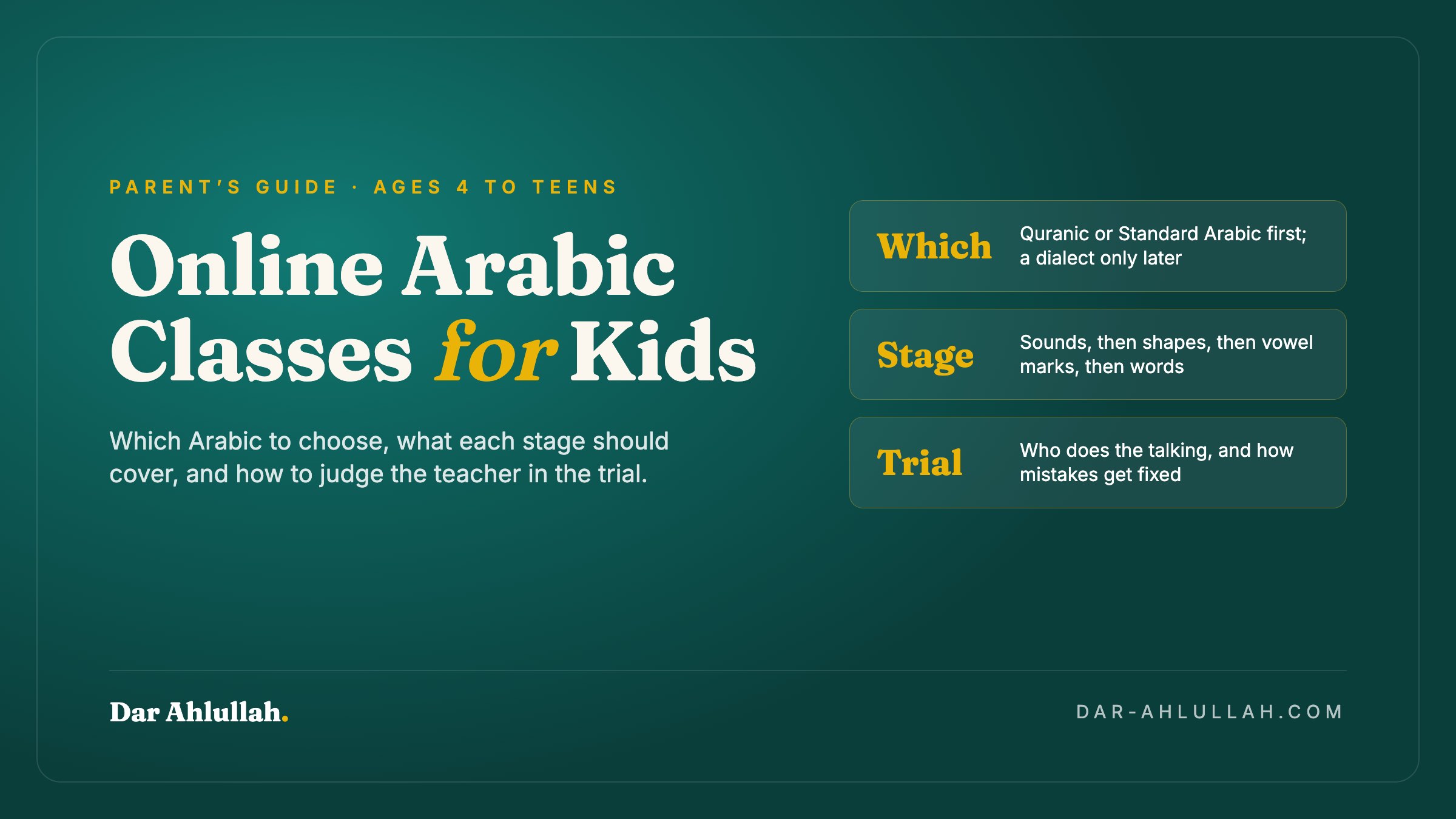
online Arabic classes for kids
Online Arabic Classes for Kids: A Parent's Guide
Which Arabic a child's class should teach, what a good class covers at each stage from four to the teens, one-to-one versus group versus apps, how to judge the teacher in the trial, and what it costs.
13 min read
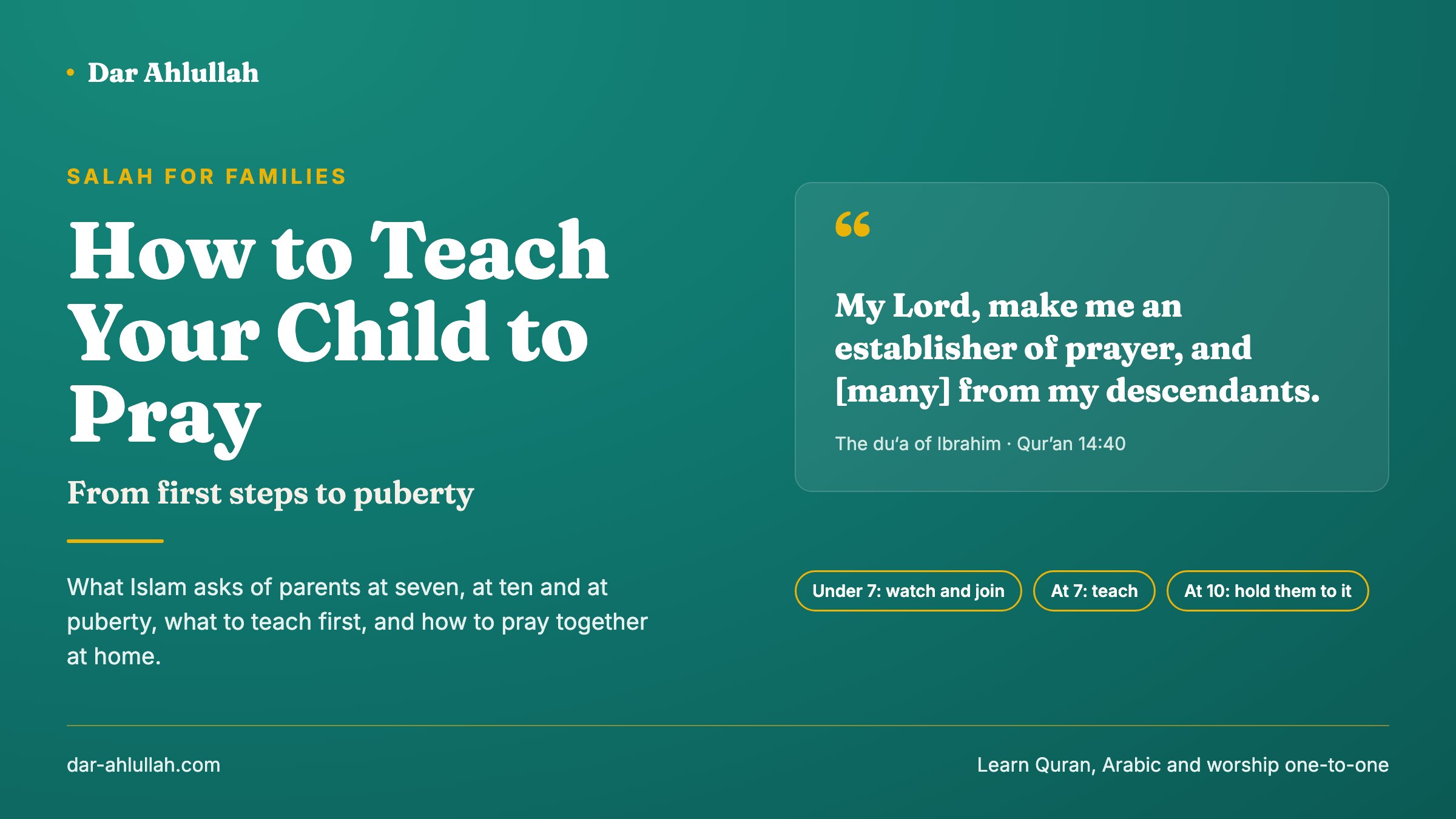
how to teach your child to pray
How to Teach Your Child to Pray: An Age-by-Age Guide for Parents
Before seven, at seven, at ten and at puberty: what Islam asks of parents at each stage, what to teach first and in what order, how to make prayer a family habit at home, and what the hadith about ten-year-olds does and does not permit.
23 min read