
Islamic homeschooling
Islamic Homeschooling: A Realistic Guide for Families in the West
Dar Ahlullah team 14 min read
Table of Contents
- Introduction: Two Very Different Families Search for This
- The Short Answer: Six Decisions, in Order
- 1. The Legal Reality, Country by Country
- 2. The Two Models: Full Homeschool vs the Home Madrasa
- 3. Quran: The Subject That Resists Self-Teaching
- 4. Arabic: Where Parents Can Do More Than They Think
- 5. Islamic Studies: The Most Parent-Teachable Lane
- 6. A Weekly Routine That Survives Term Time
- Parent-Led, Online, or Hybrid: An Honest Comparison
- The Socialization Question, Answered Briefly
- What the Outsourced Part Costs
- FAQs About Islamic Homeschooling
- Conclusion: Build the Smallest Version First
Introduction: Two Very Different Families Search for This
Type Islamic homeschooling into a search engine and you will find guides written for exactly one kind of family: a parent at home full time, in a country where homeschooling is legal, replacing school entirely with an Islamically integrated curriculum. That family exists, and this guide serves it. But it is not who most of the searches come from.
Most come from a second family: the children attend an ordinary state or private school, the parents work, and what they want is a serious Islamic education built at home around the school day — Quran, Arabic, and the basics of the deen, taught deliberately rather than absorbed by accident. In half of Europe this second model is not a compromise; it is the only legal option, because full homeschooling is restricted or banned outright.
Almost nothing written about Islamic homeschooling acknowledges that split, which is why so much of it reads as either inspiring or useless depending on which family you are. This guide takes both seriously. It covers the legal position in the countries most Muslim families in the West actually live in, the two models that follow from it, and — the part that matters most in practice — which Islamic subjects a parent can genuinely teach at home and which one quietly fails without a trained ear on the other side.
The Short Answer: Six Decisions, in Order
If you want the whole guide compressed into a list, it is this. Each item is expanded in its own section below.
- Check the law first. Whether full homeschooling is even available to you depends on your country — in Germany and Sweden it effectively is not, in France it now requires annual authorization, in the UK and US it is legal. Decide nothing before this.
- Pick your model honestly. Full homeschool with Islam integrated across every subject, or school plus a structured home madrasa. The second is not the lesser option; it is the one most families can sustain.
- Split the Islamic subjects into three lanes. Quran, Arabic, and Islamic studies are different skills that need different teaching arrangements. Treating them as one subject is the most common structural mistake.
- Teach what you can supervise; outsource what needs a trained ear. Wudu, salah, seerah and adab are parent-teachable with good materials. Quran reading and tajweed stall without someone who hears the mistakes.
- Build the week on fixed anchors, not enthusiasm. Two live lessons and fifteen minutes of daily review survive November. An ambitious daily timetable built in August does not.
- Start with the smallest version and review at half term. Adding is easy. Recovering from a collapsed over-ambitious plan costs a whole school year of momentum.
1. The Legal Reality, Country by Country
This is the unglamorous section every other guide skips, and it determines everything after it. Homeschooling law varies enormously across the countries where Muslim families in the West are concentrated, from fully legal to effectively prohibited, and it has tightened in several European countries in recent years. The summary below reflects the position documented on Wikipedia’s survey of homeschooling status by country; laws change, and the details (notification, exams, inspections) sit with regional authorities, so verify the current rules where you live before making any decision.
| Country | Full homeschooling | What that means in practice |
|---|---|---|
| United States | Legal in all 50 states | Requirements vary by state, from simple notification to annual assessment. |
| United Kingdom | Legal | Light-touch oversight from the local authority; check your council’s current process. |
| France | Authorization required | Since the 2022 school year, annual state permission granted only on limited grounds. |
| Germany | Not permitted | School attendance is compulsory; exemptions are rare and narrow. |
| Sweden | Exceptional cases only | Permitted only in extraordinary circumstances; most families cannot qualify. |
| Netherlands | Exemption-based | Narrow exemptions from compulsory schooling; rare in practice. |
| Belgium | Legal | Registration required, with periodic assessment by the education authorities. |
| Austria | Legal | Notification plus an annual external examination of the child’s progress. |
| Italy | Legal | Parental instruction is recognised, with an annual eligibility exam. |
Read the table with one question in mind: which model is available to me? A family in Texas or Birmingham can choose either model freely. A family in Munich or Stockholm is choosing the second model — and should feel no deficit about it, because everything that makes an Islamic education work fits inside it. That is the next section.
2. The Two Models: Full Homeschool vs the Home Madrasa
Model one is homeschooling in the full sense: the parents take legal responsibility for the whole of the child’s education and integrate Islam across it — tawheed alongside science, Islamic history alongside history, Quran and Arabic in the timetable’s prime morning slots rather than its exhausted margins. It requires a parent with real weekly hours, a legal environment that allows it, and comfort with being the person accountable for maths as well as memorisation.
Model two — call it the home madrasa — keeps ordinary school in place and builds a deliberate, scheduled Islamic curriculum around it: fixed Quran lessons during the week, Arabic in short regular sessions, Islamic studies as a weekend block, and daily practice woven into the household’s existing rhythm of prayer. It is what an after-school programme structure formalises, and for working parents and families in restrictive countries it is not the fallback — it is the plan.
The two models fail differently. Model one fails by burnout: the teaching parent is also the cook, the driver and the employee, and by February the Islamic subjects — the reason the family started — are the ones being skipped, because nobody external notices when they slip. Model two fails by vagueness: “we do Islam at home” without fixed slots quietly becomes a cartoon nasheed on Sunday morning. The cure is the same in both cases, and it is the routine in section six.
One more family belongs in this section: parents who are themselves new to Islam, or returning to practice, and are learning wudu, salah and Quran at the same time as their children. If that is you, teaching and learning simultaneously is not a disqualification — it is how a large share of revert households work, and modelling adult learning is itself a lesson your children absorb. Our structured guide for your first 90 days in Islam is written to be worked through as an adult while the children follow their own track alongside you.
3. Quran: The Subject That Resists Self-Teaching
Here is the honest hierarchy of the three Islamic lanes, from hardest to easiest to run without outside help — and Quran sits firmly at the hard end, for a reason that has nothing to do with effort.
Learning to read the Quran is a feedback skill. A child sounding out Arabic letters cannot hear their own mistakes: the difference between س and ص, a madd held for two counts instead of four, a ق pronounced from the wrong part of the throat. Whoever is listening must catch the error at the moment it happens, name it, model the correct sound, and have the child repeat it. An app cannot do this reliably, a YouTube video cannot do it at all, and a parent can only do it to the level of their own recitation — which for most parents raised in the West is exactly the level they hope their child will exceed.
So structure the Quran lane by what the listening parent can actually hear:
- If a parent reads fluently with tajweed — genuinely, not nostalgically — they can run the decoding stage themselves with a Noorani Qaida or equivalent, short daily sessions, one page at a time. This is the classic madrasa method and it works at a kitchen table.
- If not, the lesson itself needs a teacher, and the parent’s job changes shape: it becomes the daily ten-to-fifteen-minute review of whatever the teacher corrected, which is where the learning actually consolidates. Two live lessons a week plus daily parental review outperforms five parental lessons of unheard mistakes.
This division of labour — teacher corrects, parent reinforces — is the single highest-leverage arrangement in the whole of Islamic home education, and it is the reason a homeschooling guide from an academy is not automatically a sales pitch: the teacher is load-bearing for one lane, not all three. What one-to-one lessons look like at the youngest ages, and how to judge whether they are working, is covered in our guide to online Quran classes for kids.
4. Arabic: Where Parents Can Do More Than They Think
Arabic inverts the Quran problem. Where recitation needs a precise trained ear, language grows from volume and atmosphere — words on the fridge, commands used at dinner, songs, labels, the same fifty household phrases repeated until they are furniture. A parent who speaks no Arabic can still build that atmosphere, learning a step ahead of the child, and the home is arguably a better venue for it than any classroom because language sticks to daily life better than to a whiteboard.
What the home environment does not reliably produce is progression: grammar, reading fluency, and the jump from vocabulary to sentences. That is where a structured course or tutor enters, once or twice a week, with the home carrying everything between lessons. We wrote a full method for this — realistic for non-Arabic-speaking parents, ages three to teens — in how to teach your child Arabic at home, and it slots into the weekly routine below as the second lane.
One sequencing note that saves families a year of frustration: if the goal is understanding the Quran rather than ordering in a Cairo restaurant, prioritise Quranic vocabulary and reading over conversational fluency. The two overlap far less than parents assume.
5. Islamic Studies: The Most Parent-Teachable Lane
Aqeedah at a child’s level, the stories of the prophets, seerah, adab, and the practical fiqh of daily worship — this is the lane where the parent is not a substitute for the real teacher. The parent is the real teacher, because Islamic studies for a child is not primarily information; it is watching the people they love actually live it, with a modest amount of structure added so the knowledge arrives in order.
The structure can be light and still be real:
- Practical worship is taught by doing, at the sink and on the prayer mat. Our step-by-step guides to teaching wudu and learning salah from the beginning are written so a parent and child can work through them together, one step a week, with no prior knowledge assumed.
- Stories carry the rest. One seerah or prophets story per week, read aloud or retold, with one discussion question, beats a workbook the child resents. Depth comes from the child’s questions, not the parent’s preparation.
- One weekend block, forty-five to sixty minutes, is enough for the sit-down portion at primary age — provided it actually happens every week, which is a routine problem, not a curriculum problem.
Where outside help earns its place in this lane is age, not subject: teenagers often take fiqh and aqeedah more seriously from a teacher who is not their parent, at exactly the age they begin testing whether the family’s religion survives contact with outside authority. That is a feature of adolescence, not a failure of the home.
6. A Weekly Routine That Survives Term Time
Every failed home-education plan we have seen died the same death: it was designed in August, for the family the parents wished they were, and it met the actual family in November. The design principle that survives is anchors plus margins — a small number of fixed, non-negotiable slots, surrounded by flexible daily minutes that can flex to zero on a bad day without the structure collapsing.
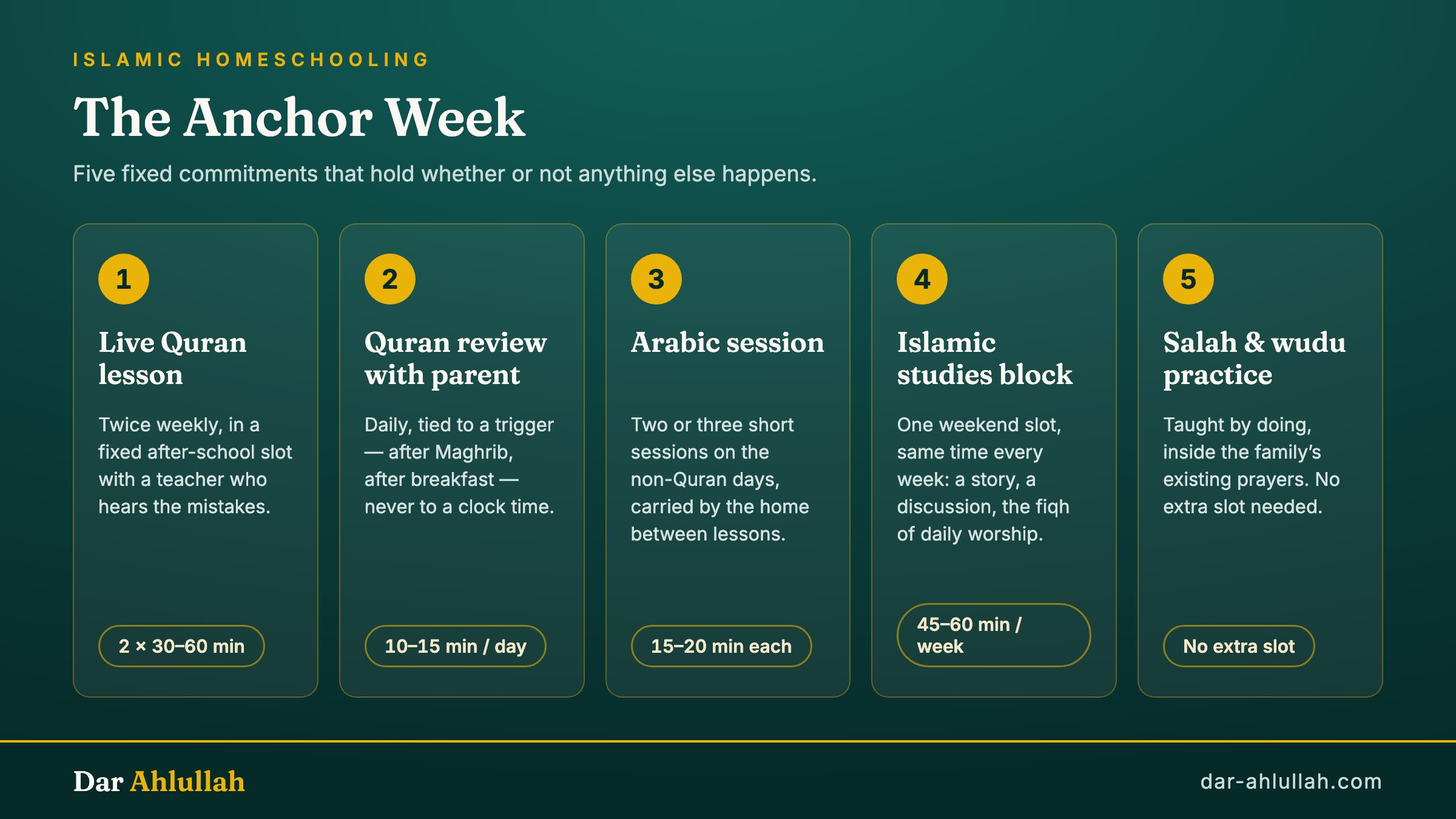
| Anchor | When | Time cost |
|---|---|---|
| Live Quran lesson | Twice weekly, fixed after-school slot | 30–60 min each |
| Quran review with parent | Daily, same trigger (after Maghrib, after breakfast) | 10–15 min |
| Arabic session | Two or three short sessions on non-Quran days | 15–20 min each |
| Islamic studies block | One weekend slot, same time every week | 45–60 min |
| Salah and wudu practice | Inside the family’s existing prayers | No extra slot |
Three rules make the table work. Tie every daily item to a trigger, not a clock time — “after Maghrib” survives the school year and the clock changes; “5:30pm” does not. Book the fixed lessons against the September timetable, including clubs and homework load, not against the empty afternoons of August. And protect the anchors, sacrifice the margins: on a chaotic day the fifteen-minute review shrinks to five, but the live lesson is never the thing that gets cancelled, because it is the only slot with another person in it — which is precisely why it holds.
Full-homeschool families use the same table with one change: Quran and Arabic move into the morning prime slots, before academic subjects, on the old madrasa logic that the hardest memory work belongs to the freshest hours.
Parent-Led, Online, or Hybrid: An Honest Comparison
Strip away the marketing — ours included — and there are three ways to staff the three lanes. Each is the right answer for a different family.
| Approach | Works when | Fails when |
|---|---|---|
| Fully parent-led | A parent reads Quran with tajweed, has real weekly hours, and enjoys teaching | The parent’s own recitation is the ceiling; corrections nobody hears compound for years |
| Fully outsourced | Both parents work full time; budget covers all three lanes with teachers | No daily review at home, so lessons stop consolidating; Islam becomes a subject, not a household |
| Hybrid (most families) | Teacher takes Quran; parent takes Islamic studies and daily review; Arabic split between them | Only when the routine has no anchors — the model itself is the sturdy one |
The hybrid row is where most households land, and it is also the cheapest arrangement that does not compromise the one lane that punishes compromise. Whatever you choose, apply the same scrutiny to any academy you hire that you would apply to a school — named teacher, written progress, safeguarding, exit terms. We published the full checklist in how to choose an online Quran academy, and it applies to us as much as to anyone.
The Socialization Question, Answered Briefly
Every homeschooling parent is asked about socialization, usually by relatives, usually at Eid. For model-two families the question dissolves — the children are at school all day. For full homeschoolers it is a real design requirement with a boring answer: schedule it like a subject. The masjid’s weekend school and youth circle, a local homeschool co-op (Muslim or otherwise), one sport, and regular time with cousins and neighbours covers what a school corridor provides, with rather more parental visibility into the company being kept. What does not work is treating social contact as something that will happen by itself once academics are handled; it is an anchor like the others, and it goes in the calendar like the others.
What the Outsourced Part Costs
The parent-led lanes cost time and a shelf of books. The outsourced lane — live Quran teaching — is the budget line, so here is ours, plainly, for comparison against whoever else you shortlist.
Our teachers are native Arabic speakers who teach in English, and every plan prices teaching at the same $9 per hour: $36 a month for eight 30-minute sessions, $70 for eight full hours, $102 for the twelve-hour intensive. Siblings — the normal case in a homeschooling family — get 20% off, and a written report follows every session, which in the hybrid model is exactly the document the reviewing parent works from the next day. Slots are booked in your own time zone, you can pause or switch plans at any time, and if a teacher is not the right fit we rematch at no cost. The full breakdown is on the pricing page.
The entry point costs nothing: a free 30-minute assessment, no card required, in which the teacher establishes the child’s actual reading level and proposes a starting point in the curriculum — which, if you are building a home-education plan, is useful information whether or not you ever book a paid lesson.
FAQs About Islamic Homeschooling
Is Islamic homeschooling legal in Europe?
Full homeschooling is legal in the UK, Belgium, Austria and Italy (with varying oversight), authorization-based in France since 2022, and effectively unavailable in Germany, Sweden and the Netherlands. The home-madrasa model — school plus a structured Islamic curriculum at home — is legal everywhere, which is one reason this guide treats it as a first-class option.
How many hours a week do the Islamic subjects need?
The anchor routine above totals roughly four to six hours across the week for a primary-age child: two live lessons, short daily reviews, two or three Arabic sessions and one weekend block. More is available to families who want it; less than this, sustained, is usually too thin to show progress, and progress is what keeps children — and parents — going.
Can I teach my child Quran if I cannot read Arabic myself?
You can run half of it: the daily review, the memorisation repetition, the encouragement. The half you cannot run is error correction — you cannot catch a mistake you cannot hear — and that half needs a teacher, whether at the masjid or online. Many parents use the same period to fix their own reading; learning two steps ahead of your child is a perfectly respectable teaching tradition.
What age should the structured routine start?
Letters and decoding from around five to seven, depending on the child; before that, the “curriculum” is atmosphere — hearing recitation, watching salah, absorbing vocabulary. Starting the formal routine at four buys very little that starting at six does not, and costs a great deal of goodwill.
My children are in public school. Does any of this apply?
All of it — that is model two, and it is the majority case this guide is written for. The three lanes, the anchor routine and the hybrid staffing model work identically around a school day; only the total hours change.
Which curriculum or books should we buy?
For Quran decoding, a Noorani Qaida or equivalent structured primer is the standard entry point regardless of who teaches it. Beyond that, resist the urge to buy a complete curriculum before the routine exists. A family that runs the anchor week for one term will know exactly what materials it needs; a family that starts from a box of books usually ends the term with a box of books.
How do two working parents fit this in?
By outsourcing the fixed lessons into reliable after-school slots and keeping only the trigger-based margins — the ten-minute review after Maghrib, the story at bedtime. That is the arrangement the after-school structure formalises, and it is sturdier than it sounds precisely because the immovable parts are staffed by someone whose job it is to show up.
Conclusion: Build the Smallest Version First
Islamic homeschooling, in either model, is not one heroic decision. It is a small set of unheroic ones: check the law, pick the model that fits your actual household, split the three lanes, hire the trained ear for the one lane that needs it, and anchor the week to triggers that survive term time. Then run the smallest version for one term and review it honestly at half term — adding a session to a routine that works takes one message; resurrecting a collapsed plan takes a school year.
If the Quran lane is the one you need to staff, the free 30-minute assessment is the practical first step: a certified teacher establishes where your child actually is and proposes a starting point, in writing, with no card required and nothing to cancel. Whatever you decide afterwards, you will be planning from a measurement instead of a guess — which is, in the end, the whole method of this guide.
Related articles
how to teach your child Arabic at home
How to Teach Your Child Arabic at Home: A Parent's Guide
You do not need to speak Arabic to teach it at home. You need to pick which Arabic you are teaching, work in sounds before letters, and protect ten minutes a day — five days a week beats one long Saturday session.
20 min read
after school Arabic program
After-School Arabic & Quran Program: Balancing School and Deen
Fitting Arabic and Quran around a Western school day is a scheduling problem, not a motivation problem. Here is the weekly plan, the right time slot, and how to keep it alive through exam season.
8 min read
child refuses to learn Quran
What to Do When Your Child Refuses to Learn Quran
Refusal is a willingness problem, not a memory problem, and it has five causes that look identical from the outside. Tell them apart first — the fix for each one is different.
15 min read