
online Quran classes
Online Quran Classes vs Masjid Classes: An Honest Comparison
Dar Ahlullah team 21 min read
Table of Contents
- Introduction: Two Things That Are Not the Same Kind of Thing
- The Short Answer
- The Difference Nobody Names: Teacher Airtime Per Student
- What the Masjid Genuinely Does Better
- What Online Genuinely Does Better
- Where Online Genuinely Fails
- The Cost Comparison, Done Honestly
- The Hybrid Answer, and When It Is Just Over-Scheduling
- Seven Questions to Ask Your Masjid Before You Conclude It Is Not Enough
- Eight Questions to Ask an Online Academy Before You Pay
- Adults Are Making a Different Decision
- How We Handle This in Practice
- Questions Parents Actually Ask
- Conclusion: The Masjid Is Not the Fallback
Introduction: Two Things That Are Not the Same Kind of Thing
The question usually arrives in September. The masjid’s weekend programme starts again, your child is enrolled for another year, and you are quietly unsure whether the last one achieved anything. Or you are an adult who has been meaning to fix your recitation since Ramadan two years ago, and the Tuesday evening halaqah is at seven, which is the exact hour you are on a train. Somebody mentions online lessons. And now you are trying to compare two options that are not really competing on the same axis.
We should say the obvious thing before anything else: we teach online, one-to-one, and we charge for it. Read everything below with that in mind. It also means we spend our working weeks watching what online does badly, and there is a fair amount of it. A comparison written by an online academy that concludes online wins on every count is not a comparison, it is a brochure, and you would be right to close it.
So here is the honest framing. The masjid weekend school and a paid online lesson are not two versions of the same product at different prices. They deliver different things. The masjid delivers belonging, a peer group, a physical building your child associates with worship, and a relationship with a local community that will still be there in fifteen years, usually for free or close to it. An online one-to-one lesson delivers something much narrower and much sharper: sustained individual correction of the sound coming out of one person’s mouth. Neither substitutes cleanly for the other, and a family that treats them as interchangeable will be disappointed by whichever one they pick.
What follows is the mechanical comparison — what each format structurally can and cannot do, what it costs, where the hybrid makes sense, and the specific questions to ask before you conclude your local programme is failing your child. If you want the broader map of the online side before the comparison, our complete guide to learning Quran online covers the whole route; this article is only about the choice between the two.
The Short Answer
If you want the conclusion before the reasoning: for community, belonging and cost, the masjid wins and it is not close. For correcting pronunciation and moving one specific student forward at their own pace, one-to-one online wins and that is not close either. The disagreement between people arguing about this is usually not a disagreement about facts. It is a disagreement about which of those two outcomes they were shopping for.
Three situations where the masjid alone is the right answer:
- Your child is young, the programme is well run, and they are keeping up. A seven-year-old learning the alphabet among friends, in a building they will grow up in, with a competent teacher, does not need a paid alternative. Adding one is solving a problem you do not have.
- Money is genuinely tight. Weekly paid lessons are a real ongoing cost. A free programme your child attends is worth more than a paid one you cancel in four months.
- Your family is new to the area, or your child is one of few Muslim children at school. The social function of the masjid programme is doing something here that no lesson can, and it should not be traded away for faster progress on juz 30.
Three situations where online earns its cost:
- The student has been attending for two or three years and still cannot read unfamiliar text. This is the clearest signal. Recognition without decoding usually means nobody has had time to listen to them individually.
- Schedules do not fit. Shift work, a long commute, a Saturday morning that is also football and a swimming lesson. An option that exists at nine in the evening beats a better option that exists at a time you cannot attend.
- A specific need the local programme cannot meet — a female teacher for a teenage girl, a hifz track, a complete adult beginner who will not sit in a children’s class, or a learner who is significantly ahead or behind the group.
Everything after this is the reasoning behind those lists, and the reasoning matters, because the third bullet in each is where families most often get the call wrong.
The Difference Nobody Names: Teacher Airtime Per Student
Almost every honest difference between these two formats reduces to one quantity, and nobody puts it on a comparison table because it is unflattering to everybody. Call it teacher airtime: the number of minutes in which a qualified person is listening to you produce sound and telling you what to change.
Airtime is the scarce input in learning to recite. Not lesson hours, not weeks enrolled, not pages covered. Learning to read the Quran correctly is a motor skill with an audio feedback loop, and the loop only closes when someone who can hear the error tells you about it. Everything else in a lesson — explanation, demonstration, listening to others, homework — supports that loop but does not replace it.
Now do the arithmetic, and treat these numbers as an illustration rather than a measurement of any particular institution. Take a weekend class of fifteen children, one teacher, sixty minutes. If the teacher spends the entire hour hearing children read one at a time and nothing else happens, each child gets four minutes. In practice the whole hour is never available: there is settling the room, taking a register, a du’a to start, a short lesson on adab or seerah, a break, discipline, and the two children who arrive late. Realistically, individual reading time per child in a class that size lands somewhere in the region of two or three minutes. Over a full academic year of weekly sessions, that is a couple of hours of individual correction.
A one-to-one lesson inverts the ratio. Sixty minutes with one student, of which the student can reasonably spend forty or forty-five actually reading aloud, gives more individual correction in a single session than a large weekend class delivers in a term. That is not a claim about teacher quality on either side. It is division.
Why this is not the whole story
Three corrections to that arithmetic, and they matter, because the simple version of this argument is used dishonestly by people selling online lessons.
The other fifty-six minutes are not empty. A child sitting in a group hears fourteen other children read and hears fourteen corrections. For young learners especially, that passive exposure is real learning — you acquire the sound of a letter partly by hearing it produced and corrected repeatedly, including when it is not your turn. Group class time is diluted, not wasted. This is why a well-run group with a strong teacher can genuinely outperform a weak one-to-one lesson, and why a child who has been in a good masjid class for two years often arrives at their first online lesson knowing far more than their parent expected.
Airtime is only as good as the ear receiving it. Forty minutes of undivided attention from someone who cannot hear the difference between the two letters that sound like an English h is worth less than three minutes from a trained qari. A masjid that has a properly trained teacher and an online academy that has a rotating pool of undertrained ones is not a close contest, and it does not go the way this article’s title might suggest. Which is why the questions further down matter more than the format.
More airtime is not always better for a child. An hour of unbroken one-to-one attention is intense. Seven-year-olds do not sustain it, which is exactly why thirty minutes is the standard unit for children in one-to-one online lessons while sixty or ninety is normal for a group. The group format is partly a rest mechanism. Take the rest away and some children simply switch off at minute twenty, at which point you are paying for airtime nobody is using.
So the honest formulation is narrower than “online is better”. It is this: if the specific thing your student needs is individual correction of their own recitation, the group format is structurally unable to supply much of it, no matter how good the teacher is. If they need something else, that constraint may not matter at all.
What the Masjid Genuinely Does Better
These are not consolation prizes. Several of them are things no online provider can deliver at any price, and a family that ignores them to buy faster progress is making a trade they may regret.
Belonging, which is the actual reason most children keep going
A child who has friends at the masjid goes to the masjid. That single sentence explains more about long-term Quran retention than any pedagogical argument in this article. Attendance is the precondition for everything, and the strongest driver of attendance in children is not curriculum quality, it is whether their friends are in the room. Online lessons have no equivalent lever. They rely entirely on a parent enforcing the appointment, which works until the week you are tired.
The building itself
There is something a physical space does that a video call does not. A child who spends Saturday mornings for eight years in a masjid builds an association between that building, the sound of the adhan, the carpet, the smell of it, and their own religious life. They know where the wudu area is. They know the imam’s name and the imam knows theirs. When they are nineteen and have moved to a different city, they walk into a masjid they have never seen and know exactly how to behave in it. That is a real educational outcome, it is just not one that appears on a progress report.
Peer learning and healthy comparison
Children calibrate against other children. Sitting next to someone slightly ahead of you is a stronger motivator than any adult’s encouragement, and hearing someone else corrected teaches you the correction without the embarrassment of receiving it. Group settings also normalise the difficulty: a child struggling with a letter in a room of fifteen can see that three others are struggling with the same letter. Alone on a screen with an adult, the same child concludes they are uniquely bad at this.
Cost
Many masjid programmes are free. Others run on donations or a modest term fee that mostly covers materials and a stipend. Against any paid alternative this is decisive for a large number of families, and it should be said plainly rather than waved past. A programme that costs nothing and runs every week for a decade delivers a great deal of cumulative teaching, and the fact that the per-hour attention is thin does not erase the fact that the hours happened.
In-person accountability
A teacher who sees your child every Saturday, who knows your family, and who will mention it to you in the car park when the homework has not been done, is a form of accountability that a written report cannot reproduce. So is the fact that other parents are there. Social accountability among people who will see each other at Jumu’ah is considerably stronger than a notification from an app.
The adult community that comes attached
This one is consistently underrated by parents evaluating a children’s programme. Dropping your child at the masjid on a Saturday puts you in the masjid on a Saturday, next to other parents, near the imam, inside the community that will be the one you call when there is a funeral, a wedding, a crisis, or a question you cannot Google. Online lessons deliver your child a teacher. The masjid delivers your whole family a jama’a. There is no line item for that and it is worth more than most of what is on the invoice.
Immersion in the discipline of the place
Group programmes teach things nobody wrote into the syllabus: sitting still, waiting your turn, praying in a line, handling a mushaf properly, lowering your voice in a prayer hall, greeting an elder. A child learns adab by being in a room where adab is expected. It is very hard to teach that through a screen, and most online academies do not seriously try.
What Online Genuinely Does Better
The list is shorter, and every item on it traces back to the airtime arithmetic above or to logistics.
Individual correction of pronunciation
This is the core of it. Arabic distinguishes sounds English does not: two letters an English speaker hears as h, three that collapse into s, two into d, two into t. Because the distinction does not exist in your own phonology, you cannot hear your own error — you will hear yourself producing the correct sound. This is not a motivation problem or an effort problem. It is a perception problem, and the only fix is another person with a trained ear listening to you produce the letter and telling you where in the throat or mouth it should be forming. That interaction takes minutes per letter, per student, and there is no way to run it fifteen at a time. A format that gives one student forty minutes of it a week will fix pronunciation faster than one that gives them three, all else equal.
Pacing that fits the person rather than the group
A group moves at one speed, and that speed is wrong for most of the room. The child who consolidated sukoon in a fortnight spends six weeks watching. The child who did not consolidate it moves on anyway, because the class does, and the gap compounds — every later block assumes the earlier one is automatic. One-to-one lessons can stop, go back a block, and stay there until it is fixed. Nothing else in the room is waiting. For a student who is significantly ahead or behind their age group, this difference is not marginal, it is the whole thing.
Teacher matching, including for women and girls
A local programme offers the teachers it has. That is not a criticism, it is a small pool. Online you choose: a female teacher for a woman or a teenage girl, a teacher experienced with complete adult beginners rather than children, a teacher who has taken students through hifz before, a teacher whose English is strong enough to explain a rule to someone with no Arabic at all. For many families the female-teacher point alone decides this, particularly for girls past the age where they would rather not read aloud in a mixed class.
Scheduling around a real week
A masjid programme happens at a fixed time, usually Saturday or Sunday morning, or a weekday evening. If your week does not contain that slot — shift work, a commute, a second job, a child with three other commitments — the quality of the programme is irrelevant to you. Online lessons across time zones can be at 6am before work or 9pm after the children are in bed, and they can move when the week moves. For working parents this is frequently the entire reason they are reading this article.
No travel time
A thirty-minute round trip attached to a sixty-minute class means the real cost of that class is ninety minutes plus fuel, twice on a weekend if you have children in different groups. Removing travel is what makes two or three short sessions a week feasible where one long one was already a stretch. Frequency matters more than session length for skill acquisition — three twenty-minute sessions beat one sixty-minute session for building an automatic motor skill — and travel is the main thing standing between families and frequency. For families whose weekdays genuinely cannot hold a lesson, weekend Quran classes are the middle path between the masjid programme and a weekday schedule.
Continuity across disruption
Term breaks, holidays, illness, house moves, a Ramadan schedule, travelling to see family for six weeks in the summer. Local programmes stop for all of these; a student who stops for six weeks in the middle of learning to decode comes back materially worse than they left. An online lesson follows the student to another country and can usually be rescheduled rather than lost.
Visible, checkable progress
A one-to-one teacher can tell you exactly which block of the primer your child is in and what marks its completion. A large group can rarely answer that per child. If you want the detail on how that sequence actually runs, our guide to the Noorani Qaida sets out the blocks in order and what each one trains.
Where Online Genuinely Fails
This section exists because the failure modes below are common, predictable, and rarely mentioned by people selling lessons.
There is no community, and pretending otherwise is dishonest
An online lesson gives a student one relationship: with their teacher. That relationship can be excellent and it is not nothing. But there is no room full of peers, no friends, no building, no other parents, and no jama’a. A child whose entire religious education happens on a laptop in their bedroom is being taught to recite and is not being socialised into anything. Some academies advertise group sessions or student communities as a fix. Be sceptical: a scheduled video call with strangers in four time zones is not a peer group in any sense a nine-year-old recognises.
Screen fatigue is real and it compounds
Most children now spend school hours on screens. Adding religious education to that pile means the mushaf becomes one more thing that happens through a rectangle. Attention degrades faster on video than in person, for adults as well as children, and it degrades hardest at the end of a day that was already screen-heavy. Short sessions mitigate this. Nothing eliminates it.
It requires a parent to enforce it, every single week
This is the failure mode that ends most online arrangements. A masjid class has momentum: it is on the calendar, other people are going, the child is already dressed and in the car. An online lesson at 6pm on a Wednesday requires an adult to stop what they are doing, find the child, close the game, open the laptop, and stay nearby enough that the lesson does not become fifteen minutes of a teacher talking to a ceiling. Do that thirty times and it is fine. Do it eighty times, across a bad month at work, and attendance quietly erodes. Families who succeed with online lessons are almost always families where one parent treats the appointment as non-negotiable.
A weak teacher is easier to hide behind a screen
In a masjid you can stand at the back of the room, and other parents can too. Online, unless you deliberately sit in, you see a schedule and an invoice. An academy with a rotating roster can put a different, cheaper, less-trained teacher in the slot each week and the parent may not notice for months, because to a non-Arabic-speaking parent all fluent recitation sounds equally good. This is the single biggest quality risk in the online market and it is why continuity of teacher matters more than almost anything else you can ask about. Our guide to choosing an online Quran academy goes through the vetting in detail.
It can isolate a child from the local jama’a
The version of this that should worry parents: a family withdraws a child from a weekend programme they judged to be too slow, moves them online, and the child’s recitation improves measurably while their connection to the local Muslim community quietly disappears. Five years later the recitation is good and the child does not know a single Muslim their own age in their own city. That is a poor trade, and it is easy to make one reasonable decision at a time.
Technology adds friction that nobody budgets for
Broken audio, a frozen screen, a teacher’s power cut, a laptop the whole family shares, a five-minute delay that eats a sixth of a thirty-minute session. None of this is fatal, all of it is real, and it is a cost that in-person teaching simply does not have.
The Cost Comparison, Done Honestly
The masjid is cheaper. Frequently it is free. There is no framing of this that goes the other way, and any article claiming online is “better value” without acknowledging that is being slippery with you.
What a paid option buys is not vaguely defined “quality”. It buys a measurable quantity: minutes of one teacher’s undivided attention. That is the only thing the money is purchasing, and it is the right basis for the comparison.
| Masjid weekend programme | One-to-one online | |
|---|---|---|
| Typical fee | Free, donation-based, or a modest term fee | Paid per hour or per monthly package |
| Hidden costs | Travel, fuel, and the parent’s Saturday morning | A device, reliable internet, and a parent on call at lesson time |
| What the money buys | Room, teacher, materials, and a peer group, shared across the class | Minutes of individual correction, and choice of teacher |
| Individual airtime | A few minutes per session, divided by class size | Most of the session |
| Fails when | The class is large, mixed-level, or the teacher is untrained | Nobody at home enforces the appointment |
Two things to watch when you price the online side. First, compare per teaching hour, not per month. Packages are quoted in ways that make direct comparison hard, and a plan advertised as cheap per month is often expensive per hour because the sessions are thirty minutes. Second, count the sessions actually delivered rather than the ones scheduled — a provider with a hard cancellation policy and an inflexible calendar can cost noticeably more per completed lesson than the headline rate. Our breakdown of what online Quran classes cost works through the per-hour maths for the common package structures.
The honest summary: if the masjid programme is working, paying for online lessons buys you very little. If it is not working, and the reason it is not working is that your child never gets to read aloud to anyone, then what you are buying is exactly the missing input and the money maps directly onto it. If the reason it is not working is that your child does not want to go, paid lessons will not fix that and may make it worse.
The Hybrid Answer, and When It Is Just Over-Scheduling
The arrangement that works best for most families who can afford it is not either-or: keep the masjid for community and continuity, add a short online session for technical correction. The masjid supplies belonging, peers, adab and the building. The online session supplies the individual airtime the group cannot. They are not redundant because they are doing different jobs.
Where this is worth doing:
- The masjid class is large or mixed-level. One or two short one-to-one sessions a week fill in exactly the gap the class size creates, without removing the child from the community.
- The student has a specific, identifiable technical problem. Consistently mispronouncing a group of letters, guessing at unfamiliar words, stalling at one block of the primer. These are narrow, diagnosable and fixable in a handful of focused sessions.
- A hifz goal exists. Memorisation needs frequent individual listening, well beyond what a weekend class can give, and building hifz on shaky decoding memorises the errors along with the text. Our guide to an online hifz programme covers what that actually requires week to week.
- There are long gaps. Summer, half-term, a family trip. Two short online sessions a week through a six-week break preserve momentum that would otherwise be lost.
Where it is over-scheduling, and this needs saying as plainly as the rest:
- The child is already at capacity. School, homework, an activity or two, the weekend programme. Adding two more fixed commitments to a nine-year-old’s week produces resentment, and a child who comes to resent Quran lessons has been taught something far more durable than tajweed.
- The masjid class is genuinely good and the child is keeping up. Then you are paying for airtime the student does not currently need. Save the money and revisit if progress stalls.
- The problem is motivation, not instruction. More lessons do not fix a child who does not want to be there. That is a different problem with a different solution, usually involving the parent’s own habits rather than the teacher’s.
- The child is under six or seven. Very young children mostly need exposure, repetition and warmth, not technical correction. The weekend class plus ten minutes at home with a parent is usually enough. Our notes on teaching Arabic at home cover what that ten minutes should contain.
A practical rule: if you cannot name the specific thing the extra sessions are meant to fix, do not add them yet. “More Quran” is not a diagnosis, and a child’s week has a finite number of hours in which they still like their parents.
Seven Questions to Ask Your Masjid Before You Conclude It Is Not Enough
Most parents who move a child online do it on a hunch, without ever asking the programme a direct question. Ask these first. The answers frequently reveal that the programme is better than you thought, or that the fix is a different class within the same masjid rather than leaving it.
- How many children are in my child’s group, and how are the groups formed? By age, or by reading level? Level-grouped classes of any size work considerably better than age-grouped ones, because the teacher is not teaching four different stages simultaneously.
- Does every child read aloud to the teacher every week, or is it a rotation? This is the airtime question in plain language. A rotation is not a scandal — it is a rational response to class size — but you should know whether your child reads weekly or fortnightly.
- Who teaches the class, and what is their training? Many programmes are staffed by dedicated volunteers, some of whom are outstanding and some of whom are parents helping out. Both are worth respecting. Only one of them can reliably correct the letters English speakers cannot hear.
- What happens when a child falls behind the group? Is there a slower group, a teaching assistant, catch-up material, or does the child simply continue at the class’s pace? The answer tells you whether the structural risk to your child is being managed.
- Is there a syllabus with checkpoints? “We are on juz 30” is a location, not a plan. “They are on the joined-letters block and will move on when they can read an unfamiliar row without stopping” is a plan. Both answers exist in real programmes.
- Is there a female teacher available for older girls? Worth asking directly rather than assuming. Many programmes have one and do not advertise it.
- How do you handle the holiday gaps? Six or eight weeks with nothing is where a lot of progress goes. Some programmes send work home; some do not; some run a short summer session.
If the answers are good and your child is still not progressing, the problem is probably practice at home rather than the class. Ten minutes of reading aloud daily changes more than any change of provider, and it is free.
Eight Questions to Ask an Online Academy Before You Pay
Apply at least as much scepticism here. The online market is unregulated, entry costs almost nothing, and the marketing is uniformly excellent regardless of what is behind it.
- Will my child have the same teacher every week, by name? Ask it exactly like that. A pooled roster where whoever is free takes the slot destroys the one thing individual teaching is for: an accumulating memory of which letters this specific student gets wrong. If the answer is evasive, that is your answer.
- What are the teacher’s qualifications, and can I verify them? Claims of certification are cheap to make. Ask what the certification is, from where, and whether you can be told the teacher’s name.
- What proportion of the lesson will my child be reading aloud? The correct answer is “most of it”. A lesson in which the teacher does the majority of the talking is a lesson in which nothing was diagnosed, and it is a common failure with teachers who are nervous about silence.
- Can I sit in, or are sessions recorded? You do not need to watch every week. You need to be able to. Providers confident in their teaching say yes without hesitating.
- What do I receive after each session? A written note of what was covered and what to practise is the minimum. Without it, a non-Arabic-speaking parent has no way of knowing whether anything is happening.
- What happens if the teacher and student are a bad fit? Personality mismatch is common, especially with children, and it is nobody’s fault. Ask whether rematching is possible and what it costs.
- What is the real cost per teaching hour? Do the division yourself from the package price and session length. Then ask about cancellation, missed sessions and whether unused sessions carry over.
- Is the trial a diagnosis or a sales call? A useful first session ends with you being told where the student’s reading actually breaks down. A weak one ends with a discount offer. You can tell the difference within ten minutes.
Adults Are Making a Different Decision
Most of this article assumes a child, because most of the people asking this question are parents. Adults face a version of the same choice with the variables weighted differently.
The community argument weakens. An adult already has, or can build, a relationship with their local masjid without enrolling in a class. You can attend Jumu’ah, the evening halaqah and the Ramadan programme while learning to recite somewhere else entirely. Children cannot separate those two things as easily; adults can.
The embarrassment factor strengthens, considerably. This is the single largest obstacle for adult beginners and it is rarely stated. A thirty-eight-year-old who has prayed all their life and cannot read the alphabet does not want to discover that in a room with other adults, still less in a class with children. So they do not enrol, or they enrol and under-read, volunteering as little as possible — which removes exactly the correction they came for. A private lesson with the same teacher every week is not a luxury here. It is often the only format in which the person will actually read aloud.
Scheduling is usually decisive. Adult classes at the masjid run on weekday evenings, which is precisely when working adults are least available. An option at 6am or 10pm is not better teaching; it is teaching that exists at a time you can attend, which beats better teaching you will miss.
Adults progress differently. Faster through the logic of the writing system, slower through articulation, because decades of speaking one language make unfamiliar sounds genuinely hard to produce. That asymmetry needs individual attention to manage well. Our guide to learning the Quran as an adult deals with the self-consciousness problem at length, because it ends more adult attempts than difficulty ever does.
The reasonable adult answer is often both, for different purposes: the masjid’s evening circle for tafsir, community and the discipline of showing up, and private lessons for the mechanical work of learning to read.
How We Handle This in Practice
We teach one-to-one over Zoom, and we tell families fairly often that they do not need us. If a child is in a well-run weekend class, keeping up, and reading aloud to their teacher every week, adding paid sessions solves nothing. That advice costs us the sale and it is still the correct advice.
Where we think the paid option is honestly worth it is narrow and specific: when a student needs more individual correction than a group can structurally provide, when the schedule does not fit, or when a particular need exists that the local programme cannot meet — a female teacher, an adult complete beginner, a hifz track, or a learner well out of step with their age group.
The practical shape of it: 1-on-1 live sessions, male and female teachers, and scheduling that works across time zones so lessons can sit outside a working day rather than compete with one. Our rate is $9 per teaching hour, with monthly packages at $36, $70 and $102, and the first session is free. See the pricing page for how the packages break down per hour, or book the free trial session and use it as a diagnosis: ask the teacher to tell you exactly where the reading breaks down. That answer is useful to you whether or not you continue with us, and it is a reasonable thing to ask of any provider.
If you decide the masjid is the right call, that is a good outcome. Most children who learn to recite well learn it there.
Questions Parents Actually Ask
Are online Quran classes as good as in-person classes?
For correcting pronunciation, one-to-one online is usually better than a large in-person group, because the student spends far more of the session actually reading aloud to a teacher. For everything else in a religious education — community, adab, belonging, peers — in-person is better and online has no real answer. The format only wins on the narrow technical axis.
Should I take my child out of the masjid class if I start online lessons?
Usually not. The two are doing different jobs, and the masjid one is not replaceable. If cost or the child’s schedule forces a choice, weigh whether the missing ingredient is technical correction or community, and keep the one supplying whichever your child needs more right now.
My child has been going to the masjid for three years and still cannot read properly. What went wrong?
Most often nothing dramatic. In a large class a child can be present, well behaved and pleasant every week while getting only a couple of minutes of individual reading time, which is not enough to make decoding automatic. The usual result is a child who recognises familiar surahs from memory but stalls on unfamiliar text. It is a structural outcome of class size, not a failure of the teacher, and it is fixable with a period of focused individual work.
Is one-to-one always better than a group?
No. A trained teacher running a small, level-grouped class will produce better readers than an undertrained teacher on a private call, and a young child may learn more in a group where they hear others corrected than in an hour of intense attention they cannot sustain. The format is a multiplier on teacher quality, not a substitute for it.
How many online sessions a week does a child actually need?
For building decoding, frequency beats duration: two or three short sessions a week do more than one long one, because the skill is motor and needs regular repetition. Thirty minutes is the usual unit for children. Beyond three sessions a week, for most children, the constraint stops being lesson time and becomes practice at home.
Can my child get a female teacher online?
Yes, and this is one of the clearest practical advantages of the online format, since you are not limited to whoever teaches locally. It matters most for teenage girls and adult women who would otherwise read aloud less than they need to.
Is online cheaper than the masjid?
No. Masjid programmes are frequently free or donation-based, and online lessons are a recurring paid cost. What the payment buys is individual teacher time, which the group format cannot supply in quantity. Whether that is worth the money depends entirely on whether individual time is the thing your student is short of.
Will my child miss out on Islamic community if we go online only?
Yes, unless you replace it deliberately. This is the honest risk of the online-only route, particularly for children in areas with few Muslim families. If you go online only, keep the child connected another way — Jumu’ah, a youth group, Ramadan programmes — because recitation and belonging are separate outcomes and only one of them is being taught in the lesson.
Do online lessons work for very young children?
They can, in short sessions with a parent nearby, but under about six or seven most children get more from exposure, repetition and warmth than from technical correction. A weekend class plus ten minutes a day at home is usually the better use of everyone’s energy at that age. Our guide to online Quran classes for kids covers session length and attention span in more detail.
How do I tell whether an online teacher is any good if I do not speak Arabic?
Watch the ratio rather than the recitation. In a good session the student does most of the talking, the teacher interrupts to correct specific letters rather than letting a whole page run, and the same errors get named across weeks until they disappear. A teacher who recites beautifully while the student listens may be an excellent reciter and is not, in that session, teaching.
Conclusion: The Masjid Is Not the Fallback
The framing this question usually arrives in — the masjid as the free default, online as the upgrade — is wrong, and it is wrong in a way that costs families something they do not get back. The masjid supplies belonging, a peer group, adab, a building, and a community that will outlast every teacher in this article. Online supplies one scarce input in quantity: a trained person listening to one student read, and telling them what to change.
Decide on the basis of which of those you are actually short of. If your child is in a well-run class, is heard reading every week, and is keeping up, you do not need to pay anyone. Practise at home instead. If your child has been attending for years and still cannot read text they have not heard before, the missing ingredient is individual airtime, and no amount of loyalty to a good programme changes the arithmetic of one teacher and fifteen children.
For most families who can manage it, the answer is both: the masjid for who your child becomes, online lessons for how your child reads. And for the many families who cannot manage both, choosing the masjid and reading with your child ten minutes a day at home is a perfectly good answer that has produced most of the reciters you have ever admired.
Related articles
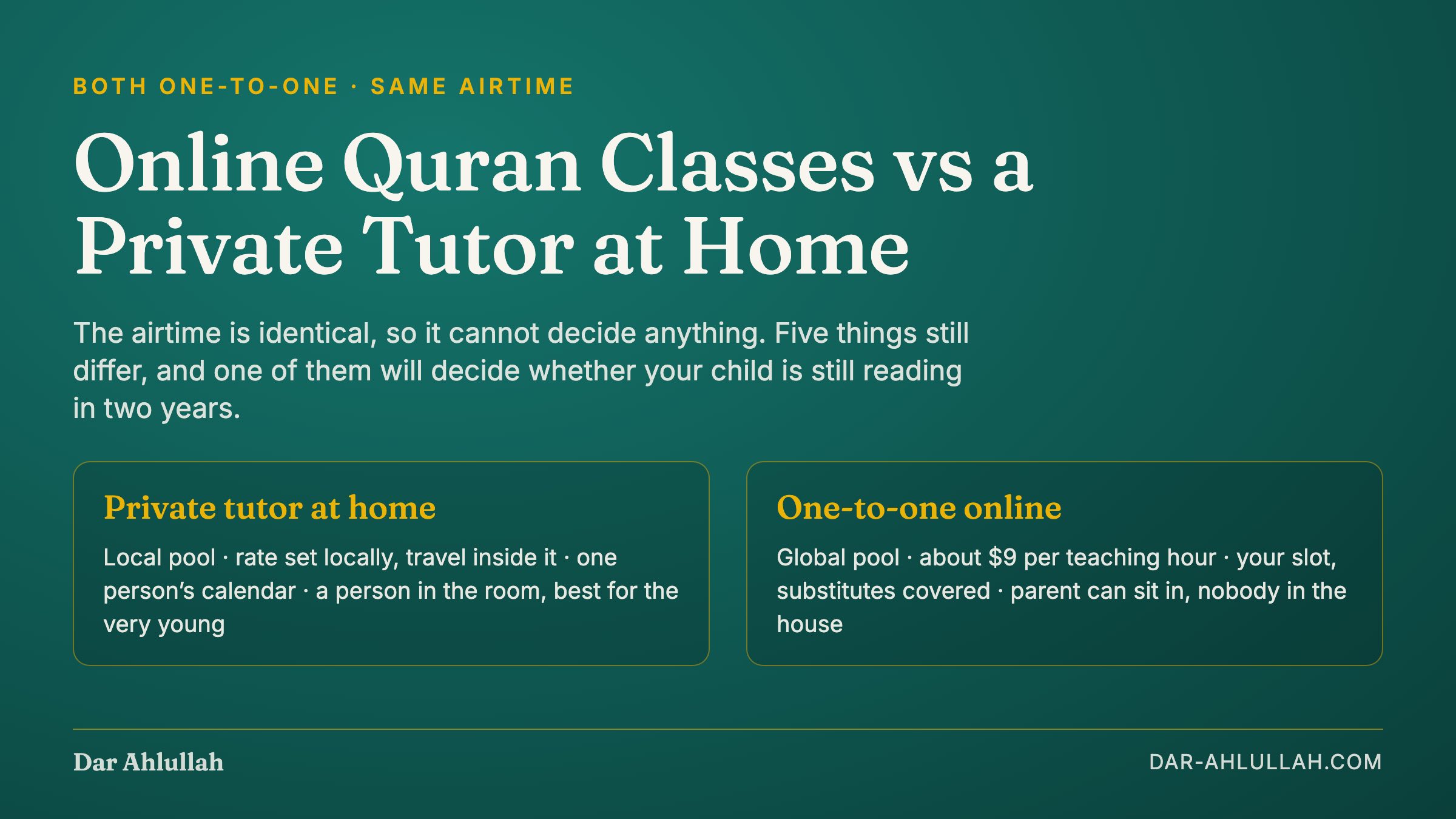
online Quran classes vs private tutor
Online Quran Classes vs a Private Tutor at Home: Which Is Better?
Both are one-to-one, so airtime does not decide it. What does: who the teacher can be, what the hour really costs, what happens when the tutor moves, who is responsible for safeguarding, and whether the learner is old enough for a screen.
19 min read
are online Quran classes worth it
Are Online Quran Classes Worth It? An Honest Answer
Online Quran classes are worth paying for when the learner needs a human ear, has no good local option, and lives in a household that will keep the slot. Here are the five cases where they are, the five where they are not, the maths on a year, and a six-week test that settles it.
20 min read
how to choose an online Quran academy
How to Choose an Online Quran Academy for Your Child
Every academy's website says the same six sentences. What separates them are the operational details nobody advertises: teacher continuity, the real hourly rate, clock changes, written progress, safeguarding, and the cancellation policy.
18 min read