online Arabic classes for kids
Online Arabic Classes for Kids: A Parent's Guide
Dar Ahlullah team 13 min read
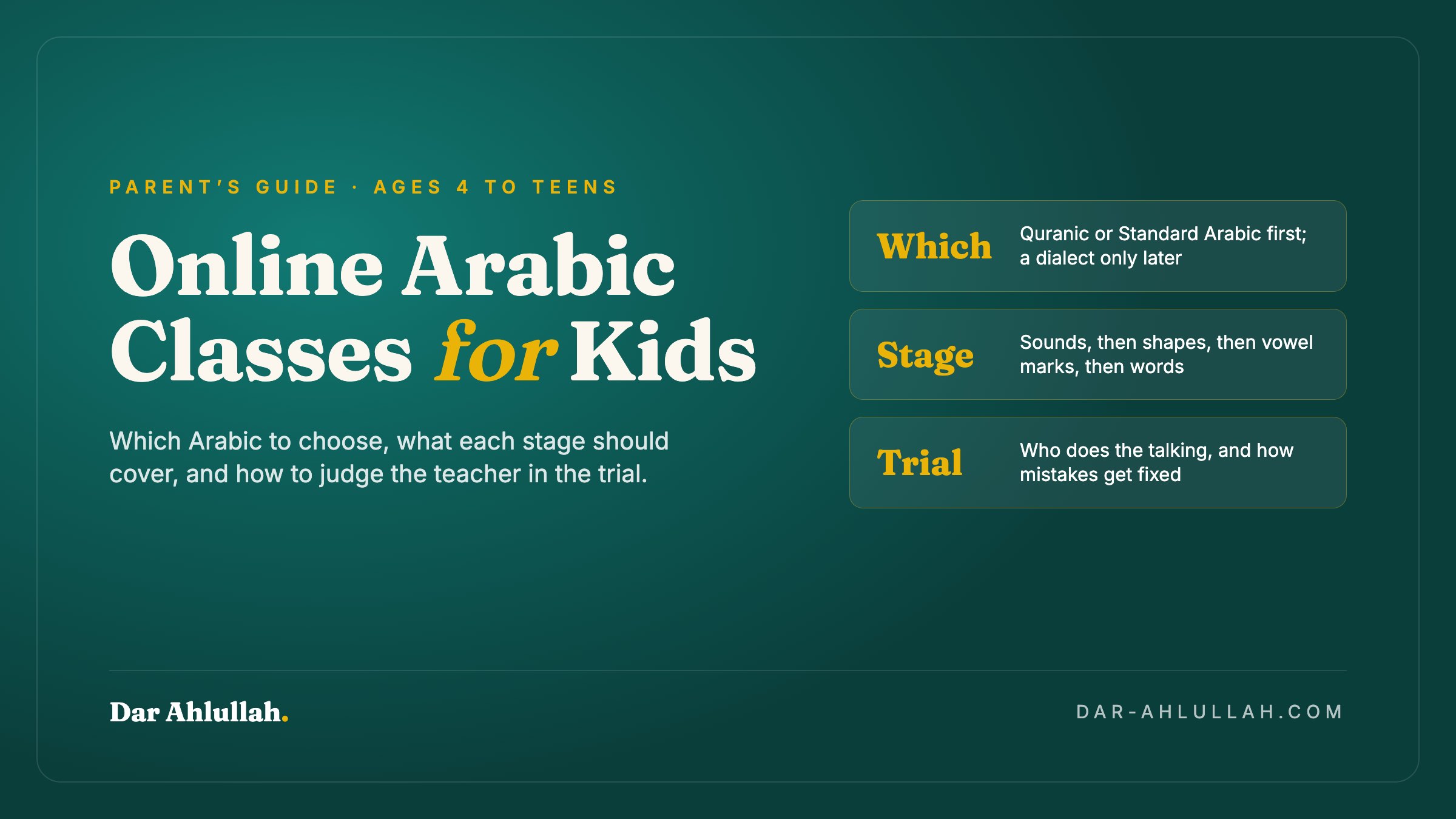
Table of Contents
- Can a Child Learn Arabic Online If Nobody at Home Speaks It?
- Which Arabic Should Your Child’s Class Teach?
- What Should an Online Arabic Class Cover at Each Age?
- One-to-One, Small Group or an App: Which Format Works for Kids?
- How Many Sessions a Week, and How Long Until They Can Read?
- How Do You Judge an Online Arabic Teacher for a Child?
- What Do Online Arabic Classes for Kids Cost?
- How Do Arabic Classes Fit Alongside Quran Lessons and School?
- Where Does Dar Ahlullah Fit?
- Quick Answers for Parents
- The Short Version
Can a Child Learn Arabic Online If Nobody at Home Speaks It?
Yes. A child in Ohio or Ontario can learn to read Arabic, build a working Quranic vocabulary and hold a simple conversation through live online lessons, even when neither parent speaks a word of it. What they cannot do is get there through an app or a video playlist alone, because the sounds that make Arabic Arabic have to be heard and corrected by a person while the child is making them.
That is the whole case for online Arabic classes for kids in one sentence: the live teacher supplies the ear the household does not have. Everything else in this guide is about choosing that teacher and that class well, which is harder than it looks because every academy website makes the same promises.
Here is what the live format does for a child that a parent without Arabic cannot do. It catches the throat letters and the emphatic letters that have no English equivalent before a near-miss hardens into a habit. It makes the child produce the language, out loud, for most of the lesson. And it gives the week a fixed anchor, which for children matters more than any curriculum. What it cannot replace is the ten minutes of daily review at home, and the sections below say plainly where that review fits.
If you are still deciding whether to teach at home first, our guide to teaching your child Arabic at home sets out how far a parent can take it and where the ceiling is. This article starts from the other side: you have decided to hire a class, and you want to pick the right one.
Which Arabic Should Your Child’s Class Teach?
For a Muslim family in the United States or Canada, the class should teach the Arabic of the Quran and of books, which academies label Quranic Arabic, classical Arabic or Modern Standard Arabic, and not a regional dialect. Choose a dialect class only if the goal is talking with grandparents in a specific country, and even then the reading foundation should come first. Ask the academy which one they teach before anything else; a surprising number cannot answer clearly.
The three options differ more than their names suggest:
- Quranic and classical Arabic is the language of the Quran, the hadith collections and the prayer. The Quran describes itself as sent down as “an Arabic Qur’an that you might understand” (Quran 12:2), and understanding it is the reason most families in the West are searching for a class at all.
- Modern Standard Arabic (MSA) is the written and broadcast language across the Arab world. It shares its alphabet, most of its grammar and a large part of its core vocabulary with Quranic Arabic, so a child who starts here is not starting over later.
- Dialects (Egyptian, Levantine, Gulf, Maghrebi) are what people speak at home. They are rarely written, differ from each other, and will not help a child understand a single ayah on their own.
For children the practical answer is simpler than the adult debate in our comparison of Quranic Arabic and Modern Standard Arabic: a child under about ten is learning sounds, letters, vowel marks and a first few hundred words, and that stage is the same whichever label the course carries. The difference shows up later, in which texts the teacher reads with them. A good kids’ course names the Quran as the destination from the first lesson and chooses vocabulary accordingly.
What Should an Online Arabic Class Cover at Each Age?
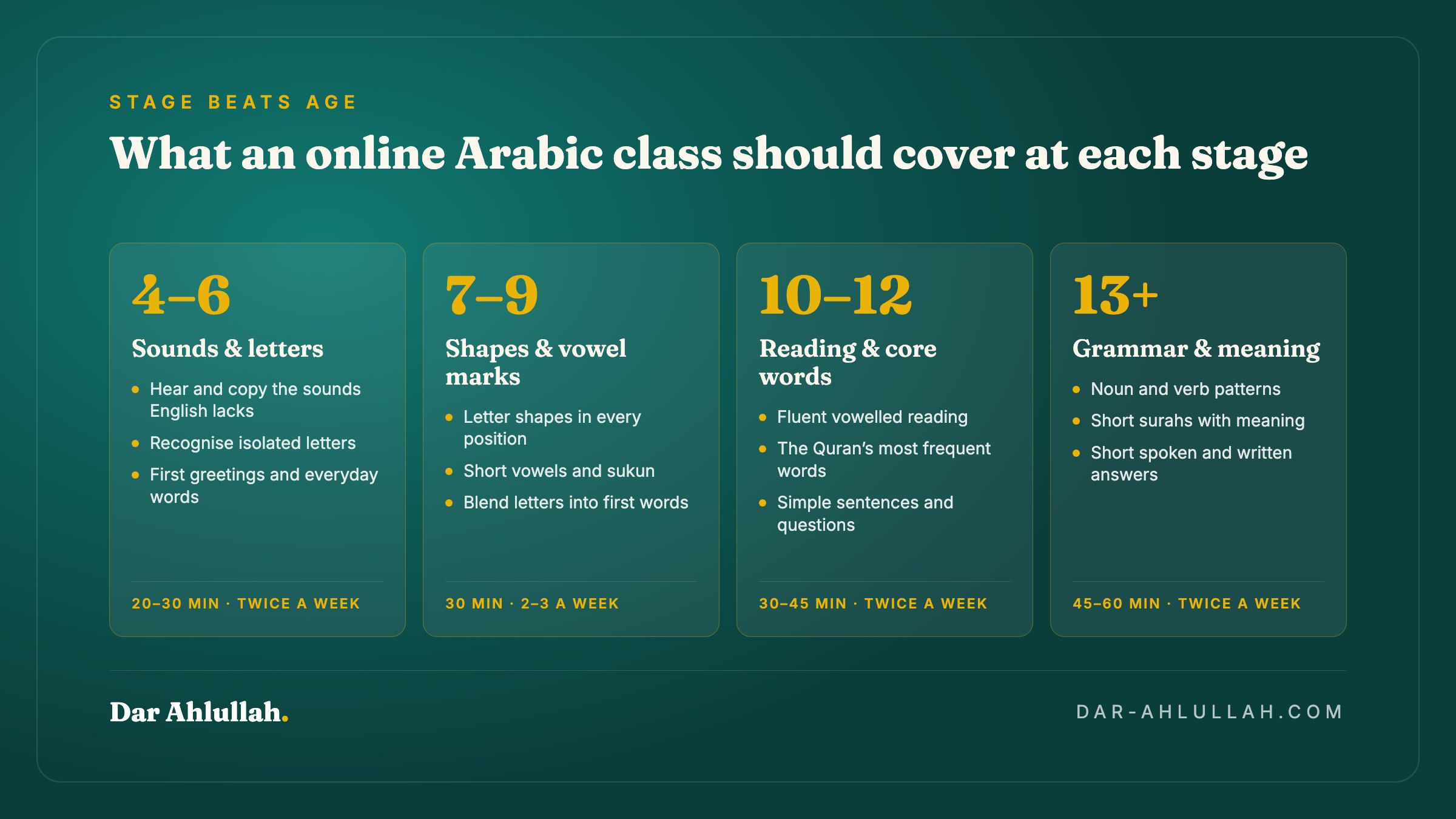
A class should match the child’s stage, not their grade. Under seven the work is sounds and letter recognition in short, playful sessions. From about seven to nine the child learns to decode: letter shapes, the vowel marks, and reading simple words. From ten the lesson can carry real vocabulary and simple sentences, and from thirteen a motivated teen can handle light grammar and short passages of the Quran with meaning.
The reason the stages look this way is the script itself. The Arabic alphabet has 28 letters, most of which change shape depending on their position in a word, it is written from right to left, and it records consonants while the short vowels are marked with optional diacritics (Wikipedia: Arabic alphabet). So a child must learn the sounds, then the shapes in all their positions, then the vowel marks, before a single word can be read. Programs that rush this order produce children who can name every letter and still cannot read.
| Stage | What a good class works on | Session | What “working” looks like |
|---|---|---|---|
| Ages 4–6 | Hearing and copying the sounds, especially the ones English lacks; recognising isolated letters; a handful of greetings and everyday words | 20–30 min, twice a week, parent nearby | Names most letters by sound, enjoys the lesson, asks for it |
| Ages 7–9 | Letter shapes in every position, the short vowels and sukun, blending letters into words, first reading of short phrases | 30 min, two or three times a week | Reads simple vowelled words slowly without help |
| Ages 10–12 | Fluent reading of vowelled text, a core vocabulary built from the Quran’s most frequent words, simple sentences and questions | 30–45 min, twice a week | Reads a short vowelled passage and explains some of it in English |
| Ages 13+ | Light grammar (noun and verb patterns, the possessive), reading short surahs with meaning, short written and spoken answers | 45–60 min, twice a week | Follows the meaning of a short surah and can describe their day in simple Arabic |
Two notes on the table. First, a nine-year-old who has never seen the alphabet starts at the ages 7–9 row regardless of birthday; stage beats age. Second, the sessions are deliberately short for the youngest children. A 60-minute lesson for a five-year-old is a sign the academy is pricing for parents rather than planning for children. For the Quran-reading side of the same question, our guide on what age a child should start learning Quran covers the parallel stages.
One-to-One, Small Group or an App: Which Format Works for Kids?
For a child who is starting from nothing, one-to-one live lessons work best, because every sound the child makes is heard and corrected and the child talks for most of the session. A small online group is a reasonable second choice for a social child who already reads. Apps and video courses are useful for review between lessons and nearly useless as the main lesson, since nothing in them can hear your child.
| Format | Where it works | Where it fails | Best used as |
|---|---|---|---|
| One-to-one live lesson | Beginners, shy children, pronunciation, any child who needs the pace set for them | Costs more per hour than a group; depends entirely on the one teacher’s skill | The main lesson |
| Small online group | Children who already decode, enjoy classmates and can wait their turn | Each child speaks for a fraction of the time; a quiet child can hide for months; the pace suits the middle of the group | A second weekly session, or the main lesson for a confident reader |
| Apps and video courses | Letter-recognition games, vocabulary repetition, review on a car journey | Cannot hear or correct; children learn to pass the game rather than say the sound; motivation fades without a person expecting them | Ten minutes of review between lessons |
| Weekend community school | Community, friends, a sense that Arabic is normal | Large classes, a week between contacts, little individual correction | Community and identity, with reading taught elsewhere |
If the weekend school is already part of your family’s week, keep it; it does a job a screen cannot. Just do not expect it to teach reading on its own. Our guide to Islamic studies for kids online goes into how one-to-one lessons and a crowded weekend school compare for the other subjects.
How Many Sessions a Week, and How Long Until They Can Read?
Two short sessions a week plus ten minutes of review on the other days is the pattern that holds up for most children. One long session a week forgets itself before the next one; five sessions a week is more than most families keep going past the first month. On that pattern the reading foundation is a matter of months, not years: our own Arabic course is listed at six to twelve months for reading and comprehension, at two to three sessions a week.
What slows children down is not the language but the gaps. A fortnight missed in December costs more than a fortnight, because the shapes and vowel marks fade quickly until they are automatic. So when you choose a class, choose a slot you can defend through the school year, not the one that looks best in September. Our after-school Arabic and Quran program guide walks through the time of day and the weekly plan that survive term time.
Be sceptical of any promise of fluency. A class can give a child confident reading, a few hundred of the words that matter most and the habit of using the language, and those three things are worth paying for. Conversational fluency comes from years of contact and, usually, time in an Arabic-speaking household or country. For a realistic picture of the reading side, see how long it takes to learn to read the Quran, which is the same skill wearing different clothes.
How Do You Judge an Online Arabic Teacher for a Child?
Judge the trial lesson, not the brochure. In a good first session the child speaks or reads for more than half the time, every mistake is named and modelled rather than passed over, explanations are in English the child understands, and the teacher adjusts within minutes when attention drifts. Afterwards, you should receive the child’s starting point in writing and the name of the teacher who will actually take the weekly slot.
Watch for these during the trial:
- Who does the talking. A teacher who recites and explains for twenty-five of thirty minutes has not diagnosed anything. Your child should be making sounds, reading, answering.
- How mistakes are handled. The right correction is specific: this letter, from this part of the mouth, listen, now you. Letting errors pass is as bad as piling on.
- English that fits the child. Many online teachers are native Arabic speakers, and that is a strength, but the explanations have to land in the child’s English, not an adult’s.
- Camera and room. Can a parent sit in? Is the lesson recorded, and who keeps the recording? A clear, written answer matters more than the answer itself.
- Continuity. Will this teacher be the teacher every week? Children attach to a person before they attach to a subject, and a rotating pool quietly undoes months of trust.
Then ask for three things: the assessment in writing, the first month’s plan, and the policy when a session is missed. The full seven-point checklist, including safeguarding and the exit terms, is in how to choose an online Quran academy; it applies word for word to an Arabic class.
What Do Online Arabic Classes for Kids Cost?
Compare classes on the price per teaching hour, not the monthly figure. A $40 month of four 30-minute lessons is $20 an hour; a $70 month of eight hour-long lessons is under $9. Academies usually publish a monthly number and leave you to do that division, and some price half-hour sessions against competitors’ full hours.
Our own rate is about $9 per teaching hour and is the same across every plan: $36 a month for eight 30-minute sessions, $70 for eight full hours, and $102 for twelve hours. Siblings get 20% off, which matters in a family putting two or three children through the same stages. There is no registration fee, and plans can be paused, upgraded or switched at any time. The breakdown is on the pricing page.
Whatever you pay, the most expensive class is the one your child stops attending in week six. Price for the slot and the teacher you can keep, not for the cheapest hour. How that calculation compares with hiring a tutor locally is covered in online Quran classes vs a private tutor.
How Do Arabic Classes Fit Alongside Quran Lessons and School?
Keep Arabic and Quran as separate short lessons on different days rather than one long combined class. The Quran lesson builds reading and tajweed from day one; the Arabic lesson builds the vocabulary that eventually turns recitation into understanding. Two 30-minute slots on, say, Monday and Wednesday, after a snack and before homework fatigue sets in, is the arrangement most school-age children sustain.
For homeschooling families the same split applies, with the advantage that the slot can sit mid-morning when the child is freshest. Either way, ask the teacher for a short note after each lesson and fold the week’s words into daily life: the names of things at the table, the greeting at the door. A child who meets the words outside the lesson keeps them. Our list of the most common words in the Quran is a good source for which words to meet first.
Where Does Dar Ahlullah Fit?
Dar Ahlullah teaches live one-to-one lessons over Zoom, in English, to children and adults who do not speak Arabic at home. It suits a family that wants a named teacher, a fixed weekly slot and individual correction. It does not offer group classes or classmates.
What our published pages state:
- An Arabic Language course for non-Arabic speakers. The courses page lists it as dual-language instruction focused on grammar, vocabulary and Quran comprehension, at two to three sessions a week over six to twelve months. Quran reading, tajweed, memorization and Islamic studies are separate courses that can run alongside it.
- Native Arabic-speaking certified teachers who teach in English, always one-to-one.
- About $9 per teaching hour, with plans from $36 a month and a 20% sibling discount. Details are on the pricing page.
- A written progress report after every session, which is the note you fold into the week at home.
- A free 30-minute assessment with no card required, and a rematch with another certified teacher at no extra cost if the first is not the right fit.
If you want to see how a lesson runs before deciding, book the free assessment and sit in. Tell the teacher at the start that the goal is reading and Quranic vocabulary, and the plan they write afterwards will be built around that.
Quick Answers for Parents
What is the best age to start online Arabic classes?
Around six or seven for structured reading lessons, when a child can sit for thirty minutes and hold a pencil comfortably. Younger children do well with shorter, playful sound-and-letter sessions, and nobody is too old to start: a motivated twelve-year-old often moves faster than a six-year-old.
Should my child learn Arabic or Quran first?
Both, on different days. Quran reading starts immediately because it is a decoding skill; Arabic as a language adds the meaning. Neither has to wait for the other.
Can my child learn Arabic from an app?
An app can teach letter recognition and drill vocabulary, and it is good for ten minutes of review. It cannot hear your child, so it cannot fix the sounds, and most children stop using it once the novelty fades.
Do I need to sit in on the lessons?
For children under about eight, sit nearby for the first weeks so the teacher can hand you the review task. After that, a parent within earshot is enough. Any class should let you observe whenever you want.
How many lessons a week does a child need?
Two short live lessons plus brief daily review at home. More sessions help if the family keeps them up; the common mistake is booking four a week in September and cancelling all of them by November.
Will my child become fluent?
A class can give confident reading, a working Quranic vocabulary and a lasting habit. Everyday fluency needs years of real contact with speakers. Choose the class for the first three outcomes and treat fluency as a long-term bonus.
The Short Version
Pick a class that teaches the Arabic of the Quran and of books, places your child by stage rather than age, keeps the youngest sessions short, and puts a live teacher in front of them who hears every sound. Use the trial to watch who does the talking and how mistakes are handled. Compare prices per teaching hour. Then protect two short slots a week through the school year, and add ten minutes a day at home. For the bigger picture across all ages, our pillar guide on the best way to learn Arabic for non-native speakers covers the adult side of the same decision.
Related articles
how to teach your child Arabic at home
How to Teach Your Child Arabic at Home: A Parent's Guide
You do not need to speak Arabic to teach it at home. You need to pick which Arabic you are teaching, work in sounds before letters, and protect ten minutes a day — five days a week beats one long Saturday session.
20 min read
after school Arabic program
After-School Arabic & Quran Program: Balancing School and Deen
Fitting Arabic and Quran around a Western school day is a scheduling problem, not a motivation problem. Here is the weekly plan, the right time slot, and how to keep it alive through exam season.
8 min read
Islamic homeschooling
Islamic Homeschooling: A Realistic Guide for Families in the West
Most Islamic homeschooling guides assume you live somewhere it is legal and have a parent free all day. This one starts from the reality: the law in your country, the hours you actually have, and which subjects genuinely need a teacher.
14 min read