
how to study the Seerah
How to Study the Seerah: A Beginner’s Reading Plan
Dar Ahlullah team 18 min read
Table of Contents
- Introduction: Why Most People Stall at the Elephants
- The Short Answer: Four Moves That Make the Seerah Stick
- 1. What the Seerah Is, and Where It Comes From
- 2. Learn the Skeleton First: Thirteen Years, Then Ten
- 3. Read One Modern Book Properly, Not Ten Badly
- 4. Read It Beside the Quran, Not Instead of It
- Three Habits That Turn Reading Into Retention
- A Twelve-Week Plan You Can Actually Finish
- Five Mistakes That Waste a Year
- Studying the Seerah With Children
- Where a Teacher Changes the Return
- Questions People Ask Before Starting
- Conclusion: Chronology First, Depth Later
Introduction: Why Most People Stall at the Elephants
Almost everyone who decides to study the life of the Prophet Muhammad ﷺ begins in the same place and stops in the same place. They open a well-recommended biography, read the opening chapters on pre-Islamic Arabia, the tribes of Quraysh, the custodianship of the Ka’bah and the Year of the Elephant — and somewhere around the fortieth unfamiliar proper noun, the book goes back on the shelf. It is not a failure of sincerity. It is a failure of sequencing.
The difficulty is structural. The Seerah is a twenty-three-year public career embedded in a tribal society whose names, alliances and geography the reader does not yet know, told through a source tradition that is itself several centuries deep. A good biography does not simplify that; it renders it faithfully. So the beginner meets Banu Hashim, Banu Makhzum, Abu Sufyan, Abu Talib, Abu Lahab and Abu Jahl in the space of ten pages, has no scaffold to hang them on, and quietly concludes that this is a subject for people with more background.
The fix is not a shorter book. It is putting the skeleton in place before the flesh: a rough chronology you could sketch on a napkin, so that every name, battle and revelation you meet afterwards has somewhere to attach. That is what this guide is about — a practical answer to how to study the Seerah that survives contact with a normal week, and one you can start tonight without buying anything.
It assumes no Arabic and no prior Islamic studies. If you are new to Islam entirely and the Seerah is one item on a longer list, our guide to what to learn in your first ninety days puts it in order alongside prayer, purification and belief; come back here when the Seerah is the thing you actually want to sit with.
The Short Answer: Four Moves That Make the Seerah Stick
If you read nothing else, do these four things in this order. They are not a curriculum; they are the minimum structure that keeps a beginner reading past week three.
- Memorise the two-block skeleton before you read a book. Thirteen years in Mecca, ten years in Medina. Every event you will ever read about sits in one of those two blocks, and knowing which one already tells you most of what you need about its context.
- Pick one complete modern biography and finish it. One. Reading three at once produces three sets of half-remembered chapters and no chronology.
- Keep the Quran open beside it. Large parts of the Quran are commentary on events in the Seerah as they happened. Read the passages that belong to each episode and both texts get sharper at once.
- Write one line per session. Not a summary — one sentence naming what happened and what it demanded of the people involved. Twelve weeks of that is a document you will actually reread.
Everything below is the detail behind those four, plus the plan that puts them on a calendar.
1. What the Seerah Is, and Where It Comes From
The word sīrah means a way of proceeding, a course of conduct — and as a genre it means the biography of the Prophet ﷺ. It is a distinct field with its own classical literature, not a chapter of hadith study, though the two overlap constantly and share many of the same transmitters.
Knowing where the material comes from matters more than it sounds, because it tells you how to read a disagreement between two books. The early biographical tradition runs through a small number of named figures. Ibn Shihāb al-Zuhrī (d. c. 737 CE) is the central early collector. His student Muhammad ibn Ishaq (d. 767 CE) assembled the material into the biography everything later depends on — but Ibn Ishaq’s own text does not survive independently. What we read is the recension of Ibn Hisham (d. 833 CE), who edited it, and the parallel quotations preserved by al-Tabari. Alongside them sits the maghāzī literature, which deals specifically with the military expeditions, and the biographical dictionaries of Ibn Sa’d.
Why two books can tell the same story differently
Historical reports in this tradition are held to a different standard than reports of religious rulings. A hadith used to establish law is scrutinised for the reliability of every link in its chain; a historical report conveying what happened at a battle is often transmitted more loosely, because the stakes of a date being wrong are not the stakes of a ruling being wrong. Classical scholars were explicit about this distinction, and it explains most of the variation a beginner notices — the number of camels, the exact day, the wording of an exchange.
The practical consequence for you is small but freeing: when two reputable biographies differ on a detail, you have not caught anyone out and you do not need to adjudicate. Note it, keep the version your book gives, and move on. Where a difference genuinely matters — a point of belief or law drawn from an episode — that is a question for a teacher, not for a footnote hunt.
The one distinction worth holding on to
Keep separate in your mind what is Quran, what is authenticated hadith, and what is historical narrative. All three appear on the same page of a good biography and they carry different weight. The Quran is the fixed text. Hadith are transmitted reports of the Prophet’s words and acts, graded for reliability. Historical narrative is the connective tissue: who marched where, in which month, with how many. Beginners who never make this distinction end up quoting a colourful scene as though it were scripture, and that habit is much harder to unlearn later than to avoid now.
2. Learn the Skeleton First: Thirteen Years, Then Ten
Here is the whole structure, and it is genuinely this simple. The Prophet ﷺ received the first revelation at the age of forty. He spent roughly thirteen years in Mecca, then migrated to Medina, where he spent roughly ten years until his death. That migration — the Hijrah — is the hinge, and it is such a decisive break that the Islamic calendar counts from it rather than from his birth or from the first revelation.
The two blocks have completely different textures, and once you feel the difference you can place almost any episode correctly on hearing it:
- Mecca is a story of endurance. A small, mostly powerless community, no state, no army, no law to enforce. The themes are patience under pressure, the oneness of God, resurrection and accountability. The revelations from this period are typically short, rhythmically intense, and addressed to a hostile audience.
- Medina is a story of construction. A community that now has to govern itself, feed itself, defend itself, treat with neighbours and honour treaties. The themes shift to law, warfare, family, finance and social conduct. The revelations lengthen and become procedural.
Almost every beginner’s confusion about apparent tonal shifts in the Quran dissolves the moment they can say which block a passage belongs to. That single question — Meccan or Medinan? — is the highest-yield thing you will learn this month.
The conventional timeline
Dates in this period are conventional rather than exact, and different sources shift some by a year. Learn the sequence and the approximate spacing; do not memorise the numbers to the year.
| Event | Approx. CE | Hijri | Why it matters |
|---|---|---|---|
| Birth in Mecca | c. 570 | — | Orphaned early; raised by his grandfather, then his uncle Abu Talib. |
| First revelation at Hira | 610 | — | Age forty. The Meccan period begins. |
| Public preaching begins | c. 613 | — | Three years of private call precede open confrontation. |
| Migration to Abyssinia | 615 | — | Persecution reaches the point of sending believers abroad for refuge. |
| Boycott of Banu Hashim | 616–619 | — | Economic and social siege of the clan protecting him. |
| Year of Sorrow | 619 | — | Khadijah and Abu Talib die. He loses emotional and tribal protection at once. |
| Hijrah to Medina | 622 | 1 AH | The hinge. Year one of the calendar. |
| Battle of Badr | 624 | 2 AH | First major engagement; an outnumbered victory. |
| Battle of Uhud | 625 | 3 AH | A costly reversal, and the Quran discusses it directly. |
| Battle of the Trench | 627 | 5 AH | Medina besieged; survival by defensive engineering. |
| Treaty of Hudaybiyyah | 628 | 6 AH | A treaty that looked like a defeat and functioned as a breakthrough. |
| Conquest of Mecca | 630 | 8 AH | Return to the city he left; a general amnesty rather than reprisals. |
| Farewell Pilgrimage | 632 | 10 AH | The summarising sermon of the whole mission. |
| Death in Medina | 632 | 11 AH | Twenty-three years after the first revelation. |
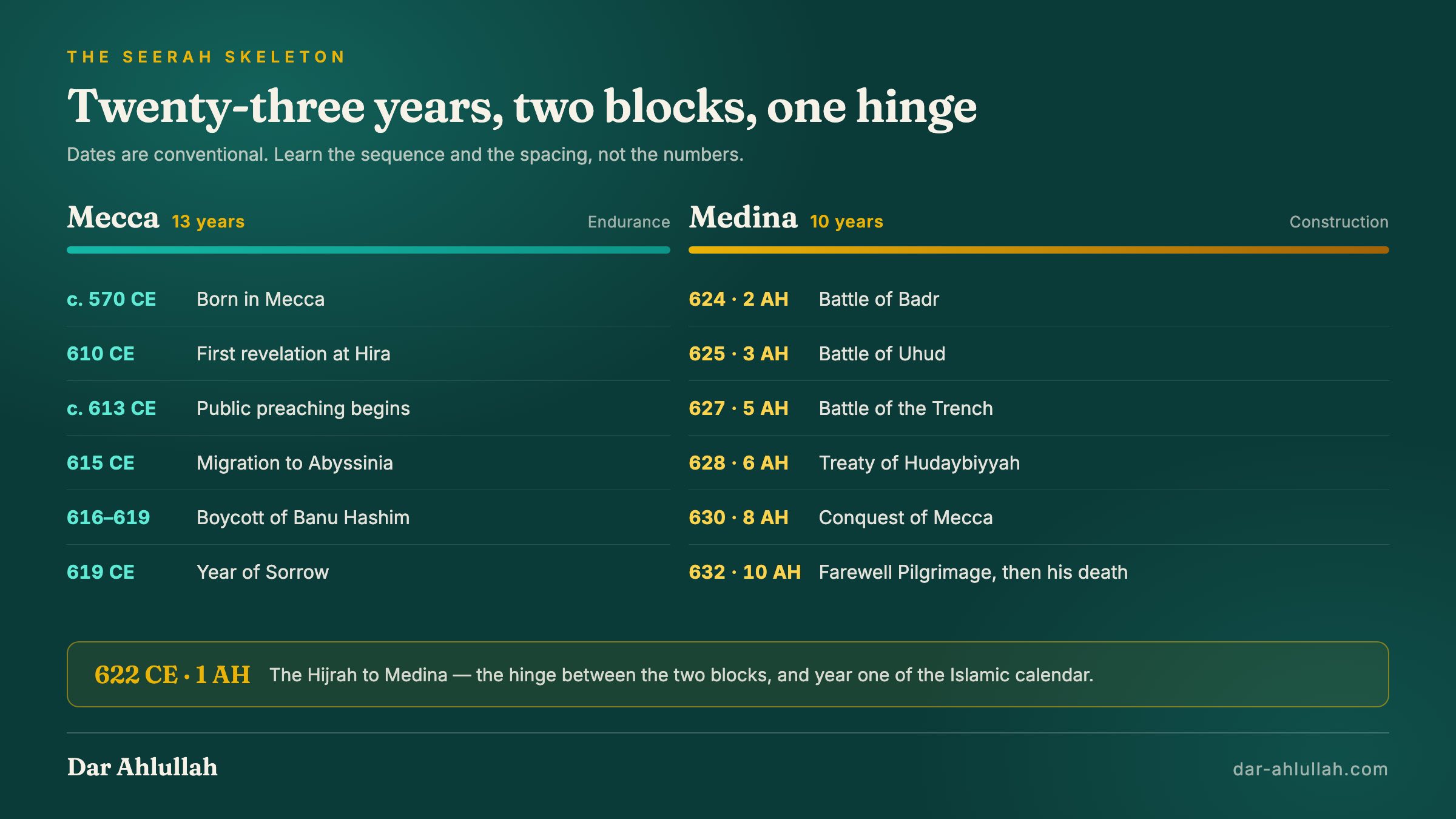
Copy that table onto one sheet of paper by hand. The act of writing it out does more for recall than rereading it five times, and you want it beside you while you read so that every chapter can be placed without effort.
3. Read One Modern Book Properly, Not Ten Badly
The classical sources are not where a beginner should start. Ibn Hisham’s recension is a magnificent text and an unforgiving first read: it assumes the genealogy, moves at the pace of a chronicle, and carries long stretches of poetry whose point is invisible without background. Start with a modern narrative biography that has already done the work of arranging the material, then go back to the classical sources later with a map in your head.
The most widely used entry point in English is Ar-Raheeq Al-Makhtum (The Sealed Nectar) by Safiur Rahman Mubarakpuri, which won first prize in the Muslim World League’s worldwide competition for biographies of the Prophet, held in Mecca in 1979. It is chronological, complete, and available in English at low cost, which is why most study circles default to it.
It is not the only reasonable choice, and the criteria matter more than the title. Whatever you pick, check four things before committing three months to it:
- It is chronological. Thematic biographies are excellent second books and poor first ones, because they assume you already have the timeline they are rearranging.
- It cites its sources. You want to be able to see where a scene came from, even if you never chase a single reference.
- It is complete. A book that stops at the Hijrah leaves you with the half of the Seerah that explains the least about how Muslims actually live.
- You can stand the prose. This is not a trivial criterion. The book you will finish beats the book you should read.
Audio counts, if it is the same book read straight through. What does not work is a diet of disconnected lecture clips: they are compelling, they are often excellent in isolation, and they will leave you with a vivid memory of four episodes and no chronology at all. Use talks as commentary on the chapter you have already read, never as the spine.
4. Read It Beside the Quran, Not Instead of It
This is the step that converts the Seerah from history into something that changes how you pray. A substantial part of the Quran was revealed into specific situations — a battle, an accusation, a treaty, a question someone asked — and reading those passages at the moment the biography reaches the event is the closest a reader can get to hearing them the way the first audience did.
A few anchors to start with, in the order the story reaches them:
- The first revelation. The opening five verses of Surah Al-‘Alaq are the first words revealed, in the cave of Hira. The narration of that night is preserved in Sahih al-Bukhari, and reading the hadith and the verses together in one sitting is a better introduction to the whole subject than any preface.
- The pause that followed. Surah Ad-Duha belongs to the interval when revelation stopped and the Prophet ﷺ feared he had been abandoned. Read cold it is a beautiful passage; read at its place in the story it is something else entirely.
- The Hijrah. Surah At-Tawbah, verse 40 refers directly to the two men in the cave on the road to Medina — the Prophet ﷺ and Abu Bakr — and to the words spoken there.
- Uhud. A long passage in Surah Al-Imran discusses the battle with startling frankness, including the community’s own errors. Any suspicion that this is a sanitised history does not survive reading it.
- The Trench. The opening verses of the relevant section of Surah Al-Ahzab describe the siege of Medina and the fear inside the city while it was happening.
- Hudaybiyyah. Surah Al-Fath follows the treaty that many of the Companions initially experienced as a humiliation, and names it a clear victory. The gap between how an event felt and what it turned out to be is the whole lesson of that chapter.
- The Farewell Pilgrimage. Jabir’s long narration of the Prophet’s pilgrimage in Sahih Muslim is the single most detailed eyewitness account in the entire Seerah, and it comes at the end of the story where it belongs.
You do not need Arabic for any of this — a reliable translation is enough to follow the connection. But the return on even a little Arabic here is unusually high, because the words that carry the emotional weight of these passages recur constantly, and a reader who knows fifty of them stops depending entirely on the translator’s choices. If that appeals, our list of the most common words in the Quran is a realistic place to start, and it pairs naturally with a Seerah reading plan.
One rule for this step: do not build rulings out of narrative. That the Prophet ﷺ did something at a particular moment does not by itself establish what is obligatory, recommended or permitted for you — deriving that is the work of fiqh, which reads the same events with a different apparatus. Our beginner’s guide to fiqh explains what that apparatus is and in what order to learn it.
Three Habits That Turn Reading Into Retention
The difference between people who finish a Seerah book and people who remember it a year later is almost entirely three small habits, none of which takes more than a few minutes per session.
Keep a running list of names
One page, three columns: name, who they are, first appearance. Add a row the first time each person matters, not the first time they are mentioned. Within a fortnight the cast stops being a blur, and the moment where Abu Sufyan moves from adversary to Muslim — or where Umar walks in intending violence and leaves having accepted Islam — lands as a reversal rather than as another sentence.
Look at a map, once, properly
Mecca and Medina are about 340 kilometres apart, and until you have seen that distance on a map, the Hijrah is an abstraction. So is Badr, which sits on the caravan route between them. Ten minutes with a map of the Hijaz will do more for your comprehension of the Medinan period than an extra chapter.
Write one sentence per session
At the end of each reading, write a single line: what happened, and what it cost the people involved. Not a summary and not a lesson — those come later and mostly write themselves. The constraint is the point; forcing an episode into one sentence is what makes you decide what its centre actually was. Twelve weeks of one-line entries is a two-page document that reconstructs the whole arc in a few minutes, and you will use it far more than the notebook you meant to keep.
A Twelve-Week Plan You Can Actually Finish
Three or four sessions a week, thirty to forty minutes each. That pace finishes a standard modern biography in a term without ever feeling like a second job, and it is deliberately slower than you think you can manage — because the plan that survives a bad fortnight beats the plan that assumed there would not be one.
| Weeks | Focus | Alongside |
|---|---|---|
| 0 | Copy the timeline table by hand. Read nothing else. | Ten minutes with a map of the Hijaz. |
| 1–2 | Arabia before Islam; birth, childhood, marriage to Khadijah. | Start the names page. |
| 3–4 | Hira, the first revelation, the private call, the first Muslims. | Surah Al-‘Alaq 1–5; Surah Ad-Duha. |
| 5–6 | Open preaching, persecution, Abyssinia, the boycott, the Year of Sorrow. | Short Meccan surahs at the end of the Quran. |
| 7 | Ta’if, the Isra and Mi’raj, the pledges of Aqabah, the Hijrah. | Surah At-Tawbah 40. |
| 8–9 | Medina: the mosque, the brotherhood, the covenant, Badr and Uhud. | Surah Al-Imran 121–128. |
| 10 | The Trench, the tribes of Medina, the shift to a governed community. | Surah Al-Ahzab 9–11. |
| 11 | Hudaybiyyah, the letters to the rulers, Khaybar, the conquest of Mecca. | Surah Al-Fath. |
| 12 | Tabuk, the Farewell Pilgrimage, the final illness and death. | Jabir’s narration of the pilgrimage. |
Week zero is not padding. Starting a biography with the timeline already in your hand is the difference between a book that explains itself and a book you keep flipping backwards through.
When you finish, do not immediately start a second biography. Reread your own twelve lines, then pick one episode that would not leave you alone — Hudaybiyyah does this to a lot of people — and go deep on that single event across two or three sources. Depth after chronology works. Depth instead of chronology is how the shelf fills up with unfinished books.
Five Mistakes That Waste a Year
| Mistake | What it costs | Do this instead |
|---|---|---|
| Starting with a classical primary source | Two hundred pages of genealogy and a closed book | One modern chronological biography first; classical sources as the second pass |
| Living on lecture clips | Four vivid episodes, no timeline, no sense of causation | Talks as commentary on the chapter you already read |
| Reading three books at once | Three sets of half-remembered chapters | Finish one. Comparison is a second-year activity |
| Chasing every disagreement over a date or a number | Weeks lost to details the tradition itself treats as secondary | Note it, keep your book’s version, ask a teacher if it touches belief or law |
| Deriving rulings from narrative | Confident conclusions that fiqh does not support | Keep Quran, hadith and history in separate mental columns |
Studying the Seerah With Children
The Seerah is the easiest Islamic subject to teach a child and the easiest to teach badly. It is easy because it is a story with people in it, and children absorb narrative at a rate adults cannot match. It goes wrong when it is delivered as a sequence of battles with dates attached, which is exactly the version most likely to be memorised for a test and forgotten in a month.
Three adjustments cover most of it. Tell it in order, so the child builds the same skeleton you did rather than a set of disconnected episodes. Emphasise conduct over chronology — how the Prophet ﷺ treated an enemy who had been handed to him, what he did with the man who mocked him daily, how he behaved on returning to the city that had expelled him. And keep the dates out of it until a child is old enough for dates to mean anything, which is later than most curricula assume.
A weekly family reading, fifteen minutes, one episode, works better than a formal lesson. If you are building a wider home routine around it rather than a one-off, our realistic starter guide to Islamic homeschooling covers how to keep something like this running past the first enthusiastic month.
Where a Teacher Changes the Return
Most of a first pass through the Seerah is genuinely self-study, and anyone telling a beginner they cannot read a biography on their own is wrong. There are three points, though, where an hour with a teacher saves a month.
The first is the source question — being told plainly which parts of what you are reading are Quran, which are authenticated reports, and which are historical narrative, in the specific book you are holding. The second is the transition from narrative to practice: what an episode actually establishes, and what it does not, which is where self-taught readers most often go wrong. The third is simply accountability, because a twelve-week plan with nobody expecting anything of you tends to become a fourteen-month plan.
At Dar Ahlullah the Seerah sits inside our Islamic Studies course alongside aqeedah, fiqh and Islamic manners, taught one-to-one by native Arabic-speaking teachers, one or two sessions a week. Sessions are live and one-to-one rather than recorded, you get a written report after each one, and you can pause or switch at any time. If you want to see where you are before committing to anything, the first thirty minutes are a free assessment with no card required — a teacher works out what you already know, proposes a starting point, and sends it to you in writing whether or not you continue.
If belief rather than biography is the gap you actually feel, start there instead: our guide to aqeedah for beginners covers the six articles of faith, and the Seerah reads very differently once those are in place.
Questions People Ask Before Starting
How long does it take to study the Seerah?
A complete first pass through a standard modern biography takes most people a term at three or four short sessions a week — roughly twelve weeks. That gets you the full arc and a working chronology. Serious depth is a lifetime subject, but the first pass is the one that changes how you read the Quran, and it is genuinely finishable.
Do I need Arabic to study the Seerah?
No. The major biographies and the standard hadith collections are all available in English, and a first pass in translation is a real education, not a compromise. Arabic changes the experience of the Quranic passages you read alongside it rather than the biography itself, which is why it is worth starting but not worth waiting for.
Should I start with the Seerah or with the Quran?
Neither, exactly — do them together, because each one explains the other. If you must sequence them, learn how to pray first. Prayer is obligatory from the moment you enter Islam and it is a practical skill with steps; the Seerah is understanding, and understanding can begin the following week. Our beginner’s guide to salah covers the first requirement.
Which Seerah book is best for a complete beginner?
The most common English entry point is Ar-Raheeq Al-Makhtum, which won the Muslim World League’s 1979 biography competition and is chronological, complete and cheap. The criteria matter more than the title: chronological, sourced, complete, and readable enough that you will finish it.
Are the classical sources unreliable, then?
That is not the right conclusion. Historical reports were simply held to a different standard than reports used to establish law, which is why biographies vary on numbers and dates while agreeing entirely on the shape of events. The tradition was transparent about this distinction rather than hiding it. Treat variation in incidental detail as normal, and treat questions of belief and law as belonging to a different discipline with a stricter apparatus.
Is it enough to listen to a Seerah lecture series?
A complete series delivered in order can work in place of a book. A feed of unconnected clips cannot, and it is the most common way people spend a year on the Seerah without acquiring a timeline. The test is simple: if you cannot say whether an episode came before or after the Hijrah, whatever you are doing is not building a chronology.
My children are young. When should they start?
As soon as they enjoy stories, which is far earlier than formal study. Keep it narrative, keep it in order, and leave the dates and the battle logistics until they are older. The conduct is the content at that age.
Conclusion: Chronology First, Depth Later
The Seerah is not a difficult subject. It is a subject that punishes being started in the wrong order — and almost everyone starts it in the wrong order, which is why so many people own a biography they have read the first four chapters of twice.
Put the skeleton down first: thirteen years in Mecca, ten in Medina, one hinge between them. Pick one chronological book and finish it. Read the Quranic passages that belong to each episode as you reach it. Write one line per session. Twelve weeks of that produces something a decade of clips does not — a shape you can hang everything else on, including everything you go on to read afterwards.
And when you have the shape, the Quran stops being a text you approach cold. You reach a passage and know which year it belongs to, who was in the room, and what was at stake. That shift is the whole reason to study the life of the Prophet ﷺ in the first place, and it is available to anyone willing to give it three sessions a week for a term.
Related articles
aqeedah for beginners
Aqeedah for Beginners: The Six Articles of Faith, Explained Simply
Aqeedah is the subject that answers what a Muslim believes, as distinct from what a Muslim does. The core of it is six articles of faith — short enough to learn in an afternoon, and the foundation everything else rests on.
17 min read
fiqh for beginners
Fiqh for Beginners: What to Learn First, and in What Order
Fiqh is the science of what a Muslim does, as distinct from what a Muslim believes. The part you use daily — purification and prayer — is a few weeks of study, and it is taught in a fixed order for a reason.
16 min read
new Muslim guide
A New Muslim Guide to Your First 90 Days in Islam
The problem is never the amount to learn, it is the order. Here is a month-by-month sequence for the first 90 days after your shahada: prayer first, the 28 letters second, and what to deliberately postpone.
14 min read