
how to choose an online Quran academy
How to Choose an Online Quran Academy for Your Child
Dar Ahlullah team 18 min read
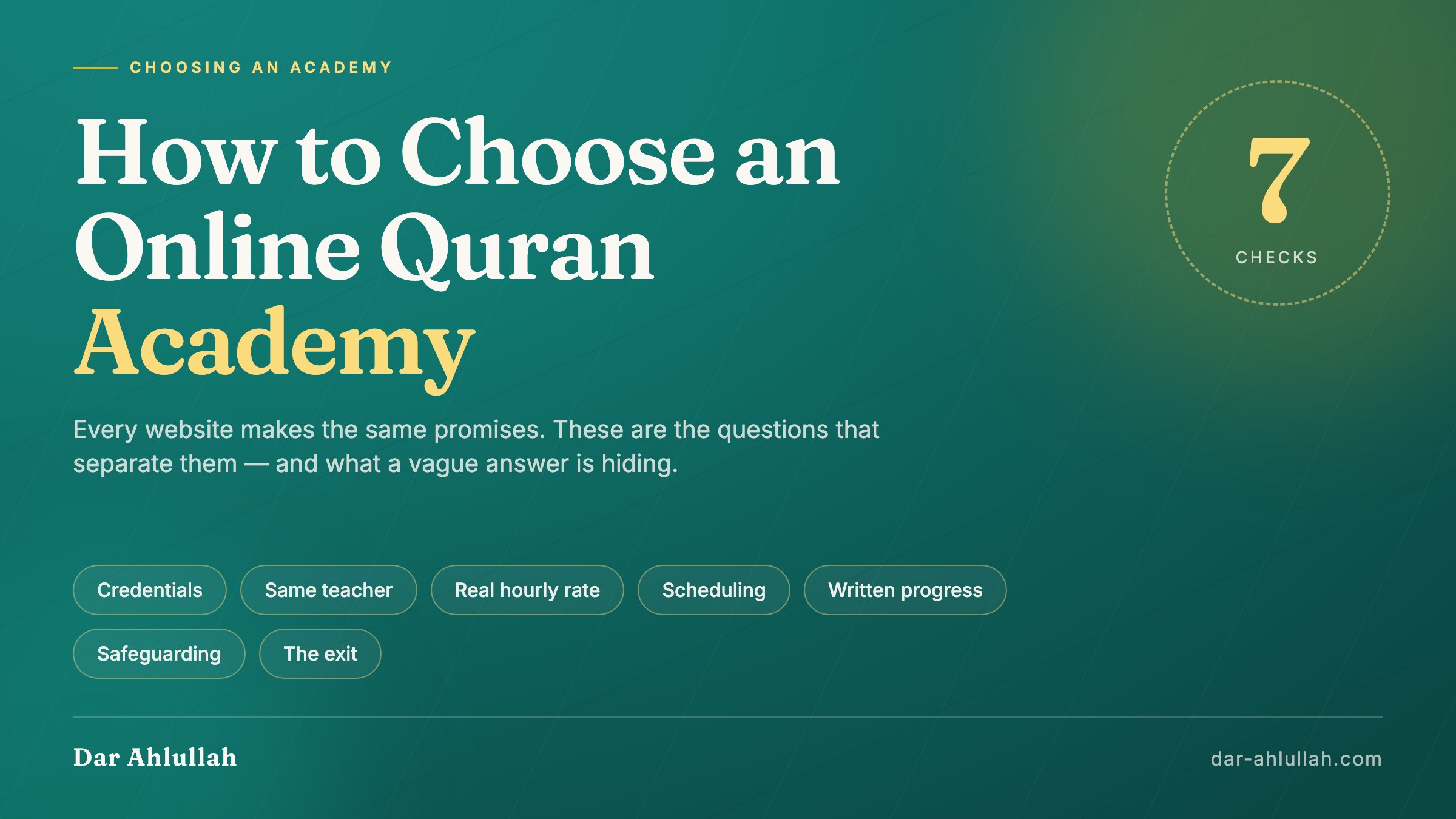
Table of Contents
- Introduction: Every Academy’s Website Says the Same Thing
- The Short Answer: Seven Checks That Predict the Outcome
- 1. What “Certified” and “Ijazah” Actually Mean
- 2. One Named Teacher, or Whoever Is Free
- 3. The Real Hourly Rate, Not the Monthly Sticker
- 4. A Schedule That Survives the School Year
- 5. Evidence of Progress, Not Reassurance
- 6. Safeguarding a Child Alone With an Adult Online
- 7. What Happens When It Goes Wrong
- Using the Trial as an Assessment, Not a Sales Call
- Red Flags Worth Walking Away From
- A Back-to-School Timeline for Setting This Up
- How We Answer These Seven Questions
- FAQs About Choosing an Academy
- Conclusion: Choose on the Boring Details
Introduction: Every Academy’s Website Says the Same Thing
Open six online Quran academies in six browser tabs and you will read the same six sentences. Qualified native Arab teachers. Al-Azhar certified. Flexible scheduling. One-to-one attention. Free trial class. Interactive, engaging, personalised. Every claim is plausible, none of them is falsifiable from the homepage, and after twenty minutes of reading you are no closer to a decision than when you started.
That is the actual problem with how to choose an online Quran academy. It is not finding one — there are hundreds, and they are all one search away. It is that the marketing copy of a genuinely excellent academy and a barely functional one is word-for-word identical, so the usual comparison method (read the sites, pick the nicest) is noise.
What separates them is a set of unglamorous operational details that almost nobody advertises: whether your child gets the same teacher every week, what the real hourly rate is once you divide the package properly, who is watching a one-to-one video call between a child and an adult, and what happens the month you need to cancel. Those details are knowable before you pay. They are just not on the homepage — you have to ask.
This guide is the list of questions worth asking, in the order they matter, with an explanation of what a good answer sounds like and what a bad one is trying to hide. It is written for parents choosing for a child, though adults choosing for themselves can skip section six and use the rest unchanged. If you are still at the earlier stage of deciding whether online study suits you at all, start with our complete guide to learning Quran online and come back here when you are ready to compare providers.
The Short Answer: Seven Checks That Predict the Outcome
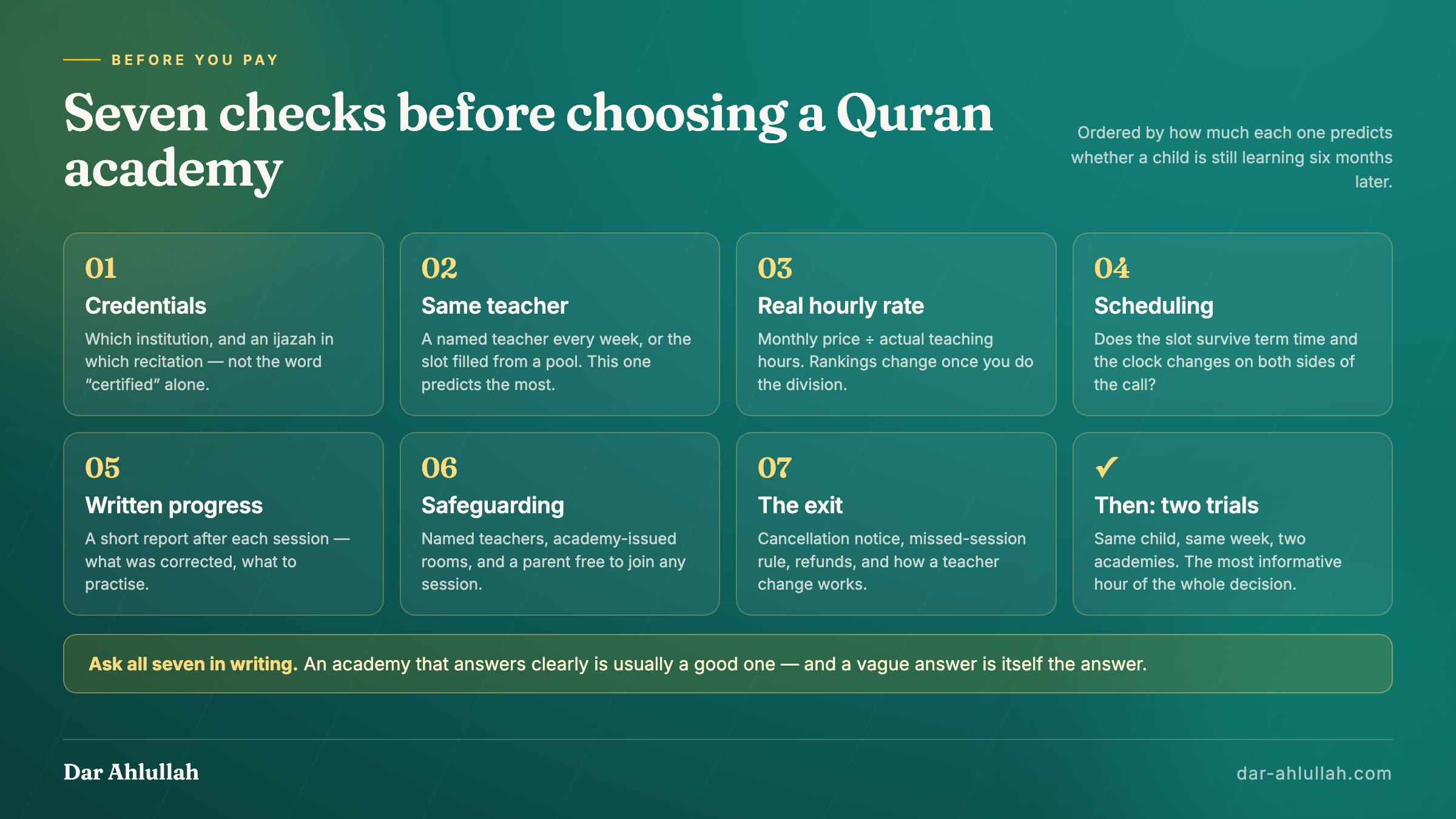
If you have ten minutes rather than an afternoon, ask these seven things and decide on the answers. They are ordered by how much each one predicts whether your child is still learning in six months, which is the only outcome that matters.
- Credentials, specifically. Which institution, which qualification, and an ijazah in which recitation — not the word “certified” on its own.
- Teacher continuity. Is a named teacher assigned to your child, or does the schedule get filled from a pool each week?
- The real hourly rate. Divide the monthly price by the actual teaching minutes. Half the market prices 30-minute sessions against competitors’ 60-minute ones.
- Scheduling durability. Can the slot survive a school term, a time-zone change, and a sick week without collapsing?
- Written evidence of progress. Do you receive something in writing after each session, or a reassuring message on WhatsApp?
- Safeguarding. Who vets the teachers, can a parent observe, and what is the recording policy?
- The exit. Cancellation notice, refund rule, missed-session rule, and how a teacher change is handled.
An academy that answers all seven clearly and in writing is usually a good one, almost regardless of what the answers are. An academy that answers vaguely is telling you something more useful than the answers would have been.
1. What “Certified” and “Ijazah” Actually Mean
“Certified” on its own is not a credential. It is a word. Ask which certification, from which body, and you will immediately separate the academies that can answer from the ones that cannot.
Two terms carry real weight. Al-Azhar refers to the university in Cairo; an Al-Azhar graduate has completed a formal degree there, which is a verifiable qualification with a faculty and a year attached to it. Ijazah is different in kind: it is a licence to transmit, granted by a teacher who has heard the student recite the Quran completely and correctly, and which traces back through a chain of teachers — the sanad. An ijazah is always in something: in Hafs ‘an ‘Asim, which is the recitation most of the world uses, or in Warsh, or in the ten qira’at for those who have gone further.
So the useful question is not “are your teachers certified?” but “does the teacher you would assign to my daughter hold an ijazah, and in which recitation?” A real answer names the recitation. A weak answer repeats the word certified in a longer sentence.
What credentials do not tell you
A scholar with an impeccable sanad may be a poor teacher of a seven-year-old. Teaching a child to read Arabic script is a pedagogical skill, largely unrelated to the depth of the teacher’s own recitation, and the two are often confused when parents compare academies. Ask about both: the credential establishes that the Quran is being transmitted correctly; experience with your child’s specific age group establishes that it will be transmitted at all.
For families who need a woman teaching a daughter or an adult sister, this is also the point to ask how deep the female faculty actually is — one teacher on the website is not the same as availability at your hour. We wrote about that separately in our guide to finding a female Quran teacher online.
2. One Named Teacher, or Whoever Is Free
This is the single most predictive question on the list and the one least likely to be answered on a website.
There are two operating models in this industry. In the first, a named teacher is assigned to your child and keeps them: same face, same voice, same memory of what went wrong last Tuesday. In the second, the academy runs a pool and fills each booked slot with whichever teacher is available, which is cheaper to operate and looks identical on the pricing page.
The pooled model fails quietly. Nobody is tracking that your son consistently rushes the madd, because no one teacher has seen him three weeks in a row. Each session restarts at a polite introduction. Corrections do not accumulate. Six months later the child is fluent at the first two pages of the Qaida and nothing beyond, and the reason is invisible from the outside because every individual lesson was perfectly acceptable.
Ask directly: “Will my child have the same teacher every week, and what happens when that teacher is ill or on leave?” The second half matters. Even a properly assigned teacher takes leave, and a good academy has an answer — a named substitute briefed on the student’s file, or a rescheduled session, rather than a stranger and a shrug.
3. The Real Hourly Rate, Not the Monthly Sticker
Monthly prices are not comparable across academies, because the number of sessions and the length of each session both vary, and the marketing rarely puts them next to each other. The fix takes thirty seconds: convert everything to a price per teaching hour.
Monthly price ÷ (sessions per month × session minutes ÷ 60) = your real hourly rate.
Run it on any three academies and the ranking usually changes. A $40 plan of eight 30-minute sessions is four teaching hours, or $10 an hour. A $60 plan of eight 45-minute sessions is six hours, or exactly the same $10 — while looking 50% more expensive on the page. Meanwhile a “$29 starter” of four 30-minute sessions is two hours, at $14.50 an hour, and is the most expensive of the three.
| Advertised | Sessions × length | Teaching hours | Real rate |
|---|---|---|---|
| $29/month | 4 × 30 min | 2.0 | $14.50/hour |
| $40/month | 8 × 30 min | 4.0 | $10.00/hour |
| $60/month | 8 × 45 min | 6.0 | $10.00/hour |
| $70/month | 8 × 60 min | 8.0 | $8.75/hour |
The illustrative rows above are arithmetic, not quotes from named competitors — run the same division on the real offers in front of you. Then check three things the hourly rate hides: whether there is a registration or admission fee, whether unused sessions expire at the end of the month, and whether the advertised price is an introductory rate that rises after the first term. A cheap first month with a silent 40% increase in month four is a common structure and a legitimate one, but you should know about it in July rather than in November.
Finally, ask about siblings before you sign, not after. Most academies discount second and third children and few advertise it. If cost is the deciding factor in your comparison, our breakdown of what online Quran classes actually cost goes through the full range in the market and where the price differences genuinely come from.
4. A Schedule That Survives the School Year
A slot that works in August is not the same as a slot that works in November. Three things break scheduling, and only the first is obvious.
The school term
Book the lesson against the timetable your child will actually have from September, including the clubs and homework load, not against the empty afternoons of summer. The most common cause of a lapsed subscription is a slot chosen in the holidays that turns out to sit on top of football training. If the family calendar is already tight, an after-school programme structure tends to survive term time better than an ad-hoc weekly booking.
Clock changes, which do not happen on the same day everywhere
This is the trap almost nobody anticipates. Your teacher is probably not in your country, and the world does not change its clocks together. The daylight saving rules differ by country: the EU and UK shift on the last Sunday of March and the last Sunday of October, the United States on the second Sunday of March and the first Sunday of November, and Egypt — where a large share of Al-Azhar-trained teachers live — on the last Friday of April and the last Thursday of October. Turkey abolished the seasonal change entirely in 2016 and Pakistan does not observe it, so a teacher in either country keeps a fixed offset while yours moves twice a year.
In practice that means the gap between you and your teacher changes several times a year, on dates that are weeks apart. In 2026 the clocks went forward on 8 March in the United States, 29 March in the EU and 24 April in Egypt, and they go back on 25 October in the EU, 29 October in Egypt and 1 November in the United States. A family in New Jersey with a teacher in Cairo goes through four separate offset changes in a single year, and every one of them is a chance for a 4pm lesson to silently become 3pm.
The question to ask is simple: “Does your platform store my slot in my local time and adjust automatically, or is it a fixed time in the teacher’s time zone?” Any academy running on a real booking system will answer the first. An academy coordinating lessons over WhatsApp will not, and you will spend four weekends a year renegotiating.
Illness, travel and Ramadan
Ask what happens when you cancel with a day’s notice, when the teacher cancels, and what the schedule does during Ramadan — when both households want different hours and demand across the whole industry peaks. An academy that has a written answer has been through it before.
5. Evidence of Progress, Not Reassurance
Every teacher will tell you your child is doing well, and they will usually mean it. That is not evidence, and after four months of “masha’Allah, very good” you still cannot tell whether the money is doing anything.
What you want is something written, after each session or at minimum each month, that contains specifics: which surah or which page, which letters or rules were corrected, what to practise before the next lesson. Three lines is enough. The purpose is not bureaucracy, it is that written notes are checkable — you can look back over eight weeks and see whether the same correction keeps recurring.
Ask for a sample report during the trial. This is a fair request and a revealing one: academies that produce them will send one immediately, and academies that do not will explain why reports are unnecessary.
The second half of this is a curriculum with a shape. “We follow the student’s pace” is not a curriculum. Ask what the sequence is — typically Noorani Qaida or an equivalent decoding syllabus, then fluent reading, then the rules of tajweed applied to what the child can already read, then memorisation if that is the goal — and ask where your child will start within it after the assessment. A teacher who can describe the next three milestones is working from a plan.
6. Safeguarding a Child Alone With an Adult Online
A one-to-one Quran lesson is a private video call between your child and an adult in another country, several times a week, for years. That is a reasonable thing to do and it is also a thing that deserves the same scrutiny you would apply to any other adult who spends that much unsupervised time with your child.
Four questions cover most of it:
- Who is the teacher, verifiably? Full name, photograph, and a background you could check. Anonymous first-name-only teachers are a hard no.
- What vetting is done before hiring? Identity, qualification verification, references. Ask what the process is; the answer’s specificity tells you whether one exists.
- Can a parent join or observe a session? The correct answer is yes, without a debate about it. Any friction here is disqualifying.
- What is the recording policy? Are sessions recorded, who can access them, how long are they retained, and does the academy hold the room link or does the teacher use a personal account? Lessons conducted on a teacher’s personal meeting room, outside any institutional record, remove every safeguard at once.
Add one practical rule of your own: keep the lesson in a shared room of the house rather than a bedroom, at least for younger children. It costs nothing and it removes the entire question.
7. What Happens When It Goes Wrong
Ask the awkward questions while you are still a prospect, because that is when you get the clearest answers. Four of them:
Cancellation. How much notice, and is it self-service or does it require a conversation with someone whose job is to keep you? A cancellation flow that requires three WhatsApp messages and a phone call is a deliberate design choice.
Missed sessions. If your child misses a lesson, is it lost, credited, or rescheduled — and what notice makes the difference? What if the teacher misses it? These should not have the same answer.
Teacher change. If the fit is wrong — a personality mismatch, an accent your child struggles with, a pace that is too fast — can you request a different teacher, does it cost anything, and how long does it take? “Yes, at no cost” should be the standard, and if it is not offered, expect to be stuck.
Refunds. What happens to the unused portion of a term you have already paid for. Many academies do not refund and say so plainly; that is an acceptable policy you can plan around. What is not acceptable is having no stated policy at all.
Using the Trial as an Assessment, Not a Sales Call
Nearly every academy offers a free trial, and most families use it as a vibe check. It is worth more than that if you go in with a list.
Watch three things during the session itself. Does the teacher listen to your child read, or read to them? Beginners need to be heard and corrected, and a lesson where the adult does most of the reciting is a lesson where nothing is being diagnosed. Does the teacher correct kindly and specifically — naming the letter, modelling it, having the child repeat it — rather than either letting errors pass or piling on? And does your child speak? A silent, nodding child in a trial lesson usually stays silent in week ten.
Then ask for three things afterwards: the assessment in writing, the proposed starting point in the curriculum, and the name of the teacher who would be assigned. If the trial teacher is not the assigned teacher, you have just learned something important that you would not have learned any other way.
Two trials at two academies, in the same week, with the same child, is the single most informative hour you can spend on this decision. It costs nothing, and the difference between a diagnostic lesson and a sales call is obvious when you see them back to back.
Red Flags Worth Walking Away From
| Signal | What it usually means |
|---|---|
| No named teacher before you pay | A pooled roster. Continuity will be accidental rather than designed. |
| Pressure to buy a year up front for a discount | Cash-flow pressure, and it moves all the risk of a bad fit onto you. |
| Everything runs on personal WhatsApp and a personal meeting link | No booking system, no institutional record, no safeguarding trail. |
| “Certified” with no institution named when asked | The credential does not survive a follow-up question. |
| No written policy on cancellation or missed sessions | The policy will be decided at the moment you need it, by them. |
| Parents cannot observe sessions | There is no defensible reason for this one. |
| Reviews that are all five stars, all one sentence, all the same month | Treat as absent rather than positive. |
A Back-to-School Timeline for Setting This Up
If you are reading this in late summer, the timing works in your favour — but only if the trials happen before the school timetable does, not after.
- Three weeks before term. Shortlist three academies. Send the seven questions by email or WhatsApp and compare the replies before you meet anyone — response quality at this stage is a preview of response quality when something goes wrong.
- Two weeks before term. Book two trials in the same week. Ask for the written assessment from both.
- One week before term. Choose, and book the slot against the September timetable rather than the August one. Start on the smallest plan.
- End of month one. Review the written reports. Is the same correction still appearing? Has the child moved forward in the curriculum? Adjust the plan or the teacher now, while switching is still cheap.
Starting small is deliberate. Two 30-minute sessions a week is enough to establish the habit and to find out whether the academy is what it claimed to be, and upgrading after six weeks is trivial while unwinding an annual commitment is not.
How We Answer These Seven Questions
It would be strange to publish this list without answering it ourselves, so here are our answers in the same order. Compare them against whoever else is on your shortlist.
Credentials. Our teachers are native Arabic speakers who teach in English, and our teachers page names them individually rather than describing them in the abstract, so you can ask any of them about their training in the free assessment.
Continuity. One teacher is assigned to each student after the assessment and stays with them. If the fit is wrong we rematch you with another certified teacher at no extra cost — you only have to say so.
Price. Our rate is $9 per teaching hour and every plan is that same number: a 30-minute session is $4.50, an hour is $9. Starter is $36 a month for eight 30-minute sessions, Committed is $70 for eight full hours, Hifz Intensive is $102 for twelve. Siblings get 20%. There is no registration fee. The full breakdown is on the pricing page.
Scheduling. Sessions are booked in your own time zone and stored that way, so clock changes on either side do not move your slot. Rescheduling is built into every plan, and you can pause or switch plans at any time without a penalty.
Progress. A written report goes out after every session — what was covered, what was corrected, what to practise. Not a monthly summary; every session.
Safeguarding. Our teachers are named on the faculty page with their credentials rather than listed as first names, and every session runs in a meeting room our own platform creates — not a teacher’s personal account — so the lesson sits inside the academy’s record rather than outside it. If you want to sit in on your child’s sessions, tell your advisor and we will set it up.
The exit. No long-term contract. Pause, downgrade or cancel from your next billing cycle. We would rather you left cleanly than stayed unhappily.
The free trial is a 30-minute assessment, not a demonstration lesson: the teacher works out the actual reading level and proposes a starting point, and you get that in writing whether or not you continue. No card is required to book it.
FAQs About Choosing an Academy
How many academies should I actually compare?
Three is enough, and two trials is enough. Beyond that the returns drop sharply, because the seven questions above separate the field faster than additional trials do, and a decision delayed by three more weeks of research costs more progress than a slightly imperfect choice would.
Is a more expensive academy better?
Not reliably. Price in this market reflects the teacher’s cost of living and the academy’s marketing spend at least as much as it reflects teaching quality, and there is no dependable correlation between the top of the price range and the top of the quality range. Compare on the seven checks; use price only to break a tie.
Group classes or one-to-one?
For learning to read the Quran, one-to-one is substantially more efficient, because the entire skill is being heard and corrected, and in a group of eight a child recites for perhaps a minute. Groups make sense for Islamic studies content and for the social element, which is a real benefit — but as a supplement rather than as the reading lesson itself.
What if my child is a complete beginner and cannot read Arabic at all?
That is the standard starting point, and any competent academy begins there with a decoding syllabus before anything else. The relevant question is not whether they teach beginners but how long they expect the decoding stage to take and what marks its completion — a teacher who cannot describe the milestone has not thought about it.
How long before I should expect to see something?
For a child of seven or eight starting from zero at two sessions a week, recognising and sounding out the letters reliably is normally a matter of a few months rather than a few weeks, and reading short surahs haltingly follows after that. Be suspicious of any promise that is much faster; the variance between children is genuinely large, which is exactly why the written reports matter more than the timeline.
Can we switch academies later without losing progress?
Yes, and this is a reason to keep the written reports. A new teacher who can read four months of session notes places the child accurately in one lesson instead of spending three lessons rediscovering it. Switching is far less costly than staying somewhere that is not working.
Do the same checks apply for adults?
Six of the seven do. Skip the safeguarding section and weight teacher continuity and written progress even more heavily, since adults tend to be self-conscious about reciting and rebuilding that comfort with a new teacher every few weeks is its own obstacle. Our guide to learning the Quran as an adult covers the rest of that case.
What about memorisation programmes specifically?
Everything above still applies, plus one addition: ask what the revision cycle is. A hifz programme without a structured plan for reviewing what has already been memorised produces a student who forgets at roughly the rate they memorise. Our guide to online hifz goes through what a workable cycle looks like.
Conclusion: Choose on the Boring Details
The academies that work are rarely the ones with the best website. They are the ones that assign a named teacher and keep them there, write down what happened in each lesson, hold the schedule steady when the clocks change, and tell you the cancellation policy before you ask. None of that photographs well, and all of it is what the outcome actually rests on.
So compare on the seven questions rather than the copy. Ask them in writing, keep the replies, and treat a vague answer as an answer. Then book two trials, watch whether your child speaks, and start on the smallest plan you can — the decision you can cheaply reverse in six weeks is worth more than the one you agonised over for a month.
If you would like to run the list against us, our 30-minute assessment is free and there is nothing to cancel afterwards. Book it, ask all seven, and compare our answers with the others on your shortlist — that comparison is the whole point of the exercise, and we would rather you made it properly.
Related articles
are online Quran classes worth it
Are Online Quran Classes Worth It? An Honest Answer
Online Quran classes are worth paying for when the learner needs a human ear, has no good local option, and lives in a household that will keep the slot. Here are the five cases where they are, the five where they are not, the maths on a year, and a six-week test that settles it.
20 min read

online Quran classes cost
How Much Do Online Quran Classes Cost? (2026 Price Guide)
Online Quran classes cost anywhere from $10 to $100 a month — but the monthly price tells you almost nothing. Here are the real per-hour numbers, the hidden fees to check, and our full price list.
8 min read

online Quran classes vs private tutor
Online Quran Classes vs a Private Tutor at Home: Which Is Better?
Both are one-to-one, so airtime does not decide it. What does: who the teacher can be, what the hour really costs, what happens when the tutor moves, who is responsible for safeguarding, and whether the learner is old enough for a screen.
19 min read