
aqeedah for beginners
Aqeedah for Beginners: The Six Articles of Faith, Explained Simply
Dar Ahlullah team 17 min read
Table of Contents
- Introduction: The Subject Everyone Says to Start With
- The Short Answer: What Aqeedah Is
- Aqeedah, Fiqh, Akhlaq: The Map of What You Are Learning
- The Six Articles of Faith
- Tawhid: The Centre of the Whole Subject
- Why Aqeedah Is Taught First
- How to Study Aqeedah as a Beginner
- Five Things That Confuse Beginners
- What to Do With Questions You Cannot Answer
- Studying Belief Alongside Prayer and Quran
- How We Teach Aqeedah at Dar Ahlullah
- FAQs About Aqeedah for Beginners
- Conclusion: Start Small, and Start Here
Introduction: The Subject Everyone Says to Start With
Ask any Muslim where a beginner should start and, sooner or later, someone will say aqeedah. Start with your aqeedah. Get your aqeedah right first. It is offered as obvious advice, usually without a definition, and it lands on a new Muslim — or a lifelong Muslim who never studied formally — as one more Arabic word on a list that already has forty of them.
Then you search for it, and the results make things worse rather than better. Half of what surfaces is a 600-page classical text. The other half is an argument between people who appear to be furious about something you cannot identify, using terminology you do not have. Neither tells you what the subject actually contains or how much of it you need before Friday.
So this guide takes aqeedah for beginners literally. What the word means, what the subject covers, the six things it asks you to believe, how it differs from the rules of prayer and washing, what order to learn it in, and which questions you can safely leave for later. No prior Arabic, no prior study, and no assumption that you already know what a madhhab is.
If you have very recently entered Islam, the wider sequence — what to learn in which month, and what genuinely cannot wait — is laid out in our guide to your first 90 days in Islam. This page is the belief half of that sequence, in more depth.
The Short Answer: What Aqeedah Is
The Arabic word ‘aqidah comes from a root meaning to tie or to bind — the same root as a knot. An aqeedah is what you are tied to: the set of convictions you hold firmly and build everything else on top of.
As a field of study, aqeedah is the subject that answers what a Muslim believes, as distinct from what a Muslim does. It covers who God is, what angels are, what revelation is and which books were revealed, who the prophets were, what happens after death, and how divine decree relates to human choice.
Three things follow, and they are worth fixing in place before anything else:
- The core of it is short. Six articles of faith. You can learn the list in an afternoon; understanding it deepens over a lifetime, which is a different thing from being unfinished.
- Most of it you already accepted. Anyone who has said the shahadah has affirmed the substance of it. Study is not adding new beliefs but making explicit what the testimony already implied.
- The contested parts are not the entry point. The debates you found online are real, centuries old, and conducted between trained scholars. They are not the beginner syllabus and mistaking them for it is the single most common way people bounce off this subject.
Aqeedah, Fiqh, Akhlaq: The Map of What You Are Learning
Islamic knowledge is conventionally divided into three areas. Almost every beginner’s confusion about what to study when dissolves the moment the map is drawn, because it becomes obvious which questions belong where.
| Field | Answers | Typical questions | Changes with time or place? |
|---|---|---|---|
| Aqeedah (creed) | What you believe | Who is God? What are angels? What happens after death? | No. The articles of faith are fixed. |
| Fiqh (jurisprudence) | What you do | How do I make wudu? What breaks a fast? How do I pray while travelling? | The rulings apply to circumstances, so the answer for a given case can differ. |
| Akhlaq (character) | Who you become | How do I deal with anger, envy, sincerity, patience? | The virtues are fixed; the work is lifelong. |
The practical consequence: when a question arrives, notice which column it belongs to. “Does God have a form?” is aqeedah. “Do I have to repeat wudu after touching my dog?” is fiqh. “How do I stop resenting my brother?” is akhlaq. Beginners often carry a fiqh question into a creed discussion, get a confusing answer, and conclude the whole subject is beyond them — when the question simply went to the wrong desk.
It also explains why aqeedah feels different in kind. In fiqh you will meet legitimate difference of opinion constantly, and learning to be comfortable with it is part of the education. In aqeedah the six articles are not a menu.
The Six Articles of Faith
The list comes from a single well-known hadith, usually called the Hadith of Jibril, in which the angel Gabriel comes to the Prophet ﷺ in the form of a man and asks him what iman — faith — is. The reply names six things (Sahih Muslim 8). The Quran gives a nearly identical list in Surah al-Baqarah 2:285, where the believers are described as believing in God, His angels, His books and His messengers.
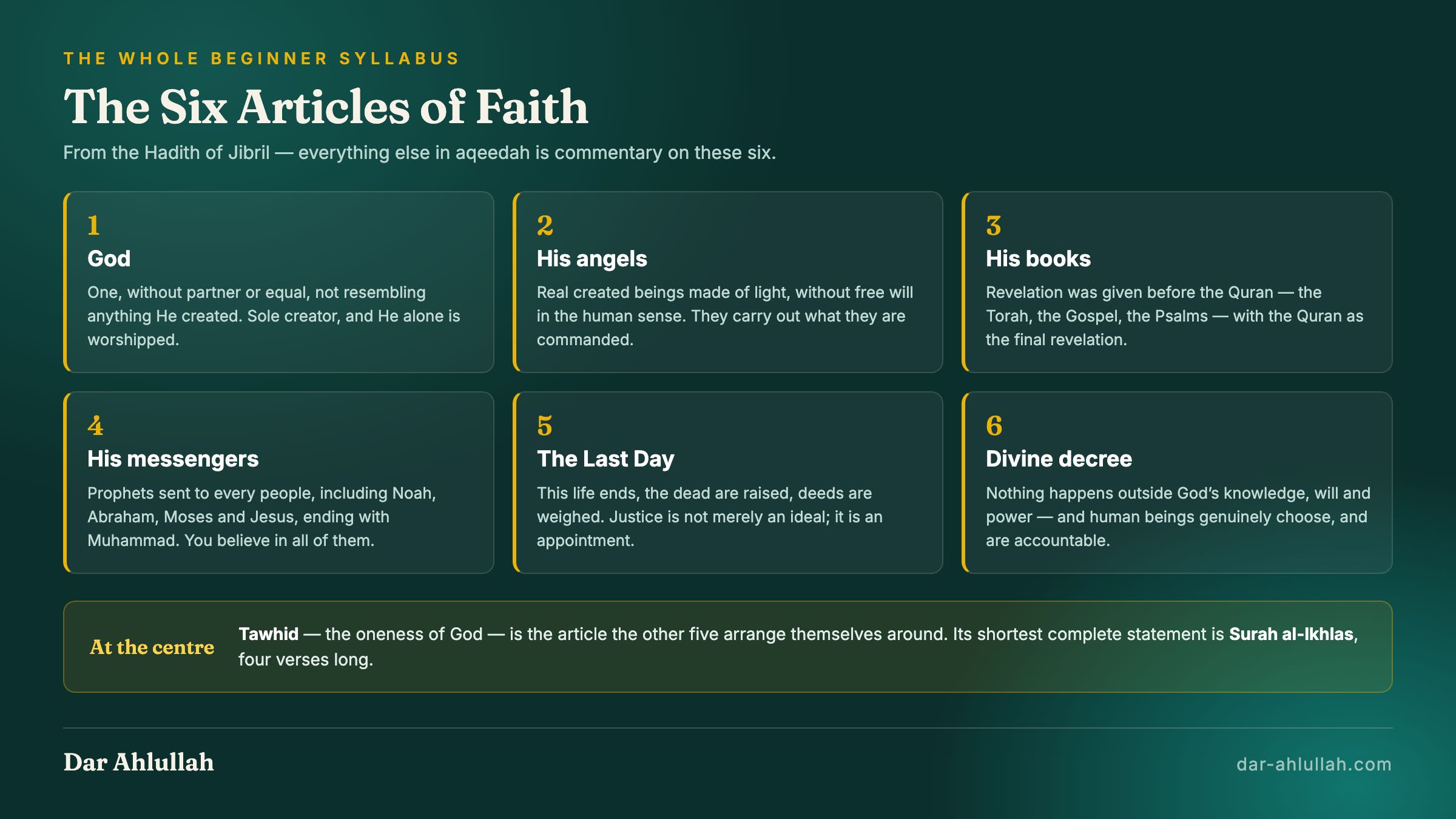
Here is the whole syllabus in one table. Everything else in the subject is commentary on these six.
| Article | In plain terms |
|---|---|
| 1. Belief in God | One, without partner, without equal, not made of parts and not resembling anything He created. He is the sole creator and sustainer, and He alone is worshipped. |
| 2. Belief in His angels | Real created beings, made of light, without free will in the human sense. They carry out what they are commanded — conveying revelation, recording deeds, taking souls. |
| 3. Belief in His books | God sent revelation before the Quran — the Torah, the Gospel, the Psalms, the scrolls. A Muslim affirms that they were revealed, while holding the Quran as the final and preserved revelation. |
| 4. Belief in His messengers | A long line of prophets sent to every people, including Noah, Abraham, Moses and Jesus, peace be upon them all, ending with Muhammad ﷺ. You believe in all of them; rejecting one is rejecting the arrangement. |
| 5. Belief in the Last Day | This life ends, the dead are raised, deeds are weighed, and there is a real Paradise and a real Hell. Justice is not merely an ideal; it is an appointment. |
| 6. Belief in divine decree | Nothing happens outside God’s knowledge, will and power — and human beings genuinely choose, and are genuinely accountable. Both halves are affirmed together. |
The three that beginners find easy, and the three that take longer
In practice, most people arrive already comfortable with articles one, three and four. Anyone coming from a Jewish or Christian background often finds them familiar in outline, and anyone coming from no religious background has usually thought about the first one for years before they got here.
The angels tend to be the first genuinely new furniture — not as a concept, but as a fact you are asked to actually believe rather than admire. The Last Day is straightforward to state and slow to absorb, because absorbing it changes how you weigh a Tuesday afternoon. And divine decree is the one that produces the questions, which is why it gets its own section further down.
Tawhid: The Centre of the Whole Subject
If aqeedah has one word at its centre, it is tawhid — the oneness of God. Every other article arranges itself around it.
Tawhid is more than a count. Saying God is one is not primarily an arithmetic claim; it is a statement that He is unique in His being, unique in what He does, and uniquely deserving of worship. He is not one of a category. There is no second thing of His kind. The shortest and most complete statement of it in the Quran is Surah al-Ikhlas, four verses long: He is God, One; the Eternal Refuge; He neither begets nor is begotten; and there is nothing comparable to Him. New Muslims are commonly advised to memorise this surah early, and this is why — it is the creed in four lines, and you will recite it in prayer for the rest of your life.
The opposite of tawhid is shirk: associating something with God in what belongs to Him alone. Its obvious form is worshipping another deity. Its subtler forms are the ones a practising Muslim actually has to watch — performing an act of worship so that other people notice it, for instance, which the tradition treats as a quiet kind of association and which is why sincerity of intention is discussed so insistently in Islamic teaching.
Two attitudes are worth taking from this section. The first: when reading about God’s names and attributes, the guardrail is that nothing in creation is comparable to Him, so no image you can form is accurate. The second: you are not required to resolve every question about the divine nature to be a Muslim in good standing. The early generations were notably restrained about speculating here, and that restraint is a position, not an evasion.
Why Aqeedah Is Taught First
The advice to start with creed is not arbitrary sequencing, and it is not because belief is more important than practice. It is because practice without it becomes unstable in a specific and predictable way.
Islamic acts of worship are defined by intention. The same physical movements — standing, bowing, prostrating — are prayer only if they are directed to God with the intention of worshipping Him. What makes a prostration meaningful is entirely a matter of who you understand yourself to be prostrating to. Get that clear and the actions have somewhere to go. Leave it vague and you are performing a sequence.
There is a practical version of this too, and it is the one that decides whether people last. A Muslim who has thought carefully about the Last Day has a reason to keep praying at five in the morning in December when nobody is watching and nothing feels like anything. Practice sustained only by community, habit or momentum tends to thin out at exactly the point when those supports are absent. Creed is what is left when the mosque is closed.
None of which means you should postpone practice until you have finished studying. You cannot, and nobody suggests you should. Learn the fundamentals of belief in parallel with learning to pray — both from the first week, neither waiting on the other.
How to Study Aqeedah as a Beginner
The subject has a bad reputation for being forbidding, and the reason is almost always that people start in the wrong place. Here is an order that works, roughly in the sequence a teacher would take you through it.
1. Learn the six articles as a list
Before any depth, hold the shape. Six items, in order, able to be recited from memory. It takes one sitting and it gives every later piece of information somewhere to attach itself.
2. Take one article at a time, with the evidence
Then go back to the top and spend real time on each. For each article, ask three questions: what exactly is being claimed, where does the Quran or the Sunnah state it, and what difference does believing it make to how I live this week? The third question is what keeps the subject from becoming trivia.
3. Memorise Surah al-Ikhlas and its meaning
Four verses, and the densest statement of tawhid in the Quran. Learn the Arabic, the translation, and a basic explanation. You will use it constantly in prayer, which makes it the most efficient memorisation you will ever do.
4. Study with a teacher, not only a search engine
This is the step people skip, and it is the one that determines the outcome. Creed is the field where a wrong turn is hardest to detect on your own, because everything you read is written confidently and the internet does not label which of two contradictory pages is the mainstream position and which is a fringe one. A teacher lets you ask follow-up questions, which is precisely what a search result cannot do.
5. Leave the advanced debates for later — deliberately
Within Sunni Islam there are recognised schools of theology, and they differ over technical questions such as how the divine attributes are best expressed in language. Those differences are real and the scholars who hold them are within the tradition. They are also, for a beginner, entirely skippable. Learn the six articles thoroughly first. If you later want the technical discussion, you will approach it with the vocabulary to follow it instead of picking a side by accident.
Five Things That Confuse Beginners
“Aqeedah seems to mean arguing”
It is what the search results suggest, because disagreement is louder than agreement and nobody writes a viral post about the things everyone accepts. The actual subject is overwhelmingly agreed upon — the six articles are not in dispute anywhere in Sunni Islam. What you found is a narrow band of technical disagreement occupying a disproportionate share of the internet.
“If everything is decreed, what is the point of my choices?”
The most common question, and the one that deserves the most patience. The tradition affirms both sides without collapsing either: God knows and wills all that happens, and human beings really do choose and are really held to account. Classical scholars wrote at length on how to hold both, and the mainstream counsel to beginners has always been the same — act as one who chooses, since you experience choosing and you will be asked about it; and trust as one who knows the outcome is not ultimately in your hands. If the resolution is not fully satisfying yet, that is normal, and it is not a barrier to being a practising Muslim.
“I do not feel my faith strongly enough”
Faith in this framework is affirmation, not sensation. The tradition treats iman as something that rises and falls — a settled, unremarkable conviction is faith, and so is a dry stretch where nothing feels moving. The response to a dry stretch is not to interrogate your sincerity but to keep the practice steady and keep learning; feeling is a passenger, not the driver.
“What about the previous scriptures?”
The Muslim position is that God revealed the earlier books, and that the Quran is the final revelation and the criterion. Affirming that revelation was given to Moses and Jesus, peace be upon them, is required — it is article three. New Muslims from a Christian or Jewish background often expect to be asked to repudiate everything they held before, and are surprised to find that a great deal of it is affirmed.
“There is too much Arabic terminology”
There is, and it is worth learning slowly rather than avoiding. Perhaps a dozen terms carry most of the subject: iman, tawhid, shirk, qadar, ghayb, rasul, nabi, akhirah. Learn a few a week in context rather than as a vocabulary list. Some learners find that a little Arabic makes all of it easier at once, and if that is you, our guide to learning Quranic Arabic as a beginner covers the vocabulary-first route.
What to Do With Questions You Cannot Answer
Questions will arrive. Some will be sharp, and some will arrive at three in the morning. It is worth deciding in advance how to handle them, because the default handling — typing them into a search box and reading whatever comes back — is the worst available option.
Three things help. Distinguish a question from a doubt. Asking how divine decree and human freedom fit together is a question, and the Islamic tradition has an enormous literature on it. Treating an unanswered question as evidence against faith is a leap, and noticing that you have made the leap usually deflates it.
Ask a person. A teacher who knows your level can answer at your level, correct the premise if the question contains a false one, and tell you honestly when something is genuinely difficult. That last one matters more than people expect: hearing a knowledgeable person say “this is one of the hard ones and here is how scholars have approached it” is far more stabilising than a confident, thin answer.
Accept that some limits are structural. A category of things is described in the Quran as al-ghayb, the unseen — realities outside the reach of observation. Human beings are not positioned to verify the nature of angels or the mechanics of the next life by inspection, and the tradition never claimed otherwise. Knowing which questions are unanswerable in principle is itself part of studying creed, and it removes a great deal of unnecessary anxiety.
Studying Belief Alongside Prayer and Quran
Aqeedah is not a course you complete before you are allowed to start living as a Muslim. In practice the three strands run together, and they reinforce each other in ways that studying any one alone does not.
Prayer is the obvious pairing. The five daily prayers are the framework everything else hangs on, and learning them is urgent in a way that theological depth is not — our beginner’s guide to salah covers the movements, the words and the timings, and the complete guide to wudu covers the washing that precedes it. Learn those in week one. Learn what you are doing and why in parallel, not afterwards.
The Quran is the other strand, and it is where creed stops being abstract. Once you can read even a little, you meet the six articles constantly in the text itself, stated far more powerfully than any summary states them. That is also the point at which people usually decide to learn to read the Arabic properly — and our guide to learning prayer in Islam is a reasonable next step if the prayer itself is still new.
A workable weekly shape for a beginner: prayer practice daily, twenty minutes of reading or recitation daily, and one focused study session a week on belief. The last one is small on purpose. Aqeedah rewards slow attention far more than volume.
How We Teach Aqeedah at Dar Ahlullah
Our Islamic studies teaching is one-to-one and in English, which for this subject matters more than it does for most. Creed is where a learner needs to be able to stop the teacher and say “I did not follow that” without holding up a class of twelve, and where the follow-up question is usually more valuable than the original answer.
The teachers are native Arabic speakers who teach in English, and the curriculum follows the mainstream Sunni position rather than someone’s reading of it. You can see the Islamic studies programmes alongside the Quran and Arabic tracks, since most learners take belief and recitation together rather than in sequence.
A written report goes out after every session, which is more useful in this subject than in any other: creed builds, and being able to look back at what was covered three weeks ago is how you notice that a term you now use freely was explained on a specific Tuesday. Teaching runs at $9 per teaching hour, the same as everything else we do, and if the teacher fit is wrong we rematch you with another certified teacher at no cost.
The starting point is a free 30-minute assessment. For Islamic studies, that conversation is mostly about where you actually are — what you already know, what you have read, what you have been asked recently and could not answer — and the mentor proposes a starting point from there. No card is required, and you get the plan in writing whether or not you continue.
FAQs About Aqeedah for Beginners
How long does it take to learn the basics of aqeedah?
The six articles as a list: one sitting. A solid working grasp of each one, with its evidence and its implications: a matter of months at a session a week, not years. Depth beyond that is open-ended, in the way that any serious subject is. The point at which most people feel steady is much earlier than they expect — usually when they can explain the six articles to someone else without notes.
Do I need to know Arabic to study aqeedah?
No. The subject can be studied entirely in English, and the great majority of new Muslims begin that way. A dozen Arabic terms will follow you around, and learning those is worthwhile, but that is vocabulary rather than a language requirement.
What is the difference between aqeedah and tawhid?
Tawhid is the central topic within aqeedah, not a separate subject. Aqeedah is the whole field — the six articles together; tawhid is the first and governing article, the oneness of God. Some teachers use the word tawhid for the beginner course as a whole, which is where the confusion comes from.
Which aqeedah book should a beginner read?
Rather than name a title, name a criterion, because the right book depends on which teacher you study with and books in this field are best read alongside one. Ask a qualified teacher what they teach from and read that. Starting with a classical primer alone, without someone to ask, tends to produce more questions than it answers — which is not a flaw in the book.
Can I learn aqeedah online?
Yes, and for most people outside a Muslim-majority country it is the only realistic option. What matters is that the teaching is live and interactive rather than a recorded lecture series, because the value in this subject is concentrated in the follow-up questions. A recording cannot answer the thing you did not understand.
Is aqeedah different for Sunni and Shia Muslims?
Yes — the two traditions differ on matters of creed as well as law, and the differences are substantive rather than cosmetic. This guide presents the Sunni position, which is what an Al-Azhar-trained teacher teaches. It is worth knowing that the difference exists so you can tell which tradition a given source is written from.
My family are not Muslim and ask me hard questions. What do I do?
Answer what you know, and say plainly that you do not know the rest yet. New Muslims often feel obliged to defend everything immediately, which turns every dinner into an examination they did not prepare for. “That is a good question, let me ask my teacher” is a complete answer, it is honest, and it is far better received than an improvised one.
Does studying creed make faith stronger, or does it just add complications?
For most people it settles things rather than unsettling them, because much of what unsettles a new Muslim is vagueness — half-remembered claims, contradictory things heard from different people, a sense that there is a hidden syllabus everyone else received. Replacing that with six clear articles and an honest account of which questions are genuinely difficult is usually a relief.
Conclusion: Start Small, and Start Here
Aqeedah has a reputation for being the heavy subject, and the reputation is earned by its advanced literature rather than by its beginner syllabus. The beginner syllabus is six articles from a single hadith, a surah of four verses at the centre of it, and a habit of noticing which of the three fields a question belongs to before trying to answer it.
So do the small version properly. Learn the six, one at a time, with the evidence and with someone to ask. Memorise Surah al-Ikhlas and what it means. Keep the technical debates on the shelf until you have the vocabulary to read them without picking a side by accident. And let the questions you cannot yet answer sit as questions, because they are questions and not verdicts.
Do that alongside learning to pray rather than after it, and within a few months you will have something more useful than a reading list: a clear account of what you believe, why, and where the edges of your knowledge currently are. That last part is not a gap. It is what studying honestly looks like at every level.
If you would like the first session to be a conversation about where to start rather than a lecture, our free 30-minute assessment is exactly that — and there is nothing to cancel afterwards.
Related articles
how to study the Seerah
How to Study the Seerah: A Beginner’s Reading Plan
Most people stall in the first four chapters of a Seerah book because they started with the flesh instead of the skeleton. Thirteen years in Mecca, ten in Medina, one book finished properly, and the Quran open beside it.
18 min read
fiqh for beginners
Fiqh for Beginners: What to Learn First, and in What Order
Fiqh is the science of what a Muslim does, as distinct from what a Muslim believes. The part you use daily — purification and prayer — is a few weeks of study, and it is taught in a fixed order for a reason.
16 min read
new Muslim guide
A New Muslim Guide to Your First 90 Days in Islam
The problem is never the amount to learn, it is the order. Here is a month-by-month sequence for the first 90 days after your shahada: prayer first, the 28 letters second, and what to deliberately postpone.
14 min read