
after school Arabic program
After-School Arabic & Quran Program: Balancing School and Deen
Dar Ahlullah team 8 min read
Table of Contents
- Introduction: The 4 p.m. Problem Every Muslim Parent Knows
- Why an After-School Arabic Program Works Better Than Weekend-Only Classes
- The Realistic Weekly Plan (Without Burning Your Child Out)
- Finding the Right Time Slot in Your Timezone
- Arabic and Quran Together: What Each Session Actually Does
- How an After-School Program Runs at Dar Ahlullah
- Surviving the School Term: Exams, Holidays and Motivation Dips
- FAQs About After-School Arabic & Quran Programs
- Conclusion: Small, Protected, Consistent
Introduction: The 4 p.m. Problem Every Muslim Parent Knows
Your child walks through the door at four o'clock, drops their bag, and is done. Homework is waiting, football practice is Tuesday, and somewhere in that week you are supposed to fit Arabic and Quran — the two things you most want them to carry into adulthood. Every parent who has tried to build an after-school Arabic program around a Western school day knows this squeeze intimately.
The usual responses both fail. Piling on an hour of extra study after a seven-hour school day produces a child who resents Arabic. Pushing everything to the weekend produces one long, exhausting session, six days of forgetting, and a slow retreat until the family quietly stops.
There is a third option, and it is the one that actually survives a school term: short, frequent, protected sessions at a sensible hour, with a teacher who works around school rather than competing with it. This guide lays out the weekly plan, the right time slot, and how Arabic and Quran fit together — the same structure we use with families across Europe and America at Dar Ahlullah.
Why an After-School Arabic Program Works Better Than Weekend-Only Classes
Language needs frequency, not duration
Arabic is a language, and languages are built by repeated contact. A child who meets Arabic twice a week for thirty minutes retains dramatically more than one who does two hours every Saturday — the same total time, spread differently. Between sessions, the material is still fresh enough to build on rather than needing to be re-taught from scratch.
This is exactly how effective language study works for adults too, as we cover in our complete guide to mastering Arabic for non-native speakers — children simply need shorter blocks and more warmth.
Weekends are where good intentions go to die
Saturday morning competes with family trips, birthday parties, tournaments, and the honest need for a lie-in. Weekday evenings are boring by comparison — and that is precisely their strength. A Monday 5 p.m. slot has almost nothing competing with it, week after week, which is why weekday consistency usually outlasts weekend enthusiasm. Where weekday evenings are genuinely impossible, a fixed weekend Quran class still beats an unscheduled week — the point is the fixture, not the day.
It becomes routine instead of an event
Children accept routine far more readily than exceptions. When Arabic is simply "what happens on Monday and Wednesday", there is no negotiation, no resistance, no weekly persuasion campaign. It sits in the week like brushing teeth — unremarkable, and therefore sustainable.
The Realistic Weekly Plan (Without Burning Your Child Out)
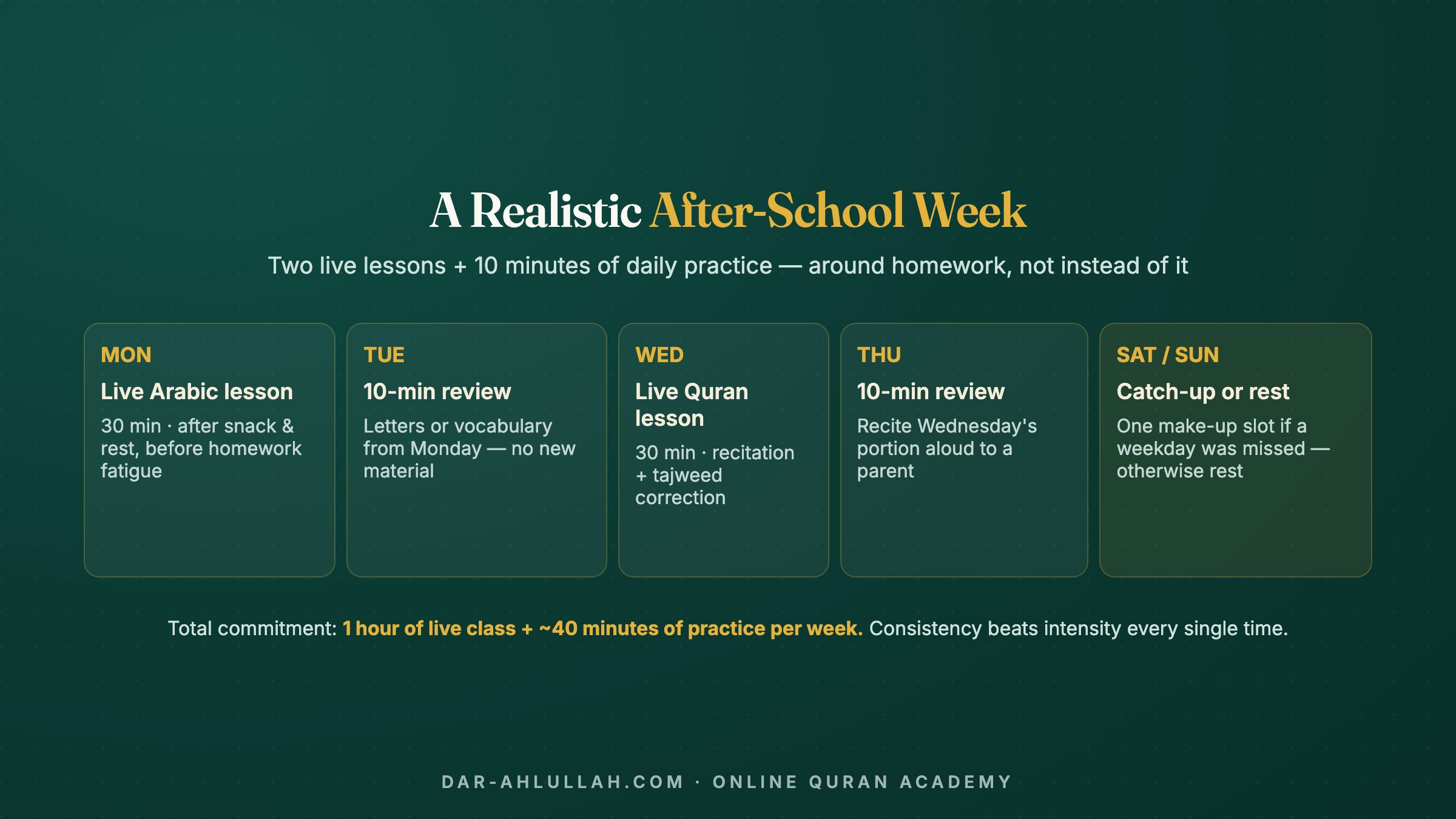
Here is the structure we recommend to almost every family starting out. Note how little it asks: one hour of live class per week, plus about forty minutes of light review spread across the week.
Two live sessions, two review days
Monday and Wednesday carry the live lessons — one Arabic, one Quran. Tuesday and Thursday carry a ten-minute review of what was covered the day before: reading the same letters, repeating the same vocabulary, reciting the same few ayahs to a parent. No new material on review days, ever. Reviewing is where memory is built.
Weekends stay free — on purpose
Leaving Saturday and Sunday open is not laziness; it is what makes the plan survive. It gives you a make-up slot when a weekday collapses, and it gives your child two days where deen study is not on the schedule at all. Children who never get a break from a subject rarely keep loving it.
Ten minutes is a real number
Parents often assume ten minutes is too little to matter. In practice a ten-minute review, done four times a week, is worth more than a single forty-minute cram — and it is short enough that a tired eight-year-old will actually agree to it. If your child is memorizing as well, the same principle drives the daily cycle in our step-by-step online Hifz guide.
Finding the Right Time Slot in Your Timezone
The decompression window
Do not schedule the lesson for the moment your child walks in. Give them 45 to 90 minutes: a snack, a change of clothes, some deliberate nothing. Then teach — before homework has drained whatever focus is left. For most families in the UK, Europe and North America, that puts the sweet spot between 4:30 and 6:30 p.m. local time.
Avoid the pre-bedtime trap
The 8 p.m. slot looks convenient on a parent's calendar and performs terribly. Tired children mispronounce, lose patience, and associate Quran with the worst part of their day. If evenings are genuinely impossible, an early-morning weekend slot beats a late weekday one.
Your timezone, not the teacher's
This is where online study quietly wins: with teachers scheduling across timezones, a 5 p.m. lesson in Manchester or Chicago is an ordinary working slot for a teacher in Cairo. You should never be asked to bend your child's sleep around an academy's convenience — insist on a fixed weekly slot in your own local time.
Arabic and Quran Together: What Each Session Actually Does
Parents often ask which comes first. The honest answer is that they do different jobs and belong on different days:
- The Quran session builds reading and tajweed — letters, articulation, then fluent recitation of real ayahs. This starts immediately, regardless of how much Arabic your child understands.
- The Arabic session builds comprehension — vocabulary, simple grammar, and eventually the moment when a word in Surah al-Fatiha is suddenly recognised rather than just recited.
Kept on separate days, each lesson stays short and distinct. Merged into one long class, they blur — and the child ends up tired without progressing in either. If your child is at the very beginning, our guide to online Quran classes for kids covers what those first months look like.
How an After-School Program Runs at Dar Ahlullah
There is no separate "after-school package" to buy — the standard program simply schedules around your school week:
- Fixed weekday evening slots in your timezone, chosen with you at booking and kept the same every week.
- Two 30-minute 1-on-1 live sessions per week — one Arabic, one Quran, or both on the same track if you prefer. That is the $36/month Starter plan; see the full pricing breakdown.
- Native Arabic-speaking teachers who teach in English and are trained to work with non-Arabic speakers, with female mentors available on request — see how to choose a female Quran teacher online.
- A written report after every session, so you know exactly what the ten-minute review should cover.
- Flexible rescheduling for exam weeks, school trips and illness — because a make-up slot keeps momentum that a cancellation destroys.
Surviving the School Term: Exams, Holidays and Motivation Dips
Exam season: shrink, do not stop
During heavy exam weeks, drop to one live session and keep the daily review. Stopping entirely almost always turns two weeks into two months — and restarting costs far more energy than maintaining a reduced pace.
School holidays: the quiet opportunity
Holidays are when families make real jumps. With no homework competing, adding a third weekly session for a few weeks is genuinely easy — and it is how many children finish Noorani Qaida or complete a memorization milestone.
The month-three dip
Almost every child hits a motivation slump around month three, once novelty has worn off and the material has become properly demanding. This is normal. Fix it with visible progress — a certificate, a completed juz', a report showing how far they have come — not with pressure. A good teacher will flag the dip before you notice it.
FAQs About After-School Arabic & Quran Programs
Q: How many hours a week should an after-school Arabic program take?
For school-age children, one hour of live class per week plus about ten minutes of daily review is the sweet spot. Two 30-minute sessions beat one 60-minute session because young learners retain far more from short, frequent contact than from a single long block at the end of a school day.
Q: What is the best time of day for after-school Quran lessons?
Roughly 45 to 90 minutes after your child gets home — after a snack and some decompression, but before homework fatigue sets in. For most European and American families that lands between 4:30 and 6:30 p.m. Avoid the slot right before bedtime; tired children absorb almost nothing.
Q: Should Arabic come before Quran, or both at once?
Both, but with different jobs. Quran sessions build reading and tajweed from day one, while Arabic sessions build the vocabulary that eventually makes the meaning click. Running them on separate days keeps each lesson short and prevents the two from blurring into one long, heavy class.
Q: My child is exhausted after school. Is an extra program too much?
It is too much only if it is scheduled like extra school. Thirty focused minutes with a warm teacher who lets your child talk, laugh, and recite is genuinely different from another worksheet. If exhaustion persists, cut to one session a week and keep the ten-minute daily review — consistency matters more than volume.
Q: How do we keep it going once the school term gets busy?
Protect the slot like a dentist appointment, keep the same weekday and time every week, and use make-up sessions instead of cancelling. Written progress reports also help: when parents can see movement week to week, motivation survives exam season.
Q: How much does an after-school Arabic and Quran program cost?
At Dar Ahlullah, eight 30-minute sessions a month cost $36 — about $9 per teaching hour, with no registration fee. That covers two live 1-on-1 lessons a week with a native Arabic-speaking teacher, plus a written progress report after every session.
Conclusion: Small, Protected, Consistent
The families whose children still read Arabic and recite beautifully at sixteen are almost never the ones who did the most in any given week. They are the ones who did something small, at a sensible hour, in a slot nobody was allowed to steal — and simply kept doing it through terms, exams and holidays.
Two short lessons, ten-minute reviews, weekends free. It is a modest ask of a school week, and over a few years it compounds into fluency, tajweed, and a child for whom Arabic was never a burden.
Ready to build the routine? Book a free 30-minute assessment — a mentor will evaluate your child's level and help you pick after-school slots that fit your actual week. Want to talk through the schedule first? Message us on WhatsApp and an advisor will reply within hours.
Related articles
how to teach your child Arabic at home
How to Teach Your Child Arabic at Home: A Parent's Guide
You do not need to speak Arabic to teach it at home. You need to pick which Arabic you are teaching, work in sounds before letters, and protect ten minutes a day — five days a week beats one long Saturday session.
20 min read

Islamic homeschooling
Islamic Homeschooling: A Realistic Guide for Families in the West
Most Islamic homeschooling guides assume you live somewhere it is legal and have a parent free all day. This one starts from the reality: the law in your country, the hours you actually have, and which subjects genuinely need a teacher.
14 min read
child refuses to learn Quran
What to Do When Your Child Refuses to Learn Quran
Refusal is a willingness problem, not a memory problem, and it has five causes that look identical from the outside. Tell them apart first — the fix for each one is different.
15 min read