
ruqyah
How to Do Ruqyah on Yourself: The Sunnah Method, Step by Step
Dar Ahlullah team 23 min read
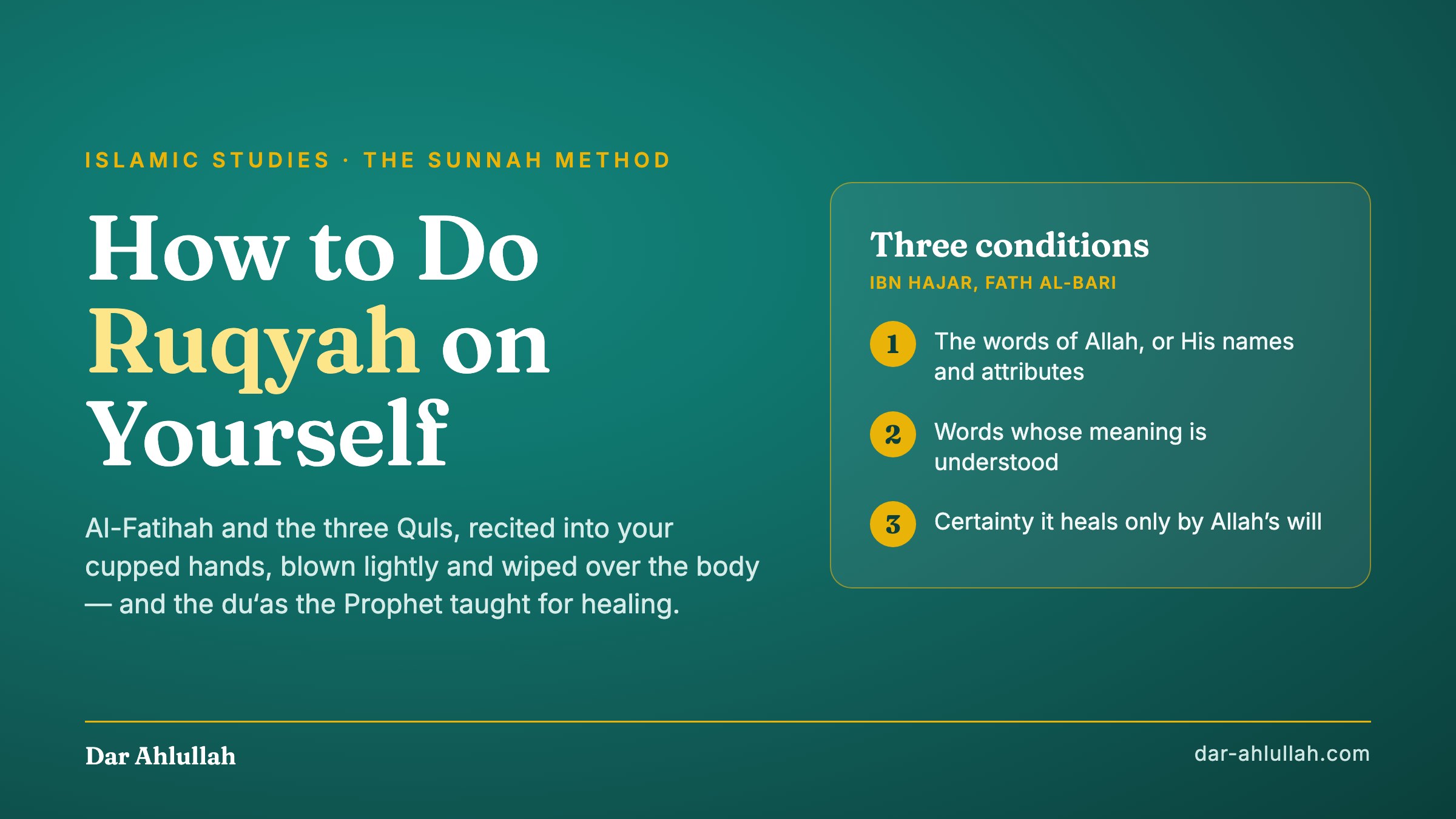
Table of Contents
- Introduction: Healing You Can Recite Yourself
- The Short Answer
- What Ruqyah Is, and the One Line It Must Not Cross
- Doing It for Yourself Is the Sunnah
- What to Recite
- The Du‘as Narrated for Healing
- The Method, Step by Step
- Reciting Over Water
- Ruqyah for the Evil Eye
- Ruqyah for Family, and Asking Someone Else
- Ruqyah and the Doctor
- Ruqyah During a Period
- Six Mistakes to Avoid
- How We Teach This
- Questions People Ask
- Conclusion: Close to Home
Introduction: Healing You Can Recite Yourself
Most Muslims first meet the word ruqyah when something has gone wrong: an illness that lingers, a child who will not settle, a run of trouble that someone in the family puts down to the evil eye. The search that follows often ends somewhere far from home — a practitioner with a waiting list, a recorded “ruqyah session” that runs for hours, a bottle of water someone else has recited over.
The Sunnah points somewhere much closer. The Prophet ﷺ recited over himself when he was ill, blew into his own hands and wiped them over his body, and he taught a Companion in pain what to say with a hand on the place that hurt. Ruqyah in its sound form is recitation and du‘a that you can do yourself, in a few minutes, using surahs you very probably already know.
This article sets out how, from the sources: what ruqyah is and the line the Sunnah draws around it, what to recite, the du‘as narrated for healing, the method step by step, reciting over water, ruqyah for the evil eye, and where a doctor fits. Every ruling is attributed to the hadith, scholar or fatwa that holds it; nothing here is a ruling of ours. If you are new to Islam, our guide to your first 90 days as a Muslim shows where this sits among everything else you are learning, and our introduction to aqeedah covers the belief about shirk that the whole subject turns on.
The Short Answer
- Ruqyah is reciting Qur’an and du‘a for healing or protection. “There is no harm in ruqyah as long as there is no shirk in it” (Muslim 2200).
- Doing it for yourself is the Sunnah. The Prophet ﷺ recited al-Mu‘awwidhat over himself when ill and blew over his body (Bukhari 5735).
- The core is short. Al-Fatihah (Bukhari 5736); al-Ikhlas, al-Falaq and an-Nas (Bukhari 5017); and the Prophet’s du‘as for the sick (Bukhari 5742, Muslim 2202).
- The method is simple. Recite, blow lightly into your cupped hands and wipe them over your body. For a pain in one place, put your hand on it, say bismillah three times and a short refuge du‘a seven times.
- Three conditions keep it sound. Ibn Hajar reported the scholars’ agreement on them: Allah’s words, names or attributes; words whose meaning is understood; and the belief that it works only by Allah’s will.
- It goes alongside medicine, not instead of it. “Make use of medical treatment” (Abu Dawud 3855, sahih per al-Albani).
What Ruqyah Is, and the One Line It Must Not Cross
A ruqyah (plural ruqa) is an incantation: words said over a sick or afflicted person for relief. The Arabs had them before Islam, and the Companions asked what to do with theirs. ‘Awf ibn Malik al-Ashja‘i reported: “We used to recite ruqyahs in the Jahiliyyah, so we said: Messenger of Allah, what do you think of that? He said: ‘Show me your ruqyahs. There is no harm in ruqyahs as long as there is no shirk in them’” (Muslim 2200).
That hadith sets the frame for everything below. Ruqyah is not banned, and it is not a ritual with secret rules; it is judged by what is in it. The other side of the line is just as clear. ‘Abdullah ibn Mas‘ud reported the Prophet ﷺ saying that “spells, charms and love-potions are shirk” — ar-ruqa wat-tama’im wat-tiwalah. When his wife Zaynab objected that a spell recited over her inflamed eye had calmed it, he told her that what she needed was the Prophet’s own du‘a: “Remove the harm, Lord of mankind, and heal; You are the Healer; there is no remedy but Yours, one that leaves no illness behind” (Abu Dawud 3883; sahih per al-Albani, sahih li-ghayrihi per Shu‘ayb al-Arna’ut, weak per Zubair Ali Zai). The ruqa condemned there are the kind that call on something besides Allah, which is why the same word can be praised in one hadith and called shirk in another.
The three conditions
Ibn Hajar, in Fath al-Bari, summarised where the scholars landed, as quoted in IslamQA 175189:
“The scholars are unanimously agreed that ruqya is permissible if three conditions are met: It should be done by reciting the words of Allah, may He be exalted, or His names and attributes, and in Arabic or in a language the meaning of which is understood, and with the belief that ruqyah has no effect in and of itself; rather it is only effective by the will of Allah.”
The second condition matters for anyone who does not speak Arabic. Al-Khattabi explained the concern: what was forbidden is ruqyah “that which is not in Arabic, because it is not known what it means and perhaps it may involve witchcraft or kufr” — “but if the meaning is clear and it contains mention of Allah”, it is permissible (Ma‘alim as-Sunan, in the same IslamQA answer). The rule is not “Arabic only”; it is “nothing you cannot understand”. The Qur’an is recited in Arabic, and a du‘a for healing in English, Urdu or French is ruqyah too.
Three kinds of ruqyah
Ibn ‘Uthaymin sorted ruqyah by its content (Fatawa Nur ‘ala ad-Darb, in the same answer):
| Kind | What it looks like | Ruling |
|---|---|---|
| Narrated in the Sunnah | Al-Fatihah, al-Mu‘awwidhat, the du‘as in this article | Prescribed and recommended |
| A permissible du‘a not narrated from the Prophet ﷺ | Your own du‘a for healing, in words you understand, with no shirk or innovation in it | Permissible |
| Shirk or innovation | Calling on jinn, saints or anything besides Allah; words or symbols whose meaning nobody can tell you | Forbidden |
Al-Qurtubi, also quoted by Ibn Hajar, put the first two rows in one sentence: whatever is by the words or names of Allah is permissible, and “if it is narrated in a report” from the Prophet ﷺ, it is recommended.
Doing It for Yourself Is the Sunnah
The clearest model of ruqyah in the hadith collections is the Prophet ﷺ treating himself. ‘A’ishah reported that in his final illness “he used to recite the Mu‘awwidhat and then blow his breath over his body. When his illness was aggravated, I used to recite those two surahs and blow my breath over him and make him rub his body with his own hand for its blessings”. One of the narrators, Ma‘mar, asked al-Zuhri how the Prophet ﷺ blew: “He used to blow on his hands and then pass them over his face” (Bukhari 5735; also 5751). Ibn Hajar added that “in his final sickness” does not limit it to that illness; ‘A’ishah was pointing out that it continued to the end of his life (IslamQA 96793).
It was also a nightly habit, not only a remedy. “Whenever the Prophet ﷺ went to bed every night, he used to cup his hands together and blow over it after reciting Surat al-Ikhlas, Surat al-Falaq and Surat an-Nas, and then rub his hands over whatever parts of his body he was able to rub, starting with his head, face and front of his body. He used to do that three times” (Bukhari 5017; see also 5748, where he asked ‘A’ishah to do it for him when he fell ill).
What about the seventy thousand?
Many people hold back from ruqyah because of one hadith: seventy thousand of this ummah will enter Paradise without being called to account, and “they are those who” — in the Arabic — la yastarqun, do not draw bad omens, are not cauterised, and rely on their Lord (Bukhari 5705). The verb yastarqun is a form that means asking for something: they do not ask others to perform ruqyah for them. The common English translation of al-Bukhari renders it “do not treat themselves with Ruqya”, which reads as though the hadith were about self-ruqyah. The Arabic is not.
A narration in Muslim (220) adds a second phrase, la yarqun, “they do not perform ruqyah”. Ibn Taymiyyah judged that addition a narrator’s mistake, “for their ruqyah for themselves and for others is a good deed. The Prophet ﷺ recited ruqyah for himself and for others; he did not ask anyone to recite ruqyah for him” (Majmu‘ al-Fatawa 1/182), and Ibn al-Qayyim said the same (Hadi al-Arwah 1/89); both are quoted in IslamQA 3476. Ibn Taymiyyah explained the difference: the one who asks for ruqyah is “seeking it from another person and turning to someone other than Allah in his heart, whereas the one who performs ruqyah is doing good and benefiting others” (IslamQA 132384).
So reciting over yourself sits entirely outside that hadith. Even asking someone else is not the disaster people fear. Ibn ‘Uthaymin distinguished three levels: asking someone to recite over you falls short of the highest level of reliance; not stopping someone who offers does not; and stopping them goes against the Sunnah, because the Prophet ﷺ did not stop ‘A’ishah (Majmu‘ Fatawa wa Rasa’il 9/99). Ibn Baz went further: “asking for ruqyah does not rule out a person’s being among the seventy thousand… if there is a need for it, then there is nothing wrong with it” (Fatawa Nur ‘ala ad-Darb 1/76). Both are quoted in IslamQA 217325.
What to Recite
The Qur’an describes itself as healing: “And We send down of the Qur’an that which is healing and mercy for the believers” (17:82; see also 10:57 and 41:44). Within it, a few passages carry direct evidence from the Sunnah. They are not equal in kind, and the table says which is which.
| Recitation | What the report says | Source |
|---|---|---|
| Al-Fatihah | A Companion recited it over a tribal chief stung by a scorpion, who recovered; the Prophet ﷺ asked, “How did you know it is a ruqyah?” and approved | Bukhari 5736, 5749 |
| Al-Ikhlas, al-Falaq, an-Nas | Recited into the cupped hands, blown, and wiped over the body, three times, every night | Bukhari 5017 |
| Al-Falaq and an-Nas | Recited over himself when ill; after they were revealed he used them and left other words of refuge | Bukhari 5735; Tirmidhi 2058 (sahih per Shakir and al-Albani, weak per Zubair Ali Zai) |
| Ayat al-Kursi (2:255) | At bedtime, a guard from Allah stays with you and no devil comes near you until morning | Bukhari 2311 — a protection by its own virtue, not a ruqyah report |
| The last two verses of al-Baqarah (2:285–286) | Recited at night, “that will be sufficient for him” | Bukhari 5009 — same note |
IslamQA calls al-Fatihah and al-Mu‘awwidhat the greatest of the ruqyahs (3476). Ayat al-Kursi and the end of al-Baqarah are recited because of their own authentic virtues, which is why they appear in almost every ruqyah booklet, but no hadith calls either of them a ruqyah. You are not confined to this list: IslamQA 175189 holds that general verses, words of refuge and authentic du‘as suited to the situation are all fine, from the Prophet’s words to a man asking about ruqyah for a sting, “Whoever among you is able to benefit his brother, let him do so” (Muslim 2199).
If the three Quls are not yet secure in your memory, they are the place to start; our guide to which surahs to memorize first begins with them. They are already part of the Sunnah’s daily routine too: three times each in the morning and evening adhkar, and once after each prayer in the adhkar after salah. A Muslim who keeps those routines is already reciting a daily ruqyah.
The Du‘as Narrated for Healing
1. “O Allah, Lord of mankind”
Anas ibn Malik offered a sick friend “the ruqyah of the Messenger of Allah ﷺ” and recited (Bukhari 5742):
Allahumma Rabban-nas, mudhhibal-ba’s, ishfi antash-Shafi, la shafiya illa ant, shifa’an la yughadiru saqama.
“O Allah, Lord of mankind, Remover of harm, heal, for You are the Healer; there is no healer but You; a healing that leaves no illness behind.”
‘A’ishah reported the Prophet ﷺ saying it over members of his family while passing his right hand over them, in a slightly different wording: adhhibil-ba’s, Rabban-nas, ishfihi wa antash-Shafi, la shifa’a illa shifa’uk — “remove the harm, Lord of mankind, heal him, for You are the Healer; there is no healing but Yours” (Bukhari 5743).
2. A hand on the place that hurts
‘Uthman ibn Abi al-‘As complained to the Prophet ﷺ of a pain he had felt in his body since becoming Muslim. He was told: “Place your hand where you feel pain in your body and say bismillah three times, and say seven times” (Muslim 2202):
A‘udhu billahi wa qudratihi min sharri ma ajidu wa uhadhir.
“I seek refuge in Allah and in His power from the evil of what I feel and what I fear.”
Some versions outside Sahih Muslim read a‘udhu bi-‘izzatillahi wa qudratihi, “in the might of Allah and His power”, and add that ‘Uthman did it, the pain left him, and he went on teaching it to his family (quoted in IslamQA 3476). This is the du‘a written for doing it yourself: it is in the first person, and it comes with its own instruction for the hand.
3. The ruqyah Jibril recited
When the Prophet ﷺ was ill, Jibril came to him and recited (Muslim 2186):
Bismillahi arqika, min kulli shay’in yu’dhika, min sharri kulli nafsin aw ‘aynin hasid, Allahu yashfik, bismillahi arqik.
“In the name of Allah I recite ruqyah over you, from everything that harms you, from the evil of every soul or envious eye. May Allah heal you. In the name of Allah I recite ruqyah over you.”
It is addressed to someone else, so it is the one to use over a child, a spouse or a parent.
4. The words of refuge Ibrahim used for his sons
The Prophet ﷺ used to seek refuge for al-Hasan and al-Husayn with words he said Ibrahim had used for Isma‘il and Ishaq (Bukhari 3371):
A‘udhu bi-kalimatillahit-tammah, min kulli shaytanin wa hammah, wa min kulli ‘aynin lammah.
“I seek refuge in the perfect words of Allah from every devil and every poisonous creature, and from every harmful eye.”
5. Your own du‘a, in your own words
By the second row of Ibn ‘Uthaymin’s table, a du‘a for healing that you compose yourself, in any language you understand, is a permissible ruqyah. Call on Allah by the names that fit the need, as Ibrahim spoke of his Lord: “And when I am ill, it is He who cures me” (26:80). Our guide to learning the 99 names of Allah covers calling on Him by His names, and for a need that has worn you down, the prayer described in our guide to salat al-hajah sits naturally beside this.
The Method, Step by Step
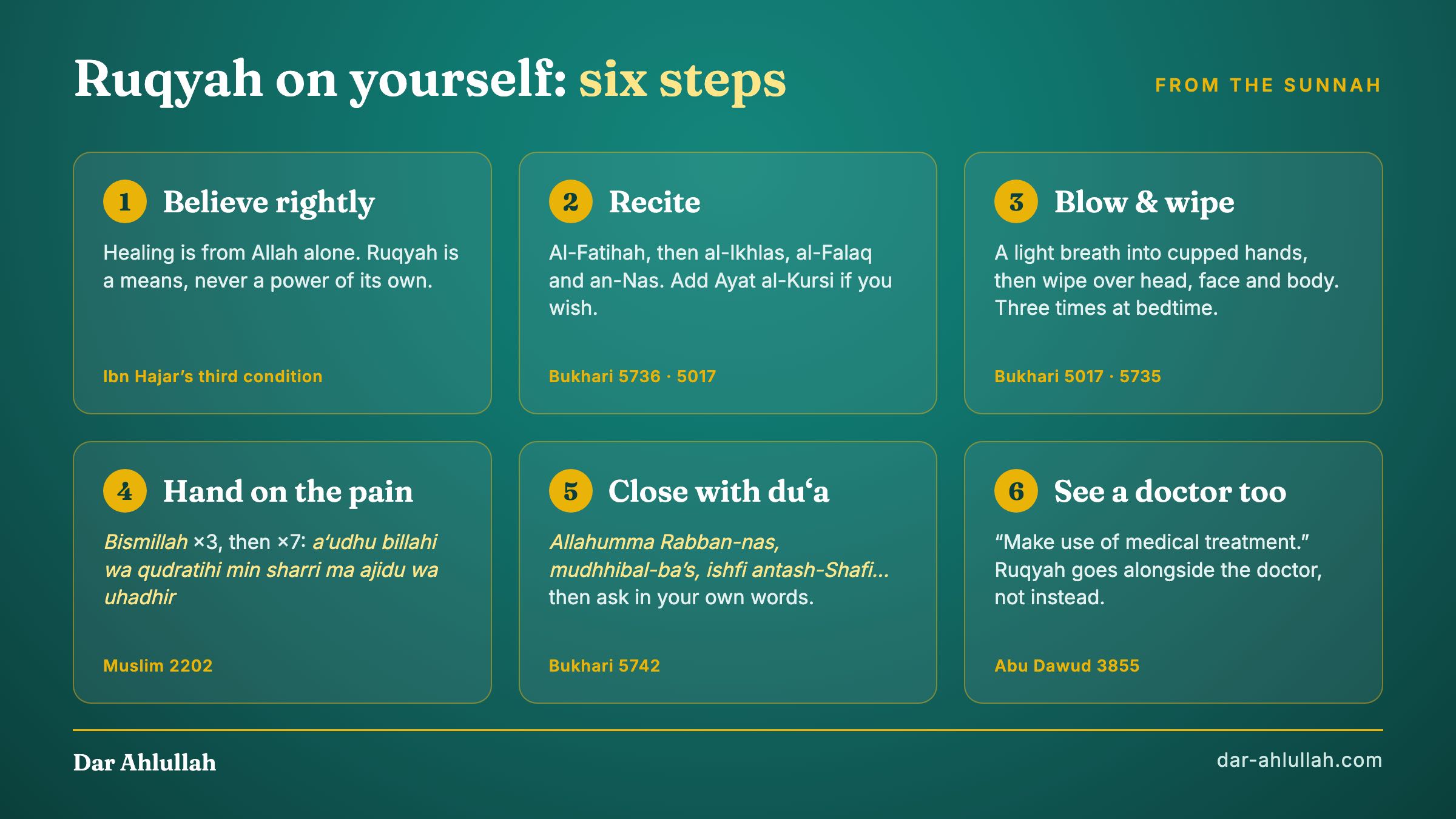
- Start from the right belief. This is Ibn Hajar’s third condition, and he called it essential: ruqyah has no effect by itself; it is a means, and the healing is from Allah. Nothing about the room, the time or the reciter changes that.
- Recite. Al-Fatihah, then al-Ikhlas, al-Falaq and an-Nas. Add Ayat al-Kursi and the last two verses of al-Baqarah if you wish. Recite them correctly and attentively; they are Qur’an, and the words are the remedy.
- Blow and wipe. Blow lightly into your cupped hands — the word in the hadith is nafth, which IslamQA’s translation renders “spit drily”: a breath, not spitting — and wipe them over your head, your face and the front of your body, then whatever else you can reach (Bukhari 5017). The bedtime report repeats this three times.
- For a pain in one place, use your hand. Rest your hand on the place, say bismillah three times, then a‘udhu billahi wa qudratihi min sharri ma ajidu wa uhadhir seven times (Muslim 2202).
- Close with du‘a. Allahumma Rabban-nas, mudhhibal-ba’s…, and then whatever you want to ask in your own words.
- Keep the other means too. Take your medicine and keep your appointments; the section on the doctor below explains why that is the Sunnah’s instruction, not a lack of trust.
Two things are deliberately absent. The reports fix only the counts given above — the three Quls three times at bedtime, bismillah three times and the refuge du‘a seven times — and none sets a number of sessions, days or bottles. And none of them requires a particular place, a practitioner or a special kind of water. You can do it in bed, at your desk or in a hospital waiting room, as often as you need.
Reciting Over Water
Reciting Qur’an into water and then drinking it or washing with it is widespread, and the scholars quoted here permit it. IslamQA 96793 tells a questioner affected by sihr that he may recite over water himself, drink some and wash with it, and that heating the water first is fine. IslamQA 12627 says there is nothing wrong with reciting into water or oil for the sick, “but reciting over the sick person and blowing onto him is better and is preferable”.
The report usually cited for it is graded differently, though. In it, the Prophet ﷺ visited the sick Thabit ibn Qays, said “Remove the harm, Lord of mankind, from Thabit”, took some earth from the valley of Bathan, put it in a bowl, mixed it with water, blew into it and poured it over him (Abu Dawud 3885). IslamQA 12627 calls its chain hasan; al-Albani graded the chain weak, and Zubair Ali Zai graded it weak. Ibn ‘Uthaymin rested the practice on something else: “Some of the Salaf did this, and it is effective and beneficial by Allah’s leave” (IslamQA 21581).
He also drew the line that matters most. Blowing into water after reciting al-Fatihah is fine; blowing into it “with the intention of seeking barakah (blessing) from the saliva of the one who blows into it” is “undoubtedly prohibited”, because no one’s saliva is a source of blessing except the Prophet’s ﷺ (Fatawa Ibn ‘Uthaymin 1/107, in the same answer). The recitation is the remedy, not the reciter. A bottle recited over by a famous practitioner carries no more than one you recite over yourself.
Ruqyah for the Evil Eye
The evil eye, al-‘ayn, is affirmed in the Sunnah without hedging. “The effect of an evil eye is a fact” (Bukhari 5740). “The evil eye is real; if anything could precede the decree, the evil eye would precede it; and when you are asked to wash, then wash” (Muslim 2188). And ruqyah is the remedy the Prophet ﷺ named for it. ‘A’ishah said he ordered ruqyah against the evil eye (Bukhari 5738). Seeing a girl with a dark mark on her face in Umm Salamah’s house, he said: “She is under the effect of an evil eye; so treat her with a ruqyah” (Bukhari 5739). And when Asma’ bint ‘Umays asked about Ja‘far’s children, he told her yes, and gave the reason: “if there was anything that could overcome the decree, then the evil eye would overcome it” (Tirmidhi 2059, sahih per al-Albani and Shakir).
What to recite is the same core as above. Two of the du‘as name the eye directly: Jibril’s “from the evil of every soul or envious eye” and Ibrahim’s “from every harmful eye”.
The washing
The Sunnah adds one remedy that is specific to the eye. ‘Amir ibn Rabi‘ah saw Sahl ibn Hunayf bathing and exclaimed at his skin, and Sahl collapsed. The Prophet ﷺ asked whom they suspected, rebuked ‘Amir — “Why would one of you kill his brother? If he sees something that he likes, then let him pray for blessing for him” — and had ‘Amir wash his face, arms, knees and inside his lower garment, then pour the water over Sahl (Ibn Majah 3509, sahih per al-Albani). That is what “when you are asked to wash, then wash” refers to. It applies when the person is known; it is not a licence to suspect your neighbours.
Prevention
The same hadith carries the prevention: when you admire something in someone else, ask Allah to bless it for them. A Muslim who does that habitually is guarding others from their own eye, and the morning and evening adhkar guard you.
One caution runs the other way. Asked whether hair loss and weak eyesight meant the evil eye, IslamQA answered that they “may be due to some physical cause or some psychological cause”, advised specialist doctors, and added: “It is not right to attribute everything that happens to witchcraft or the evil eye” (IslamQA 217325). Recite, by all means — but do not let a diagnosis of ‘ayn stand in for a diagnosis.
Ruqyah for Family, and Asking Someone Else
Over your child or a relative
The Prophet ﷺ recited over his grandsons (Bukhari 3371) and passed his right hand over members of his family with the du‘a Allahumma Rabban-nas (Bukhari 5743). A parent needs nothing more: recite al-Fatihah and the Quls, blow lightly, wipe over the child, and say Jibril’s du‘a or Ibrahim’s.
Who may recite over others
No licence or specialist training is required. IslamQA’s answer on who may be a raqi: “every reader who can recite the Quran well and who understands its meanings, has a sound belief, does righteous deeds and is of upright conduct”, without needing to have “studied all branches of knowledge in depth”. It cites the Companion in Abu Sa‘id’s story, of whom they said they had not known him to do ruqyah before (IslamQA 7874).
Payment
Taking a fee is permitted. When Companions objected that one of them had taken a sheep for reciting al-Fatihah, the Prophet ﷺ said: “You are most entitled to take wages for doing a ruqyah with Allah’s Book” (Bukhari 5737; see also IslamQA 12627). The same answer on the raqi adds that he “should not be concerned with money or payment” (7874).
Recorded ruqyah
Listening to a ruqyah recording on a phone is, in IslamQA’s view, not “asking for ruqyah” and is “beneficial, in sha Allah… although the best is for the individual to recite Qur’an himself, or for someone else to recite it over him”. It cites Ibn Baz’s fatwa that Surat al-Baqarah recited over the radio drives the Shaytan from the house (IslamQA 132384). A recording is a supplement to your own recitation, not a replacement for it.
Signs a ruqyah has crossed the line
Each of these comes straight from the sources above:
- Words you cannot understand, or names and symbols nobody will explain. Ibn Hajar’s second condition and al-Khattabi’s reason for it.
- Calling on anything besides Allah — jinn, the dead, a saint. That is the shirk of Muslim 2200.
- Charms to wear. “Spells, charms and love-potions are shirk” (Abu Dawud 3883). Ibn Baz held that even verses of the Qur’an should not be worn around the neck or arm, and that what is prescribed is to recite and blow (IslamQA 133552).
- Treating the reciter as the source of blessing, his saliva or his touch. Ibn ‘Uthaymin’s line in IslamQA 21581.
The Permanent Committee set the same limits — Qur’an, dhikr and du‘a, “so long as it does not involve shirk or words of which the meaning cannot be understood” — and IslamQA, quoting it, calls a ruqyah outside them “corrupt and harmful”, says it “may be the cause of troubles and calamities”, and tells the one who recited it to repent and learn the Sunnah ruqyahs instead (IslamQA 180492).
Ruqyah and the Doctor
The Sunnah does not ask you to choose between them. “There is no disease that Allah has created, except that He also has created its treatment” (Bukhari 5678). Asked by desert Arabs whether they should use medical treatment, the Prophet ﷺ answered: “Make use of medical treatment, for Allah has not made a disease without appointing a remedy for it, with the exception of one disease, namely old age” (Abu Dawud 3855, sahih per al-Albani). Ruqyah is a du‘a and a remedy; medicine is a remedy; both are means, and Allah is the One who heals by them.
In practice: keep taking what you have been prescribed, and recite as well. Physical symptoms go to a doctor first, as IslamQA advised for the questioner losing hair and eyesight. The same applies to the symptoms people most readily blame on the eye, sihr or jinn — anxiety, low mood, panic, sleeplessness, hearing or seeing things: see a doctor, and recite. Nothing in the Sunnah of ruqyah asks anyone to stop treatment.
Ruqyah During a Period
This is a real disagreement. The majority of jurists hold that a menstruating woman may not recite the Qur’an until she is pure, with an exception for dhikr and Qur’anic phrases said as du‘a rather than as recitation; Malik and one narration from Ahmad permit recitation, and Ibn Taymiyyah and al-Shawkani preferred that view (IslamQA 2564). IslamQA 152742, following the second view, permits a woman on her period to do ruqyah for herself with Qur’an, du‘a and dhikr, touching a mushaf only through a barrier.
Whichever view you follow, the du‘as in this article stay open to you: Allahumma Rabban-nas, the hand on the pain with bismillah and the refuge du‘a, Jibril’s words and Ibrahim’s are du‘a and dhikr, not recitation. Our guide to the morning and evening adhkar handles the same question for the daily adhkar.
Six Mistakes to Avoid
- Waiting for a practitioner. The Sunnah’s model is the Prophet ﷺ reciting over himself. Start there.
- Reading the seventy-thousand hadith as a ban. It is about asking others (la yastarqun), not about reciting yourself.
- Believing the words, water or reciter heal by themselves. That breaks Ibn Hajar’s third condition, which he called essential.
- Accepting what you cannot understand. Unintelligible words, numbers, symbols and wearable charms are where ruqyah becomes shirk.
- Blaming every hardship on the eye or sihr. “It is not right to attribute everything that happens to witchcraft or the evil eye” (IslamQA 217325).
- Stopping treatment. “Make use of medical treatment” is itself the Prophet’s instruction.
How We Teach This
Almost everything in a sound ruqyah is Qur’an you recite and du‘a you understand, so the two skills it rests on are the ones we teach. The first is reciting al-Fatihah and the last surahs of the Qur’an correctly — the words are the remedy, so getting them right matters. The second is enough Arabic to know what you are saying, so that your du‘a is a conversation rather than a string of sounds.
Dar Ahlullah runs one-to-one live sessions with certified teachers, scheduled in your own timezone, in Quran, Arabic and Islamic Studies. Teaching is charged at $9 per teaching hour, with monthly plans at $36, $70 and $102 depending on how many hours you want, and a 20% discount for siblings. You can pause, upgrade or switch plans at any time, and if a teacher is not the right fit we rematch you with another certified mentor at no extra cost. The first step is a free 30-minute assessment that does not ask for a card — the details are on our pricing page.
Questions People Ask
Can I do ruqyah on myself?
Yes, and it is the Sunnah. The Prophet ﷺ recited al-Mu‘awwidhat over himself and blew over his body when he was ill (Bukhari 5735), and every night before sleep (Bukhari 5017).
What do I recite for ruqyah?
Al-Fatihah, al-Ikhlas, al-Falaq and an-Nas carry direct evidence; many add Ayat al-Kursi and the last two verses of al-Baqarah for their own virtues. Then the narrated du‘as: Allahumma Rabban-nas (Bukhari 5742) and the hand-on-the-pain du‘a (Muslim 2202).
How many times should I recite?
The reports give two sets of counts: the three Quls three times at bedtime (Bukhari 5017), and bismillah three times with the refuge du‘a seven times (Muslim 2202). Beyond that, no number of repetitions, sessions or days is fixed; recite as you need.
Does ruqyah have to be in Arabic?
The Qur’an is recited in Arabic. Du‘a for healing can be in any language you understand: Ibn Hajar’s condition is Arabic “or a language the meaning of which is understood”, and al-Khattabi explained that the concern is words whose meaning nobody knows.
Can I just listen to a ruqyah recording?
IslamQA considers it beneficial and not the same as asking for ruqyah, but says reciting yourself, or having someone recite over you, is better (IslamQA 132384).
Is it allowed to pay someone to do ruqyah?
Yes. “You are most entitled to take wages for doing a ruqyah with Allah’s Book” (Bukhari 5737). It is not required, though; you can do it yourself.
Can I do ruqyah for the evil eye on my child?
Yes. The Prophet ﷺ told Asma’ bint ‘Umays to have ruqyah done for Ja‘far’s children (Tirmidhi 2059) and sought refuge for his own grandsons with Ibrahim’s words (Bukhari 3371).
Can I wear a taweez with Qur’an in it?
Ibn Baz held that nothing, “whether it is Qur’an or anything else”, should be worn around the neck or arm, and that what is prescribed is to recite and blow (IslamQA 133552). Charms of other kinds are named as shirk in Abu Dawud 3883.
Does asking someone for ruqyah stop me being among the seventy thousand?
Ibn Baz said it does not when there is a need for it (IslamQA 217325). Ibn ‘Uthaymin said that accepting someone’s offer to recite over you does not count as asking at all.
Can I do ruqyah during my period?
The schools differ on reciting Qur’an during menstruation (IslamQA 2564); IslamQA 152742 permits ruqyah with Qur’an in that state. The narrated du‘as are open to you on every view.
Conclusion: Close to Home
Ruqyah is one of the most misunderstood words in a Muslim household, and one of the simplest practices in the Sunnah. The Prophet ﷺ recited the last surahs of the Qur’an into his hands and wiped them over himself. He taught a Companion in pain to put his hand on the place and seek refuge in Allah’s power, and he approved a ruqyah of al-Fatihah with a smile. The conditions are three and they are all about belief: Allah’s words, words you understand, and certainty that He alone heals.
Learn al-Fatihah and the three Quls well, keep the du‘as somewhere you can find them, recite over yourself and your family when you need to, and see your doctor as well. “And when I am ill, it is He who cures me” (26:80).
Related articles
99 names of Allah
How to Memorize the 99 Names of Allah: Which List, and a Plan That Sticks
How to memorize the 99 names of Allah, from the sources: what the authentic hadith promises and what ahsaha means, why the familiar list is a narrator's compilation graded weak, and a ten-block plan anchored to verses you already recite, with a spaced review routine.
20 min read
morning and evening adhkar
Morning and Evening Adhkar: What to Say and When
Morning and evening adhkar from the sound reports: the windows from dawn to sunrise and from 'Asr to sunset, the core set with the source and count of each line, and the grade printed on the popular additions the hadith scholars dispute, from Ayat al-Kursi to hasbiyallah seven times.
29 min read
aqeedah for beginners
Aqeedah for Beginners: The Six Articles of Faith, Explained Simply
Aqeedah is the subject that answers what a Muslim believes, as distinct from what a Muslim does. The core of it is six articles of faith — short enough to learn in an afternoon, and the foundation everything else rests on.
17 min read