
how to set Quran goals
How to Set Quran Goals You Will Actually Keep
Dar Ahlullah team 17 min read
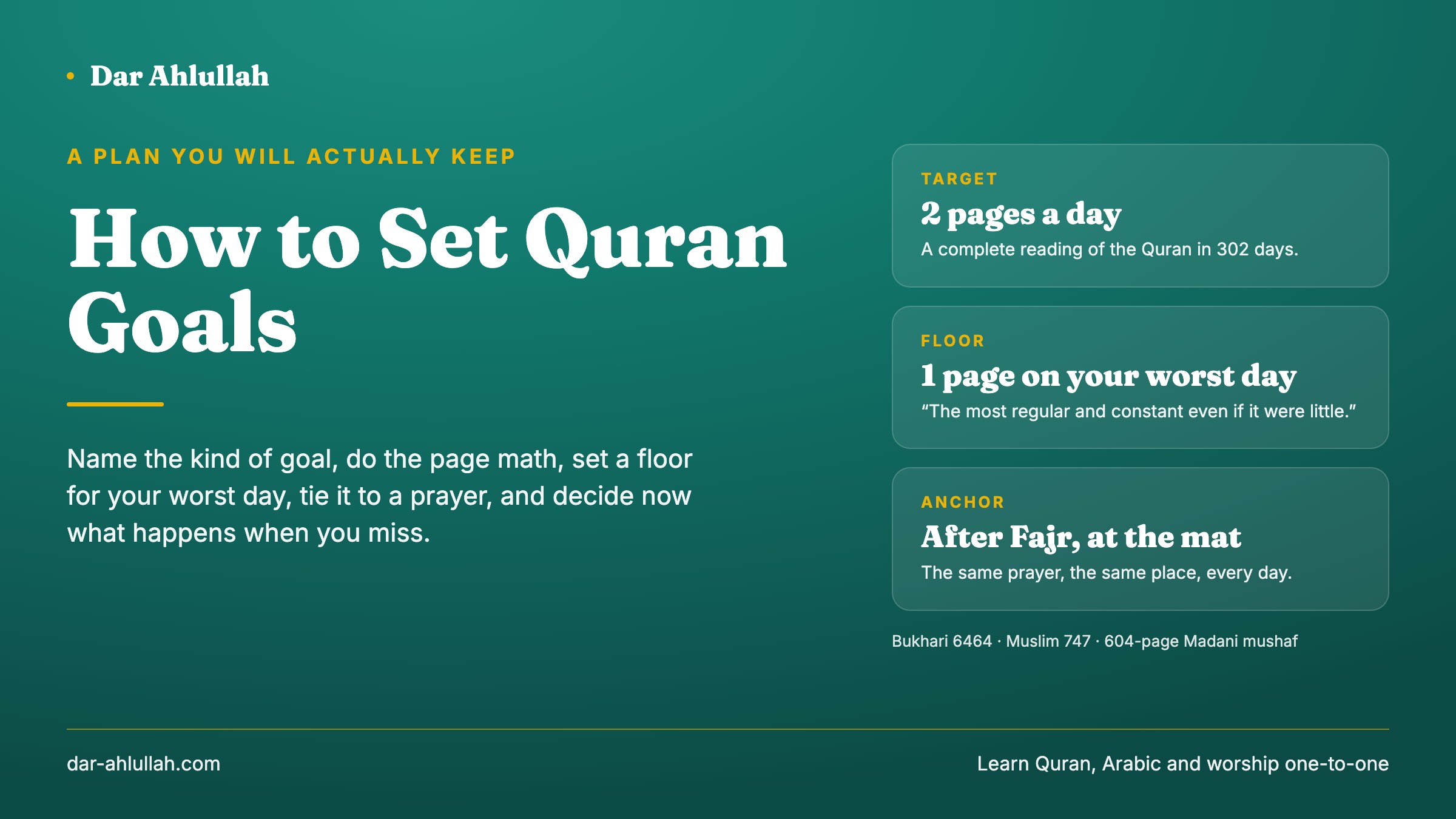
Table of Contents
- Introduction: “Read More Quran” Is a Wish, Not a Goal
- The Short Answer
- Step 1: Decide Which Kind of Quran Goal You Are Setting
- Step 2: Do the Page Math
- Step 3: Set a Floor as Well as a Target
- Step 4: Tie It to a Prayer You Already Pray
- Step 5: Make It Specific Enough to Check
- Step 6: Decide Now What Happens When You Miss
- Memorisation Goals Need a Revision Line
- Four Sample Goal Sheets
- Review the Goal Monthly, and Pick a Start Date
- How We Teach This
- Questions People Ask
- Conclusion: Small, Fixed, and Planned for Bad Days
Introduction: “Read More Quran” Is a Wish, Not a Goal
Almost everyone who sets a Quran goal sets some version of the same one. Read more this year. Finish it at least once. Memorise a few more surahs. Be more consistent. Every one of those is sincere, and none of them tells you what to do tomorrow morning at twenty to seven, which is where a goal is actually kept or lost.
This guide is about how to set Quran goals that turn that wish into a plan you can check. The method is short. Decide which kind of Quran goal you are setting. Do the arithmetic against the 604 pages of the standard mushaf. Set a floor for your worst day as well as a target for a normal one. Tie the reading to a prayer you already pray. And decide in advance what happens when you miss. Each step rests on something firmer than motivation: the Sunnah’s own preference for small, regular deeds, and a few well-replicated findings from research on goals and habits.
It is written for adults setting a goal for themselves — whether you read fluently, still stumble, or have not learned the letters yet. If you are at the very start and still weighing how to learn at all, the wider picture is in our comprehensive guide to learning the Quran online. This article is the part that comes after you have decided to start.
The Short Answer
- Name the kind of goal. Reading the whole Quran, learning to read it correctly, memorising it and understanding it are four different goals, counted in four different units: pages, lessons, lines and words.
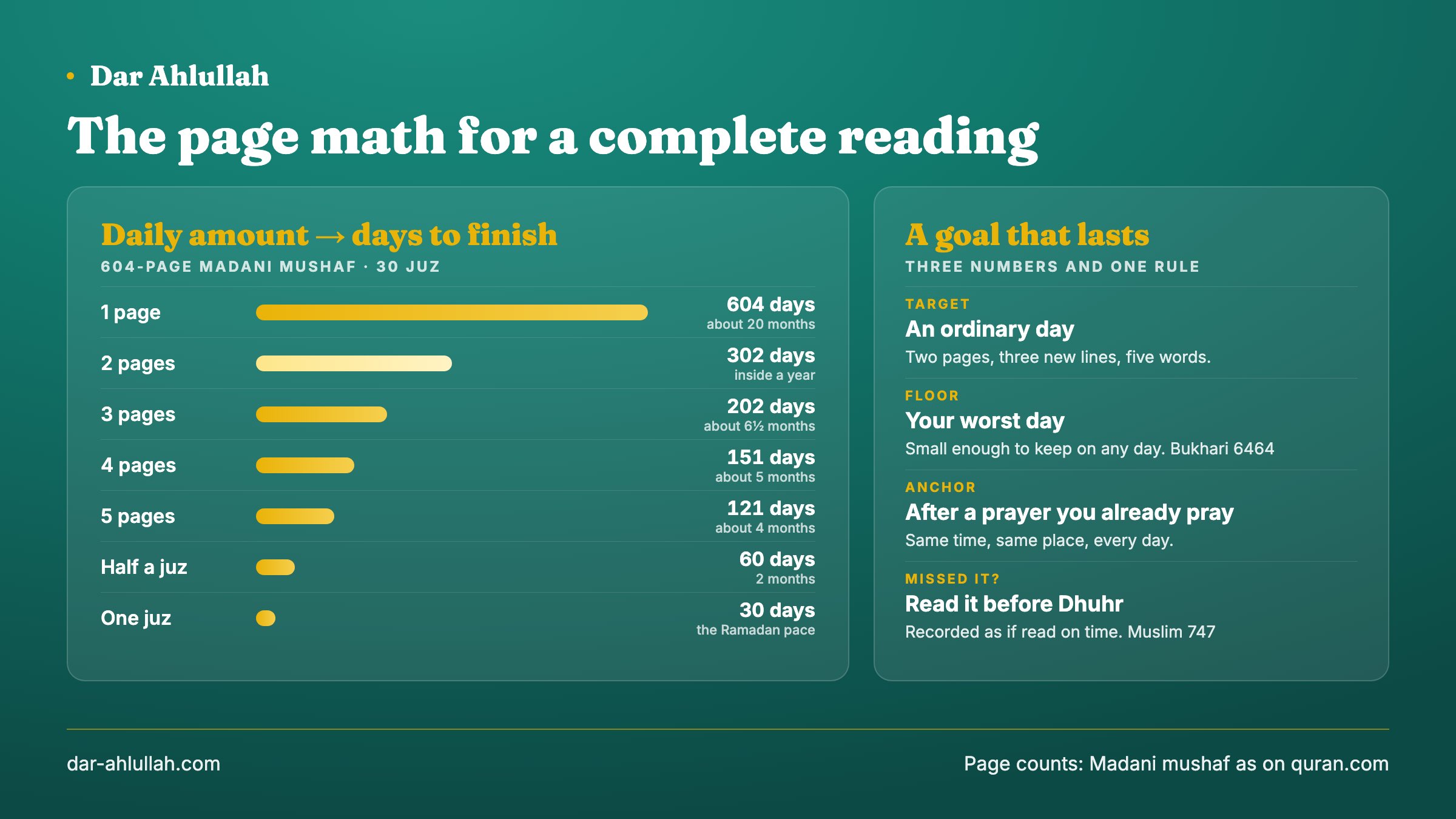
- Do the math. The standard Madani mushaf has 604 pages in 30 juz of about 20 pages each. Two pages a day completes a reading in 302 days; one juz a day completes it in 30.
- Set two numbers. A target for an ordinary day and a floor for your worst one. The Prophet ﷺ said the most beloved deed to Allah is “the most regular and constant even if it were little” (Bukhari 6464).
- Tie it to a prayer. “After Fajr, at the prayer mat, I read two pages” is a plan. “I will read in the mornings” is not. If–then plans of this kind have a medium-to-large average effect on whether goals are reached.
- Plan the missed day. A daily portion missed at night and read the next morning before Dhuhr is recorded as though it were read on time (Muslim 747). In habit research, one missed day did not materially set the habit back.
- Give memorisation a revision line. A memorisation goal that only counts new lines is half a goal.
- Review it monthly. Raise the target when it gets easy; lower it before you abandon it.
Step 1: Decide Which Kind of Quran Goal You Are Setting
“A Quran goal” covers four different projects, and the commonest mistake is to set one while needing another: a beginner who sets “finish the Quran this year” when what comes first is learning to read it, or a fluent reader who sets “memorise Surah al-Mulk” with no plan to keep the surahs they already carry.
| Kind of goal | What you count | What “done” looks like | Read next |
|---|---|---|---|
| Read it (a complete reading, or khatm) | Pages or juz per day | The last page of Surah an-Nas | The page math below |
| Read it correctly (learning to read, tajweed) | Lessons completed and mistakes corrected | Reading an unseen page aloud without being stopped | How long it takes to learn to read the Quran |
| Carry it (memorisation, hifz) | New lines, plus pages revised | Reciting the portion from memory weeks later, not just today | Which surahs to memorise first |
| Understand it (meaning, Quranic Arabic) | Words or verses studied with their meaning | Following a surah you recite in salah without reaching for a translation | The most common words in the Quran |
You can hold more than one, and most people eventually do. But set them as separate lines with separate numbers. A single daily block called “Quran time” can easily end up spent on whichever kind feels easiest that day, which is rarely the one you set the goal for.
If you cannot read Arabic script yet, the honest first goal is the second row, and it is counted in lessons, not pages. That is not a lesser goal. The Prophet ﷺ said that the one who is proficient in the Quran is with the noble, upright recording angels, “and he who falters in it, and finds it difficult for him, will have two rewards” (Sahih Muslim 798).
Step 2: Do the Page Math
A reading goal is the easiest kind to plan, because the Quran has a fixed length. The Madani mushaf — the 604-page layout that quran.com and many printed copies use — ends on page 604 with Surah an-Nas (quran.com, page 604). It is divided into 30 juz. The first juz runs to 21 pages and the last, Juz ‘Amma, to 23 (pages 582 to 604); every juz in between is 20 pages. If your copy is a different print, such as an Indo-Pak mushaf, its page count will differ, so count in juz instead: the juz divisions are nearly the same, with a few juz starting a verse or a few verses apart.
| Daily amount | Time to complete a reading |
|---|---|
| 1 page | 604 days (about 20 months) |
| 2 pages | 302 days (about 10 months) |
| 3 pages | 202 days (about 6½ months) |
| 4 pages | 151 days (about 5 months) |
| 5 pages (a quarter of a juz) | 121 days (about 4 months) |
| Half a juz | 60 days (2 months) |
| One juz | 30 days |
Two rows deserve a comment. Two pages a day is the smallest whole number of pages that completes a reading inside a year, with about two months to spare for the days that go wrong. One juz a day is the familiar Ramadan pace: thirty juz in a month.
What the table cannot tell you is how long a page takes you, because that depends entirely on your reading. Time yourself on three ordinary pages this week, take the average, and multiply. A goal you have measured in minutes is far easier to find room for than one measured in pages.
The Sunnah sets a ceiling as well
Speed has a limit in the Sunnah. When ‘Abdullah ibn ‘Amr told the Prophet ﷺ that he finished the Quran every night, he was told: “Recite the whole Qur’an in one month’s time.” He said he could do more. “Then finish the recitation of the Qur’an in seven days, and do not finish it in less than this period” (Sahih al-Bukhari 5054; the fuller story is in 5052). In another report from the same Companion: “He who recites the Qur’an in less than three (days), he does not understand it” (Jami‘ at-Tirmidhi 2949, graded sahih).
For someone setting a goal, the useful detail is the order of the conversation. A month was the first instruction, given to a man who was already overdoing it. Faster is not automatically better, and a pace that leaves no room to attend to what you are reading is not the ideal the reports describe.
Step 3: Set a Floor as Well as a Target
A single daily number fails in a predictable way. On a good day you meet it. On a bad day — a sick child, a late shift, a flight — you cannot, and with nothing smaller to fall back on, the day goes to zero. The fix is two numbers: a target for an ordinary day, and a floor for your worst one.
The floor should be small enough to be slightly embarrassing: one page, one page of revision, five new words. Its job is not to move you forward much. Its job is to keep the chain unbroken on the day the target was impossible.
This is the shape of the Sunnah’s own advice on deeds. Asked which deeds Allah loves most, the Prophet ﷺ said: “The most regular constant deeds even though they may be few,” and added: “Don’t take upon yourselves, except the deeds which are within your ability” (Sahih al-Bukhari 6465; see also 6464). And when ‘A’ishah was asked whether he set aside particular days for particular acts, she said: “No. His act was continuous” (Sahih Muslim 783).
| Goal | Target (an ordinary day) | Floor (your worst day) |
|---|---|---|
| Complete a reading this year | 2 pages | 1 page |
| Learn to read correctly | One lesson’s practice | Read yesterday’s line aloud once |
| Memorise | 3 new lines and 1 page revised | 1 page revised, no new lines |
| Understand | 5 new Quranic words | Review yesterday’s 5 |
Notice the memorisation row. On a floor day it is the new material that goes, never the revision. The reason is in the section on memorisation goals below.
Step 4: Tie It to a Prayer You Already Pray
“I will read every morning” leaves the hardest decision — when, exactly — to be made again every morning. Psychologists call the alternative an implementation intention: a plan of the form “when situation X arises, I will do Y.” A meta-analysis by Peter Gollwitzer and Paschal Sheeran, covering more than 8,000 participants in 94 independent studies, found that forming such plans had a medium-to-large average effect on goal attainment, d = 0.65 (Gollwitzer & Sheeran, 2006, as summarised in Wieber, Thürmer & Gollwitzer, 2015).
A Muslim already has five fixed cues a day. Use one. “After the adhkar after Fajr, before I pick up my phone, I read two pages at the prayer mat” names the time, the place and the amount. If mornings are impossible, the same sentence works after Maghrib or ‘Isha’. Choose the prayer you are most reliably at home for, not the one that sounds most impressive.
Research on habits points the same way. In a study run at University College London, 96 volunteers each chose one new daily behaviour to perform in the same context — the researchers’ example was “after breakfast” — and tracked it for twelve weeks (Lally et al., 2010). Repetition in a consistent context is how a behaviour becomes automatic, and a prayer is about as consistent a context as a day contains.
Step 5: Make It Specific Enough to Check
The central finding of goal-setting research, summarised by Edwin Locke and Gary Latham after 35 years of studies, is that specific, challenging goals lead to better performance than simply being told to “do your best” (Locke & Latham, 2002). “Do your best” is exactly what most Quran goals say. The test is simple: at the end of the day, can you answer yes or no?
| Vague | Specific |
|---|---|
| Read more Quran | Two pages after Fajr every day, starting from Surah al-Baqarah |
| Improve my tajweed | One rule a week with my teacher; record one page a day and listen back for that rule |
| Memorise more | Three new lines a day, five days a week, and one page revised every day |
| Understand the Quran | Five frequent Quranic words a day, reviewed the next morning |
| Be consistent | Never below one page, whatever the day |
If tajweed is the line you are setting, choose the rules in the order a teacher would; our guide to tajweed rules for beginners sets out that order.
Step 6: Decide Now What Happens When You Miss
You will miss days. The plan should say what happens then, before it happens, because the decision made in the moment is usually “start again next Monday.”
The Sunnah already has a provision for exactly this. The Prophet ﷺ said: “Should anyone fall asleep and fail to recite his portion of the Qur’an, or a part of it, if he recites it between the dawn prayer and the noon prayer, it will be recorded for him as though he had recited it during the night” (Sahih Muslim 747). Two things in that hadith matter for anyone setting a goal. The Companions had a fixed daily portion of the Quran, which is what a target is. And a missed portion had a defined way back, the next morning, rather than being abandoned.
Habit research is reassuring here too. In the UCL study, missing one opportunity to perform the behaviour “did not materially affect the habit formation process” (Lally et al., 2010). What the study did show is that the road is long: among the participants whose data fitted the researchers’ model well, the median time to reach near-peak automaticity was 66 days, and the range across individuals was 18 to 254 days. A Quran routine that still feels like effort in week three is not failing. It is on schedule.
Three rules worth writing down now:
- One missed day: read it the next morning if you can, as in the hadith above. If you cannot, simply return to the target. Do not double the next day as a penalty.
- A missed week: come back at the floor for a few days, then the target. Do not try to repay seven days in one sitting; spread the missed pages across ordinary days until you are level, or move the finish date.
- Repeated misses at the same time of day: the anchor is wrong, not you. Move it to a different prayer.
Memorisation Goals Need a Revision Line
A memorisation goal that counts only new lines is half a goal. “Keep refreshing your knowledge of the Qur’an,” the Prophet ﷺ said, “for I swear by Him in Whose Hand is the life of Muhammad that it is more liable to escape than camels which are hobbled” (Sahih Muslim 791; also Sahih al-Bukhari 5033). Every surah you add is a surah you now have to keep.
In practice that means two numbers again — new material and revision — with revision protected first on a bad day. As the memorised portion grows, the revision line grows with it, and either the new line shrinks or the daily time grows. Our guide on how to revise Quran memorisation covers the cycle that structures this, and memorising the Quran with a full-time job shows how both lines fit into a working week.
If your goal is Juz ‘Amma, know its size before you set a date. It holds 37 surahs, from an-Naba’ to an-Nas, and 564 verses across 23 pages of the Madani mushaf, with its longer surahs at the start. Which of them to take first is its own question, answered in which surahs to memorise first.
Four Sample Goal Sheets
These are templates, not prescriptions. Change every number to fit your life; keep the shape.
An adult who cannot read Arabic yet
- Goal: read an unseen page of the mushaf aloud, slowly and correctly.
- Target: one lesson’s practice a day.
- Floor: read yesterday’s line aloud once.
- Anchor: after Maghrib.
- Monthly check: how many lessons are behind you, and which letters still trip you up.
How long this stage takes varies a great deal from one person to the next. Our article on how long it takes to learn to read the Quran breaks the stage down, and how to read the Quran for beginners sets out the order of the steps.
A reader who stumbles and wants a first complete reading
- Goal: complete a reading of the whole Quran within a year.
- Target: two pages.
- Floor: one page.
- Anchor: after the adhkar after Fajr, at the prayer mat.
- Monthly check: your page number against the schedule. At two pages a day, the end of the first month is around page 60.
A working adult memorising Juz ‘Amma
- Goal: Juz ‘Amma held from memory, with every surah revised at least weekly.
- Target: three new lines on weekdays, plus one page revised every day.
- Floor: the revision page only.
- Anchor: after ‘Isha’, when the house is quiet.
- Monthly check: recite last month’s surahs from memory to someone else.
A fluent reader who wants to understand
- Goal: follow the meaning of the surahs you recite in salah.
- Target: five frequent Quranic words a day, and the meaning of one short surah a week.
- Floor: review yesterday’s five words.
- Anchor: after Dhuhr.
- Monthly check: recite one of your salah surahs and say what each verse means.
For this line, the vocabulary list in the most common words in the Quran is a ready-made starting point, and how to learn Quranic Arabic covers what comes after it.
Review the Goal Monthly, and Pick a Start Date
A goal set once and never adjusted is a guess. Once a month, look at three things. Did you hit the floor every day? Did you hit the target on most days? Does the finish date still hold? If the target has become easy, raise it a little. If you have been living on the floor, lower the target before you abandon it. The hadith above is explicit that the deed Allah loves most is the one kept up, even if it is small.
As for when to start: the goal does not need an occasion. People often begin at the start of a calendar year, at a new Hijri year or in the weeks before Ramadan, and any of those is a fine start date. But the arithmetic is the same on an ordinary Tuesday, and each week of waiting is fourteen pages at the two-page pace. If Ramadan is the target, starting the routine weeks before it means the habit is already running when the month arrives, instead of being built during it.
How We Teach This
Most of this article can be done alone. Two parts are harder to do alone: knowing which of the four kinds of goal you are actually ready for, and setting a target and a floor that match your real reading rather than your hopes. Both are easier once someone has heard you read.
Dar Ahlullah runs one-to-one live sessions with certified teachers, scheduled around your own time zone, in Quran reading, Tajweed, Hifz, Arabic and Islamic Studies. Teaching is charged at $9 per teaching hour, with monthly plans at $36, $70 and $102 depending on how many hours you want, and a 20% discount for siblings. You can pause, upgrade or switch plans at any time, which suits a goal you expect to adjust, and if a teacher is not the right fit we rematch you with another certified mentor at no extra cost. The first step is a free 30-minute assessment that does not ask for a card — the details are on our pricing page.
Questions People Ask
How many pages of the Quran a day to finish it in a year?
The Madani mushaf has 604 pages, and 604 divided by 365 is about 1.7 pages a day. Rounding up to two pages a day completes the Quran in 302 days, which leaves about two months of slack for missed days.
How long does it take to finish the Quran reading one juz a day?
Thirty days. The Quran is divided into 30 juz, which is why one juz a day is the usual pace for completing a reading in Ramadan.
What is the fastest you should finish the Quran?
The Prophet ﷺ first told ‘Abdullah ibn ‘Amr to finish it in a month, then, when he insisted he could do more, in seven days and no less (Bukhari 5054). He also said that whoever recites it in less than three days does not understand it (Tirmidhi 2949). For most people setting a goal, the practical question is the opposite one: the slowest pace they can keep every day.
Is it better to read a lot or to understand a little?
The reports reward both. Each letter recited carries a reward, and the reward of ten like it (Jami‘ at-Tirmidhi 2910), and the one who recites with difficulty is promised two rewards (Muslim 798). Neither hadith makes the reward depend on how much you understood. The limit the Sunnah does set is on speed, in the three-day report above. Many people keep a reading line and an understanding line side by side for that reason; our guide on how to reflect on the Quran covers the second line.
I can’t read Arabic yet. Can I still set a Quran goal?
Yes. It is counted in lessons rather than pages: learning to read is the goal, and a complete reading comes after it. The hadith of the two rewards (Muslim 798) describes someone at exactly this stage, reciting with difficulty.
Should I set Quran goals for the new year?
Any date works as a start date. The calendar year, the Hijri new year and the weeks before Ramadan are all common starting points. What decides whether the goal survives is the plan — the target, the floor, the anchor and the rule for missed days — not the date.
I missed a whole week. Should I start over?
No. Come back at your floor for a few days, then return to the target, and either spread the missed pages across the coming weeks or move your finish date. The habit research only tested single missed days, which did not materially affect habit formation; for a longer gap the practical advice is the same: resume, do not restart.
Conclusion: Small, Fixed, and Planned for Bad Days
A Quran goal that lasts has a kind, a number, a floor, a time and a rule for the day it goes wrong. None of those needs extraordinary discipline. They need ten minutes of arithmetic and one honest look at your week.
The Companions had a daily portion and a way back when they missed it. The Prophet ﷺ told a man who was overdoing it to slow down to a month. And the deed Allah loves most, by his own description, is the one kept up even if it is small. Two pages after Fajr, every day, is a goal in that spirit — and it completes a reading of the Quran, from al-Fatihah to an-Nas, with two months of the year to spare.
Related articles
how long does it take to learn to read the Quran
How Long Does It Take to Learn to Read the Quran? An Honest Answer
Every academy quotes a different number and none of them say what they are measuring. Here is the honest version: four different goals people confuse, the hours each one really costs, what those hours look like at two versus four lessons a week, and the specific habits that stretch a four-month job into two years.
19 min read
how to reflect on the Quran
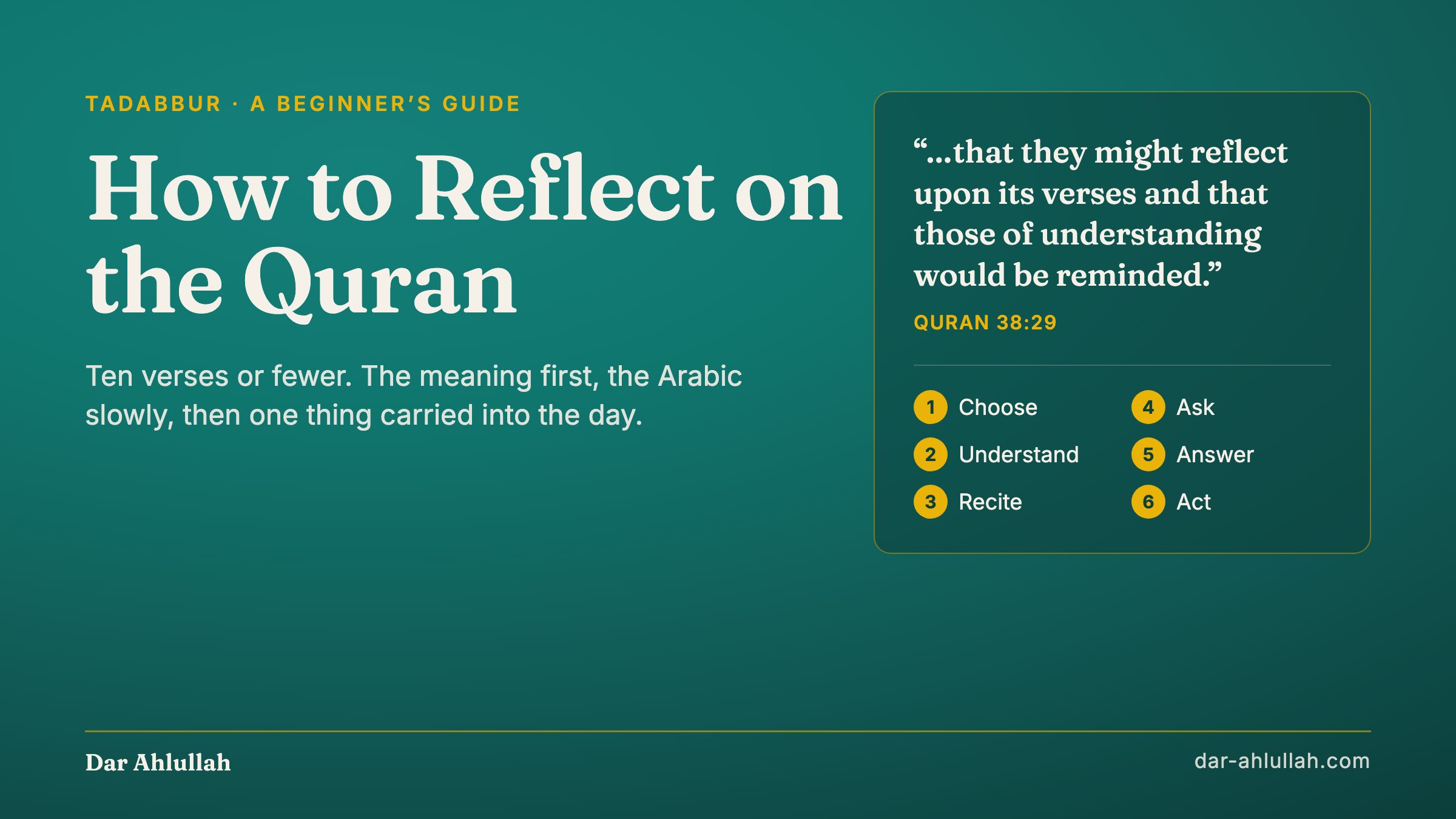
How to Reflect on the Quran: A Beginner’s Guide to Tadabbur
Tadabbur, reflecting on the Quran, is a purpose of its revelation and open to every Muslim, translation in hand. What it is and is not, how far a translation takes you, how the Prophet ﷺ and the Companions read, a six-step method for one session, and Surah al-‘Asr worked through.
19 min read
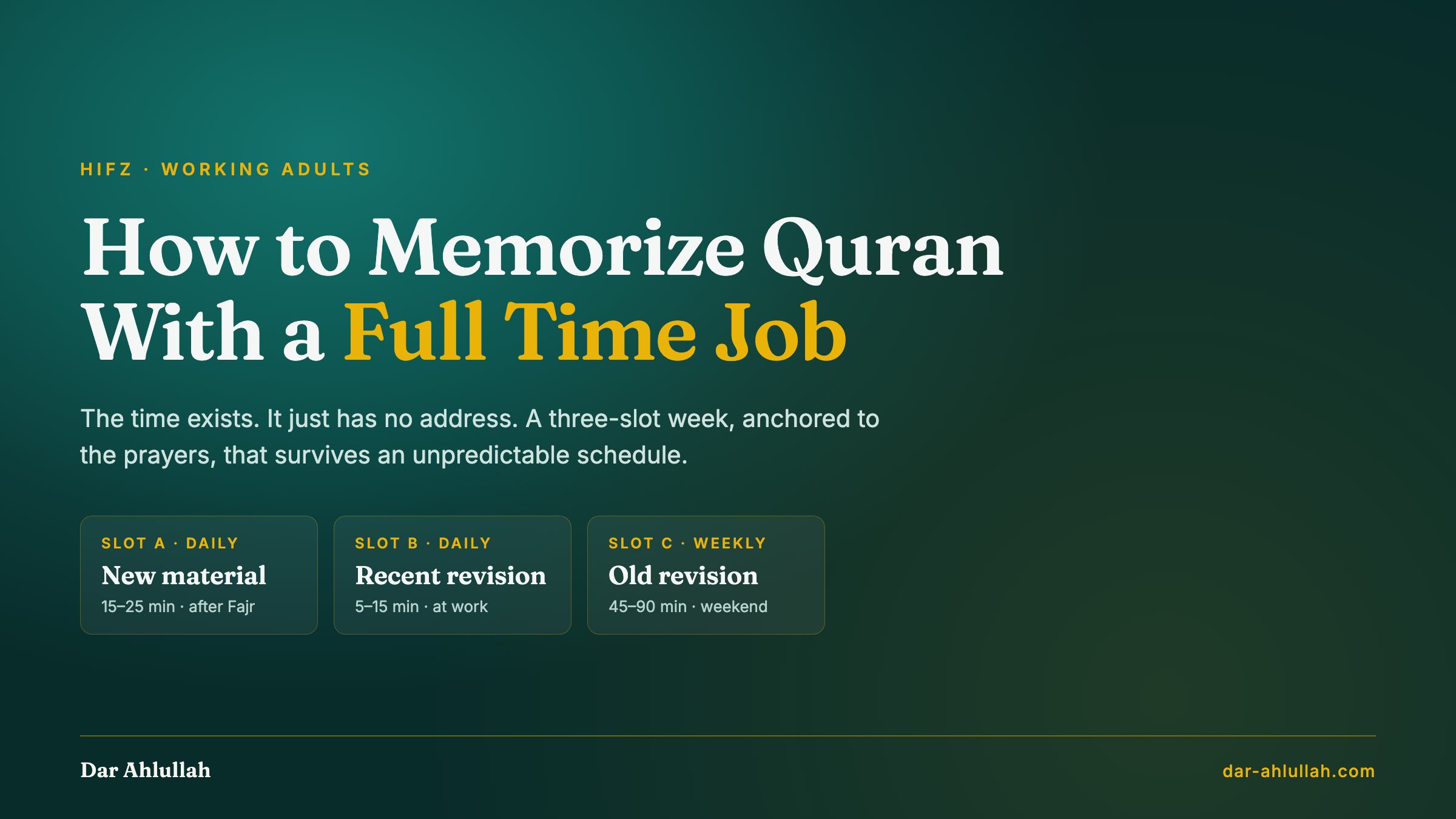
how to memorize Quran with a full time job
How to Memorize Quran With a Full Time Job: A Schedule That Survives Your Week
Working adults rarely lose hifz for lack of time. They lose it because the time never had a fixed address in the week — and the first genuinely busy fortnight takes it back.
20 min read