
how to reflect on the Quran
How to Reflect on the Quran: A Beginner’s Guide to Tadabbur
Dar Ahlullah team 19 min read
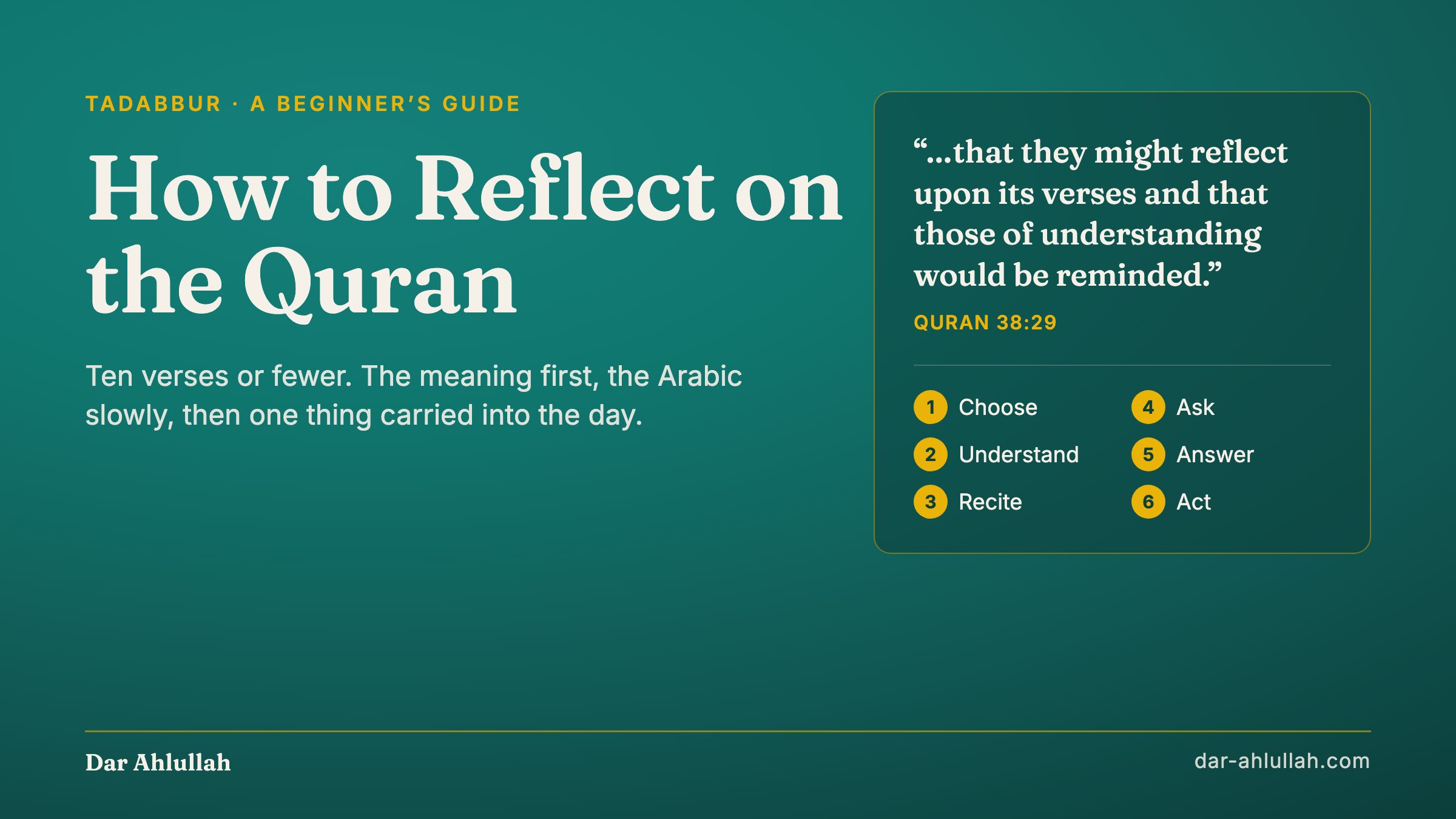
Table of Contents
- Introduction: Reciting Every Day, and Still Not Hearing It
- The Short Answer
- What Tadabbur Is, and What It Is Not
- Can You Reflect on the Quran Without Knowing Arabic?
- How the Prophet ﷺ and His Companions Read
- A Six-Step Method for One Session
- Worked Example: Surah al-‘Asr
- Let Reflection Pull Your Arabic Forward
- Taking It Into the Prayer
- Five Mistakes That Stall Reflection
- How We Teach This
- Questions People Ask
- Conclusion: Ten Verses, Understood and Lived
Introduction: Reciting Every Day, and Still Not Hearing It
A great many Muslims reach the same quiet place. They recite every day, some of them beautifully, and if you stopped them after a verse and asked what it had just asked of them, they could not say. The words are Allah’s, the reward for reciting them is real, and still something is missing.
The Quran names the missing thing. Allah describes it as “a blessed Book which We have revealed to you, [O Muḥammad], that they might reflect upon its verses and that those of understanding would be reminded” (Quran 38:29). The word for that reflection is tadabbur, and this guide is about how to reflect on the Quran when Arabic is not your first language.
It covers what tadabbur is and how it differs from tafsir, how far a translation can take you and where it stops, how the Prophet ﷺ and his Companions read, and a six-step method for a single session, worked through on a surah almost everyone already knows. It is written for adults at any stage, including those still learning to read the script. If you are still deciding how to learn the Quran at all, our comprehensive guide to learning the Quran online is the place to start; this article assumes you want more from the recitation you already have.
The Short Answer
- Tadabbur is looking behind the words to what they mean and what they ask of you. Allah gives it as a purpose of the revelation (38:29) and asks twice, “Then do they not reflect upon the Qur’ān?” (4:82, 47:24).
- You can start without Arabic. A reliable translation and a short tafsir are enough for reflection. They are not enough to interpret the Quran or derive rulings from it, which are separate disciplines.
- Take a small portion. The Companions learned ten verses at a time and did not move on until they had learned “the knowledge and application” in them (Musnad Ahmad 23482, graded hasan).
- Meaning first, then the Arabic, slowly. Read the translation and tafsir, then recite the passage at a measured pace, more than once.
- Ask it four questions: what it tells you about Allah, what it asks of you, what it promises or warns of, and where you are in it.
- Answer it. In a night prayer, the Prophet ﷺ glorified Allah at verses of glory, asked at verses of asking and sought refuge at verses of seeking refuge (Sahih Muslim 772).
- Carry one thing into the day. Reflection that ends on the page is unfinished.
- A translation is not a recitation. Reading it to understand is rewarded as tafsir, but the reward per letter belongs to reciting the Arabic (IslamQA 2589). Keep both.
What Tadabbur Is, and What It Is Not
Tadabbur comes from dubur, the back of a thing, as a Yaqeen Institute paper on tadabbur by Yousef Wahb and Mohammad Elshinawy points out. To do tadabbur of a verse is to look past its surface to what lies behind it: what it means, where it leads and what it requires of the person reading it.
The Quran uses the word itself. In 38:29 the Book is revealed li-yaddabbarū āyātihī, “that they might reflect upon its verses”, and the Yaqeen paper notes that the “that” there states a purpose of the revelation, not a side benefit. In 4:82 and 47:24 it comes as a question, afalā yatadabbarūna l-Qur’ān, “Then do they not reflect upon the Qur’ān?”, and the second verse ends, “or are there locks upon [their] hearts?”
Tadabbur sits among several ways of engaging with the Quran that are easy to blur. Keeping them apart answers most of the worries people have about it.
| What you are doing | What it is | What it needs |
|---|---|---|
| Reciting (tilāwah) | Saying the Arabic words, ideally with tajweed | Reading the script, or a teacher to repeat after. The one who recites with difficulty has two rewards (Sahih Muslim 798). |
| Reading a translation | Reading the meaning in your own language | A reliable translation. Rewarded as reading tafsir, not as reciting (IslamQA 2589). |
| Tadabbur | Pondering what an understood meaning tells you and asks of you, and responding to it | The meaning, attention and time |
| Tafsir | Explaining what a verse means | Arabic, the Sunnah, the context of revelation and the statements of earlier scholars |
| Deriving rulings | Extracting law from the text | The jurist’s training and the whole body of evidence, not one verse |
Tadabbur needs the fourth row’s results, not its training. You read a tafsir someone qualified wrote, and then you do the reflecting yourself.
Can You Reflect on the Quran Without Knowing Arabic?
The sources give two answers, and they are less opposed than they first look.
The stricter one is in a SeekersGuidance answer by Shaykh Ahmad al-Ahmad on the guidelines for contemplating the Quran. Contemplation, he writes, is religiously recommended, but it “is not arbitrary or based solely on an individual’s perception or understanding”. He lists four guidelines: learning Arabic, studying the life of the Prophet ﷺ, knowing the context of revelation, and referring to reliable tafsirs. “Without knowledge of Arabic grammar, rhetoric, and linguistic tools,” he adds, “one cannot fully grasp the depth of the Quran’s meaning.”
The more open one is in the Yaqeen paper. It agrees that a baseline understanding is necessary and says this “is easily done by consulting a reliable book of tafsīr”, adding: “For beginners, a trustworthy Sunni translation should suffice in that regard.” It is clear that this does not qualify anyone to interpret the Quran or extract rulings independently, and equally clear that it is not permitted “for the average Muslim to neglect tadabbur under the premise that they are not specialized in Qur’anic studies.” It quotes the Hanbali scholar Ibn Hubayrah on what that premise really is: one of Satan’s schemes is to keep people from tadabbur by telling them “This [practice of reflection] is risky”, until they say, “I will not speak on the Qur’an out of pious caution.”
IslamQA’s answer on reading the Quran in translation fits between them. Someone who reads a translation “in order to understand the meanings and benefit from what the ayat are saying” is rewarded for it, “because the Muslim will be rewarded for reading tafsir (explanation and commentary), and a translation is tafsir.”
Put together: the full depth of the Quran needs Arabic, and reflection at the level of a sound meaning does not. The line that matters is between reflecting on a meaning the scholars have already explained and producing a meaning of your own.
That line is also where the well-known warning belongs. At-Tirmidhi records, from Ibn ‘Abbas, “Whoever says (something) about the Qur’an without knowledge, then let him take his seat in the Fire” (Jami‘ at-Tirmidhi 2950), and a second version that says “according to his (own) opinion” (2951). At-Tirmidhi graded the first hasan sahih and the second hasan; Ahmad Shakir, al-Albani and Zubair Ali Zai graded both da‘if. Whatever their grade, at-Tirmidhi’s own comment in the same chapter shows what the concern was: people of knowledge among the Companions and those after them “were very stern about this — about explaining the Qur’an without knowledge.” Asking what an explained verse asks of you is a different act. A useful working rule: if your reflection produces a meaning you have not seen in any tafsir, treat it as a question for a teacher, not a conclusion.
How the Prophet ﷺ and His Companions Read
Five reports describe the kind of reading tadabbur is trying to recover.
He read slowly and answered what he read. Hudhayfah prayed behind the Prophet ﷺ one night as he recited al-Baqarah, an-Nisa’ and Al ‘Imran, “and recited leisurely. And when he recited the verses which referred to the Glory of Allah, he glorified … and when he recited the verses which tell (how the Lord) is to be begged, he (the Holy Prophet) would then beg (from Him), and when he recited the verses dealing with protection from the Lord, he sought (His) protection” (Sahih Muslim 772).
He stayed with a single verse. Abu Dharr said: “The Prophet (ﷺ) stood reciting a Verse and repeating it until morning came.” The verse was 5:118, “If You should punish them — indeed they are Your servants; but if You forgive them — indeed it is You who is the Exalted in Might, the Wise” (Sunan Ibn Majah 1350, graded hasan by al-Albani and Shu‘ayb al-Arna’ut).
He listened. He asked ‘Abdullah ibn Mas‘ud to recite to him, and when Ibn Mas‘ud asked how he could, when it had been revealed to him, he said, “I like to hear it from another person.” Ibn Mas‘ud recited an-Nisa’ until 4:41, “How (will it be) then when We bring from each nation a witness, and We bring you (O Muhammad) as a witness against these people,” and the Prophet ﷺ said, “Stop!” — “Thereupon I saw his eyes overflowing with tears” (Sahih al-Bukhari 5055).
The Companions learned in small portions and acted on them. Abu ‘Abd al-Rahman as-Sulami reported that the Companions who taught him the Quran said they “would listen to ten verses from the Prophet … and not move to the next ten verses until they learned the knowledge and application contained therein. They said: So, we learned knowledge and application” (Musnad Ahmad 23482, graded hasan on HadeethEnc).
He tied pace to understanding. “He who recites the Qur’an in less than three (days), he does not understand it” (Jami‘ at-Tirmidhi 2949, graded sahih). The reason he gave is understanding.
The scholars drew the obvious conclusion, though not unanimously. The Yaqeen paper cites Ibn al-Jazari, a leading authority on the recitations, as noting that some scholars held that reciting more is better, because of the reward for every letter, but that the view of most earlier and later scholars is that “reciting less but with tartīl and tadabbur is superior, because the objective is to comprehend the Qur’an and act upon it, while reciting and memorizing it are a means to realize that [objective of] comprehension” (al-Nashr 1:208–209).
A Six-Step Method for One Session
What follows turns those reports into a routine. None of it is a prescribed ritual. It is a way of making sure each session has the parts the Companions’ reading had: a small portion, its meaning, slow recitation, a response and an action.
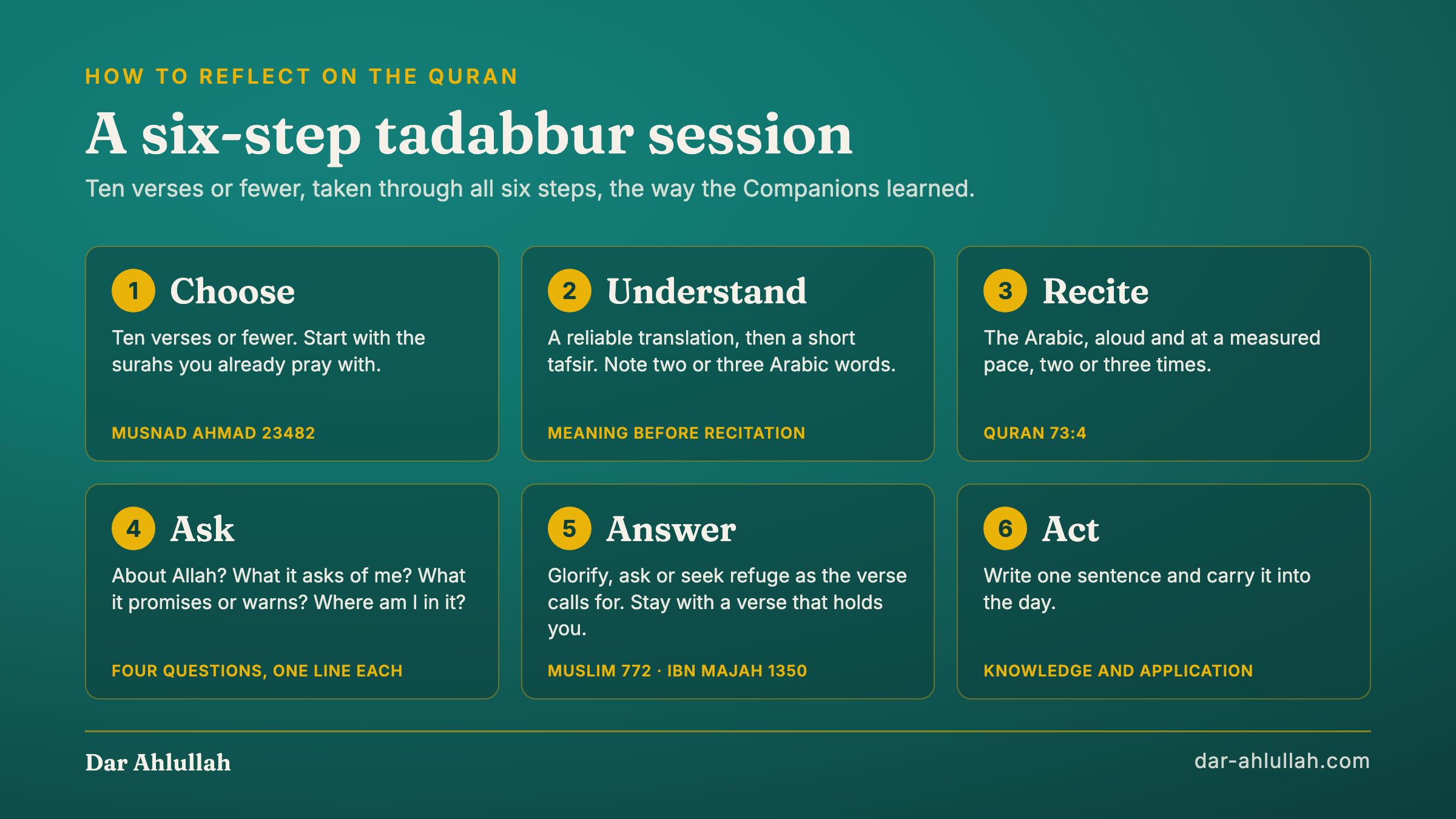
1. Choose ten verses or fewer
Ten is the Companions’ number, not a rule, and a short surah of three or four verses is a complete session. The best place to begin is what you already recite: al-Fatihah and the short surahs you pray with. You meet those verses several times a day, so whatever you understand in them goes straight into your prayer. If you are still building that set, our guide on which surahs to memorise first suggests an order.
2. Read the meaning before you recite
Read the passage in a reliable translation, then in a short tafsir. On quran.com, two well-known English tafsirs are available free beside the verses: Ibn Kathir (abridged) and Ma‘arif al-Qur’an. Read the tafsir for the verses you chose, not the whole surah’s commentary in one sitting. The Yaqeen paper quotes the early exegete at-Tabari: “I marvel at how someone who does not know the tafsīr could enjoy the Qur’an.”
As you read, note two or three Arabic words in the passage and their meanings. Over months, those words are what make the translation less necessary.
3. Recite the Arabic slowly, more than once
Now recite the passage, aloud and at a measured pace: “recite the Qur’ān with measured recitation” (Quran 73:4). Recite it two or three times, listening this time for the words you noted. If you do not understand the Arabic yet, the slowness still matters. Al-Ghazali, quoted in the Yaqeen paper, wrote that “the non-Arabic speaker who cannot understand the Qur’an should still recite in a calm and measured way, because that is more reverent and respectful, and has a greater impact on the heart compared to [reciting in] jabber and haste” (Ihya’ 2:278).
If you cannot read the script yet, listen to a reciter and repeat after them; the Prophet ﷺ himself chose to listen in Bukhari 5055. Learning to read is its own project, set out in our guide on how to read the Quran for beginners.
4. Ask the passage four questions
- What does it tell me about Allah? A name, an attribute, an action, a promise He has made.
- What does it ask of me? A belief, a deed, something to stop, an attitude.
- What does it promise, or warn of? And to whom.
- Where am I in it? Which of the people it describes am I closest to this week?
Write one line for each. The fourth question is the one that turns study into reflection. The Yaqeen paper describes it as introspection: the same verse will speak to different people, and to one person at different times, according to what they need, and the work is to bring your own flaws and needs to it rather than reflect “for posting, collecting, and discussing.”
5. Answer it
In Hudhayfah’s report, the Prophet ﷺ did not pass a verse of glory, of asking or of seeking refuge without responding to it (Muslim 772). Outside the prayer you can do the same in your own language: say subḥāna Llāh at a verse about Allah’s greatness, ask at a verse about His mercy, seek refuge at a verse about the Fire. If one verse holds you, stay with it and repeat it, as he did with 5:118 (Ibn Majah 1350).
6. Carry one thing into the day
Finish by writing one sentence: what you will do, stop or remember today because of these verses. This is the “application” half of the Companions’ method. The Yaqeen paper cites al-Hasan ibn ‘Ali: “Those who were before you saw the Qur’an as messages from their Lord so they used to reflect on them at night and follow them during the day.” Tomorrow’s session can start by checking yesterday’s sentence.
Worked Example: Surah al-‘Asr
Surah al-‘Asr is three verses on page 601 of the Madani mushaf, short enough to learn by heart in one sitting if you do not know it already. In his tafsir, Ibn Kathir records al-Shafi‘i’s remark about it: “If the people were to ponder on this Surah, it would be sufficient for them” (Tafsir Ibn Kathir on 103:1). Here is one session on it.
Steps 1 and 2: the portion and its meaning
By time, indeed, mankind is in loss, except for those who have believed and done righteous deeds and advised each other to truth and advised each other to patience. (Quran 103:1–3)
Ibn Kathir explains al-‘aṣr as “the time in which the movements of the Children of Adam occur, whether good or evil”, the popular view; Malik narrated from Zayd ibn Aslam that it is the evening. Khusr is “loss and destruction”. The exception is those who “believe in their hearts and work righteous deeds with their limbs”. Advising one another to the truth he explains as performing acts of obedience and avoiding what is forbidden, and the patience as patience with the harm that comes to those who call others to good.
Step 3: the Arabic, slowly
Wal-‘aṣr. Inna l-insāna la-fī khusr. Illā lladhīna āmanū wa ‘amilu ṣ-ṣāliḥāti wa tawāṣaw bil-ḥaqqi wa tawāṣaw biṣ-ṣabr. Words worth noting this session:
| Arabic | Meaning |
|---|---|
| al-insān | the human being, mankind |
| khusr | loss |
| āmanū | they believed |
| ‘amilū | they did |
| aṣ-ṣāliḥāt | righteous deeds |
| tawāṣaw | they advised each other |
| al-ḥaqq | the truth |
| aṣ-ṣabr | patience |
Recite it three times. By the third, āmanū, ṣāliḥāt and ḥaqq should register as you say them; all three recur across the Quran.
Step 4: the four questions
- About Allah: He swears by al-‘Asr, which Ibn Kathir explains as the time in which everything people do, good or evil, takes place. The oath is by the very thing you are spending as you read.
- What it asks of me: four things. Two concern my own heart and actions: belief and righteous deeds. Two are done with other people: tawāṣaw describes a mutual act, advising each other, to the truth and to patience.
- The warning: loss is the condition of mankind. The exception is the only way out of it, and it has all four parts.
- Where am I? Of the four, which is weakest in me this week? For many people it is one of the last two, which cannot be done alone.
Steps 5 and 6: the answer and the action
Ask Allah, in your own words, to make you among those excepted from loss. Then write the sentence. It might be “Today I will remind one person of one true thing, gently”, or “Today I will stay patient in the one conversation that usually goes wrong.” The next time you recite al-‘Asr in prayer, the sentence will come back with it.
Let Reflection Pull Your Arabic Forward
Every session leaves a few Arabic words behind, and they add up faster than most people expect, because the Quran repeats its most common words constantly. Learning those first is the quickest way to depend less on the translation; our list of the most common words in the Quran is a ready-made start. If you want to go further, how to learn Quranic Arabic sets out the path, and Quranic Arabic vs Modern Standard Arabic explains which kind of Arabic course actually serves this goal.
It helps to treat understanding as its own line in your routine, counted in words and verses, next to your reading or memorisation. Our guide on how to set Quran goals shows how to keep the two lines side by side without one swallowing the other.
Taking It Into the Prayer
Most reflection happens outside the prayer, with the mushaf, the tafsir and a notebook open. Its payoff comes inside it: once you have sat with al-‘Asr or al-Ikhlas for a session, you hear it differently when you recite it in salah. Hudhayfah’s report of the Prophet ﷺ responding to verses describes a voluntary night prayer, and whether to respond the same way in the obligatory prayers is a point the schools treat differently. Our guide to khushu in salah sets out those views and the rest of what helps the heart stay with the words.
Five Mistakes That Stall Reflection
- Measuring only by speed. Pages per day is a fine reading goal and a poor reflection goal. The Prophet ﷺ set three days as the shortest time for a complete reading and gave understanding as the reason (Tirmidhi 2949).
- Waiting until you know Arabic. That day may be years away. The Yaqeen paper’s point, and Ibn Hubayrah’s, is that the “I am not qualified” feeling is often the very thing keeping people from the Quran. A translation and a tafsir are enough to begin.
- Turning reflection into rulings. A translation can show you what a verse asks of you. It cannot tell you on its own how a ruling applies, what other evidence qualifies it or what the schools concluded. For that, ask someone qualified.
- Letting the translation replace the recitation. Reading the meaning is rewarded as tafsir, but the reward for each letter recited belongs to the Arabic (IslamQA 2589). Recite and reflect; do not choose one.
- Reflecting for an audience. A reflection written to be posted is shaped by the audience. Write the sentence for yourself, and judge it by whether it changed your day.
How We Teach This
Much of tadabbur is done alone, with a translation and a notebook. Three parts go faster with a teacher: reciting the Arabic correctly enough that you can listen to yourself, learning the words that unlock the surahs you pray with, and checking a reflection against what the scholars have said before you build on it.
Dar Ahlullah runs one-to-one live sessions with certified teachers, scheduled around your own time zone, in Quran reading, Tajweed, Hifz, Arabic and Islamic Studies. Teaching is charged at $9 per teaching hour, with monthly plans at $36, $70 and $102 depending on how many hours you want, and a 20% discount for siblings. You can pause, upgrade or switch plans at any time, and if a teacher is not the right fit we rematch you with another certified mentor at no extra cost. The first step is a free 30-minute assessment that does not ask for a card — the details are on our pricing page.
Questions People Ask
What does tadabbur mean?
Reflecting deeply on the Quran: looking behind the words to what they mean, imply and ask of you. The word comes from dubur, the back of a thing, and the Quran itself uses it in 38:29, 4:82 and 47:24.
Can I do tadabbur in English?
Yes, on the meaning. A reliable translation and a short tafsir give you a sound meaning to reflect on, and the Yaqeen paper says that for beginners a trustworthy translation should suffice. What English cannot give you is the full depth of the Arabic, which is why the stricter view puts learning Arabic first among the guidelines. Recite the Arabic as well, even slowly.
Do I get the reward of reciting if I only read the translation?
IslamQA’s answer is that there is no evidence that it does: the reward mentioned for each letter is for reading the Quran as it is, in Arabic. Reading the translation to understand it is rewarded separately, as reading tafsir (IslamQA 2589).
Is it better to read more of the Quran, or less with reflection?
Both are rewarded, and scholars have differed on which is better. Ibn al-Jazari reports that some preferred reciting more, for the reward of each letter, and that most earlier and later scholars preferred less with tartil and tadabbur, because understanding and acting on the Quran is the goal. In practice many people keep both: a reading portion for the day and a smaller reflection portion.
How long should a tadabbur session be?
There is no prescribed length. The useful limit is the portion, not the clock: ten verses or fewer, taken through all six steps, which for a short surah is often under half an hour.
Which tafsir should a beginner read?
Start with what is easy to reach. On quran.com, Ibn Kathir (abridged) and Ma‘arif al-Qur’an are available in English beside each verse. If you have a teacher, ask which tafsir they read with students; a single tafsir read consistently is worth more than five dipped into.
What if my reflection leads me to a meaning I have never heard?
Treat it as a question, not a conclusion. Check it against a tafsir, and if you still cannot find it, ask someone qualified. The early scholars’ caution was about explaining the Quran without knowledge, which is exactly what an untested new meaning risks.
Conclusion: Ten Verses, Understood and Lived
Tadabbur is not a skill reserved for scholars. It is the way the Companions read: a small portion, its meaning, slow recitation, a response, and something done about it before the next ten verses.
You do not need fluent Arabic to begin, only a translation, a short tafsir, a notebook and the three verses of al-‘Asr. Recite them slowly tomorrow, ask them the four questions and write one sentence. The Quran describes itself as revealed so that its verses would be reflected upon, and that reflection can start with a surah you already know by heart.
Related articles
Makki and Madani surahs
Makki and Madani Surahs: What the Labels Mean and How Scholars Know
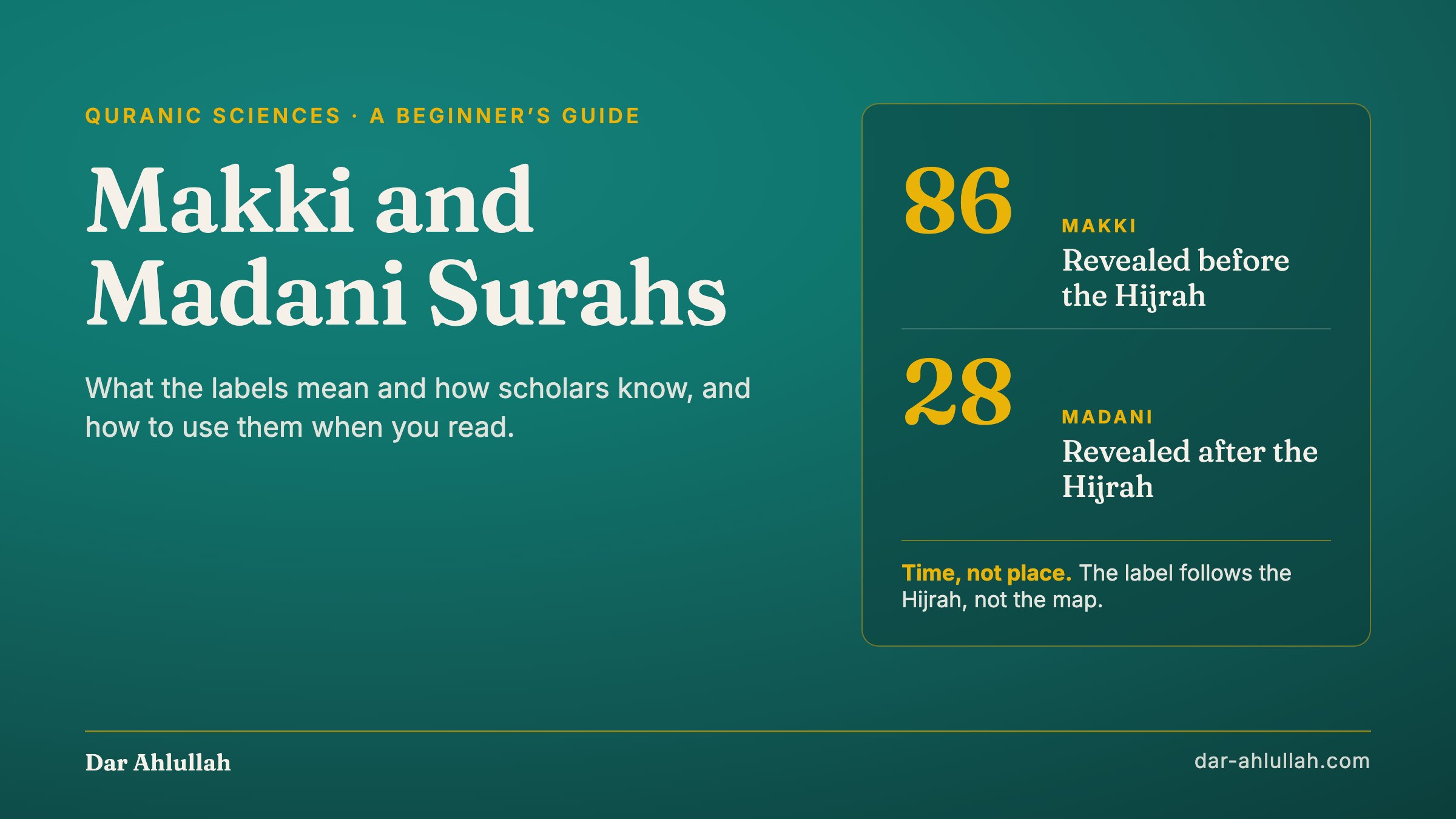
Makki means revealed before the Hijrah and Madani after it, wherever the revelation came. How the Companions knew, how the two groups differ in style and subject, the classical rules of thumb tested against the Arabic text, the surahs where the labels disagree, and how to use the label when you read.
18 min read
how to set Quran goals
How to Set Quran Goals You Will Actually Keep
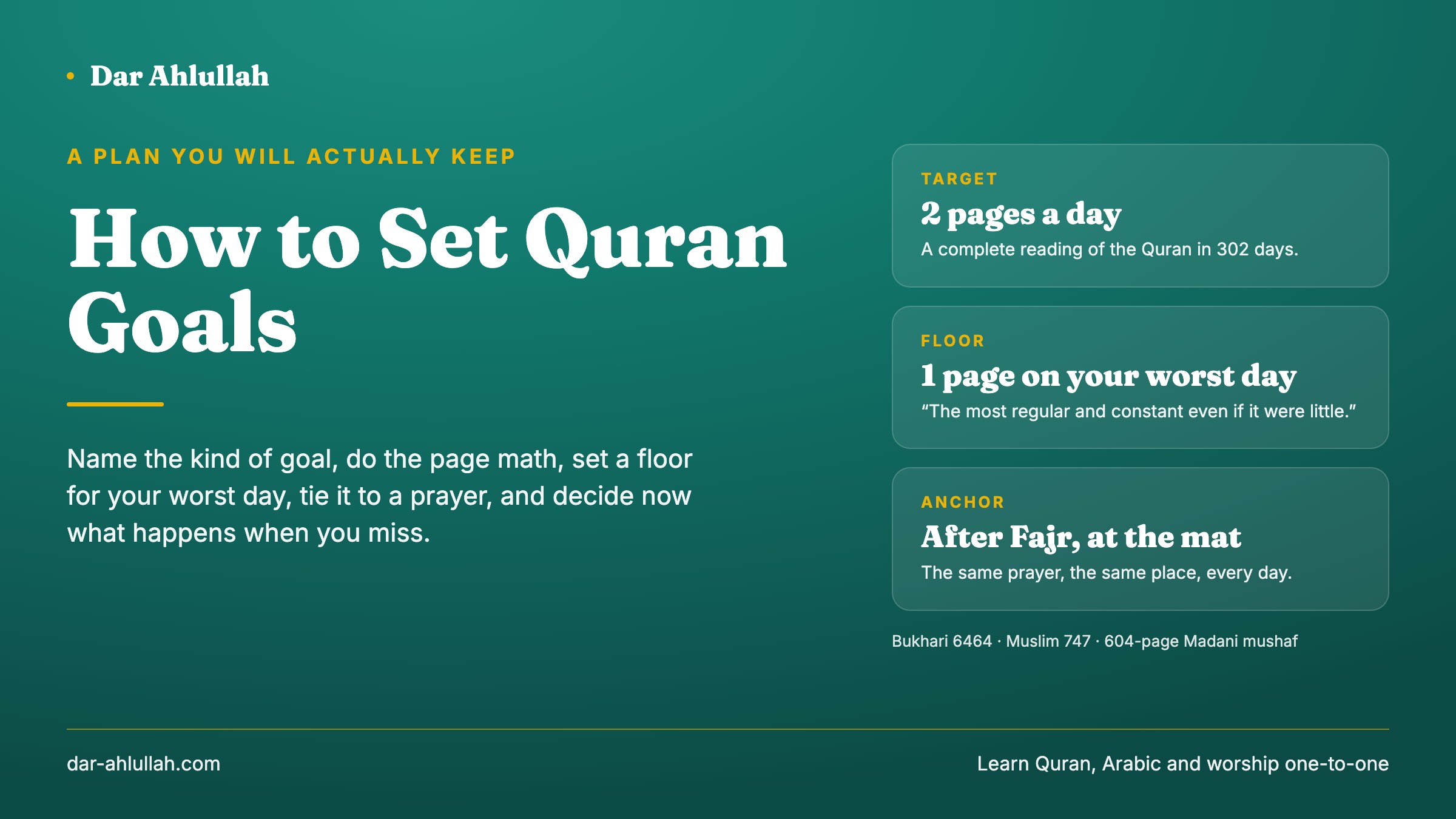
Most Quran goals are wishes, not plans. How to set one that lasts: name which of the four kinds of goal it is, do the math against the 604-page mushaf, set a floor for your worst day as well as a target, tie it to a prayer, and decide now what happens when you miss.
17 min read
most common words in the Quran
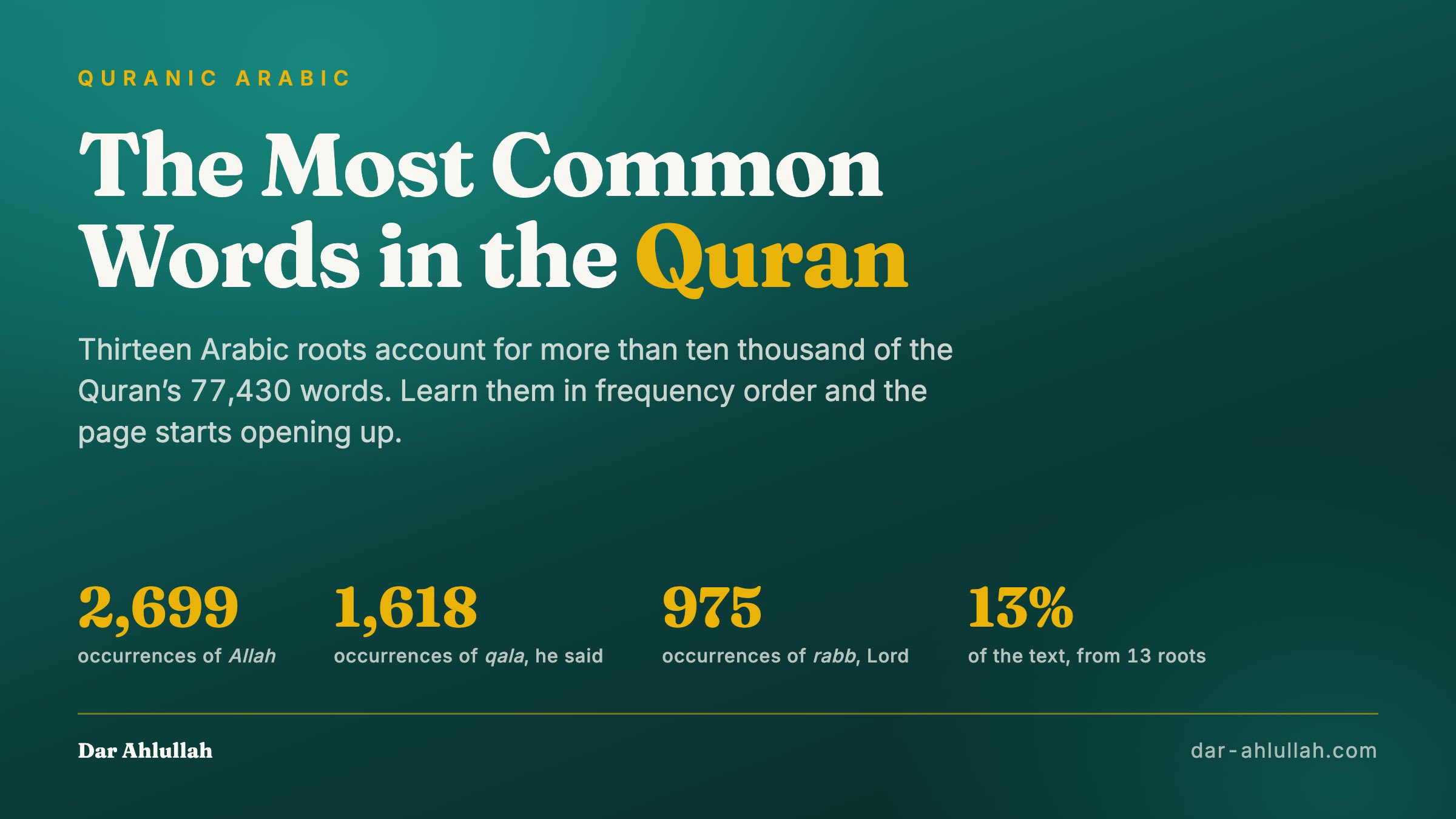
The Most Common Words in the Quran: 13 Roots That Cover 10,000+ Words
Thirteen Arabic roots account for more than ten thousand of the Quran's 77,430 words. Learning them in frequency order is the shortest route from reciting to understanding.
16 min read