
Indo-Pak vs Uthmani script
Indo-Pak vs Uthmani Script: What Actually Differs in the Mushaf
Dar Ahlullah team 21 min read
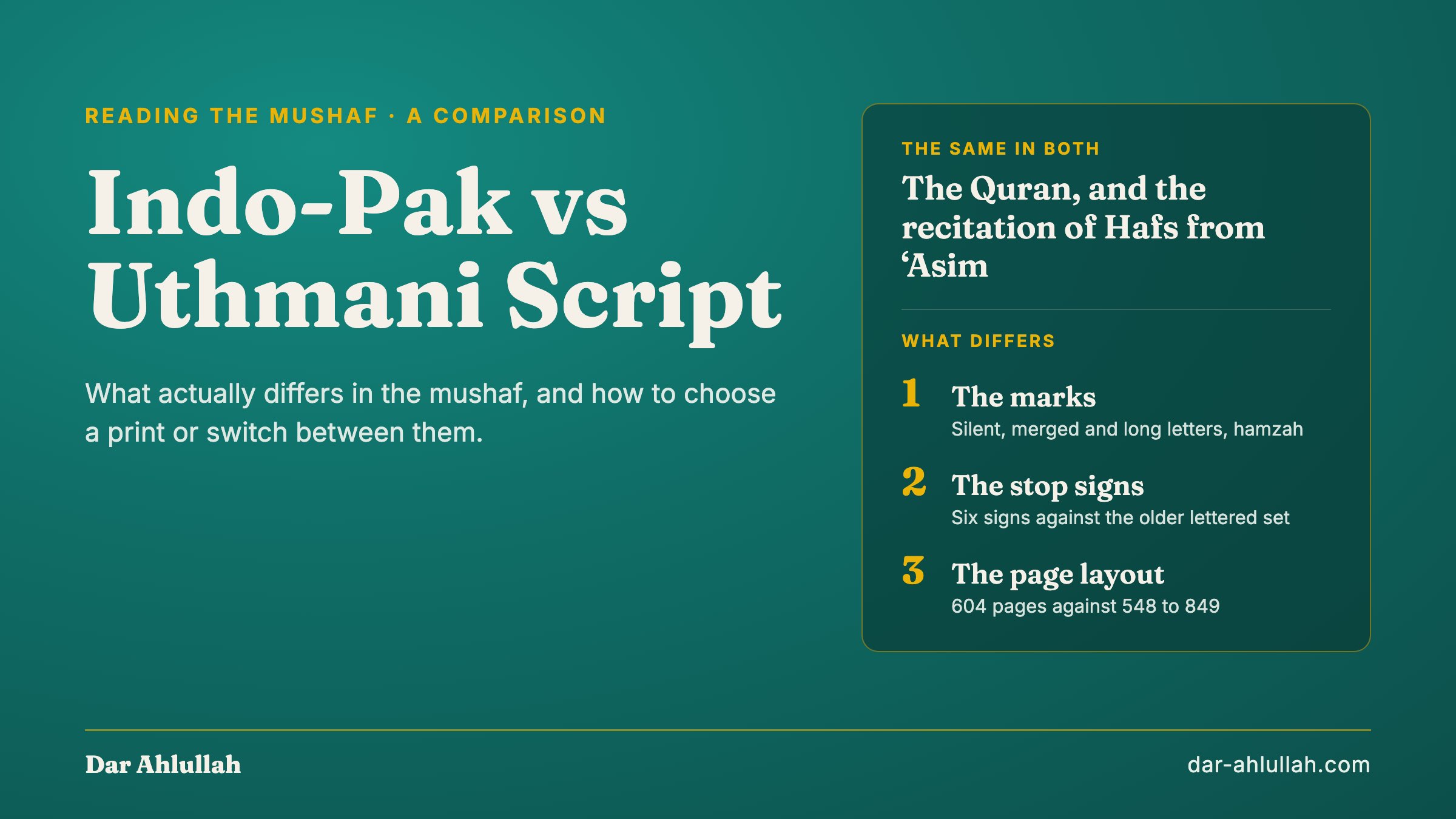
Table of Contents
- Introduction: The Same Surah on a Page That Looks Wrong
- The Short Answer
- What the Two Names Actually Mean
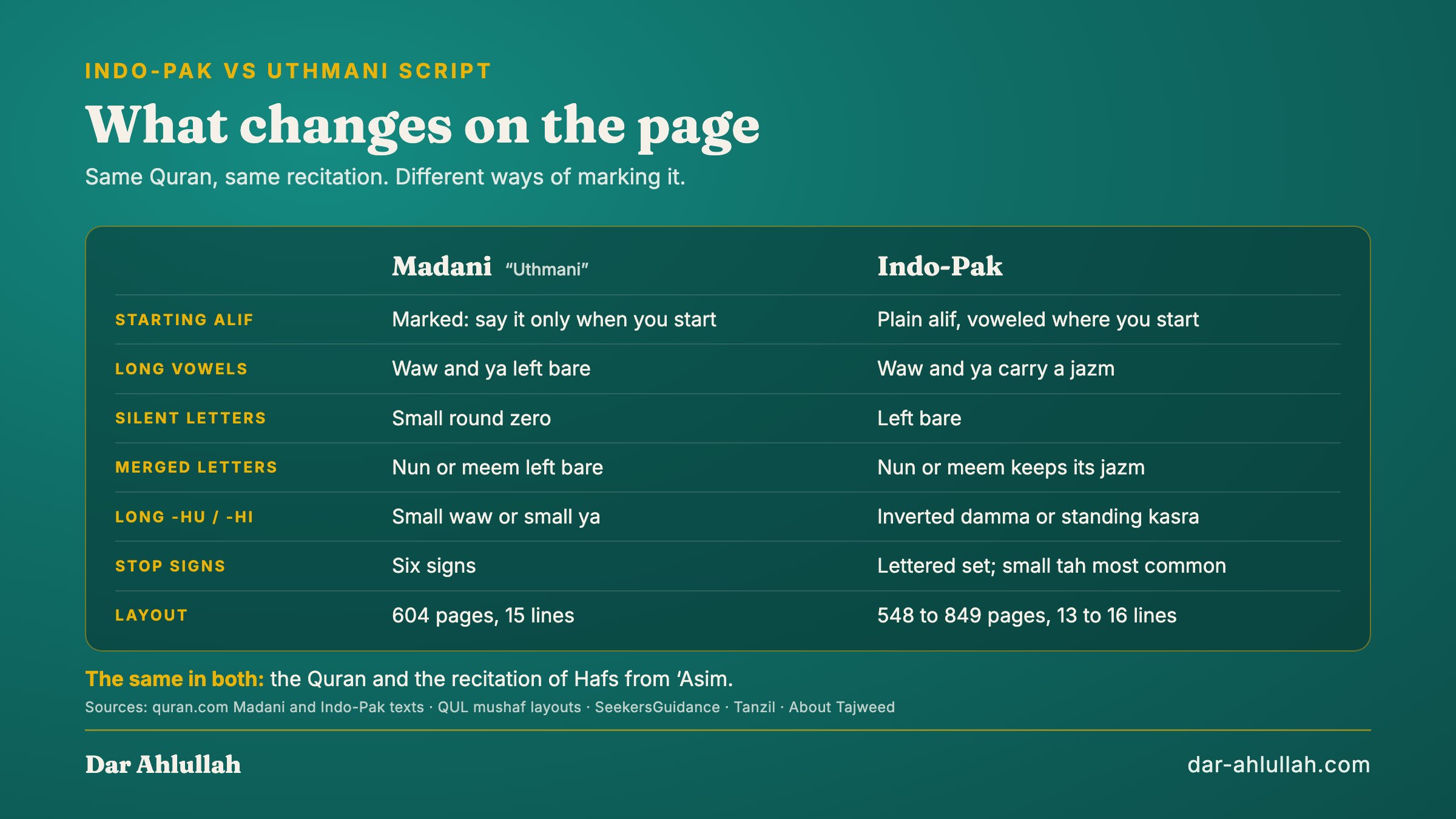
- Indo-Pak vs Uthmani Script at a Glance
- The Marks That Differ, Word by Word
- Stop Signs: Two Systems for the Same Pauses
- Pages, Juz and Ruku‘: Why Your Place Moves
- Which Should You Read?
- Switching From One Print to the Other
- Five Common Misunderstandings
- How We Teach This
- Questions People Ask
- Conclusion: Learn the Page, Keep the Recitation
Introduction: The Same Surah on a Page That Looks Wrong
If you learned to read the Quran from a South Asian mushaf and then open a copy printed in Madinah, the first page can feel like a different book. The letters sit differently on the line, small circles and strokes appear in unfamiliar places, the stop signs have changed, and the surah you could find without looking is now on another page. Readers going the other way get the same shock in reverse: a reader trained on the Madinah print who opens an Indo-Pak copy at a local mosque finds marks over long vowels that seem to say “stop the sound” exactly where they have always lengthened it.
Search for the difference between Indo-Pak vs Uthmani script and you mostly find one sentence repeated: the scripts look different, but the Quran is the same. That sentence is true, and it is not enough to read with. This guide goes further. It sets the two prints side by side using quran.com’s own Madani and Indo-Pak texts, shows the specific marks that change and what each one tells you, counts the stop signs in each, and ends with a practical way to choose a print and to switch when you need to.
The Short Answer
- It is the same Quran and the same recitation. Both prints carry the reading of Hafs from ‘Asim, and the tajweed you apply follows that reading, not the print: “The rules of tajwid should be applied no matter which script one is reciting from” (SeekersGuidance).
- “Uthmani script” usually means the Madani print, the Naskh-hand mushaf of the King Fahd Complex in Madinah. “Indo-Pak” means the South Asian print tradition. Both are meant to follow the spelling of the Uthmanic codex, so the name is a habit, not a verdict.
- The differences are in the marks, the stop signs and the layout: how hamzah, silent letters, merged letters and long vowels are shown; which stop signs are used and how often; and where the pages and a few juz break.
- Neither is more correct. Read from the print you will actually use every day, usually the one your teacher and your mosque use, and memorise from one consistent copy.
What the Two Names Actually Mean
The labels confuse people because they name different kinds of thing. “Uthmani” is about spelling: the written form of the copies the Caliph ‘Uthman had made and sent to the Muslim lands, which fixed the order of the surahs and verses as we have them now (Wikipedia, Uthmanic codex). “Indo-Pak” is about a region and its printing tradition. In everyday use, though, people say “Uthmani script” for the mushaf printed in Madinah and “Indo-Pak script” for the mushaf printed in South Asia, and that is how this article uses them.
The Madinah mushaf is the work of the King Fahd Glorious Quran Printing Complex, which opened in 1985 and has printed more than 128 million copies; its original copy was handwritten by the calligrapher Uthman Taha (Wikipedia, King Fahd Complex; Wikipedia, Uthman Taha). Tarteel’s Quranic Universal Library describes it as “the Madani script (also known as Uthmani script)”, used in Madinah and other Arab regions, and the Indo-Pak style as the one “used in South Asian printed Mushafs” following “the Indian subcontinent reading tradition” (QUL, Quran Script). The Quran Fonts guide puts the visual difference in one line: the Madinah print is a Naskh hand, while printed mushafs in Pakistan, India and Bangladesh usually use Nastaleeq, where “the line slopes, and the letter groups hang in a way Madani Naskh does not” (Quran Fonts).
Three facts keep the comparison in proportion:
- The recitation is the same. Hafs from ‘Asim is the reading chosen by the 1924 Cairo edition, the first printed Quran accepted by al-Azhar and a model for many later editions (Wikipedia, Cairo edition), and it is the reading of both prints. “The only thing that distinguishes these two scripts is the writing. The sound remains the same,” as the support page of Greentech’s Quran app puts it (GTAF).
- Both claim the Uthmanic spelling. Asked why a mushaf printed in India looked different from one printed in the Gulf, IslamWeb answered that the differences “might be due to the style of calligraphy” and that “all the styles are within the limits of the script during the caliphate of ‘Uthmaan” (IslamWeb 89482). The spellings are not identical letter for letter, as you will see below, but the variations are read the same way.
- Madinah prints an Indo-Pak edition too. QUL lists a 15-line Indo-Pak Nastaleeq layout “published by the King Fahad Glorious Quran Printing Complex”, 610 pages long (QUL). The choice is not Saudi against South Asian; it is one set of reading conventions against another.
If you are still at the stage of learning the letters, none of this needs solving first. Our complete guide to learning the Quran online sets out the whole path, and the comparison below matters most once you can already read a line.
Indo-Pak vs Uthmani Script at a Glance
| Madani (“Uthmani”) print | Indo-Pak print | |
|---|---|---|
| Where you meet it | The Arab world; per GTAF, it is also what you are most likely to find on the shelves of the two Harams | Bangladesh, India, Indonesia and Pakistan, per GTAF |
| Hand | Naskh | Nastaleeq-style |
| Recitation | Hafs from ‘Asim | Hafs from ‘Asim |
| Alif you say only when starting (hamzat al-wasl) | Marked on the alif: ٱلْحَمْدُ | Plain alif, given a vowel where you are expected to start: اَلۡحَمۡدُ |
| Hamzah on an alif | Hamzah sign: أَنْعَمْتَ | Vowel only: اَنۡعَمۡتَ |
| Long-vowel waw and ya | Left bare: ٱلَّذِينَ | Carry a jazm: الَّذِيۡنَ |
| Letters never pronounced | Small round zero: تُفْسِدُوا۟ | Left bare: تُفۡسِدُوۡا |
| Nun or meem merged into the next letter | Left bare: مِّن رَّبِّهِمْ | Keeps its jazm: مِّنۡ رَّبِّهِمۡ |
| The lengthened -hu / -hi | Small waw or ya: عِندَهُۥٓ | Inverted damma or standing kasra: عِنۡدَهٗۤ |
| Stop signs | Six | The older lettered set, with the small ط the most common |
| Sections | Hizb quarters | Ruku‘ sections marked with ع |
| Common layouts | 604 pages, 15 lines | 13, 15 or 16 lines; 548 to 849 pages |
The Marks That Differ, Word by Word
All the Arabic in this section is copied from quran.com’s two public texts (Madani and Indo-Pak), the Madani form first and the Indo-Pak form second. Your screen will probably draw both in the same font, so the letter shapes will look alike. Compare the marks, which is where the real differences are, and open any verse on quran.com to see it in a proper mushaf font. Where a count is given, it is our own count of each mark across all 6,236 verses of those two texts.
1. The alif you only say when you start
The first word of al-Fatihah’s second verse is ٱلْحَمْدُ in the Madani text and اَلۡحَمۡدُ in the Indo-Pak (al-Fatihah 1:2). The Madani print puts a small mark on the alif, the sign of hamzat al-wasl, and puts the same mark on the alif of ٱلْعَـٰلَمِينَ later in the verse. The mark means: pronounce this alif only if you begin on this word; in the middle of a phrase, skip it. It appears 13,483 times in the Madani text.
The Indo-Pak text has no such mark at all. Where the editors expect you to start, the alif carries the vowel you need, as in اَلۡحَمۡدُ; in the middle of a phrase it is left bare, as in الۡعٰلَمِيۡنَ, and you pass over it. A Shaykh at SeekersGuidance explains that this absence is “to facilitate ease and fluency of recitation for anyone who does not know Arabic”, and adds the catch: if you start somewhere the print did not expect, you supply the vowel yourself. His example is 112:2: starting on it, you say Allahu with a fatha on the alif; joined to the verse before, it becomes …ahadunillahu (SeekersGuidance).
2. Hamzah written, or only voweled
In 1:7 the Madani text writes أَنْعَمْتَ with a hamzah sign on the alif; the Indo-Pak text writes اَنۡعَمۡتَ, with only the fatha. The same happens with إِلَّا against اِلَّا and تَأْخُذُهُۥ against تَاۡخُذُهٗ in Ayat al-Kursi (2:255). The person who asked SeekersGuidance the question above noticed the same thing: “in the Indo-Pak style, there is no hamzah on the alif.” The pronunciation is unchanged. In ta’khudhuhu, the jazm on the Indo-Pak alif tells you it is a hamzah closing the first syllable, which is exactly what the Madani hamzah sign says.
3. Long vowels: a bare letter or a jazm
Later in 1:7, the Madani text has ٱلَّذِينَ and ٱلْمَغْضُوبِ, with the ya and the waw of the long vowels left unmarked. The Indo-Pak text has الَّذِيۡنَ and الۡمَغۡضُوۡبِ, with a jazm on each. The sound is identical: alladhina, al-maghdubi, with the ordinary two-count length.
This one convention changes how busy the page looks. The Madani text uses about 37,000 sukun marks; the Indo-Pak text uses about 62,000, and some 18,000 of those sit on a long-vowel waw or ya. It is also the mark that most often trips a reader moving from Madani to Indo-Pak, who has learned that a sukun means the vowel stops. On a long vowel it does not: the letter is still lengthened.
4. Letters you do not pronounce
In 2:11, the Madani text writes تُفْسِدُوا۟: the final alif carries a small round zero, which means “the letter is not pronounced in any case”, whether you stop or continue (About Tajweed). The Madani text uses that mark 3,988 times. The Indo-Pak text writes تُفۡسِدُوۡا: the alif after the waw has no mark at all, and in that print a bare alif that does not follow a fatha is silent.
The Madani print has a second, rarer sign: an upright oblong zero on a final alif, meaning read the alif when you stop on the word and drop it when you carry on. It is on أَنَا۠ in 109:4. The Indo-Pak text writes اَنَا with no special mark, so the reader is expected to know that ana is short when joined to the next word. The Madani text uses this sign 66 times and the Indo-Pak text not at all.
5. Letters that merge into the next
Take مِّن رَّبِّهِمْ in 2:5. In the Madani text the nun has no sukun and the ra after it is doubled: the bare nun is the cue that it disappears into the ra. The Indo-Pak text writes مِّنۡ رَّبِّهِمۡ, with a jazm on the nun. The doubled ra still tells you to merge, but the cue on the nun itself is gone. The same happens with the meem in لَهُم مَّثَلًا against لَهُمۡ مَّثَلًا (36:13). The rule underneath is the same idgham in both prints, which our Tajweed rules for beginners walks through.
Tanween works the same way. In Ayat al-Kursi the Indo-Pak text writes سِنَةٌ وَّلَا, with a shaddah on the waw to show the tanween merging into it. The Madani text reads سِنَةٌ وَلَا with no shaddah. In the printed Madinah mushaf the merge is shown by the tanween itself: “tanweens are shown sequentially in the cases of idgham and ikhfa”, that is, the two strokes are staggered rather than stacked (Tanzil). Standard Unicode has no character for a staggered tanween, which is why the Madani line here looks plain.
6. The lengthened -hu and -hi
When the pronoun -hu or -hi is lengthened, the Madani text writes a small waw or small ya after it: عِندَهُۥٓ and بِإِذْنِهِۦ in Ayat al-Kursi. The Indo-Pak text writes an inverted damma or a standing kasra on the letter itself: عِنۡدَهٗۤ and بِاِذۡنِهٖ. These are the marks many South Asian teachers call ulta pesh and khari zer. The two systems line up almost one for one: 1,257 small waws against 1,255 inverted dammas, and 957 small yas against 986 standing kasras. Both mean the same thing: lengthen.
7. A few words written differently
Some long vowels are written with a full alif in one text and a small superscript alif in the other. In 1:6 the Madani text has ٱلصِّرَٰطَ and the Indo-Pak text الصِّرَاطَ; 2:7 does the same with absarihim and ghishawah. You read them identically, with a long aa.
One difference is in a vowel. In 30:54 the Madani text has ضَعْفٍ with a fatha on the dad, and the Indo-Pak text ضُعۡفٍ with a damma. When a reader asked a South African mufti about exactly this word, the answer was: “Both ways are permissible” (Mufti Ebrahim Salejee, via islamqa.org). Read it the way your print and your teacher do.
Stop Signs: Two Systems for the Same Pauses
Stop signs are where the two prints differ most, and where a reader who switches most often goes wrong. They are an aid added by editors, not part of the revealed text: “These signs were inserted later on for the convenience of the reciter,” in the words of a mufti asked why the two prints place them differently (Mufti Online). The lettered convention most mushafs grew from is attributed to Muhammad ibn Tayfour al-Sajawandi, who died in 560 AH (Wikipedia, Qur’anic punctuation).
The table counts each sign across quran.com’s two texts. The meanings are Wikipedia’s.
| Sign | Meaning | Madani text | Indo-Pak text |
|---|---|---|---|
| م | Necessary stop: ignoring it “may lead to change in the meaning” | 22 | 88 |
| ط | Absolute stop: “Full stop even though the verse is not complete” | 0 | 3,542 |
| ج | Permissible: better to stop, but you may carry on | 1,972 | 1,694 |
| قلى | Stopping is preferable | 603 | 0 |
| صلى | Joining is preferable | 1,682 | 269 |
| لا | Do not stop; if you do, go back and restart before the sign, “unless it’s the end of a verse” | 68 | 1,549 |
| Three dots, in pairs | Stop at one of the two places, not both | Yes | Yes, drawn over a small ج |
Three things stand out. Apart from a few small س marks for the brief pause called saktah, the Madani text uses just the six signs above. The Indo-Pak text’s most frequent sign, the small ط, does not appear in the Madani text at all. And the Indo-Pak لا often sits on the verse-end circle itself, as at the end of 1:2 and 1:6; by Wikipedia’s note, stopping at a verse end does not send you back. Wikipedia’s article lists further lettered signs from the same older system, such as ز, ص, ق and قف, and you will meet some of them in Indo-Pak prints.
The necessary stop shows how far the systems can part. In 36:13 the Indo-Pak text reads الۡقَرۡيَةِ ۘ اِذۡ, with a compulsory م after al-qaryah; the Madani text reads ٱلْقَرْيَةِ إِذْ with no sign there at all. This is the exact verse a questioner raised with Mufti Online, and the answer was the one above: the signs are a convenience, so some mushafs have them where readers need them.
What should you do with that? The SeekersGuidance answer is practical. If you do not know the rules of stopping and starting, “he should just stick to the stops and starting points in the Mughali script”, because “Those stops and pauses are all based on the stops of the Prophet (Allah bless him and give him peace), tafsir-related positions, and choices that facilitate recitation.” The same advice works for either print. Follow the signs of the copy in front of you, and when you switch prints, learn its signs before anything else.
Pages, Juz and Ruku‘: Why Your Place Moves
Layout is the difference you feel first and the one with nothing to do with reading. Page counts in QUL’s layout data:
| Layout | Lines per page | Pages |
|---|---|---|
| Madani, King Fahd Complex (1405H, 1421H and 1441H prints) | 15 | 604 |
| Indo-Pak Nastaleeq, King Fahd Complex | 15 | 610 |
| Indo-Pak, Qudratullah (Lahore) | 15 | 610 |
| Indo-Pak, Taj Company | 16 | 548 |
| Indo-Pak, Taj Company | 13 | 847 |
| Indo-Pak, Qudratullah | 13 | 849 |
Sources: QUL layouts Madani 1405H, 1421H, 1441H, KFGQPC Nastaleeq, Qudratullah 15-line, Taj 16-line, Taj 13-line and Qudratullah 13-line. Even within one publisher the page breaks can move between print years: GTAF notes that page 121 of the 1405H Madani print starts at al-Ma’idah 5:77 and of the 1440H print at 5:78 (GTAF).
The thirty juz are almost, but not quite, the same. GTAF lists seven juz that begin at a different verse depending on the script (GTAF). quran.com, which follows the Madani division, starts them at the first verse in each pair below (quran.com juz data):
| Juz | Madani start | Indo-Pak start |
|---|---|---|
| 4 | Al ‘Imran 3:93 | 3:92 |
| 7 | Al-Ma’idah 5:82 | 5:83 |
| 11 | At-Tawbah 9:93 | 9:94 |
| 14 | Al-Hijr 15:1 | 15:2 |
| 20 | An-Naml 27:56 | 27:60 |
| 21 | Al-‘Ankabut 29:46 | 29:45 |
| 23 | Ya-Sin 36:28 | 36:22 |
Within the juz, the prints subdivide differently. The Madani print marks the quarters of each hizb, half a juz, with a small emblem in the text. Indo-Pak prints add the ruku‘, sections of roughly ten verses (Wikipedia, Quran) whose end is marked with an ع in the margin (Wikipedia). The ruku‘ is not part of the Uthmanic writing either; IslamWeb suggests, with an “It seems”, that it was introduced to portion the recitation for the twenty rak‘ahs of tarawih (IslamWeb 89482).
For a reader, none of this matters. For someone memorising, it matters a great deal. A hafiz remembers where a verse sits on the page, and that cue “belongs to one printing”, as our guide to memorising similar verses puts it. Move from a 13-line copy to a 15-line copy and every page boundary you built moves with it. If you set reading targets by page, as in our guide to setting Quran goals, count in juz when your copy is not the 604-page Madani print.
Which Should You Read?
There is no right answer in the abstract, only a right answer for your situation:
| Your situation | What to read |
|---|---|
| You already read one print fluently | Stay with it. Nothing about it needs fixing. |
| You are starting from zero as an adult | The print your teacher reads from. If you have no teacher yet, the one on the shelves of the mosque you attend, so that what you learn at home matches what you meet there. |
| You are memorising | One fixed copy, the same layout as your teacher’s, and never a switch midway. |
| You are teaching a child | Choose the mushaf first, then a Qaida whose marks match it. Our Noorani Qaida guide makes the same point about letterforms: drill the ones you will meet. |
| You read in mosques that use both | Keep one print for memorising and learn to read the other. It takes the marks in this article, not a new alphabet. |
| You read on a phone | Some apps offer both. Greentech’s Quran app, for example, lets you pick the script in Settings (GTAF). Choose the one that matches your printed copy. |
If you are torn between the two on their merits, the honest summary is that they make different trade-offs. The Indo-Pak print puts a jazm on far more letters and gives you the vowel to start on, and the SeekersGuidance answer explains its missing wasl sign as an aid for “anyone who does not know Arabic”. The Madani print puts more of the tajweed on the page: it shows silent letters, merged letters and merging tanween with marks of their own. Either way, you still need the rules underneath, which our guide to reading the Quran for beginners takes in order.
Switching From One Print to the Other
Switching is mostly a matter of re-learning what a handful of marks mean. This order puts the mistakes that cost the most first:
- Learn the new stop signs before anything else. A misplaced stop can change the meaning, which is not true of most of the other differences. Going to Indo-Pak, learn that the small ط is a full stop. Going to Madani, learn قلى and صلى and the six-sign set.
- Read surahs you already know in the new print. With the words familiar, the marks are the only new thing on the page, and you will notice them instead of decoding around them.
- Drill the five mark pairs. Hamzat al-wasl against a voweled or bare alif; a bare long vowel against a jazm on it; the small round zero against a bare silent letter; a bare merged nun or meem against one with a jazm; a small waw or ya against an inverted damma or standing kasra.
- Listen while you read. The recitation is the same in both prints, so any recording of Hafs confirms that the new marks are producing the sounds you already know.
- Read to someone qualified for a few sessions. The errors switchers make are predictable: dropping an alif they should start on, shortening a long vowel under a jazm, missing a stop. A listener catches them in minutes.
- Do not move your memorisation. If you are a hafiz or working towards it, keep your old copy for memorising and revising, and use the new print only for reading.
Five Common Misunderstandings
1. “The Indo-Pak mushaf is not the Uthmani Quran”
The name invites this, and it is wrong. IslamWeb holds that the styles “are within the limits of the script during the caliphate of ‘Uthmaan”, adding that committees of specialised scholars supervise printing in every country. The differences are in the marks, the signs and the layout.
2. “A different script means a different recitation”
Both prints are Hafs from ‘Asim. The tajweed rules follow the reading, not the script, and in a word like da‘f / du‘f, where the prints differ, both ways are permissible.
3. “The stop signs are part of the revealed text”
They are editors’ guidance, “inserted later on for the convenience of the reciter”. That is why the two prints can disagree about a verse like Ya-Sin 36:13 and both be right to print what they print.
4. “A jazm on a long vowel means stop the sound”
In the Indo-Pak print, the jazm on the waw of al-maghdubi or the ya of alladhina marks a long vowel, not a closed syllable. Lengthen it as you always have.
5. “If I know my pages, I will know them in any copy”
Page memory belongs to one layout. A 604-page Madani copy and an 847-page 13-line copy break in different places, so a hafiz who switches loses every visual anchor at once.
How We Teach This
A print is something you learn to read, not something you have to choose correctly on day one. What a teacher adds is the part a page cannot: hearing you recite, catching the alif you dropped or the stop you missed, and keeping your recitation the same whichever page is in front of you. If you take lessons anywhere, it helps to say at the start which print you read from, so the page you use and the page your teacher refers to match.
Dar Ahlullah runs one-to-one live sessions with certified teachers, scheduled around your own time zone, in Quran reading, Tajweed, Hifz, Arabic and Islamic Studies. Teaching is charged at $9 per teaching hour, with monthly plans at $36, $70 and $102 depending on how many hours you want, and a 20% discount for siblings. You can pause, upgrade or switch plans at any time, and if a teacher is not the right fit we rematch you with another certified mentor at no extra cost. The first step is a free 30-minute assessment that does not ask for a card; the details are on our pricing page.
Questions People Ask
Is the Indo-Pak mushaf less correct than the Madani one?
No. Both carry the same recitation, both are meant to follow the Uthmanic spelling, and IslamWeb attributes the differences to calligraphic style. “The sound remains the same,” in GTAF’s words.
Is “Uthmani script” the same as “Madani script”?
In everyday use, yes: QUL calls it “the Madani script (also known as Uthmani script)”. Strictly, “Uthmani” describes the spelling of the Uthmanic codex, which both prints aim to follow.
Which script is easier for beginners?
Neither is easier in general. The Indo-Pak print puts a jazm on far more letters and gives you the vowel to start on, which helps a reader who does not know Arabic; the Madani print puts more of the tajweed on the page. The easier one is the one your teacher uses, because every correction then refers to the page in front of you.
Can I memorise from one print and revise from the other?
It is better not to. The text is the same, but page position is one of the strongest cues a memoriser has, and it does not survive a change of layout.
What do “13-line” and “15-line” mean?
The number of lines on each page. QUL’s data gives 847 and 849 pages for two 13-line Indo-Pak layouts, 610 for two 15-line Indo-Pak layouts, 548 for a 16-line one, and 604 for the 15-line Madani print.
Why does my app start a juz at a different verse from my printed copy?
Seven juz begin at different verses in the two traditions, Juz 23 at Ya-Sin 36:28 in the Madani division and at 36:22 in the Indo-Pak, for example. Check which script the app is set to.
Why does my mushaf have an ع in the margin?
It marks the end of a ruku‘, a section of roughly ten verses used in Indo-Pak prints. The Madani print does not use them.
Does the Noorani Qaida use the Indo-Pak or the Madani style?
Editions differ. Pick one whose marks match the mushaf you will read from, so that the jazm, the alif and the long vowels you drill are the ones you will meet.
Conclusion: Learn the Page, Keep the Recitation
The Indo-Pak and Madani prints are two ways of writing down the same recitation. One shows a silent alif with a small zero, the other leaves it bare. One leaves a long vowel unmarked, the other gives it a jazm. One stops with قلى, the other with ط. Learn which conventions your copy uses and the page stops looking wrong.
So pick the print you will actually read from, most often the one your teacher and your mosque use. Memorise from one copy and keep it. When you meet the other print, read a familiar surah in it, learn its stop signs first, and listen as you go. The recitation does not change between them, so you can learn to read both.
Related articles
Noorani Qaida
Noorani Qaida: What It Is and How to Actually Finish It
Every Quran teacher says “we will start with the Qaida” as if you already know what that means. Here is what the book is, what each block of lessons trains, why the order is not negotiable, and the five habits that leave people stuck on page nine.
20 min read
how to read the Quran for beginners
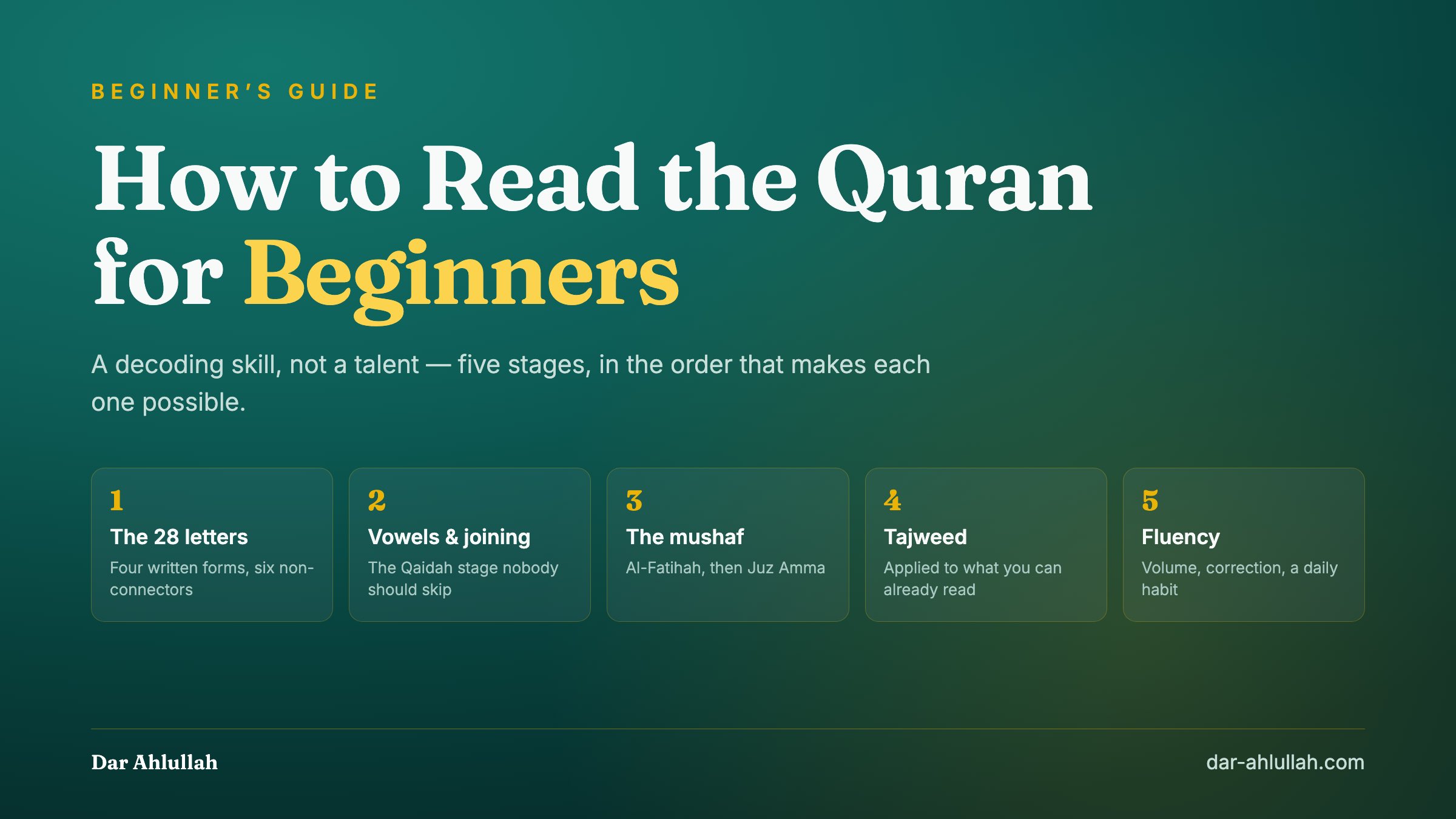
How to Read the Quran for Beginners: A Step-by-Step Route
Reading the Quran is a decoding skill, not a talent — and almost every beginner who stalls stalled on the order, not the difficulty. Here are the five stages, what marks the end of each, and why the Qaidah is the one nobody should skip.
20 min read
sajdah tilawah
Sajdah Tilawah: What to Do at a Prostration Verse
Sajdah tilawah is the single prostration that belongs to reciting or hearing one of the Qur'an's verses of prostration. Where those verses are, why the four schools count fourteen, fifteen and eleven of them, how to perform it, and the answers for a desk, a recitation app, a live lesson and a hifz drill.
26 min read