
how to help a child who forgot Quran memorization
What to Do When Your Child Forgets Their Quran Memorization
Dar Ahlullah team 22 min read
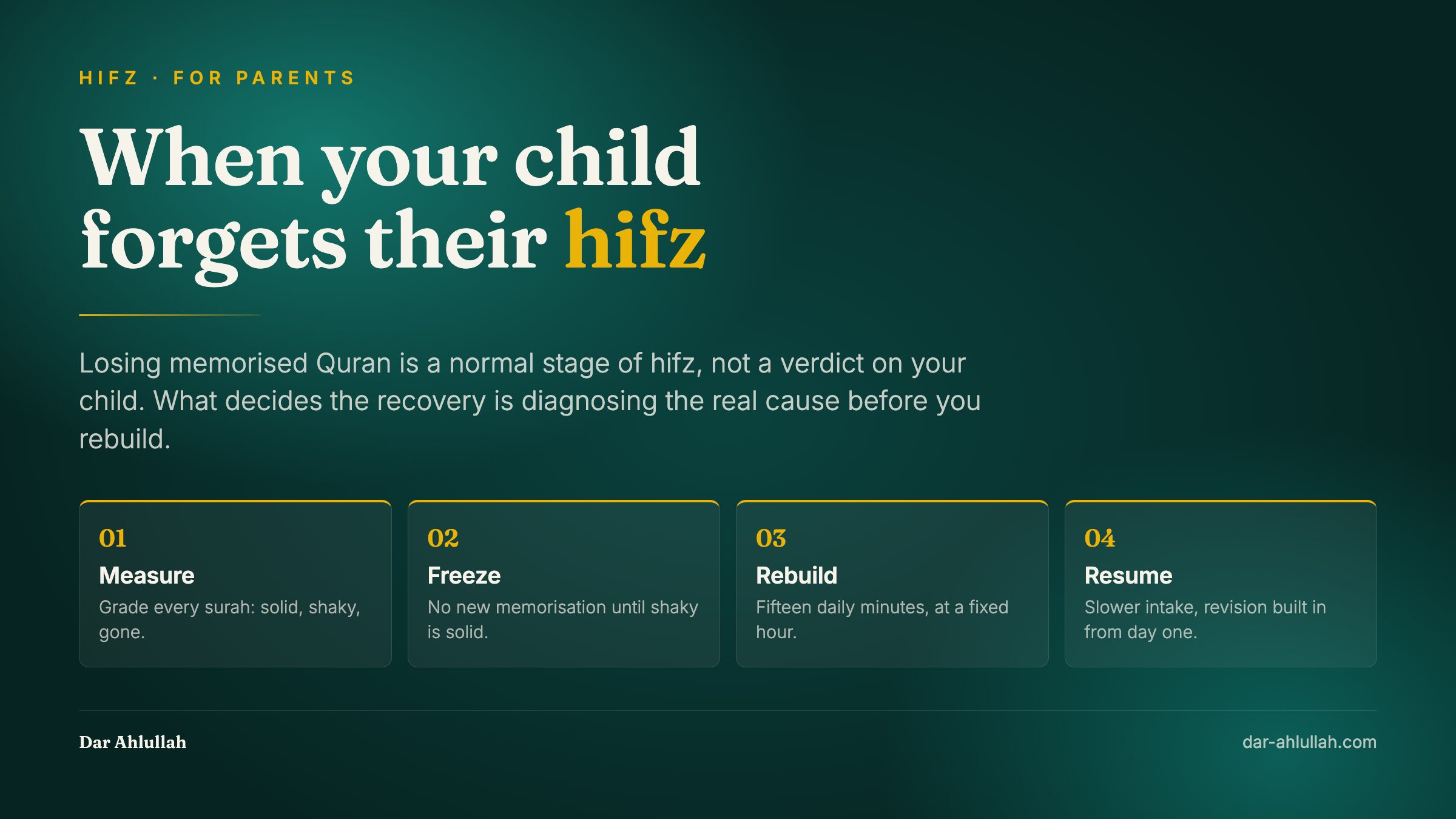
Table of Contents
- Introduction: The Evening It Falls Apart
- The Short Answer: Stop, Measure, Freeze, Rebuild
- Forgetting Is How Memory Works, Not How Your Child Failed
- Diagnose Before You Fix: Five Causes That Look Identical
- The Audit: Find Out What Your Child Actually Still Holds
- Freezing New Memorisation, and Why It Feels Wrong
- A Four-Week Recovery Block
- The Daily Loop, at a Child’s Scale
- What a Parent Who Reads No Arabic Can Still Do
- When the Memory Is Not the Problem — the Reading Is
- The Half of This That Is Not Technical
- When the Teacher, Not the Child, Is the Variable
- The Predictable Relapse Points in a Year
- How We Handle a Child Who Has Lost Ground
- Questions Parents Ask
- Conclusion: The Recovery Is Shorter Than the First Pass
Introduction: The Evening It Falls Apart
It usually surfaces by accident. You ask your son to lead a short prayer, or a relative asks your daughter to recite something she finished last year, and what comes out is two lines and then silence. The surah you both sat through for six weeks last spring is gone. Not shaky — gone.
The reaction in that moment tends to be some blend of alarm and guilt, and it usually produces the two worst available responses: an emotional conversation about how much time was wasted, or a decision to double the daily portion to catch up. Both make the situation worse, and both are extremely common.
This guide is about how to help a child who forgot Quran memorization without either of those. It is written for a parent, not for a hifz student, and it assumes you may not read Arabic yourself. The sequence it describes is deliberately unglamorous: find out what is actually still there, stop adding to the pile, rebuild on a schedule, and only then start moving forward again. It also assumes something that most parents are not told early enough — that losing memorised material is a normal, expected stage of hifz rather than evidence that your child is not suited to it.
If your child has not started memorising yet and you are here pre-emptively, the better starting point is our step-by-step guide to memorising the Quran online, which lays out the cycle this article is trying to repair.
The Short Answer: Stop, Measure, Freeze, Rebuild
If you have ten minutes rather than an afternoon, this is the whole method in five moves.
- Say nothing evaluative in the moment. Whatever you say the evening you discover the loss becomes the emotional frame for the next six months. Postpone the conversation.
- Measure before you plan. Sit with the teacher and grade every surah your child has memorised into three buckets: solid, shaky, gone. Almost nobody does this, and almost every recovery plan built without it is aimed at the wrong material.
- Freeze new memorisation completely. No new lines until the shaky bucket is solid. This is the single hardest instruction in the article and the one that decides the outcome.
- Rebuild on a fixed daily loop, not on effort. A small amount of revision every day beats a long weekend session, and the gap between those two approaches widens over months.
- Change one input, not five. If the schedule, the teacher, the time of day and the portion size all change at once, you will never know which one was the problem.
The rest of this article is the detail: how to run the audit, how to tell the five causes apart, what a four-week recovery block looks like, and what to do when the real problem turns out to be reading rather than memory.
Forgetting Is How Memory Works, Not How Your Child Failed
The most useful thing a parent can internalise here is that the loss was predicted. It is not a diagnosis of the child.
The Prophet ﷺ is reported in Sahih al-Bukhari 5033 to have compared the Qur’an slipping from memory to camels escaping once their tethers are untied. That image was given to the first generation of huffaz — people memorising in an oral culture, with far fewer distractions than a nine-year-old in Manchester or New Jersey has. If it needed saying to them, it is not a modern discipline problem.
The mechanism is well described outside the tradition too. The forgetting curve describes how retention of newly learned material drops steeply in the first days after learning unless it is deliberately reviewed, with people typically halving their recall of new knowledge within days or weeks. The counter-measure is not more intensity at the start; it is spaced repetition, where the same material is revisited at widening intervals, which encodes far more into long-term memory than one concentrated block of study.
Put those two together and the shape of the problem becomes clear. A child who memorised twenty surahs in a year and reviewed none of them properly has not underperformed. They have done exactly what the curve says a person does. The system around them was missing its second half.
There is a third mechanism worth knowing, because it explains a specific and maddening symptom: your child recites a passage perfectly, then jumps mid-verse into a similar-sounding passage from a completely different surah. That is retroactive interference — newer memories obstructing the retrieval of older ones — and in Quran memorisation it concentrates in the verses that resemble each other closely. It looks like forgetting. It is not; the material is still there, and it needs a different fix, which we cover in our guide to memorising similar verses.
None of this makes the loss painless. It does mean that the honest sentence to say to your child is “this happens to everyone who memorises, and it is fixable,” and that the sentence is true rather than kind.
Diagnose Before You Fix: Five Causes That Look Identical
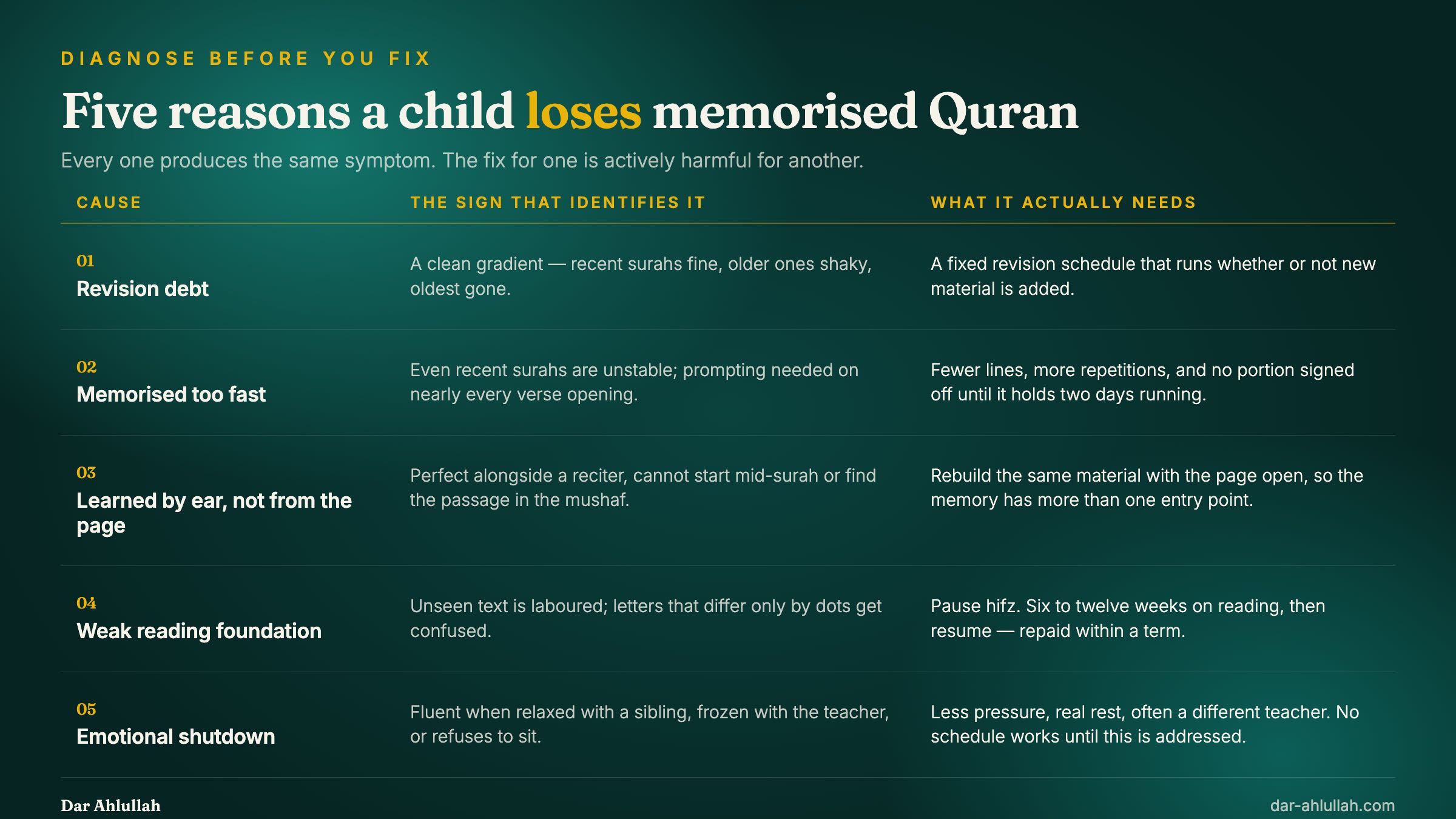
Every one of the five causes below produces the same visible symptom: a child who cannot recite something they once could. They need different responses, and applying the wrong one costs months.
Cause 1: Revision debt
By far the most common. New material was added every week and old material was never systematically revisited, so the total load quietly outgrew the review time allotted to it. The telltale sign is a clean gradient: recent surahs are fine, surahs from six months ago are shaky, surahs from two years ago are gone.
The fix is structural, not motivational — a fixed revision schedule that runs whether or not new material is being added. Our full treatment of that is in the muraja’ah guide; this article is the version for when the debt has already come due.
Cause 2: Memorised too fast to begin with
The material never reached the depth at which it survives. A child who memorised five lines in a session and moved on the next day has a pass-level memory of those lines and nothing more. The telltale sign is the opposite gradient to cause one: even fairly recent surahs are unstable, and the child needs prompting on the first word of almost every verse.
The fix is to slow the intake dramatically when memorisation resumes — fewer lines, more repetitions, and a rule that a portion is not finished until it can be recited on two consecutive days without the page.
Cause 3: Memorised by ear, not from the page
Very common with young children and with families who lean on recitation audio. The child learned the sound of the passage rather than its text, which works beautifully until the audio scaffold is removed. The telltale sign is that the child can recite along with a reciter perfectly and can start a surah unaided, but cannot start from the middle, cannot answer “what comes after this verse,” and cannot find the passage in the mushaf.
The fix is to rebuild the same material while looking at the page, which is slower and feels redundant to the child. It is not redundant — it is the difference between a memory with one entry point and a memory with many.
Cause 4: The reading foundation was never solid
The child cannot decode Arabic script fluently, so every memorisation session is really two tasks stacked on top of each other. Memory built this way is expensive to make and cheap to lose. The telltale sign is hesitation on unfamiliar words when reading rather than reciting, confusion between similar letters, and slow, effortful sounding-out.
The fix is to step back to the reading track for a period. This feels like a demotion and is nothing of the kind; see the section below for how to handle it.
Cause 5: Emotional shutdown
The child has stopped trying, usually after a period of being corrected more than encouraged, or after a public recitation that went badly. The telltale sign is a mismatch between capability and output: the child recites fluently when relaxed with a sibling and freezes with the teacher, or simply refuses to sit.
The fix is not a schedule. It is time, a reduction in pressure, and often a change of teacher — and no amount of revision structure will work until it is addressed.
The Audit: Find Out What Your Child Actually Still Holds
You cannot plan a recovery around an estimate, and almost every parent’s estimate is wrong in both directions — some material is far more intact than feared, some is more damaged.
The audit is one or two sessions, run by the teacher with you present or with a recording you can listen back to. Go through every surah on the child’s completed list. For each one, the child recites it from memory, unprompted, at normal pace. Grade the result into exactly three buckets.
| Grade | What it means | What it needs |
|---|---|---|
| Solid | Recited start to finish with no prompting and at most one small slip | Long-cycle maintenance only — once every week or two |
| Shaky | Recited, but with pauses, prompts on verse openings, or a wrong turn into a similar verse | Active daily rotation until it moves to solid |
| Gone | Cannot begin, or stops within the first few verses | Re-memorised from scratch — but far faster than the first time |
Two things almost always come out of this. The first is that the “gone” bucket is smaller than feared, because material that feels lost is often only unprompted-lost and returns after two or three sittings. The second is that the shaky bucket is much larger than anyone realised, and it is where the recovery plan should spend most of its time. Shaky material is cheap to save and expensive to lose; every week it stays shaky it drifts closer to gone.
Write the three lists down. Keep them somewhere visible. This is the document the next three months are built on, and it is also what you will use to show your child — concretely, on paper — that things are moving.
Freezing New Memorisation, and Why It Feels Wrong
Here is the instruction that gets resisted hardest: while the shaky bucket is being repaired, your child memorises nothing new. Not a reduced amount. Nothing.
Parents resist this because a hifz programme is usually measured by how much has been memorised, and a freeze looks like the counter stopping. Children resist it because their peers keep moving. Some teachers resist it because progress is easier to demonstrate than consolidation.
But the arithmetic is not really arguable. Adding new material while old material is unstable increases the revision load at exactly the moment the child is already failing to carry it, and it adds fresh interference to memories that are already competing with each other. It is pouring water into a bucket while you are trying to find the hole.
The freeze is also shorter than people expect — typically four to eight weeks for a child who has lost a year’s worth of material, because re-securing something once memorised is a fraction of the work of memorising it. Told as “four weeks of repair, then we move again,” with a date on the calendar, most children accept it. Told as an open-ended punishment, none do.
One narrow exception is worth allowing: if the child has an immediate, real need for a specific short surah — they are about to start praying independently and do not hold enough to do it — take that one surah out of the freeze. That is not progress-chasing; it is a functional requirement, and it is the same logic behind the ordering we describe in which surahs to memorise first.
A Four-Week Recovery Block
This is a template, not a prescription; the portion sizes scale with the child’s age and how much they hold. What should not change is the shape: daily, small, in a fixed slot, with the week’s work planned in advance rather than decided each evening.
Week 1 — stabilise the solid, stop the bleeding
Nothing from the gone list yet. The whole week runs on the solid and shaky lists. Each day the child recites two or three solid surahs (fast, from memory, no page) and works one shaky surah properly with the teacher. The goal of week one is not repair — it is that the daily slot actually happens seven times. If that does not hold, no later week will.
Week 2 — convert shaky to solid
The shaky list becomes the main workload. Each surah on it gets a full session, then reappears two days later, then four days later. Surahs that survive both re-tests move to the solid list, and the child crosses them off the sheet themselves. That crossing-off is doing real work; it is the first evidence they have seen in months that the direction has reversed.
Week 3 — reopen the gone list, shortest first
Now start re-memorising, beginning with the shortest lost surahs. Re-memorisation is fast — often two or three sessions for something that took two weeks originally — and the speed is the point. Your child needs to feel that difference directly, because it is the strongest available argument against the belief that the last two years were wasted.
Week 4 — run the full cycle without the teacher leading it
The child runs the daily loop themselves: today’s repair portion, yesterday’s portion, and one older surah from the solid list. The teacher listens and corrects rather than driving. If this week holds, the child has a system rather than a rescue, and new memorisation can resume the following week — at a slower intake than before, with revision built into the schedule from day one instead of bolted on later.
The Daily Loop, at a Child’s Scale
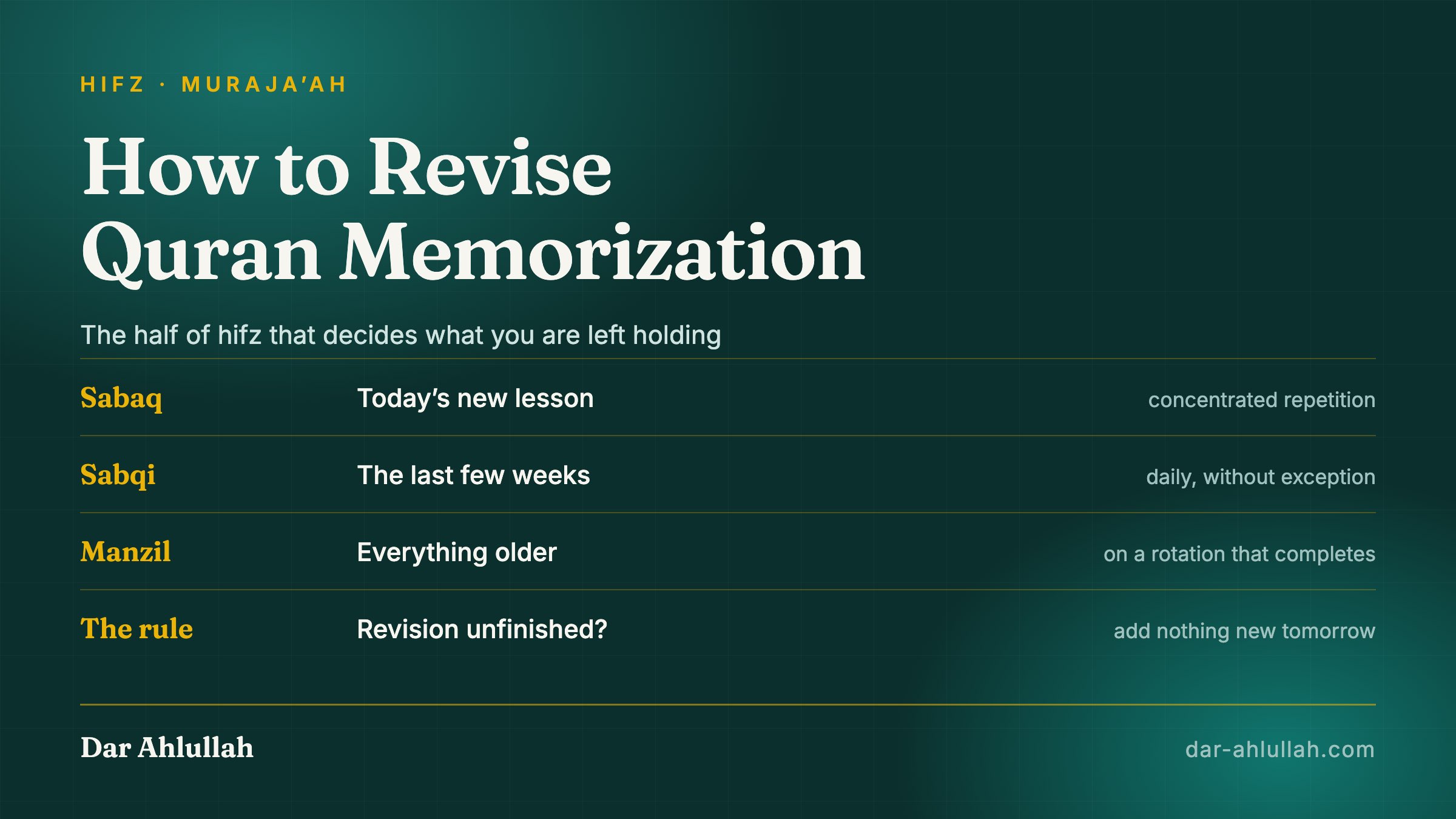
Classical hifz methodology splits daily work into three streams, and the vocabulary is worth knowing because your child’s teacher will use it: sabaq (the new portion), sabqi (recently memorised material, revised intensively), and manzil (older material on a long maintenance rotation).
During a recovery block, sabaq is switched off and the other two carry everything. What that looks like in practice, per day:
- 5–8 minutes: today’s repair portion, worked properly with the page open and then closed.
- 3–5 minutes: yesterday’s repair portion, recited from memory. This is the test that tells you whether yesterday actually landed.
- 3–5 minutes: one surah from the solid list, on rotation, so the maintained material keeps being touched.
Twelve to eighteen minutes. That is the entire daily requirement, and it is deliberately small enough that it survives a bad day, a late return from school, and a parent working a long shift. The testing effect — the finding that retrieving material from memory strengthens it far more than re-reading it — is why the second and third blocks are recited rather than read. It is also why a child who “revises” by reading along with an audio recording gets so little out of forty minutes.
Two rules make the difference between a loop that survives and one that quietly stops. First, it happens at the same time every day, attached to something that already happens — after Fajr, before breakfast, immediately after Maghrib. Second, on the worst days it still happens in a five-minute form. A five-minute day preserves the chain. A skipped day starts a negotiation.
What a Parent Who Reads No Arabic Can Still Do
Most parents we work with in Europe and North America cannot follow their child’s recitation closely enough to correct it. That rules out one job and leaves four that matter more than people assume.
- Own the schedule. The daily slot happening is a logistics problem, and logistics is a parent’s job, not a teacher’s. Nobody else can protect fifteen minutes in your household’s evening.
- Be the audience. Sit and listen while your child recites, even understanding nothing. Reciting to a person is a fundamentally different act from reciting to a wall, and the difference shows up in retention.
- Keep the sheet. You own the three-bucket list and update it weekly. The teacher knows what happened in the session; you are the only person who sees the trend across months.
- Catch the stall early. You will notice a slot quietly disappearing three weeks before it shows up in a session report. Say something at week one, not month three.
What is worth doing yourself, if you have the appetite: learn enough Arabic script to follow along in the mushaf. You do not need to understand the meaning to see whether your child is on the right line, and it changes what you can supervise. Our guide to the Arabic alphabet is roughly a two-week evening project for an adult.
When the Memory Is Not the Problem — the Reading Is
Cause four deserves its own section, because it is the one most often misread as a memory failure and the one where the standard fix does the most damage.
If your child cannot decode Arabic script confidently — if they hesitate on unfamiliar words, confuse letters that differ only by dots, or read at a laboured pace — then every memorisation session has been doing two hard things at once. The memory built on top of shaky decoding is thin, because the child never had a stable text to attach it to. Piling revision on that does not help; it just runs the same broken process more often.
The correct move is unpopular: pause hifz properly and spend six to twelve weeks on reading. Usually that means going back through the Noorani Qaida at a serious pace, then a period of straight recitation from the mushaf with tajweed correction, before any memorisation resumes.
Parents hesitate because it reads as going backwards, and children hate it because it is what the younger kids do. Both objections are worth naming out loud and overruling. A child who can read fluently memorises several times faster than one who cannot, so the twelve weeks are repaid inside the following term — and everything memorised afterwards is built on something that will hold.
How you can tell which situation you are in, without knowing Arabic: ask the teacher to have your child read a page they have never seen before, out loud, and to tell you honestly how that went compared to a child of the same age. Memorised material tells you nothing about decoding. Unseen text tells you everything.
The Half of This That Is Not Technical
A child who has lost a significant amount of memorised Quran is usually carrying something about it, and what they are carrying determines whether any schedule works.
The specific belief to watch for is “I am not good at this.” It forms quickly, it is very hard to dislodge once it has, and it is almost always the product of a stretch where the child heard corrections far more often than anything else. Once it is in place, the child stops trying in a way that looks like laziness and is not.
A few things that help, none of which are complicated:
- Separate the fact from the verdict. “Surah Al-Mulk needs rebuilding” is a fact. “You have forgotten everything” is a verdict, and it is also inaccurate — the audit will show that most of it is still there.
- Make the progress visible. The three-bucket sheet with items moving from shaky to solid does more for a child’s sense of direction than any amount of encouragement, because it is external evidence rather than a parent’s opinion.
- Do not use recitation as a party trick during the recovery. Being asked to perform for guests when your memory is unstable is exactly how a child learns to dread it.
- Keep the reason in view. Surah Al-Qamar 54:17 — “And We have certainly made the Quran easy to remember” — is a better frame for a struggling child than any productivity argument. The difficulty they are experiencing is a scheduling problem, not a statement about them or about the text.
Some children need a break before any of this lands. Two or three weeks with no hifz at all, framed openly as a rest rather than a failure, costs very little against material that is already lost, and it is sometimes the only thing that resets a child who has started to dread the sessions.
When the Teacher, Not the Child, Is the Variable
Before restructuring your child’s week, it is worth checking whether the teaching setup was contributing to the loss. Four signs matter.
New material every session, revision never. If the session structure has been sabaq-only for months, the loss was designed in. Revision has to be a scheduled part of each session, not something the child is told to do at home.
No written record. If nothing is written down after each session, nobody can see a trend. A teacher who cannot tell you which surahs are weak, without checking, has not been tracking.
A different teacher each week. Some academies fill each booked slot from a pool. It looks identical on the pricing page and fails quietly here, because no single teacher has seen your child enough times to notice that the same surah has been shaky for two months. We wrote about how to check for this in our guide to choosing an online Quran academy.
Correction without warmth. Technically accurate teaching that a child dreads produces cause five. If your child is fine reciting to you and freezes with the teacher, that is information about the pairing, not about the child.
None of these mean the teacher is bad. Some mean the pairing is wrong for this child at this stage, which is a normal thing that happens and is worth fixing early rather than after another lost term.
The Predictable Relapse Points in a Year
Recovery holds or collapses at the same four points every year, and all four are visible on a calendar months ahead.
- The long summer break. Six to eight weeks with no structure is the single biggest cause of the loss you are currently repairing. The fix is a deliberately minimal summer schedule — ten minutes a day, revision only, no new material — agreed before the term ends rather than improvised in July.
- Term start. New timetable, new after-school commitments, and the Quran slot is the one with no external deadline attached. Re-book it in the first week of term, not the fourth.
- Ramadan. Counter-intuitively a risk, not a boost. Late nights, disrupted sleep and a shifted routine break the daily slot, and the extra recitation people do during the month is usually reading rather than revision from memory. Decide in advance which time of day the loop moves to.
- Exam season and travel. Both are the minimum-day scenario. Five minutes, from memory, no new material. The chain matters more than the volume.
A schedule that already contains its own reduced version survives these. One that only has a full version does not; it stops entirely and takes a month to restart.
How We Handle a Child Who Has Lost Ground
At Dar Ahlullah this situation is common enough that we treat it as a normal starting point rather than a problem case.
A family in this position starts with a free 30-minute assessment session, with no card required. For a child who has lost material, that session is largely the audit described above — the mentor listens to what the child holds, checks whether unseen text can be read fluently, and comes back with which of the five causes is actually in play, along with a plan that says plainly whether the next block should be revision, re-memorisation, or a return to reading.
Sessions are one-to-one and live, which is what makes any of this measurable — a child reciting from memory to a mentor is the only reliable way to find out what is solid, and it is not something that can be assessed from a recording or a worksheet. Our rate is about $9 per teaching hour, with monthly plans at $36, $70 and $102, and siblings receive a 20% discount. You can pause, upgrade or switch plans at any time, which matters during a recovery block because the right intensity in week one is often not the right intensity in week eight. All of it is set out on our pricing page.
If the pairing turns out to be wrong — the fifth cause, where a child has simply stopped trying with a particular teacher — we will rematch you with another certified mentor at no extra cost. In a recovery, teacher fit is not a soft factor. It is frequently the whole problem.
Questions Parents Ask
Is it a sin for my child to forget Quran they memorised?
This worries parents a great deal, and it is a question for a scholar rather than for an academy. What is clear from Sahih al-Bukhari 5033 is that the Prophet ﷺ warned that memorised Quran slips away without maintenance — which is guidance to keep revising, addressed to people for whom forgetting was an expected risk. If the question is weighing on you or your child, ask a scholar you trust; do not let a child carry it silently, because guilt is one of the reliable routes to cause five.
How long does recovery take?
For a child who has drifted for a year, four to eight weeks of consistent daily work usually restores most of the shaky material and re-memorises the shorter lost surahs. Longer lost portions take longer, but re-memorisation runs several times faster than the first pass. The variable that actually predicts the timeline is whether the daily slot happens, not how much is lost.
Should I make my child re-memorise everything from scratch?
No, and doing so is the most common wasted effort in this situation. Most of the material is in the shaky bucket, not the gone one, and shaky material is repaired in a fraction of the time it takes to rebuild. That is exactly what the audit is for — without it, you will spend weeks re-memorising things that only needed three sittings.
My child memorised a lot when they were five and lost it all. Was that a waste?
Not entirely, but it is worth knowing why it happened. Very young children memorise readily by ear and lose it readily too, because the memory has one entry point and no textual anchor. What survives is the ear for the language and the familiarity with the sound, which are real assets. What has to be rebuilt is the memory itself, this time from the page. Our guide to what age a child should start learning Quran covers how to set that up so it does not repeat.
Can we keep memorising new surahs during the recovery?
We would strongly advise against it, for the reason set out above: new material increases the revision load and adds interference at exactly the wrong moment. The exception is a specific short surah your child needs for their own prayer right now.
My child recites perfectly with the audio but not alone. What is that?
That is cause three — a memory built on the recording rather than on the text. It is genuinely fixable, and it is fixed by rebuilding the same material while looking at the page, not by more listening. Expect it to feel slow for the first two weeks and then move quickly.
How much revision should a child do once things are stable?
As a rule of thumb, the majority of the daily session goes to revision and the minority to new memorisation, and the revision share increases as the child holds more. A child holding several juz who is still spending most of the session on new lines is heading straight back to where you started.
Conclusion: The Recovery Is Shorter Than the First Pass
The thing worth holding on to during the difficult fortnight after you discover the loss is that re-memorising is not memorising again. The traces are still there, and material that took two weeks the first time frequently takes two sessions the second. Almost every parent in this position over-estimates the damage and under-estimates the recovery.
What decides the outcome is not intensity. It is whether fifteen minutes happens every day, whether new material stays frozen until the old material is solid, and whether the plan was aimed at the right cause in the first place. Run the audit before you build the schedule, and you will be repairing what is actually broken rather than what feels broken.
And keep the frame right in front of your child. The loss is a scheduling failure in the system around them. It is not a verdict on whether they can do this.
Related articles
how to revise Quran memorization
What Murajaah Means, and How to Revise Quran Memorization
Every hifz plan is a memorisation plan, and almost every one that fails, fails because nothing in it described what happens to the pages behind you.
15 min read

how to memorize Quran with a full time job
How to Memorize Quran With a Full Time Job: A Schedule That Survives Your Week
Working adults rarely lose hifz for lack of time. They lose it because the time never had a fixed address in the week — and the first genuinely busy fortnight takes it back.
20 min read

how to memorize similar verses in the Quran
How to Memorize Similar Verses in the Quran (Mutashabihat)
The places where recitation derails are not the unfamiliar verses. They are the familiar ones — the passages that resemble each other so closely that memory takes the wrong branch.
17 min read