
how long does it take to memorize the Quran
How Long Does It Take to Memorize the Quran? An Honest Answer
Dar Ahlullah team 13 min read
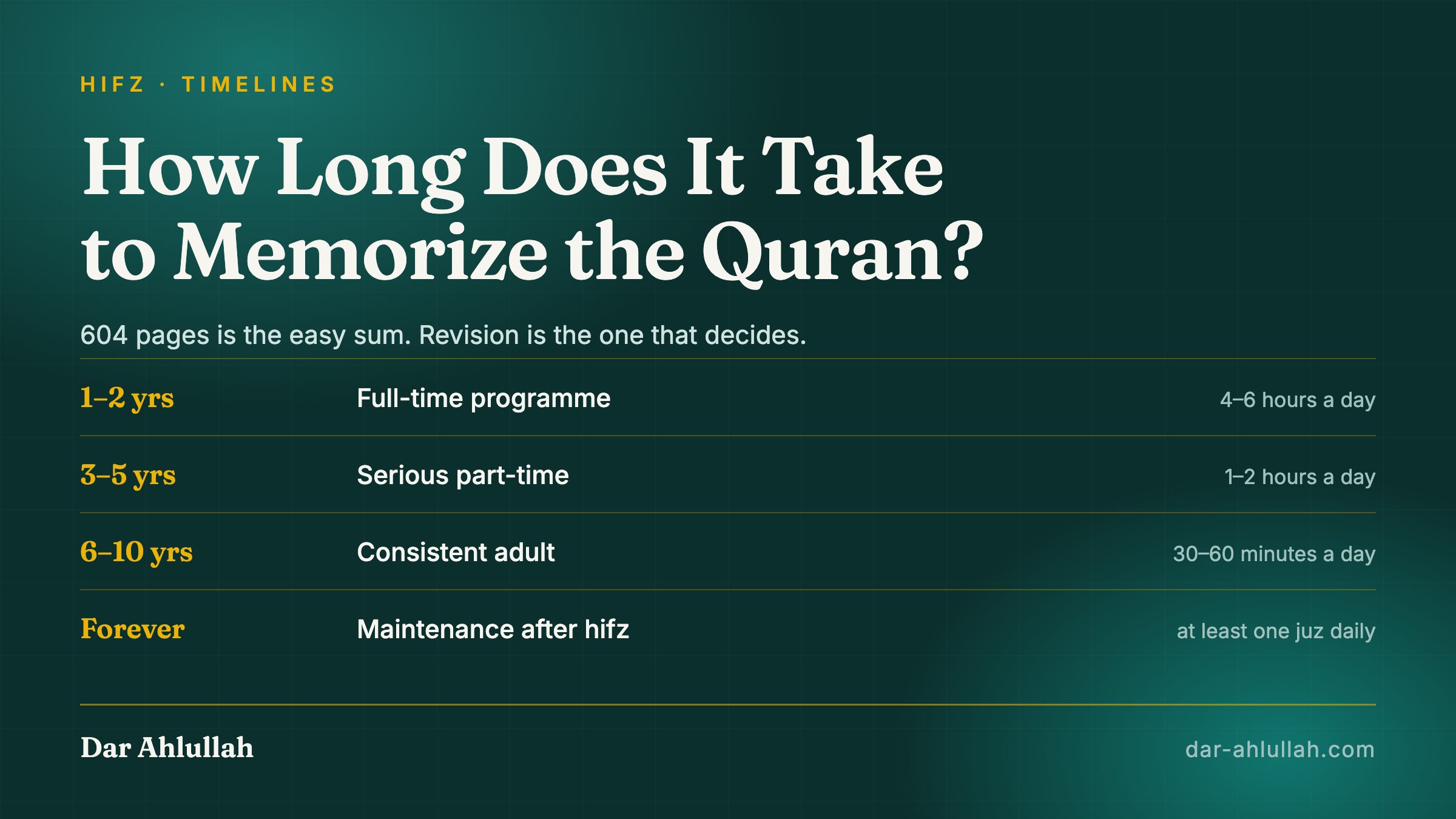
Table of Contents
- Introduction: Why Every Answer You Have Read Is Too Optimistic
- The Arithmetic Everyone Starts With
- Where the Arithmetic Breaks: The Revision Tax
- Realistic Bands, and What Each One Costs Per Day
- The Four Variables That Actually Move the Number
- Age: What Genuinely Differs Between Children and Adults
- Estimate Your Own Number in One Week
- If You Do Not Want the Whole Quran
- What Actually Compresses the Timeline
- Why Finishing Is Not the Finish Line
- How We Plan It
- Questions People Ask About the Timeline
- Conclusion: Plan the Revision, and the Date Takes Care of Itself
Introduction: Why Every Answer You Have Read Is Too Optimistic
Ask how long it takes to memorize the Quran and you will be told one to three years, or two to five, or — on the more excitable pages — six months. Those numbers are not invented. They are simply the wrong kind of number: they describe how long the memorising takes, and memorising is not the part that determines when you finish.
The part that determines when you finish is revision. It grows every week, it never stops, and it is the reason two students with identical daily minutes arrive years apart. This guide gives you the arithmetic, then shows you exactly where the arithmetic breaks, then gives you a way to estimate your own timeline in a single week — which is worth more than any published average, because the spread between students is far wider than the average suggests.
If you are earlier in the journey than this, our step-by-step guide to memorising the Quran online covers how a hifz programme is actually structured, and which surahs to memorize first covers where to begin.
The Arithmetic Everyone Starts With
The standard Madani mushaf used in most Quran schools runs to 604 pages, divided into 30 juz. That gives you a clean sum:
| New material per day | Days of new memorisation | Elapsed time |
|---|---|---|
| 2 pages | 302 | Under a year |
| 1 page | 604 | About 1 year 8 months |
| Half a page | 1,208 | About 3 years 4 months |
| A quarter page (~4 lines) | 2,416 | About 6 years 8 months |
That table is where almost every published answer comes from, and as far as it goes it is correct. It is also the source of nearly every abandoned hifz plan, for three reasons it silently assumes:
- That you memorise every day. Nobody does. Illness, travel, exams, Ramadan disruption, a bad month at work — a realistic year contains between 250 and 300 productive days, not 365. That alone stretches every row by twenty to thirty per cent.
- That a page is a page. A page of Juz Amma is short, familiar verses you have heard all your life. A page in the middle of the Quran is dense, unfamiliar, and full of passages that resemble other passages. The second takes several times longer than the first, and the table treats them identically.
- That memorising is the whole job. It is not, and this is the big one.
Where the Arithmetic Breaks: The Revision Tax
Here is the mechanism that the page-count sums leave out, and it is the single most useful thing to understand about hifz timelines.
New memorisation is a constant. Whether you are on page 40 or page 400, one page of new material costs roughly the same effort. Revision is a function of everything you already hold, and it therefore grows without limit. In month one you revise two pages. In month twelve you are revising eight juz. In year three you are maintaining twenty-five juz while still adding new pages, and the maintenance alone can exceed an hour a day.
So a student’s daily hifz time does not stay flat. It looks roughly like this:
| Stage | New material | Revision | Total daily time |
|---|---|---|---|
| First 2–3 juz | 15–25 min | 10–15 min | ~30–40 min |
| Around 10 juz held | 20–30 min | 25–40 min | ~1 hour |
| Around 20 juz held | 20–30 min | 45–70 min | ~1.5 hours |
| Approaching 30 juz | 20–30 min | 60–90 min | ~2 hours |
Read that table again, because it explains almost every hifz story you have heard. The student who fixed a one-hour daily budget and planned on that basis was accurate for their first year and badly wrong for their third. What actually happens when the budget stops fitting is that revision gets cut — it is the part with no visible progress, so it is the part that gets sacrificed — and within a few months the earlier juz have degraded to the point where they need re-memorising rather than reviewing.
That is the real failure mode. Very few people abandon hifz because memorising new pages became too hard. They abandon it because the pile behind them stopped holding, and it stopped holding because the plan never budgeted for it. Our guide to revising Quran memorization sets out the schedules that keep this under control.
Realistic Bands, and What Each One Costs Per Day
With the revision tax accounted for, here is what completion actually looks like. These are the ranges teachers see, not best cases.
Full-time student: 1–2 years
Four to six hours a day, six days a week, in a structured programme with daily supervision. This is the traditional madrasa model and it is where the “a child finished in eighteen months” stories come from. It is real, and it is not available to anyone with a job or a full school curriculum alongside it.
Serious part-time: 3–5 years
Roughly one to two hours a day, most days, with a teacher listening several times a week. This is the realistic ceiling for a working adult or a school-age child in a good after-school programme. Most people who complete hifz outside a full-time institution do it in this band.
Moderate and consistent: 6–10 years
Thirty to sixty minutes a day, sustained. This finishes, and it finishes far more often than the ambitious plans do, because the daily cost stays inside what a normal life can absorb. If you are an adult with children and a job, this is the band to plan for and there is nothing second-rate about it.
Light: unlikely to complete, and that is fine
Under twenty minutes a day. At this level the revision curve overtakes you somewhere in the first several juz — you reach a point where all your time goes on holding what you have. That is not wasted; several juz held well for life is an excellent outcome. It is simply not a route to thirty.
Notice what does not appear in any band: six months. Completions that fast exist, in tiny numbers, among children in intensive residential programmes with exceptional aptitude. Planning around them is like planning your running on the marathon world record.
The Four Variables That Actually Move the Number
1. Reading fluency — the largest single factor
If you decode the page letter by letter, you are doing two jobs at once and both go badly. Students who can read a page of unfamiliar Quran aloud smoothly memorise roughly two to three times faster than students who cannot, and their memorisation is more robust because it is anchored to the text rather than to a remembered sound.
This is why a teacher who tells a slow reader to fix their reading before starting hifz is giving them time, not taking it. Our guide to how long it takes to learn to read the Quran covers that prerequisite, and it is typically months, not years.
2. Revision discipline
Covered above, and it is the difference between a plan that compounds and one that leaks. Two students memorising a page a day, one revising properly and one not, are not on similar timelines — the second one is not on a timeline at all.
3. Session frequency, not session length
Twenty minutes six days a week beats two hours on Saturday, and it is not close. Memory consolidates across sleep and decays across gaps, so frequency is doing the work that duration cannot. A student with five short sessions a week will overtake one with two long ones on the same weekly total.
4. Understanding the Arabic
Not required — a great many huffaz have memorised without Arabic comprehension. But it helps, because meaning gives you a second retrieval route when the sound alone fails, and it is especially valuable for the mutashabihat, the near-identical passages that appear in several places and are the main cause of mid-recitation derailment. If you are considering it, learning Quranic Arabic and the most common words in the Quran are the efficient starting points.
Age: What Genuinely Differs Between Children and Adults
The folk wisdom is that children memorise faster. That is broadly true, and the reason is narrower than people assume.
Children hold sound better. Rote acquisition of unfamiliar phonetic material comes more easily to them, and they are far less troubled by memorising text they do not understand — an adult’s mind keeps demanding to know what the words mean, which is a real cognitive cost.
Adults revise better. Adults understand the system, can run a schedule, notice their own weak spots, and connect meaning to text. Left unsupervised, an adult with good habits will out-retain a child with none.
Children usually have more available hours. This is the underrated one. Much of the apparent speed advantage is simply that a ten-year-old in a hifz programme has three hours a day and a thirty-five-year-old has forty minutes. Correct for time and the gap narrows a great deal.
The practical implication: an adult should not compete on speed and should compete on consistency. On when to start a child, our guide to what age a child should start learning Quran covers the readiness signals worth waiting for.
Estimate Your Own Number in One Week
Published averages have an enormous spread. Your own data is more useful and takes seven days to gather.
- Days 1–5. Every day, memorise five lines of new material from a part of the Quran you do not already know by heart. Time yourself honestly — from opening the mushaf to reciting those lines correctly from memory.
- Day 6. Do not memorise anything new. Recite all twenty-five lines from memory to another person. Count the lines you could not produce without a prompt.
- Day 7. Repeat the day-6 test. Count again.
Now read the result:
- Time per five lines. A page is about fifteen lines. Multiply by three, then by 604, and you have your raw memorisation hours — before revision. Then add roughly the same amount again for revision over the life of the project. That is your real budget.
- Day-7 retention. This is the number that matters most. Above 80% and your revision approach is basically sound. Below 50% and no amount of new memorisation will accumulate — you are filling a bucket with a hole in it, and fixing the hole comes first.
Most people are surprised twice: memorising takes less time than they feared, and retention is worse than they assumed. Both surprises point the same way.
If You Do Not Want the Whole Quran
Complete hifz is one goal among several, and it is not the default obligation many people assume it to be. Perfectly respectable targets, with rough part-time timelines:
| Goal | Scope | Part-time estimate |
|---|---|---|
| Pray with variety | Al-Fatihah plus 6–10 short surahs | 2–5 months |
| Juz Amma | 37 surahs, the last juz | 1–3 years |
| Juz Amma plus the habit surahs | Adds Al-Mulk, Ya-Sin, Al-Kahf | 2–4 years |
| Complete hifz | 30 juz | 3–10 years |
A student who holds Juz Amma flawlessly for forty years has done something more valuable than one who reached twenty juz and lost fifteen of them. Choose the target you can maintain, not the one that sounds most impressive at the outset.
What Actually Compresses the Timeline
Four things genuinely speed this up. Almost everything else marketed as a shortcut does not.
- Fix reading first. The single biggest multiplier, and the one people skip because it feels like a detour. It is not.
- Memorise at the same time every day. Not for mystical reasons — because a fixed slot removes the daily decision, and the daily decision is where the habit dies. Most teachers point to the period after Fajr, when the day has not yet made claims on you.
- Use one mushaf, forever. Visual memory of page layout does a surprising amount of the work: where the verse sat, which line it started on, what was opposite it. Switching editions discards that for free.
- Recite to a listener several times a week. Silent revision hides errors, and errors that survive become permanent. This is the part that is genuinely hard to do alone, and it is the main practical argument for a teacher.
What does not compress it: memorising more per day than you can revise, switching methods every few months, or any app that promises hifz without somebody listening to you. On the cost of getting a teacher involved, we set out real figures in what online Quran classes cost.
Why Finishing Is Not the Finish Line
One more thing the timeline question hides. Completing thirty juz is the start of a permanent maintenance commitment, not the end of the work. A hafiz who stops revising loses material at a rate that shocks people — the traditional expectation is at least one juz reviewed daily, indefinitely, simply to hold what is there.
This is worth knowing before you start, not after, because it changes what a good plan looks like. A plan that gets you to thirty juz in three years and is unsustainable at hour four of daily maintenance has not succeeded. A plan that takes eight years and leaves you with habits you can keep for life has.
How We Plan It
At Dar Ahlullah, the first thing we establish is not a target date. It is the two numbers from the self-test above: how fast the student actually memorises, and how much survives a week. The complimentary 30-minute assessment exists for that, and it changes the plan more often than not — usually by sending a student to fix reading fluency first, which feels like a delay and functions as an accelerator.
Sessions are one-to-one with a certified teacher, which for hifz is less about instruction than about the listening: you cannot hear your own errors, and errors you cannot hear become permanent. If the pairing is not right, we will rematch you with another certified mentor at no extra cost, and you can pause, upgrade or switch plans at any time. Our rate is about $9 per teaching hour, and the pricing page shows how each plan is built on it.
Questions People Ask About the Timeline
Can I memorise the Quran in one year?
Only full-time. One year means roughly two pages of new material every day plus a revision load that reaches two hours daily by the end — four to six hours a day, sustained, for twelve months. It happens in residential programmes. It does not happen alongside a job.
How long does one juz take?
A juz is about twenty pages. At a page a day with revision, six to eight weeks is realistic for a middle juz; Juz Amma takes longer than its page count suggests for beginners and less for anyone who already recites those surahs in prayer.
Is it too late to start as an adult?
No. Adults memorise more slowly per session and retain better per hour of revision, and they can run a schedule that a child cannot. The real constraint is available minutes, not age.
How many hours a day do I need?
Thirty to sixty minutes, most days, is the honest minimum for steady progress towards complete hifz — and it must rise as your revision load grows. Twenty minutes a day maintains a few juz well; it does not accumulate thirty.
Does memorising get faster as you go?
The memorising does — technique improves, Quranic vocabulary and phrasing become familiar, and by juz ten you are noticeably quicker at new pages than you were at juz two. The total daily time still rises, because revision grows faster than memorisation speeds up.
What if I miss a few weeks?
Recover revision before adding anything new. A gap costs you retention, not memorisation speed, and the instinct to make up lost ground by memorising extra is exactly backwards. Return to the pile behind you first.
Do I need a teacher, or can I use an app?
Apps are good at scheduling revision and completely unable to tell you that your pronunciation drifted. The scheduling you can do yourself; the listening you cannot. That is the part worth paying for.
Does memorising in a language I do not speak really work?
Yes — a large proportion of huffaz worldwide are not Arabic speakers. Comprehension helps retention and helps with similar passages, but it has never been a prerequisite.
Conclusion: Plan the Revision, and the Date Takes Care of Itself
The honest answer to how long it takes to memorize the Quran: one to two years full-time, three to five years for a committed part-time student, six to ten for a consistent adult with a job and a family — and never, for anyone who plans the memorising and not the revision.
Run the seven-day self-test before you commit to a date. It will tell you more about your timeline than any average, and if your day-7 retention comes back low, you will have learned the most useful thing available: that the work in front of you is a revision routine, and every week you spend building one buys back a year later on.
Related articles
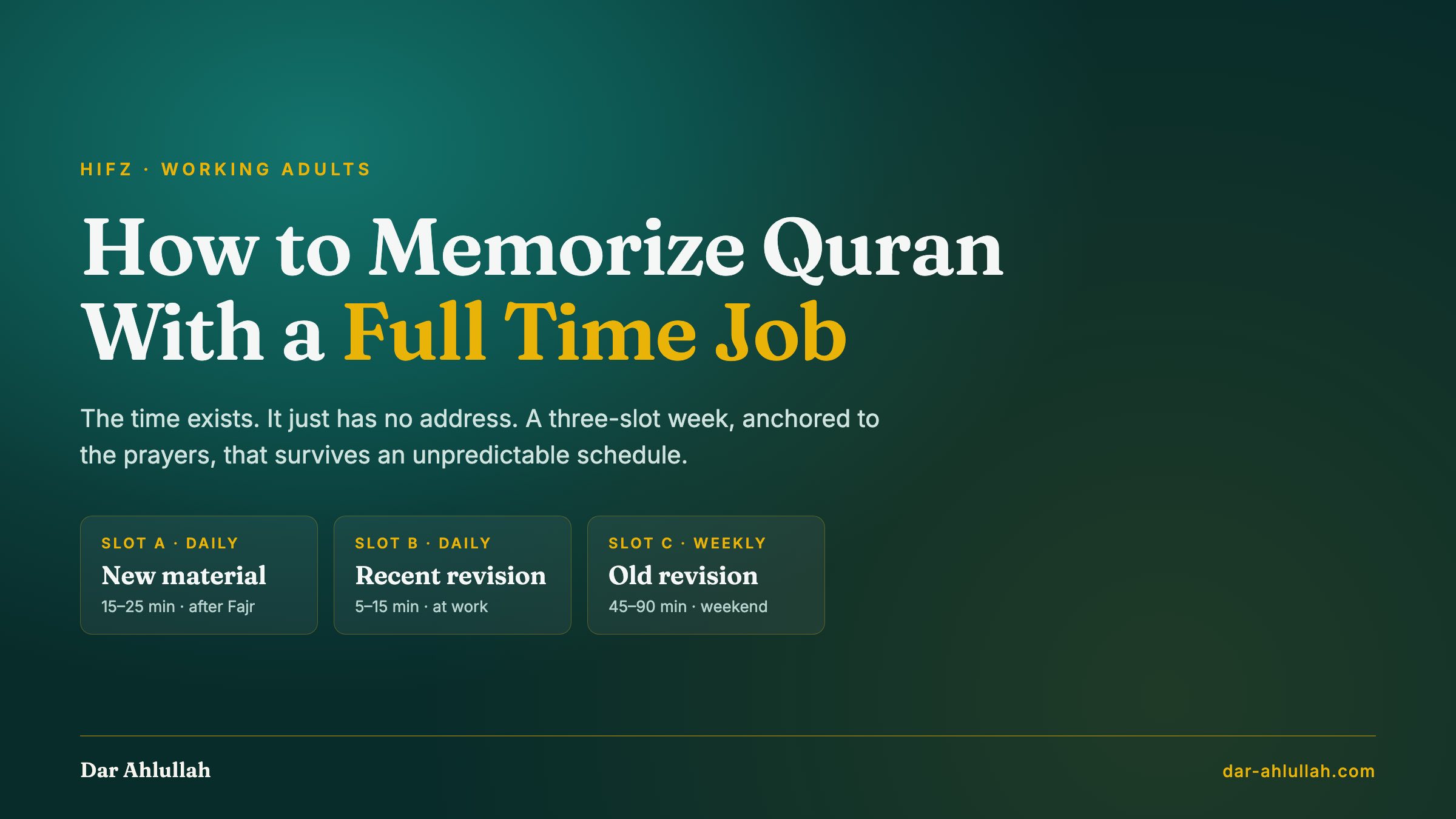
how to memorize Quran with a full time job
How to Memorize Quran With a Full Time Job: A Schedule That Survives Your Week
Working adults rarely lose hifz for lack of time. They lose it because the time never had a fixed address in the week — and the first genuinely busy fortnight takes it back.
20 min read
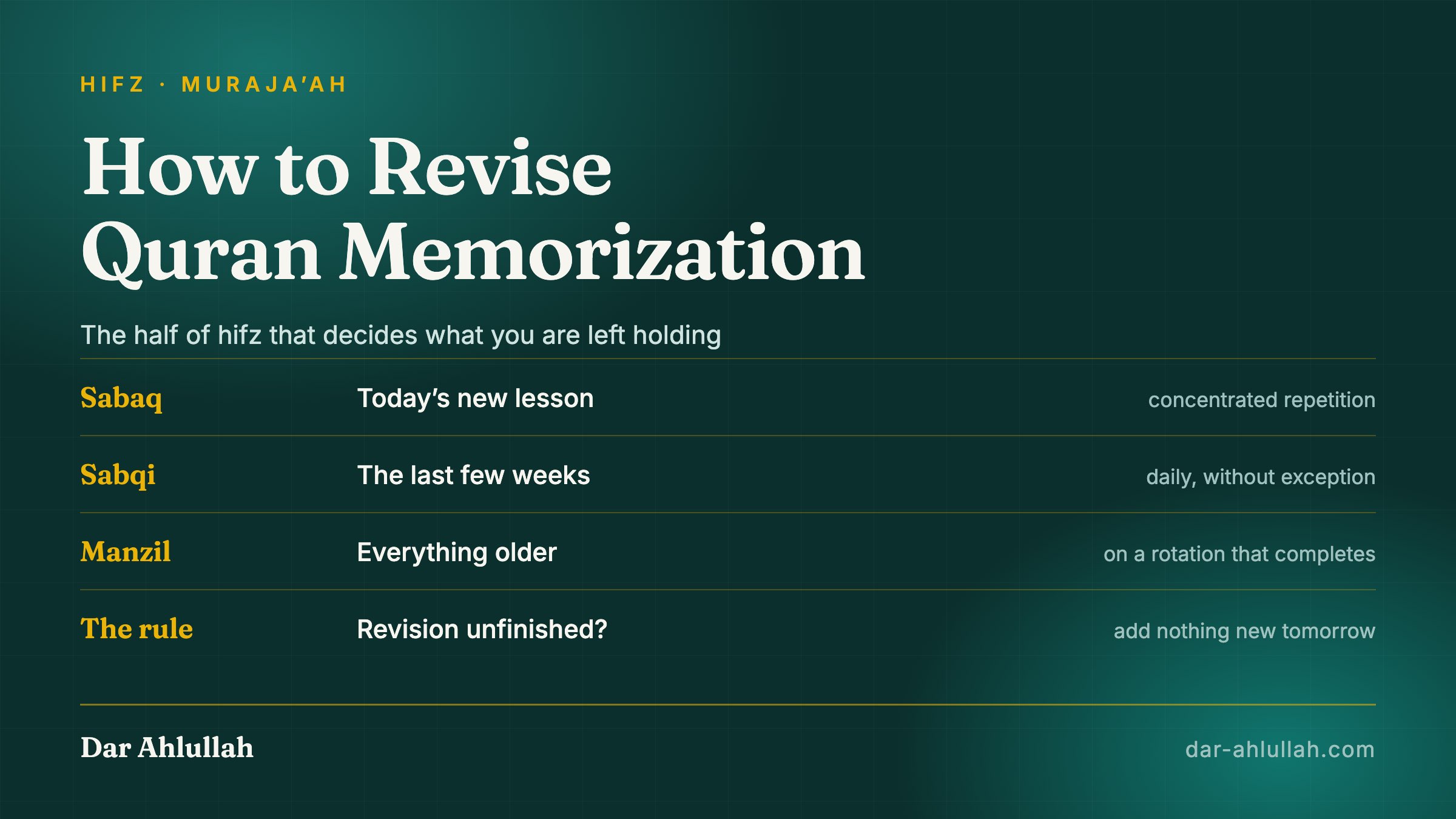
how to revise Quran memorization
What Murajaah Means, and How to Revise Quran Memorization
Every hifz plan is a memorisation plan, and almost every one that fails, fails because nothing in it described what happens to the pages behind you.
15 min read
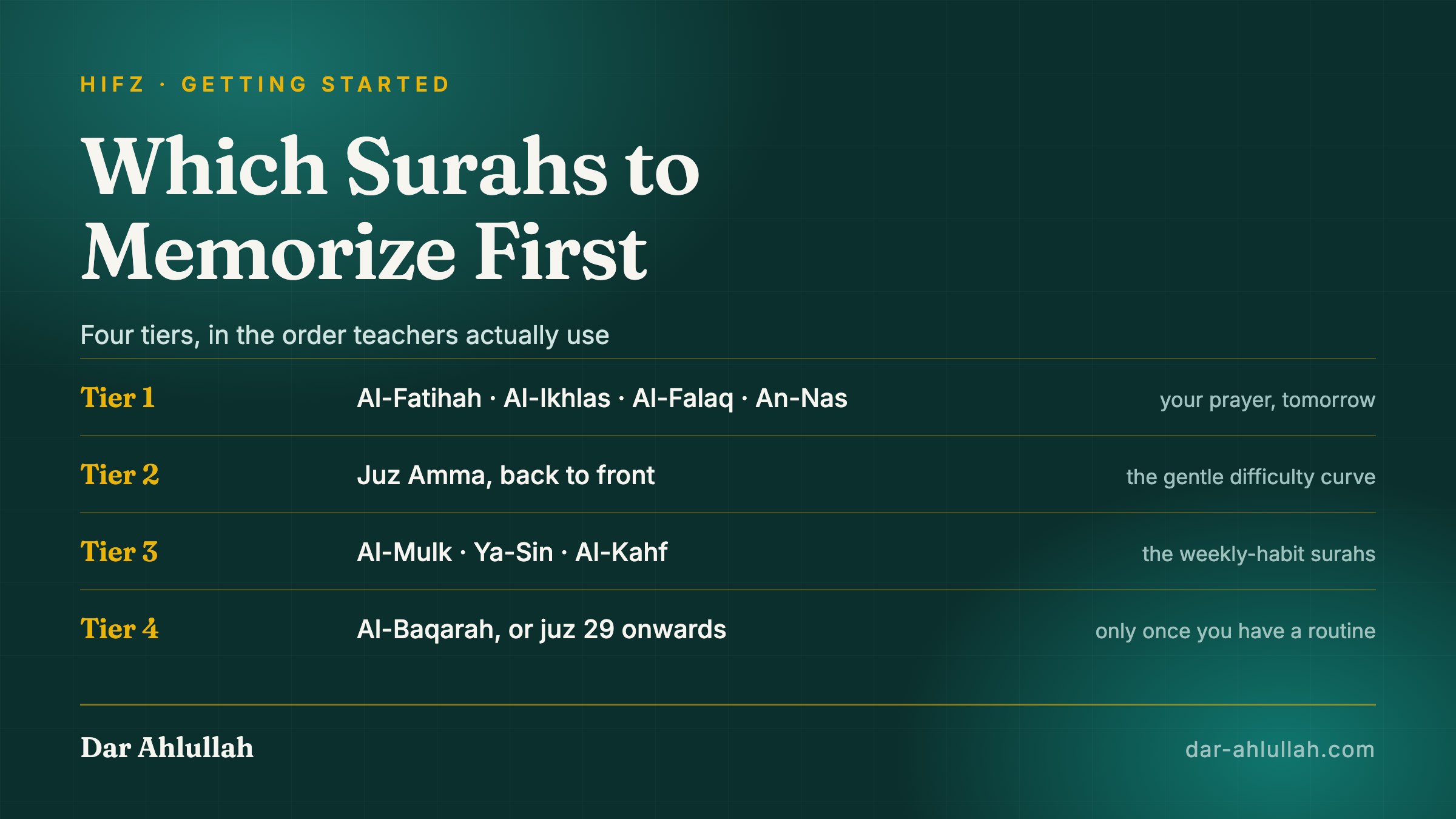
which surahs to memorize first
Which Surahs to Memorize First: A Practical Order
Almost nobody asking which surahs to memorize first is really asking about surahs. Here is the order teachers actually use, the reason behind each step, and the point where beginners lose a year.
15 min read