
what breaks your fast
What Breaks Your Fast? The Invalidators, the Grey Areas and What You Owe
Dar Ahlullah team 23 min read
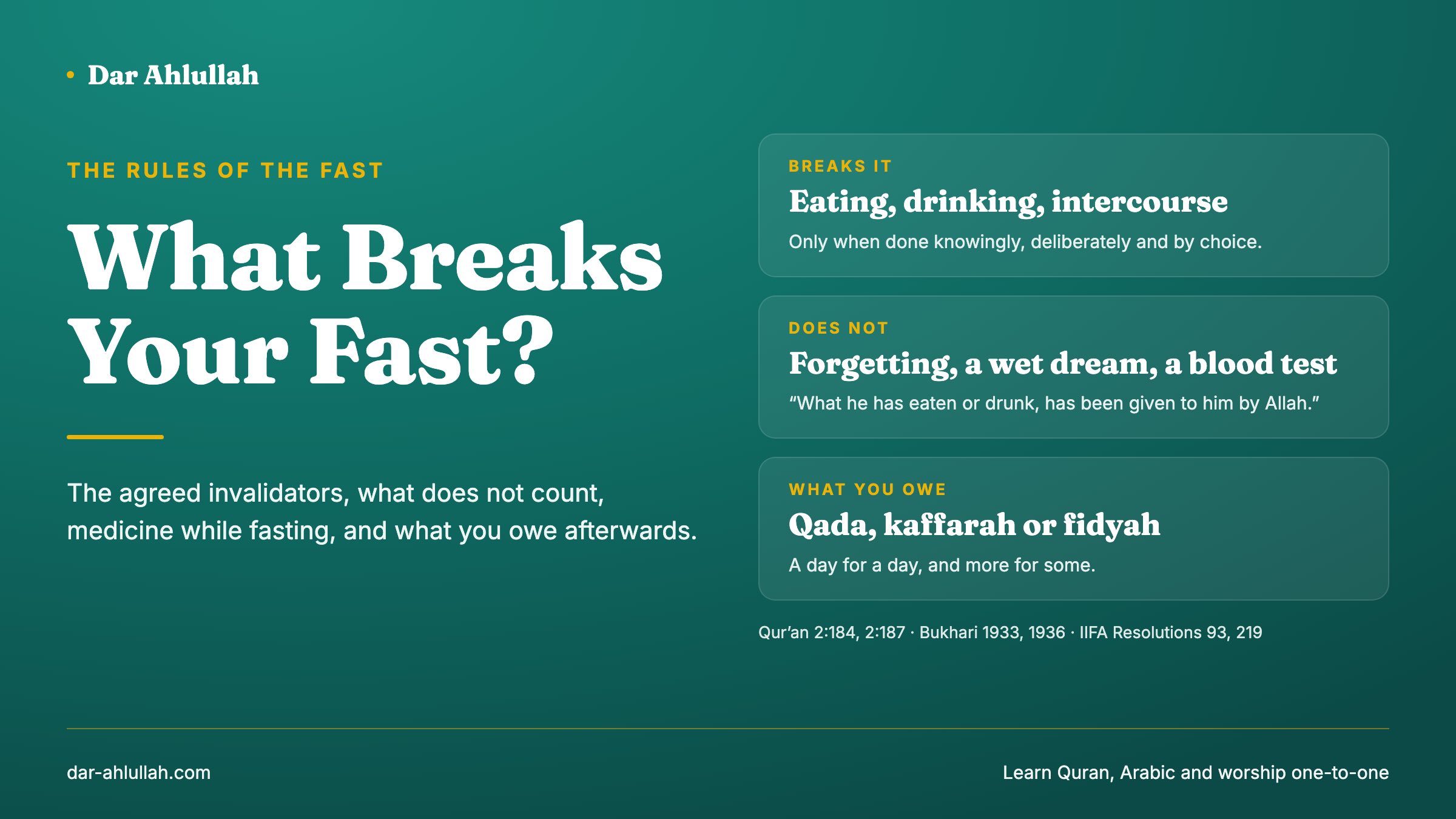
Table of Contents
- Introduction: The Question You Ask Halfway Through a Sip
- The Short Answer
- The Rule Before the List: Knowingly, Deliberately, By Choice
- What Breaks the Fast: The Agreed List
- Twelve Things That Do Not Break the Fast
- Where the Schools Genuinely Split
- Getting the Time Wrong: Suhur After Dawn, Iftar Before Sunset
- Medicine While Fasting: What the Fiqh Academy Ruled
- What You Owe Afterwards: Qada, Kaffarah or Fidyah
- Not Breaking It vs Being Allowed to Break It
- How We Teach This
- Questions People Ask
- Conclusion: A Short List and a Merciful Rule
Introduction: The Question You Ask Halfway Through a Sip
Almost everyone who fasts has had the moment. A glass of water is halfway to your mouth at three in the afternoon before you remember. Or the dentist’s only free appointment falls on a weekday in Ramadan. Or you use an inhaler every morning, have a blood test booked for Tuesday, wake up after the dawn adhan with suhur still in your mouth, or brush your teeth and are not sure whether any water went down. The question in every case is the same: did that break my fast, and if it did, what do I owe now?
The answer is shorter than the internet makes it look. The Qur’an names what a fasting person holds back from between dawn and sunset — eating, drinking and intercourse (Qur’an 2:187) — and the Sunnah adds a handful more. Around that short list sits one rule that settles most of the anxious questions, a set of real disagreements between the schools, and a newer layer of rulings on medicine that the classical books were written too early to address.
This article sets out all of it: what breaks the fast by agreement, what does not, where the four schools split, what the International Islamic Fiqh Academy ruled on inhalers, injections and blood tests, and what you owe afterwards — a make-up day, the heavy expiation called kaffarah, or the feeding called fidyah. Nothing here is a ruling of ours; every position is attributed to the school or scholar who holds it. If you are new to Islam, our guide to your first 90 days as a Muslim puts the fast of Ramadan in its place among the other obligations, and our guide to fiqh for beginners explains how the categories used below fit together.
The Short Answer
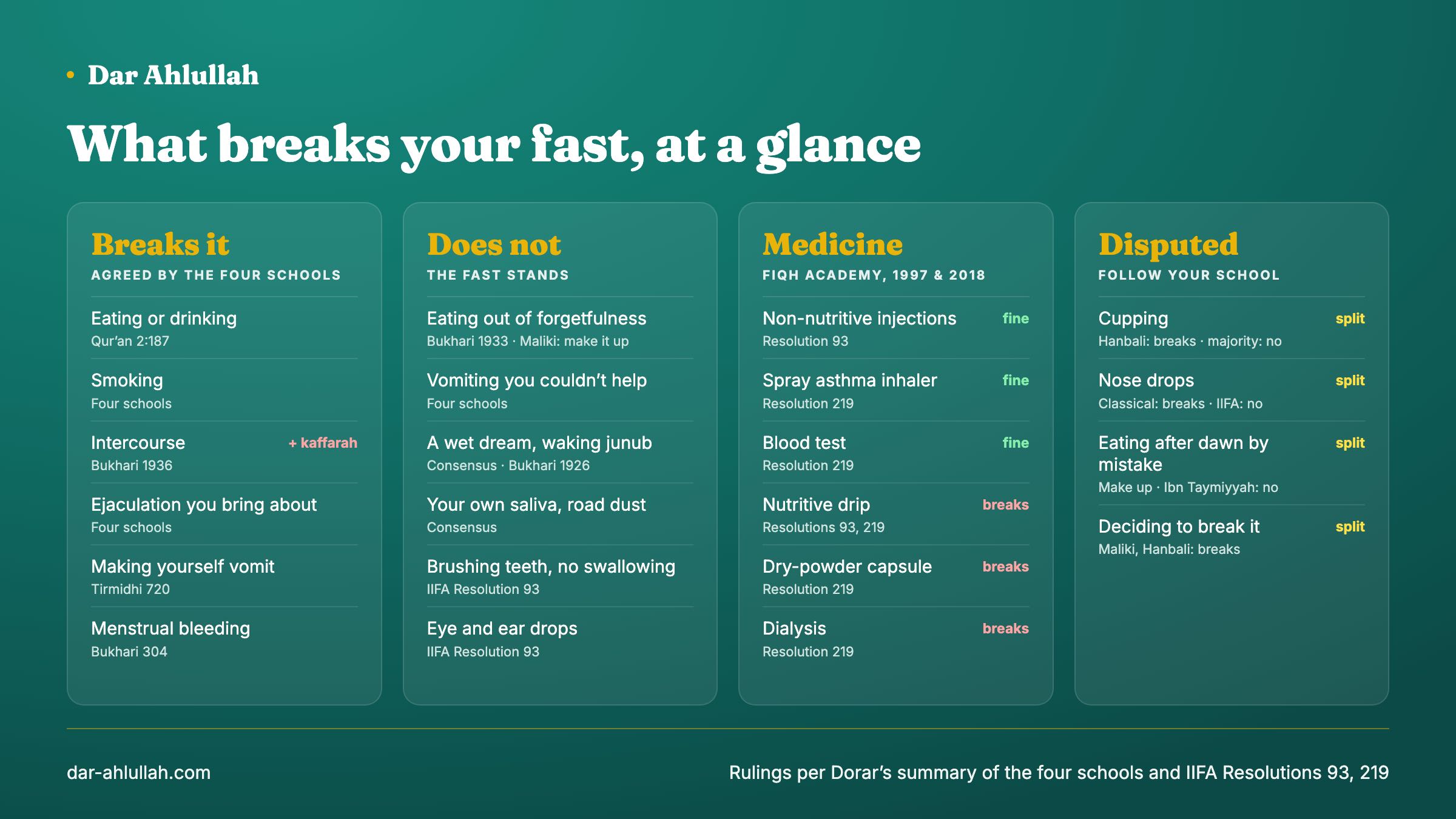
- Breaks the fast, by agreement: deliberately eating or drinking anything, including things that are not food; smoking; sexual intercourse; ejaculation you bring about yourself; making yourself vomit; the start of menstrual or postnatal bleeding; and leaving Islam (Dorar, What Invalidates the Fast).
- The rule that saves most fasts: an act only breaks the fast if you did it knowingly, deliberately and by choice. Eating out of forgetfulness does not break it (Bukhari 1933), though the Malikis still require a make-up day in an obligatory fast.
- Does not break it: vomiting you could not help, a wet dream, waking up in a state of major impurity, swallowing your own saliva, road dust, brushing your teeth or using mouthwash without swallowing, eye and ear drops, and a blood test.
- Medicine: the International Islamic Fiqh Academy ruled that non-nutritive injections, a metered-dose asthma inhaler, oxygen and blood tests do not break the fast; nutritive drips, receiving a blood transfusion, dialysis and dry-powder inhaler capsules do.
- Disputed: cupping and giving blood, nose drops, an enema, a decision to break the fast that you never act on, and eating at the edges of the day by mistake.
- What you owe: a make-up day for each obligatory day broken. Intercourse during a day of Ramadan adds the kaffarah — in practice two consecutive months of fasting, or feeding sixty poor people if you cannot. The Hanafis and Malikis add the kaffarah for deliberate eating and drinking in Ramadan too.
- Fidyah is something else: feeding a poor person for each day, owed by someone who cannot fast and will not be able to make the days up.
The Rule Before the List: Knowingly, Deliberately, By Choice
Before any list of invalidators comes the condition every item on it shares. An act breaks the fast when you do it knowing you are fasting, meaning to do it, and free to choose. Take away any of the three and, on most of the questions people actually ask, the fast stands.
Forgetting
The Prophet ﷺ said: “If somebody eats or drinks forgetfully then he should complete his fast, for what he has eaten or drunk, has been given to him by Allah” (Sahih al-Bukhari 1933). The Hanafis, Shafi‘is and Hanbalis take this at face value: nothing is owed, and you carry on fasting (Dorar). The moment you remember, you stop.
The Malikis are the exception. Malik said: “Whoever eats or drinks thoughtlessly or forgetfully in Ramadan or during any other obligatory fast that he must do, has to fast another day in its place” (Muwatta Malik, Book of Fasting). So if you follow the Maliki school, a forgotten glass of water in Ramadan still costs you a day; on the other three schools’ view it costs you nothing.
Forgetfulness covers intercourse too, on a strong set of views: the Hanafis and Shafi‘is, with Ibn Taymiyyah, Ibn al-Qayyim, al-Shawkani and Ibn ‘Uthaymin, hold that someone who had intercourse having genuinely forgotten the fast owes nothing (Dorar).
Being forced
“Allah has forgiven my nation for mistakes and forgetfulness, and what they are forced to do” (Sunan Ibn Majah 2045, graded sahih by al-Albani). A person forced to break the fast, including by having water forced down their throat, commits no sin, and on a position held among the Shafi‘is and Hanbalis their fast is still valid (Dorar, Other Reasons for Breaking the Fast).
What gets in without being chosen
Whatever enters the body of a fasting person without their intending it, like the dust on a road, does not break the fast; Dorar gives this as the overall position, noting a difference only over a fly that reaches the throat. Swallowing your own saliva does not break it either, by a consensus Ibn Hazm reported, as long as it has not left the mouth or been gathered there on purpose. Nor does a fragment of food between the teeth too small to spit out (Dorar).
The Qur’an teaches the believers to ask: “Our Lord, do not impose blame upon us if we have forgotten or erred” (Qur’an 2:286). Read the rest of this article with that verse in mind. Most of the anxious questions about fasting are about things that happened without a choice.
What Breaks the Fast: The Agreed List
These are the invalidators on which Dorar’s summary of the four schools records a consensus or the agreement of all four. In every case the condition above applies: done knowingly, deliberately and by choice. What each one costs you afterwards is set out further down.
| Invalidator | Main evidence | Standing |
|---|---|---|
| Eating or drinking | Qur’an 2:187 | Consensus, quoted by Ibn Hazm and Ibn Qudamah |
| Swallowing something that is not food (a coin, a small stone, a piece of cloth) | — | Agreement of the four schools |
| Smoking | — | Agreement of the four schools |
| Sexual intercourse | Qur’an 2:187; Bukhari 1936 | Consensus, quoted by Ibn al-Mundhir, Ibn Hazm, Ibn Qudamah and Ibn Taymiyyah |
| Ejaculation you bring about (masturbation, or kissing and touching that goes that far) | — | Agreement of the four schools |
| Making yourself vomit | Tirmidhi 720 | Agreement of the four schools |
| Menstrual or postnatal bleeding, at any point in the day | Bukhari 304 | Consensus, quoted by Ibn Hazm, Ibn Rushd, al-Nawawi and Ibn Taymiyyah |
| Leaving Islam | — | Consensus, quoted by Ibn Qudamah, al-Nawawi and al-Mardawi |
Eating, drinking and smoking
Anything taken in through the mouth and swallowed on purpose ends the fast, whether it nourishes or not: the four schools agree that swallowing a coin, a small stone or a piece of cloth breaks it just as food does, and that smoking breaks it. Someone who breaks the fast deliberately must still hold back from food and drink for the rest of the day, by agreement of the four schools (Dorar). If food is in your mouth when dawn arrives, spit it out; swallowing it breaks the fast, again by agreement of the four schools (Dorar, The Pillars of Fasting).
Intercourse and ejaculation
Intercourse during the day breaks the fast by consensus, and in Ramadan it is the one act all four schools agree carries the kaffarah as well as a make-up day. Ejaculation you bring about yourself, through masturbation or through kissing and touching that goes that far, breaks the fast by agreement of the four schools; the Hanafis, Shafi‘is and Hanbalis hold that it owes a make-up day without the kaffarah (Dorar).
A kiss on its own does not break the fast. ‘A’ishah reported: “The Prophet (ﷺ) used to kiss and embrace (his wives) while he was fasting, and he had more power to control his desires than any of you” (Sahih al-Bukhari 1927). The last clause is the caution in that report.
Vomiting
“Whoever is overcome by vomiting, then he is not required to make up (the fast), and whoever vomits on purpose, then he must make it up” (Jami‘ at-Tirmidhi 720). The hadith scholars grade this report apart — al-Albani and Ahmad Shakir graded it sahih, Bashar ‘Awwad Ma‘ruf weak — but the rule itself is agreed by the four schools: deliberate vomiting breaks the fast and is made up without kaffarah, and vomiting you could not help leaves the fast intact (Dorar). Bringing a little up from the throat, or blood from the gums, does not break it as long as it does not go back down; Ibn Hazm reported consensus on that.
Menstruation and postnatal bleeding
The Prophet ﷺ asked: “Isn’t it true that a woman can neither pray nor fast during her menses?” (Sahih al-Bukhari 304). Bleeding that starts at any point in the day ends that day’s fast, even shortly before sunset, and the day is made up later. The prayers missed in the same days are not: ‘A’ishah said the women were ordered to make up the fasts and not the prayers (Sahih Muslim 335c), the distinction our article on making up missed prayers covers from the prayer side. The majority — Hanafis, Malikis and Shafi‘is — hold that a woman whose fast ended this way need not hold back from food for the rest of that day (Dorar).
Twelve Things That Do Not Break the Fast
- Eating or drinking out of forgetfulness — Bukhari 1933, with the Maliki make-up day in an obligatory fast noted above.
- Vomiting you could not help — agreement of the four schools.
- A wet dream during the day — consensus, reported by al-Mawardi, Ibn Hazm, Ibn ‘Abd al-Barr, al-Nawawi and Ibn Hajar among others.
- Waking up in a state of major impurity. ‘A’ishah and Umm Salamah reported that the Prophet ﷺ would at times wake in the morning junub and “would then take a bath and fast” (Sahih al-Bukhari 1926). Eat your suhur, start the fast, and bathe in time for Fajr; our guide to ghusl sets out the bath itself.
- A kiss, for someone in control of themselves — Bukhari 1927.
- Swallowing your own saliva — consensus reported by Ibn Hazm, as long as it has not left the mouth.
- Road dust and whatever else gets in unchosen — the overall position, with a difference over a fly that reaches the throat.
- Brushing your teeth, a miswak, mouthwash or a gargle, provided nothing is swallowed — International Islamic Fiqh Academy, Resolution 93.
- Eye drops, ear drops and ear washing, as long as what reaches the throat is not swallowed — the same resolution.
- A blood test — the Academy’s Resolution 219, and the view of Ibn Baz (who made it conditional on need) and Ibn ‘Uthaymin.
- Creams, ointments and skin patches — Resolution 93.
- Sleeping through most of the day. If you wake for a moment at any point, the fast is valid by a consensus al-Nawawi reported; the Malikis, Shafi‘is and Hanbalis hold it valid even if you slept from before dawn until after sunset (Dorar).
Where the Schools Genuinely Split
These are disagreements between qualified scholars, not mistakes on one side. Follow the position of the school or scholar you already follow; if you have none yet, the table shows who holds what. The attributions are from Dorar’s summary of the schools unless another source is named.
| Question | Breaks the fast | Does not break the fast |
|---|---|---|
| Cupping (hijamah) | The Hanbali school, Ibn Taymiyyah, Ibn Baz and Ibn ‘Uthaymin | The Hanafis, Malikis and Shafi‘is; the Fiqh Academy (Resolution 219) |
| Bloodletting (fasd) | One of two Hanbali positions, Ibn Taymiyyah, Ibn ‘Uthaymin and Saudi Arabia’s Permanent Committee | The Hanafis, Malikis and Shafi‘is; the Fiqh Academy (Resolution 219) |
| Giving blood | Scholars who hold that cupping breaks the fast do not permit giving a large amount of blood while fasting (Ibn Baz, Ibn ‘Uthaymin, the Permanent Committee) | The Fiqh Academy (Resolution 219) |
| Ejaculation from repeated looking | The Hanbalis, Ibn ‘Uthaymin and the Permanent Committee, without kaffarah | The Hanafis and Shafi‘is |
| Nose drops and nasal spray | The four schools classically, along with snuff | Ibn Hazm, Ibn ‘Uthaymin, the Permanent Committee and the Fiqh Academy (Resolution 93), if nothing is swallowed |
| An enema | The four schools classically | The Zahiris, a group of the Malikis, Ibn ‘Abd al-Barr and Ibn Taymiyyah; the Fiqh Academy for anything entering through the anus except a nutrient injection (Resolution 219) |
Cupping: two reports that pull in opposite directions
Ibn ‘Abbas reported: “The Prophet (ﷺ) was cupped while he was fasting” (Sahih al-Bukhari 1939). Thawban reported him saying: “A man who cupped and a man who has himself cupped broke their fast” (Sunan Abi Dawud 2367, graded sahih by al-Albani), and the same words come from Rafi‘ ibn Khadij in Tirmidhi 774. The Hanafis, Malikis and Shafi‘is act on the first. The Hanbali school acts on the second, and Ibn Taymiyyah described that as the position of most of the hadith scholars, naming Ahmad, Ishaq ibn Rahawayh, Ibn Khuzaymah and Ibn al-Mundhir. In 2018 the Fiqh Academy ruled that cupping and bloodletting do not break the fast. If you follow the Hanbali view, book the cupping for after iftar.
A decision you never act on
The fast is an intention held from dawn to sunset as well as an abstention. Dorar records the Malikis and Hanbalis, a position among the Shafi‘is, and Ibn Hazm as holding that if you firmly decide during the day to break your fast, it is broken even if nothing passes your lips.
Getting the Time Wrong: Suhur After Dawn, Iftar Before Sunset
The fast runs from true dawn to sunset: “eat and drink until the white thread of dawn becomes distinct to you from the black thread [of night]. Then complete the fast until the night” (Qur’an 2:187). The Prophet ﷺ described the end of it: “When night falls from this side and the day vanishes from this side and the sun sets, then the fasting person should break his fast” (Sahih al-Bukhari 1954). With timetables, apps and overcast skies, the edges of the day are where honest mistakes happen, and what you owe for them is a real split.
| What happened | The four schools | A group of the Salaf, Ibn Taymiyyah, Ibn ‘Uthaymin |
|---|---|---|
| You ate after dawn, believing it was still night | Make the day up | The fast is valid; nothing is owed |
| You broke the fast believing the sun had set, then saw it had not | Make the day up | No make-up day (Ibn al-Qayyim held the same) |
| You ate while unsure whether the sun had set, and never checked | Sinful, and the day is made up, by agreement of the four schools | |
In the second case the four schools agree that you stop eating the moment you realise, and hold back until sunset (Dorar). Both columns are positions of qualified scholars. What neither excuses is guessing: the third row is agreed.
Medicine While Fasting: What the Fiqh Academy Ruled
The classical rulings were worked out before injections, inhalers or endoscopes existed. Two resolutions of the International Islamic Fiqh Academy of the Organisation of Islamic Cooperation address most of what a patient will actually face. Resolution 93, issued in Jeddah in 1997, settled the easier cases and deferred six for further study; Resolution 219, issued in Madinah in 2018, settled the six. Resolution 219 defines the inside of the body that matters as whatever goes past the throat into the digestive system and reaches the stomach, nutritious or not.
| Treatment | Ruling | Source |
|---|---|---|
| Eye drops, ear drops, ear washing | Does not break the fast, as long as what reaches the throat is not swallowed | Resolution 93 |
| Nose drops and nasal spray | Does not break the fast, on the same condition | Resolution 93 |
| Tablets under the tongue (for angina, for example) | Does not break the fast, provided nothing is swallowed | Resolution 93 |
| Injections into the skin, muscle or vein | Do not break the fast, except drips and nutritive fluids | Resolution 93 |
| Nutritive drips and injections | Break the fast | Resolutions 93 and 219 |
| Asthma spray inhaler (metered-dose) | Does not break the fast | Resolution 219 |
| Dry-powder inhaler capsules | Break the fast, because part of the powder reaches the stomach | Resolution 219 |
| Humidified (nebulised) asthma treatment | Breaks the fast; far more reaches the stomach | Resolution 219 |
| Oxygen; anaesthetic gas | Does not break the fast, if no nutritive fluids are given | Resolution 93 |
| A blood test, or giving blood | Does not break the fast | Resolution 219 |
| Receiving a blood transfusion | Breaks the fast | Resolution 219 |
| Haemodialysis and peritoneal dialysis | Break the fast | Resolution 219 |
| Suppositories, ointments, scopes or injections through the anus | Do not break the fast, except a nutrient injection | Resolution 219 |
| Vaginal pessaries or examinations, an IUD; catheters in the urinary tract | Do not break the fast | Resolution 93 |
| Tooth extraction or cleaning, toothbrush, miswak, mouthwash | Do not break the fast, provided nothing is swallowed | Resolution 93 |
| Gastroscopy without added fluids | Does not break the fast | Resolution 93 |
| General anaesthesia during part of the day, without fluids | Does not break the fast, even if you stay unconscious for the rest of it | Resolution 219 |
The inhaler rows are the ones most worth reading twice: the Academy distinguished a metered-dose spray from a capsule of dry powder and from a humidified treatment, so it is worth knowing which kind yours is. Two of the Academy’s recommendations matter as much as the table. Resolution 93 asks the Muslim doctor to advise postponing any of these treatments until after the fast if the delay does no harm. Resolution 219 says that kidney-failure patients who are not expected to recover are excused from fasting and should pay a fidyah of feeding a needy person for every day not fasted. That something does not break the fast is not an instruction to fast through an illness the fast makes worse; that is the concession below.
What You Owe Afterwards: Qada, Kaffarah or Fidyah
Three different words get used loosely for “what I owe”. They are not interchangeable.
| Qada (make-up) | Kaffarah (expiation) | Fidyah (ransom) | |
|---|---|---|---|
| What it is | Fasting one day for each obligatory day broken or missed | Two consecutive months of fasting; if you cannot, feeding sixty poor people | Feeding one poor person for each day not fasted |
| Who owes it | Whoever broke or missed an obligatory fast and can fast later: the sick who recover, travellers, women after their period, anyone who broke a day deliberately | Whoever had intercourse during a day of Ramadan (all four schools); whoever ate or drank deliberately in Ramadan (the Hanafis and Malikis) | Whoever cannot fast and cannot make the days up: the very old, the chronically ill with no expectation of recovery |
| Source | Qur’an 2:184 | Bukhari 1936 | Qur’an 2:184 |
Qada: a day for a day
“So whoever among you is ill or on a journey [during them] — then an equal number of other days [are to be made up]” (Qur’an 2:184). Each obligatory day that was broken or missed is made up with one day, and the majority of scholars hold that a day broken deliberately by eating or drinking is made up the same way (Dorar). When the make-up days must be done, and whether voluntary fasts may come before them, is covered in our guide to voluntary fasting in Islam.
Kaffarah: the heavy expiation
Abu Hurayrah reported that a man came to the Prophet ﷺ and said, “I have been ruined”: he had had intercourse with his wife while he was fasting. The Prophet ﷺ asked him whether he could free a slave, then whether he could fast two successive months, then whether he could feed sixty poor people (Sahih al-Bukhari 1936). On this report the four schools agree that intercourse during a day of Ramadan owes the kaffarah as well as the make-up day, and the Hanafis, Shafi‘is and Hanbalis keep the order the Prophet ﷺ asked in (Dorar). With no slaves to free today, the expiation begins in practice at the two consecutive months.
- Only for Ramadan. Intercourse during a make-up fast owes no kaffarah, by agreement of the four schools.
- Both spouses. A woman who consented owes the make-up day and the kaffarah herself, on the view of the Hanafis, Malikis, Hanbalis and a position among the Shafi‘is.
- Once per day. Intercourse more than once in the same day owes one kaffarah if none has been paid yet, by a consensus Ibn ‘Abd al-Barr and Ibn Qudamah reported; on separate days it owes one for each day, on the view of the Malikis, Shafi‘is and Hanbalis.
- A period does not break the two months. A woman fasting the two consecutive months does not have to restart when her period comes, by a consensus Ibn al-Mundhir and Ibn Taymiyyah reported.
- Deliberate eating and drinking. Here the schools divide. The Hanafis and Malikis require the kaffarah for breaking a Ramadan fast deliberately by eating or drinking, on top of the make-up day; the Shafi‘is and Hanbalis require only the make-up day and repentance (IslamOnline; Dorar).
Fidyah: when the days cannot be made up
The same verse continues: “And upon those who are able [to fast, but with hardship] — a ransom [as substitute] of feeding a poor person [each day]” (Qur’an 2:184). An old man or woman who cannot bear fasting may leave it, by consensus, and the Hanafis, Shafi‘is and Hanbalis hold that they feed a poor person for each day (Dorar, The Old). The Fiqh Academy applied the same to kidney-failure patients not expected to recover. Fidyah is not a way to buy out a fast you could make up: if you will be able to fast the days later, the days are what you owe.
Pregnancy and breastfeeding are where the two get confused most. Breaking the fast out of fear for yourself or for your child is permitted by agreement of the four schools. If the fear was for yourself, the Hanafis, Shafi‘is and Hanbalis say you make the days up. If it was for the child alone, Dorar records the Hanafis, Ibn al-Mundhir, Ibn Baz and Ibn ‘Uthaymin as holding that the make-up days are all that is owed; other scholars add a fidyah in that case, so ask whoever you follow (Dorar, The Pregnant and the Breastfeeding).
Not Breaking It vs Being Allowed to Break It
Everything above is about what breaks a fast. A separate question is when you are allowed, or required, not to fast. “Allah intends for you ease and does not intend for you hardship” (Qur’an 2:185).
- Illness and travel: both allow you to break the fast and make the days up later (Qur’an 2:184–185). The schools’ detail on which illnesses and which journeys is in Dorar’s sections on the sick and the traveller.
- Old age, pregnancy and breastfeeding: as above.
- Danger to life: someone struck by hunger or thirst to the point of fearing death must break the fast and make the day up later; the Malikis and Shafi‘is state this explicitly (Dorar).
- Very long days: where day and night still turn within twenty-four hours, you fast the actual day however long it is, and anyone who seriously fears for their health may break the fast and make the days up when the days are shorter — the view of Ibn Baz, Ibn ‘Uthaymin and the International Islamic Fiqh Academy (Dorar). Our article on prayer times at high latitude covers the timing side for northern countries.
How We Teach This
A list of invalidators is the easy part. The question you actually have is usually the follow-up — the inhaler you use, the procedure on your calendar, the day you are not sure about — and the answer often depends on which school you follow. That is the kind of question that goes better with a teacher than with a search engine. Our articles on what breaks wudu and what invalidates salah follow the same pattern as this one: the agreed list, the genuine disagreements, and the things that do not count.
Dar Ahlullah runs one-to-one live sessions with certified teachers, scheduled in your own timezone, in Quran, Arabic and Islamic Studies; the Islamic Studies course, which covers Aqeedah and Fiqh basics with the Seerah, is designed for children and teens. Teaching is charged at $9 per teaching hour, with monthly plans at $36, $70 and $102 depending on how many hours you want, and a 20% discount for siblings. You can pause, upgrade or switch plans at any time, and if a teacher is not the right fit we rematch you with another certified mentor at no extra cost. The first step is a free 30-minute assessment that does not ask for a card — the details are on our pricing page.
Questions People Ask
Does swallowing saliva break the fast?
No. Ibn Hazm reported consensus that swallowing your own saliva does not break the fast, as long as it has not left the mouth or been gathered there on purpose.
Can I brush my teeth while fasting?
Yes. The Fiqh Academy’s Resolution 93 lists cleaning the teeth with a toothbrush or a miswak, and mouthwash or gargling, among what does not break the fast, on the condition that nothing is swallowed. That condition is the whole point with toothpaste and water: spit it all out.
Does using an inhaler break the fast?
A metered-dose asthma inhaler does not, according to the Fiqh Academy’s Resolution 219, and Ibn Baz and Ibn ‘Uthaymin held the same. Dry-powder inhaler capsules and humidified (nebulised) treatment do break it under the same resolution, because more of the medicine reaches the stomach.
Does a blood test break the fast?
No, on the Fiqh Academy’s Resolution 219 and the view of Ibn Baz and Ibn ‘Uthaymin. Giving blood is also permitted by the Academy, but scholars who hold that cupping breaks the fast, such as Ibn Baz and Ibn ‘Uthaymin, do not permit giving a large amount while fasting.
I ate, then remembered I was fasting. What now?
Stop, and carry on fasting. On the Hanafi, Shafi‘i and Hanbali view nothing is owed, because “what he has eaten or drunk, has been given to him by Allah” (Bukhari 1933). On the Maliki view, if it was Ramadan or another obligatory fast, you make up the day.
Does vomiting break the fast?
Only if you made yourself vomit, in which case the day is made up without kaffarah. Vomiting you could not help does not break it. Both are agreed by the four schools.
Does a wet dream break the fast?
No, by consensus. Nor does waking up in a state of major impurity: the Prophet ﷺ sometimes woke junub, bathed and fasted (Bukhari 1926).
My period started an hour before sunset. Does the day count?
No. Bleeding that begins at any point in the day ends that day’s fast, by consensus, and the day is made up later. The prayers missed during the period are not made up.
What is the kaffarah for breaking a fast in Ramadan?
Two consecutive months of fasting, or feeding sixty poor people if you cannot fast them, on top of making up the day itself (Bukhari 1936). All four schools require it for intercourse during a day of Ramadan; the Hanafis and Malikis also require it for eating or drinking deliberately.
What is the difference between kaffarah and fidyah?
Kaffarah is an expiation for deliberately breaking a day of Ramadan in the ways above. Fidyah is feeding a poor person for each day by someone who cannot fast and will never be able to make the days up, such as the very old. Neither replaces a make-up day you are able to fast.
Does kissing my spouse break my fast?
Not on its own; the Prophet ﷺ kissed his wives while fasting (Bukhari 1927). If it leads to ejaculation, the fast is broken by agreement of the four schools.
Does sleeping all day break the fast?
No. If you wake at any point in the day the fast is valid by consensus, and the Malikis, Shafi‘is and Hanbalis hold it valid even if you slept from before dawn until after sunset. Missing the prayers while asleep is a separate matter.
Conclusion: A Short List and a Merciful Rule
Strip the question back and the list is short: eating and drinking, intercourse, ejaculation you brought about, vomiting you caused, and the bleeding that ends a woman’s fast for that day. Almost everything else people worry about — the forgotten sip, the wet dream, the toothbrush, the eye drops, the blood test — does not break it.
Where the schools split, the split is real and old, and the honest course is to follow the school or scholar you follow rather than the most convenient answer to each question. Where medicine is involved, the Fiqh Academy’s two resolutions give a clear map, and the concession for illness sits above all of it.
The fast is the act of worship whose whole content is holding back, and it comes with a rule that holds back the blame as well. What you ate in forgetfulness, the Prophet ﷺ said, “has been given to him by Allah.”
Related articles
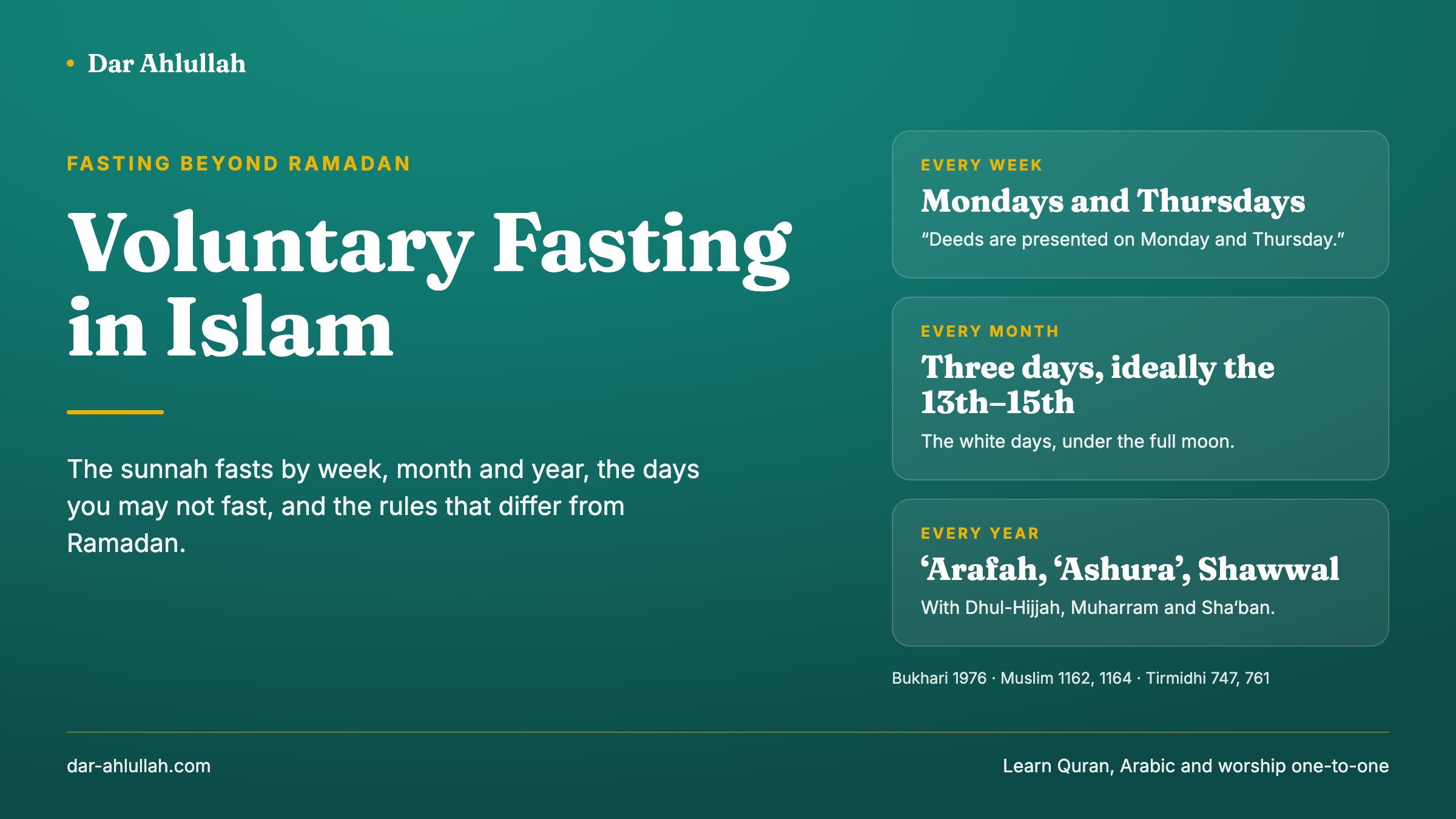
voluntary fasting in Islam
Voluntary Fasting in Islam: The Sunnah Fast Days and Their Rules
Voluntary fasting in Islam from the sound reports: the weekly, monthly and yearly sunnah fasts with the source and grade of each, the days you may not fast or should not single out, and the rules that differ from Ramadan, from a morning intention to breaking the fast and owing Ramadan days, with the schools where they differ.
28 min read
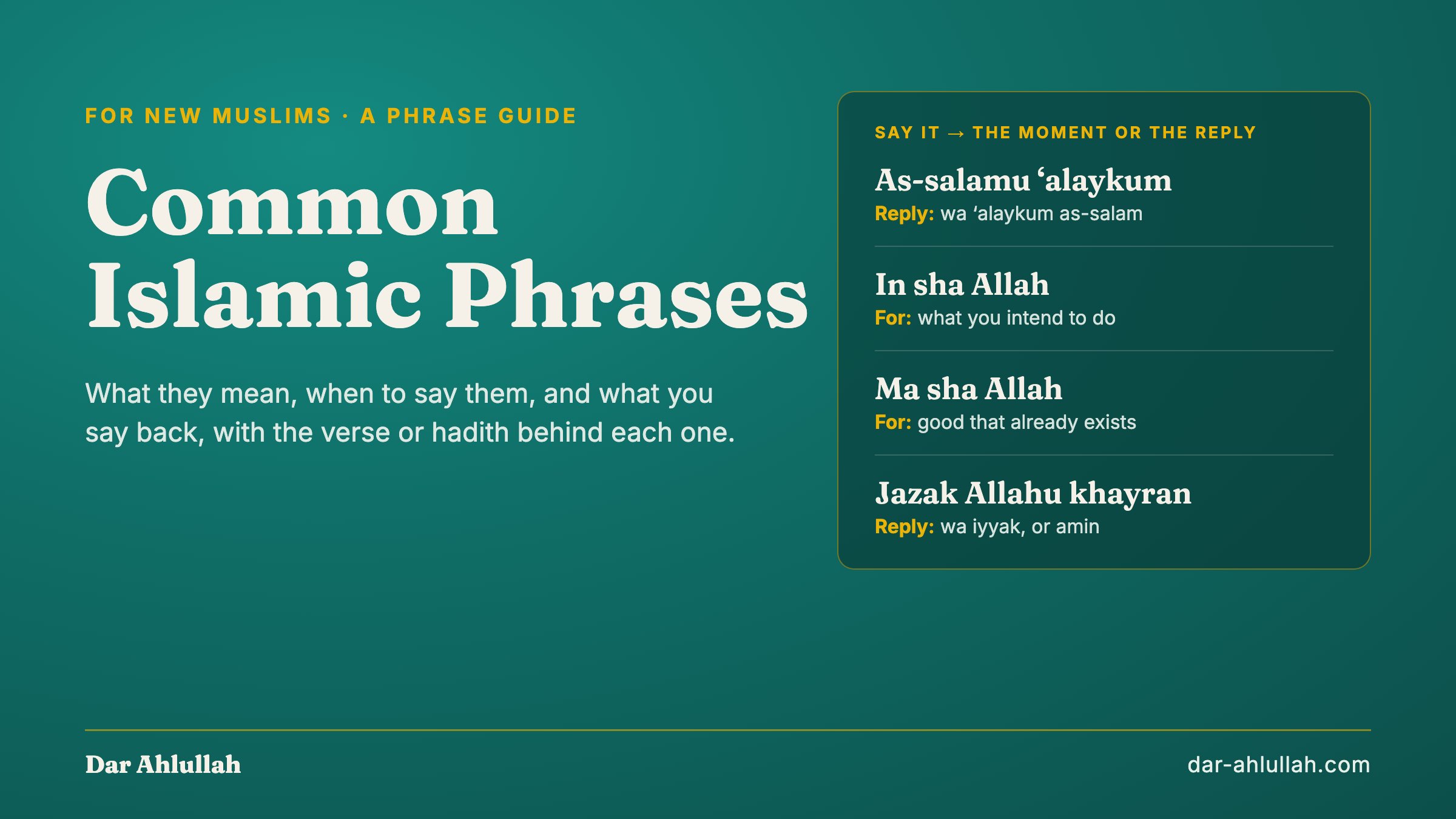
common Islamic phrases
Common Islamic Phrases: What They Mean, When to Say Them and the Reply
In sha Allah, ma sha Allah, jazak Allahu khayran, the salam and the sneeze: what each common Islamic phrase means, the moment it belongs to, what you say back, and the verse or hadith behind it, with the scholars' positions where they differ.
24 min read
fiqh for beginners
Fiqh for Beginners: What to Learn First, and in What Order
Fiqh is the science of what a Muslim does, as distinct from what a Muslim believes. The part you use daily — purification and prayer — is a few weeks of study, and it is taught in a fixed order for a reason.
16 min read