
voluntary fasting in Islam
Voluntary Fasting in Islam: The Sunnah Fast Days and Their Rules
Dar Ahlullah team 28 min read
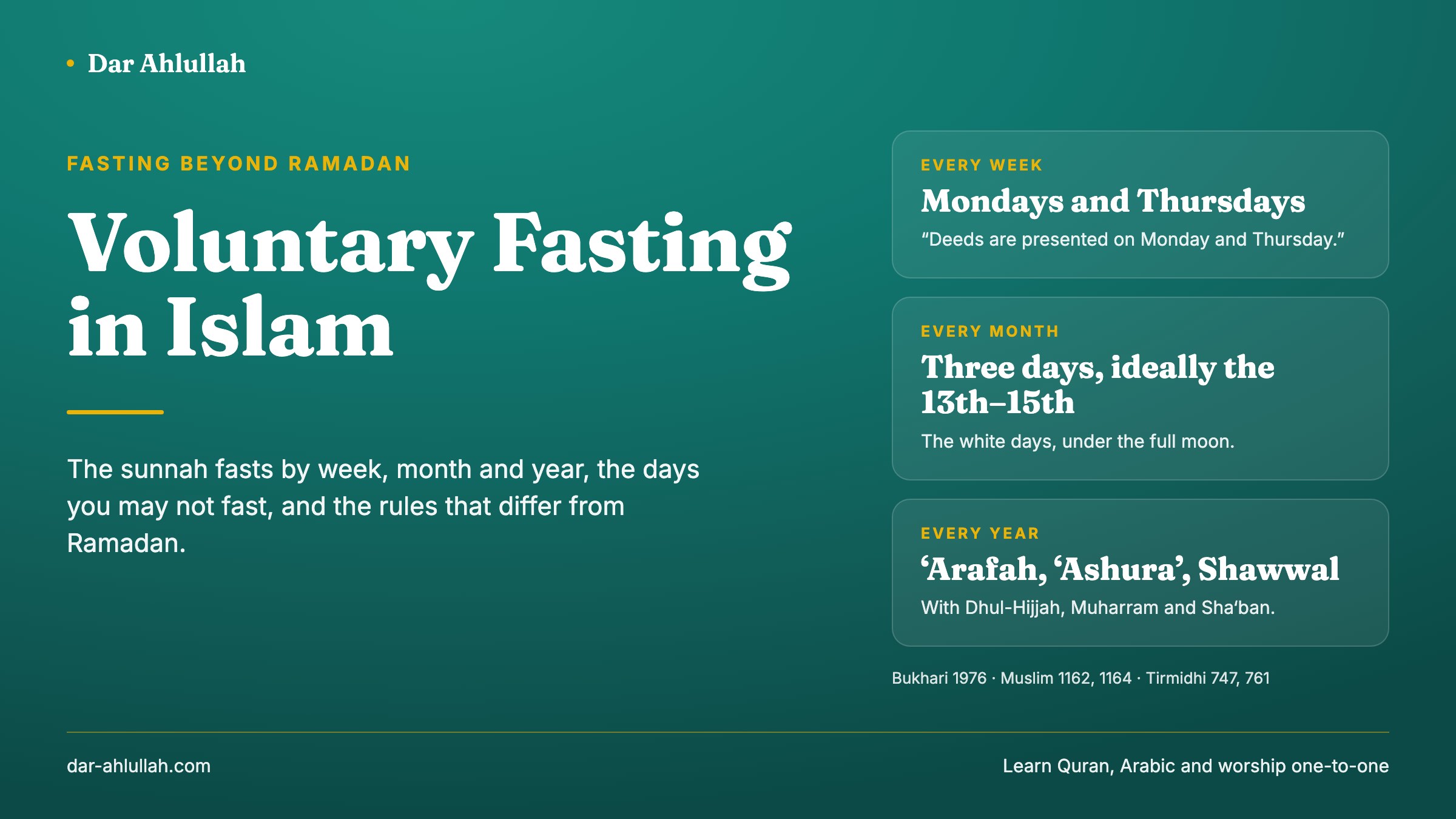
Table of Contents
- Introduction: The Fasts Nobody Will Ask You About
- The Short Answer
- The Sunnah Fasts at a Glance
- Every Monday and Thursday
- Three Days a Month, and the White Days
- The Six Days of Shawwal
- The First Nine Days of Dhul-Hijjah, and the Day of ‘Arafah
- Muharram and ‘Ashura’
- Sha‘ban, and the Second Half of It
- The Fast of Dawud: The Upper Limit
- Days You May Not Fast, and Days Not to Single Out
- The Rules That Differ From Ramadan
- If You Still Owe Days From Ramadan
- Fasting Voluntarily in a Western Week
- Where to Start
- How We Teach This
- Questions People Ask
- Conclusion: A Fast Nobody Sees
Introduction: The Fasts Nobody Will Ask You About
Ramadan is public. The mosque announces it, colleagues know about it, the whole community breaks its fast at the same minute. The voluntary fasts are the opposite. Nobody will ask whether you fasted last Monday, or the thirteenth of the lunar month, or the day of ‘Arafah if you were not on Hajj. They are kept quietly, by whoever decides to keep them.
That is close to how the Sunnah describes fasting itself. In the hadith qudsi recorded by al-Bukhari, Allah says: “All the deeds of Adam’s sons are for them, except fasting, which is for Me, and I will give the reward for it” (Sahih al-Bukhari 1904). And of a single voluntary day: “Every servant of Allah who observes fast for a day in the way of Allah, Allah would remove, because of this day, his face farther from the Fire to the extent of seventy years’ distance” (Sahih Muslim 1153).
The voluntary fasts have a calendar — weekly, monthly and yearly days the Prophet ﷺ kept or recommended — and a handful of rules that work differently from Ramadan. You may decide to fast in the morning. You may, on most views, break the fast if you change your mind. Some days are forbidden outright and some are disliked if picked out on their own. And there is a question many women who missed days of Ramadan end up asking: can I fast the six days of Shawwal before I have made those up?
This article sets out each sunnah fast with its source and the grade of the report it rests on, the days you may not fast, and the rules, with the schools’ positions where they differ. Nothing here is a ruling of ours. If you are new to Islam, none of it comes first: the fast of Ramadan does, as our guide to your first 90 days as a Muslim explains. The voluntary fasts are what you build once the obligations are in place.
The Short Answer
- What it is: any fast you keep that Allah did not make obligatory. Fasting voluntarily is recommended (mustahabb) on any day that is not a forbidden one (Dorar, Section I: Mustahabb Fasting).
- The weekly fast: Mondays and Thursdays. The Prophet ﷺ said deeds are presented on those days, “and I love that my deeds be presented while I am fasting” (Tirmidhi 747).
- The monthly fast: any three days of each month, and the majority of jurists prefer the “white days”, the 13th, 14th and 15th of the lunar month.
- The yearly fasts: six days of Shawwal; the first nine days of Dhul-Hijjah, above all the day of ‘Arafah; ‘Ashura’ with the day before it; as much of Muharram as you can; and most of Sha‘ban.
- The upper limit: the fast of Dawud, one day on and one day off. Fasting every day is disliked.
- Forbidden: the two Eids and the three days after Eid al-Adha. Disliked: singling out a Friday; on several views singling out a Saturday or Rajab; fasting ‘Arafah while on Hajj.
- Different from Ramadan: you may form the intention during the morning if you have not eaten, and the Prophet ﷺ once broke a voluntary fast when food arrived. Whether a broken voluntary fast must be made up is where the schools differ.
The Sunnah Fasts at a Glance
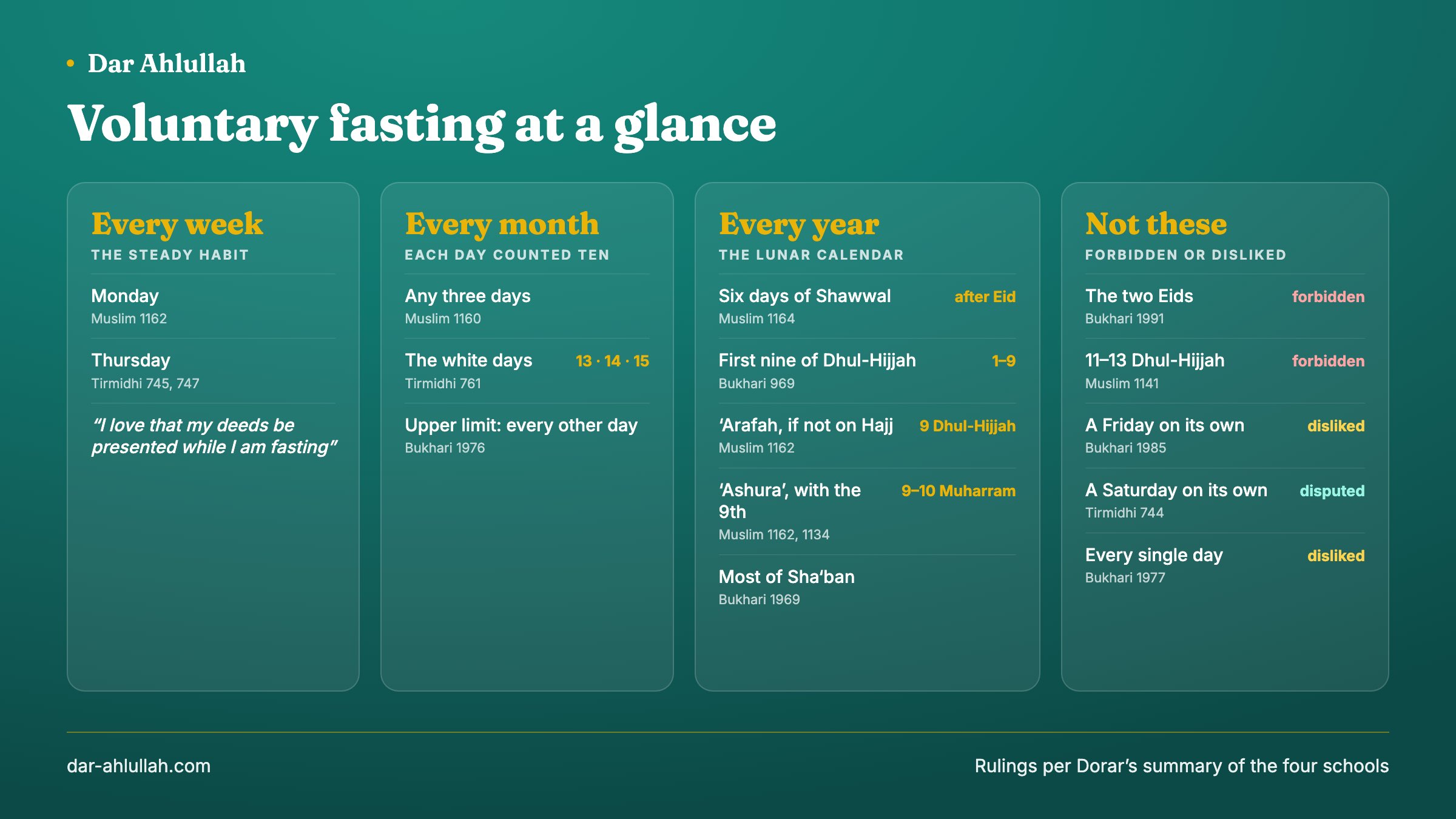
Every voluntary fast below rests on a report in al-Bukhari or Muslim, or on one the hadith scholars graded sound; where they graded a report apart, the table says so. The rulings in the last column are from the summary of the four schools at Dorar unless another source is given in the section.
| Fast | When | Main source | Standing in the schools |
|---|---|---|---|
| Mondays and Thursdays | Every week | Muslim 1162; Tirmidhi 745, 747 | Mustahabb, by agreement of the four schools |
| Three days a month | Any three days of each lunar month | Bukhari 1976, 1981; Muslim 1160 | Mustahabb, by agreement of the four schools |
| The white days | 13th, 14th and 15th of the lunar month | Tirmidhi 761; Nasa’i 2420, 2422 | Preferred for the three days by the Hanafis, Shafi‘is, Hanbalis and a group of the Malikis |
| Six days of Shawwal | Any six days of Shawwal after Eid | Muslim 1164; Ibn Majah 1715 | Sunnah for al-Shafi‘i, Ahmad and most later Hanafis; Malik disliked it |
| First nine days of Dhul-Hijjah | 1st–9th Dhul-Hijjah | Bukhari 969; Abu Dawud 2437 (against Muslim 1176) | The first eight mustahabb, by agreement of the four schools |
| The day of ‘Arafah | 9th Dhul-Hijjah, if you are not on Hajj | Muslim 1162 | Mustahabb for the non-pilgrim, by agreement of the four schools |
| ‘Ashura’ and the 9th | 10th Muharram, with the 9th | Muslim 1162, 1134; Bukhari 2004 | ‘Ashura’ by consensus; the 9th by agreement of the four schools |
| Muharram | As much of the month as you can | Muslim 1163 | Mustahabb, by agreement of the four schools |
| Most of Sha‘ban | The month before Ramadan | Bukhari 1969, 1970 | Mustahabb for the Hanafis, Malikis and Shafi‘is |
| The fast of Dawud | Every other day | Bukhari 1131, 1976; Muslim 1159 | Mustahabb; Ibn Hazm reports consensus |
Every Monday and Thursday
This is the fast with the most regular rhythm, and the one the reports describe as the Prophet’s ﷺ habit. ‘A’ishah said: “The Prophet used to try to fast on Mondays and Thursdays” (Tirmidhi 745, graded sahih by al-Albani and Ahmad Shakir).
Two reasons are given in the reports, one for each day and one for both.
- Monday. Asked about fasting on Monday, he said: “It was the day on which I was born, on which I was commissioned with prophethood or revelation was sent to me” (Sahih Muslim 1162).
- Both days. “Deeds are presented on Monday and Thursday, and I love that my deeds be presented while I am fasting” (Tirmidhi 747). Al-Albani and Ahmad Shakir graded it sahih and Bashar ‘Awwad hasan. Usamah ibn Zayd’s version, in which he kept the habit into old age, is in Abu Dawud 2436; al-Albani graded that chain sahih, while Shu‘ayb al-Arna’ut and Zubair Ali Zai graded it da‘if.
Nothing obliges you to keep both days, or to keep them every week. A Monday kept on its own is a sunnah fast kept. What the reports do describe is regularity, and a habit of Mondays and Thursdays has a useful side effect explained below: it is the “habit” that lifts the restrictions on fasting before Ramadan and on a Friday or Saturday that falls on one of your days.
Three Days a Month, and the White Days
The monthly fast has the clearest arithmetic in the Sunnah. When ‘Abdullah ibn ‘Amr wanted to fast every day, the Prophet ﷺ told him: “Fast three days a month as the reward of good deeds is multiplied ten times and that will be equal to one year of fasting” (Sahih al-Bukhari 1976). Three days at ten times their reward is thirty days, every month. Abu Hurayrah counted it among the three things his friend advised him never to leave, alongside the two rak‘ahs of Duha and praying witr before sleeping (Sahih al-Bukhari 1981) — the other two have their own guides, our guide to salat ad-duha and our guide to tahajjud and witr.
Which three days? Two sets of reports answer differently, and both are sound.
- Any three. Mu‘adhah al-‘Adawiyyah asked ‘A’ishah which days of the month he fasted. “He was not particular about the days of the month on which to observe fast” (Sahih Muslim 1160).
- The white days. “O Abu Dharr! When you fast three days out of a month, then fast the thirteenth, fourteenth, and fifteenth” (Tirmidhi 761, hasan sahih per al-Albani and Ahmad Shakir). Jarir ibn ‘Abdullah’s report names them “the shining days of al-Bid” (Nasa’i 2420, hasan per al-Albani), and Qatadah ibn Milhan’s says “he used to command us to fast the days of the white nights” (Abu Dawud 2449, sahih per al-Albani, da‘if per Zubair Ali Zai).
Dorar puts the two together the way the jurists did: fasting three days a month is recommended by agreement of the four schools, and the majority preferred that the three be the white days — named for the full moon that lights those nights (Dorar). So the white days are the better choice when you can make them, and any three days still keep the sunnah when you cannot.
SeekersGuidance was asked which is better for someone who cannot do both, the white days or Mondays and Thursdays, and answered that both are recommended and that Mondays and Thursdays would appear the more virtuous, since they come to eight days a month rather than three (SeekersGuidance). Nothing stops you combining them: when the 13th falls on a Monday, one fast carries both intentions (see combining intentions below).
The Six Days of Shawwal
“He who observed the fast of Ramadan and then followed it with six fasts of Shawwal, it would be as if he fasted perpetually” (Sahih Muslim 1164). Thawban’s report gives the arithmetic: “Whoever fasts six days after the Fitr will have completed the year, for whoever does a good deed will have the reward of ten like it” (Ibn Majah 1715, sahih per al-Albani, Shu‘ayb al-Arna’ut and Zubair Ali Zai). Thirty days of Ramadan at ten times is ten months; six days at ten times is two more.
Three practical questions come up every year.
- Consecutive or spread out? Either. Al-Nawawi reported his school’s position as recommending them straight after Eid, one after another, “but if one separates them or delays them until later in Shawwal, this is permissible”, and said this was also the view of Ahmad and Dawud (IslamQA 7858). The Hanafi answer at Darul Fiqh records the Hanafi and Hanbali schools leaving the order to the individual (islamqa.org 156422).
- Not the day of Eid. The first of Shawwal is Eid al-Fitr, which may not be fasted at all. The six begin from the 2nd at the earliest.
- Malik’s position. Imam Malik disliked ordinary people fasting the six days — as the same answer reports from Mawahib al-Jalil, “in fear that they would regard it to be at par with the fasts of Ramadhan”. Abu Hanifah, al-Shafi‘i and Ahmad recommended them.
The question of whether they count before you have made up missed Ramadan days has its own section below, because the answers split cleanly.
The First Nine Days of Dhul-Hijjah, and the Day of ‘Arafah
“No good deeds done on other days are superior to those done on these” — the first ten days of Dhul-Hijjah (Sahih al-Bukhari 969). The tenth is Eid al-Adha and may not be fasted, so the fast covers the first nine.
The reports on whether the Prophet ﷺ fasted them pull in two directions:
- He did. One of his wives said he “used to fast the first nine days of Dhul-Hijjah, Ashura’ and three days of every month” (Abu Dawud 2437, sahih per al-Albani, isnad sahih per Zubair Ali Zai). IslamQA notes that the critics of hadith differed on this report, because it comes from Hunaydah ibn Khalid through several chains in several wordings (IslamQA 145046).
- ‘A’ishah never saw it. “I never saw the Messenger of Allah ﷺ fasting in the ten days of Dhu’l-Hijjah” (Sahih Muslim 1176).
Al-Nawawi’s reconciliation, quoted by the Iftaa’ Department of Jordan, is that her words do not make fasting those days disliked: he may have left them because of illness, travel or some other reason, or she may not have seen him fast them, and the report of Hunaydah supports that reading. Ibn Hajar added that he may have left them “for fear that Muslims would think that it is an obligation” (islamqa.org 228700). The four schools agree that fasting the first eight is recommended (Dorar).
The day of ‘Arafah
The ninth is the one fast in the year with the largest promise attached to it. Asked about it, the Prophet ﷺ said: “It expiates the sins of the preceding year and the coming year” (Sahih Muslim 1162). The four schools agree it is recommended for anyone not on Hajj.
For the pilgrim standing at ‘Arafah it is different. Umm al-Fadl, when people argued over whether he was fasting that day, sent him a bowl of milk “while he was riding over his camel and he drank it” (Sahih al-Bukhari 1988; Muslim 1123). The Malikis, Shafi‘is and Hanbalis hold that fasting it is disliked for the pilgrim (Dorar, Section II: Makruh Fasting). The explicit prohibition sometimes quoted, “he prohibited fasting on the day of Arafah at Arafah” (Abu Dawud 2440), is graded da‘if by al-Albani and Shu‘ayb al-Arna’ut, though Zubair Ali Zai graded its chain hasan; the milk report carries the ruling on its own.
If you live outside Saudi Arabia, your 9th of Dhul-Hijjah may not be the day the pilgrims stand at ‘Arafah. That question is answered under fasting in a Western week.
Muharram and ‘Ashura’
“The most excellent fast after Ramadan is God’s month, al-Muharram, and the most excellent prayer after what is prescribed is prayer during the night” (Sahih Muslim 1163). Any fasting in Muharram is in that virtue; the four schools agree it is recommended (Dorar).
Its tenth day, ‘Ashura’, has its own history. The Prophet ﷺ came to Madinah, found the Jews fasting it as the day Allah saved Musa and the Children of Israel, and said: “We have more claim over Moses than you.” He fasted it and told the Muslims to fast it (Sahih al-Bukhari 2004). Its reward: “It expiates the sins of the preceding year” (Muslim 1162).
Late in his life he added the day before it: “If I live till the next year, I would definitely observe fast on the 9th” (Sahih Muslim 1134). He died before that year came. Fasting the 9th, Tasu‘a’, is recommended by agreement of the four schools (Dorar), and al-Shafi‘i, Ahmad, Ishaq and others recommended fasting the 9th and 10th together. IslamQA’s summary: there are several ways to fast ‘Ashura’, “the least of which is to fast the tenth only, but it is better to fast the ninth as well” (IslamQA 21785). Of the reasons the scholars gave for adding the 9th, the one Ibn Hajar judged most likely is to differ from the People of the Book.
Sha‘ban, and the Second Half of It
‘A’ishah: “I never saw Allah’s Messenger ﷺ fasting for a whole month except the month of Ramadan, and did not see him fasting in any month more than in the month of Sha‘ban” (Sahih al-Bukhari 1969). The Hanafis, Malikis and Shafi‘is hold that fasting most of Sha‘ban is recommended (Dorar).
Two restrictions sit at the end of the month, and they are graded very differently.
- The day or two before Ramadan. “None of you should fast a day or two before the month of Ramadan unless he has the habit of fasting” (Sahih al-Bukhari 1914). This is undisputed. Its exception matters: if your Monday or Thursday falls there, you fast it.
- The whole second half. “When a half of Sha‘ban remains then do not fast” (Tirmidhi 738; Abu Dawud 2337). Al-Albani and Ibn Baz graded it sahih. Ibn Hajar, however, reported that the majority of scholars graded it weak and allowed voluntary fasting after mid-Sha‘ban, and that Ahmad and Ibn Ma‘in called it munkar. The Shafi‘is acted on it, most of them treating the prohibition as one of haram and al-Ruyani as one of makruh; Ibn ‘Uthaymin said that even if it is sahih, the prohibition is one of dislike. Everyone who acted on it excepted the person with a fasting habit and the person continuing from fasting in the first half (IslamQA 13726).
In practice: fast in the first half of Sha‘ban if you want to fast much of it, keep your usual Mondays and Thursdays all the way through, and do not start a new fast in the last day or two before Ramadan.
The Fast of Dawud: The Upper Limit
‘Abdullah ibn ‘Amr had vowed to fast every day and pray all night for the rest of his life. The Prophet ﷺ talked him down step by step — three days a month, then one day in three — and stopped at a ceiling: “Fast one day and give up fasting for a day and that is the fasting of Prophet David and that is the best fasting” (Sahih al-Bukhari 1976). Elsewhere: “The most beloved fasts to Allah are those of David” (Sahih al-Bukhari 1131).
Beyond that ceiling the Sunnah turns against it. Of the man who fasts every day of his life the Prophet ﷺ said “He neither fasted nor broke it” (Sahih Muslim 1162), and to ‘Abdullah: “your eyes have a right on you, and your body and your family have a right on you” (Sahih al-Bukhari 1977). Fasting every day is makruh for the Hanafis and on positions within the other three schools (Dorar). Wisal, fasting day into day without eating at night, the Prophet ﷺ forbade outright while practising it himself: “I am not like you, for I am given food and drink by Allah” (Sahih al-Bukhari 1962).
The point of the ceiling is not that more is bad. It is that the fast of Dawud left room for the rights of the body and the family, and that he “would never flee from the battlefield” (Bukhari 1979): fasting did not cost him his other duties.
Days You May Not Fast, and Days Not to Single Out
Voluntary fasting is open on every day of the year except these. The first three are forbidden; the rest are disliked, mostly when the day is picked out on its own, and several are disputed.
| Day | Ruling | Source | Exceptions and disputes |
|---|---|---|---|
| Eid al-Fitr and Eid al-Adha | Haram, by consensus | Bukhari 1990, 1991; Muslim 1137 | None |
| The days of tashriq (11th–13th Dhul-Hijjah) | Haram, by agreement of the four schools | Muslim 1141: “days of eating and drinking”; Bukhari 1997 | The pilgrim who cannot afford the sacrifice, for the Malikis, Hanbalis and al-Shafi‘i’s old position |
| The day of doubt (30th Sha‘ban, moon not sighted) | Haram if fasted in case Ramadan has begun, for the Malikis and Shafi‘is and others | Abu Dawud 2334 (‘Ammar); Bukhari 1914 | A habitual fast that falls on it |
| A Friday on its own | Makruh for the Shafi‘is, Hanbalis and some Hanafis | Bukhari 1985, 1986; Muslim 1144 | Fine with Thursday or Saturday, or if it falls on a day you habitually fast |
| A Saturday on its own | Makruh without a reason, for the four schools; Ibn Taymiyyah and Ibn Hajar held it permissible | Tirmidhi 744; Abu Dawud 2421 — graded sahih by al-Albani, weak or munkar by Malik, Ahmad and others | Fine with Friday or Sunday, or for ‘Arafah, ‘Ashura’, the white days or a habit |
| ‘Arafah, for the pilgrim | Makruh for the Malikis, Shafi‘is and Hanbalis | Bukhari 1988; Muslim 1123 | Recommended for everyone else |
| Rajab, singled out | Makruh for the Malikis and Hanbalis, and al-Shawkani | Dorar, Makruh Fasting | Your usual fasts in Rajab are unaffected |
| Every day of the year | Makruh for the Hanafis and on positions within the other schools | Bukhari 1977; Muslim 1162 | The fast of Dawud is the recommended maximum |
The rulings in the second column are from Dorar’s sections on forbidden and disliked fasting. Two of the rows need a word more.
Friday. “None of you should fast on Friday unless he fasts a day before or after it” (Sahih al-Bukhari 1985). When the Prophet ﷺ found Juwayriyah fasting on a Friday, he asked whether she had fasted the day before or meant to fast the day after; she had not and did not, and he told her to break her fast (Bukhari 1986). Muslim’s wording adds the exception: “but only when anyone among you is accustomed to fast on dates which coincide with this day” (Muslim 1144). So a Friday that is your 13th, or the day of ‘Arafah, is fasted.
Saturday. “Do not fast on Saturday except what has been made obligatory on you” (Tirmidhi 744). Al-Tirmidhi called it hasan and explained: “What is makruh in this case is for a man to single out Saturday for fasting”. Al-Albani graded it sahih. Malik, Ahmad, al-Zuhri, al-Awza‘i, Ibn Taymiyyah, Ibn al-Qayyim and Ibn Hajar judged it weak or munkar, and Ibn Baz, Ibn ‘Uthaymin and the Permanent Committee also favoured the view that it is weak (IslamQA 81621). The working rule is Ibn Qudamah’s, quoted in the same answer: the dislike is for singling Saturday out, so if you fast another day with it, or it falls on a day you regularly fast, it is not makruh. The same answer applies that to a Saturday that is ‘Arafah or ‘Ashura’.
The Rules That Differ From Ramadan
A voluntary fast is the same fast as Ramadan — from true dawn to sunset, with the same things breaking it. What changes is how it starts, whether it can be stopped, and whose permission it needs.
You may decide in the morning
‘A’ishah reported that the Prophet ﷺ came in one day and asked: “Is there anything with you (to eat)?” She said no. “Thereupon he said: I shall then be fasting” (Sahih Muslim 1154). A Ramadan fast or a make-up fast needs its intention before dawn; a general voluntary fast can be intended during the day, on one condition — that you have done nothing since dawn that breaks a fast.
How late in the day the intention can come is where the schools differ:
- Hanafi: before the Islamic midday (al-dahwa al-kubra), the halfway point between dawn and sunset (SeekersGuidance).
- Shafi‘i: before the sun passes its zenith (islamqa.org 30000).
- Ibn ‘Uthaymin: at any point in the day, with the reward counted “only from the time the intention was formed” (IslamQA 218362).
Ibn ‘Uthaymin draws a consequence from that last line which matters for the named fasts. Because the reward runs from the moment of intention, someone who decides at noon to make today one of the six of Shawwal has fasted half of it, and he told such a person: “you have not attained the reward for fasting the six days, because you did not fast six full days. The same may be said with regard to the day of ‘Arafah.” IslamQA’s summary of the rule: a general voluntary fast can be intended during the day, but one done for a specific reason needs its intention from the night before (IslamQA 218362). If tomorrow is ‘Arafah, decide tonight.
You may break it — and whether you make it up depends on the school
The same report continues: on another day food was brought, and he said, “Show that to me; I had been fasting since morning”, and ate (Muslim 1154). In the report of Umm Hani’, he told her, “The one fasting a voluntary fast is the trustee for himself; if he wishes he fasts, and if he wishes he breaks” (Tirmidhi 732, sahih per al-Albani, da‘if per Zubair Ali Zai).
| School | If you break a voluntary fast, must you make it up? | Source |
|---|---|---|
| Hanafi | Yes, it is wajib, “whether it is due to an excuse or not” | SeekersGuidance |
| Maliki | Only if it was broken intentionally without an excuse | Islam and Ihsan |
| Shafi‘i and Hanbali | No. Completing it is recommended, not obligatory | Dorar |
Dr. Khalid al-Musleh, who holds that the make-up is not compulsory, still recommends it, “especially if they are for a reason like fasting for three days every month” (almosleh.com).
A married woman and her husband’s permission
“A woman should not fast (optional fasts) except with her husband’s permission if he is at home” (Sahih al-Bukhari 5192; Muslim 1026). Dorar records the four schools agreeing on the ruling, with differences in its reach: the Malikis restrict it to when the husband has a need of his wife, and for the Shafi‘is a fast kept without permission is valid though she is sinful, while a day that does not come round again, such as ‘Arafah, may be fasted without his permission unless he forbids it (Dorar). The ruling as the schools state it concerns voluntary fasts and a husband who is present; Ramadan itself is not his to permit.
If You Still Owe Days From Ramadan
This is the question women ask most, since a period means missed days every Ramadan. Fasts missed for menstruation are made up, unlike prayers, which is one of the differences our article on making up missed prayers explains. Can voluntary fasts come first?
Voluntary fasts in general
‘A’ishah: “Sometimes I missed some days of Ramadan, but could not fast in lieu of them except in the month of Sha‘ban” (Sahih al-Bukhari 1950). The four schools agree you may delay the make-up days through the year as long as they are done before the next Ramadan, though hastening is better (Dorar). On fasting voluntarily in the meantime:
- Hanafi: permissible.
- Maliki and Shafi‘i: permissible but disliked.
- Hanbali: forbidden, in the position IslamWeb reports; Dorar records a narration from Ahmad that sides with the majority.
Dorar gives the majority position — Hanafis, Malikis, Shafi‘is and a narration from Ahmad — as: making up the obligatory days first “is not wajib” as long as there is time for both (Dorar). IslamWeb sets out the same split and concludes that “there is nothing wrong with fasting the six days of Shawwaal, the tenth day of Muharram, or any voluntary fast before you observe the days you have missed” (IslamWeb 3718). The hadith sometimes quoted against it — that a voluntary fast is not accepted from someone who owes Ramadan days — is, in the same fatwa, “not authentic given the inconsistency of its chains of transmission”.
The six days of Shawwal specifically
Here the wording of the hadith creates a second question. The promise is for the one who “observed the fast of Ramadan and then followed it with six” (Muslim 1164).
- Make up first, for the reward. IslamQA, following Ibn ‘Uthaymin, reads the “then” (thumma) as an order: “The one who still owes missed Ramadan fasts is said to have fasted part of Ramadan; we cannot say that he has fasted Ramadan.” Someone who spends Shawwal making up days for a valid reason — their example is a woman whose postnatal bleeding lasted the month — may fast the six in Dhul-Qa‘dah instead (IslamQA 40389).
- Either order. The majority position above, and IslamWeb’s conclusion naming the six days explicitly, allow the six before the make-up.
If Shawwal has room for both, making up first satisfies both views. If it does not, you are choosing between two scholarly positions, not between right and wrong.
Combining intentions
Two virtues on one day are counted twice when both are voluntary. Asked about fasting the six of Shawwal on Mondays and Thursdays, Ibn ‘Uthaymin said the person “will attain the reward of fasting on a Monday with the intention of attaining the reward for fasting the six days, and the intention of attaining the reward for fasting on a Monday or Thursday” (IslamQA 106468).
Combining an obligatory make-up day with a voluntary one is disputed. IslamQA’s position is in the title of its answer: “It is not valid to combine making up missed Ramadan fasts with fasting six days of Shawwal with one intention” (IslamQA 39328). The Shafi‘is have two views; the Iftaa’ Department of Jordan holds it permissible but says one intention “doesn’t entail the same reward as fasting each with a separate intention”, and advises keeping them separate (islamqa.org 228958).
Fasting Voluntarily in a Western Week
A Monday at work
A voluntary fast at a desk job is mostly a lunch problem, and the Sunnah has two answers for it. If someone invites you: “If any one of you is invited to a meal when he is fasting, he should say: I am fasting” (Sahih Muslim 1150), and “If any one of you is invited, he should accept. In case he is fasting, he should pray (in order to bless the inmates of the house), and if he is not fasting he should eat” (Muslim 1431, with the translator’s gloss). And if the occasion matters more than the fast, the Prophet’s ﷺ own practice in Muslim 1154 is that a voluntary fast can be broken. On the Shafi‘i and Hanbali view you owe nothing for it; on the Hanafi view you make it up.
Short winter days, long summer ones
“Fasting during the winter is an easy reward” (Tirmidhi 797; sahih per al-Albani and Ahmad Shakir, da‘if per Zubair Ali Zai). In northern Europe the sentence is almost literal: a December fast can be over by late afternoon. The summer is the reverse, and at high latitudes the fasting day can run very long. For an obligatory fast that raises real questions, which our guide to prayer times at high latitude covers for the prayer side. For a voluntary fast it raises none: nothing obliges you to fast a long June Monday, and the winter months are the season to build the habit.
Whose 13th, and whose ‘Arafah?
The white days and ‘Arafah are lunar dates, and Muslim communities in the West do not always start the month on the same day. Ibn ‘Uthaymin was asked whether to fast ‘Arafah by one’s own country’s sighting or by Makkah’s, and answered that the moon sighting varies by place, so if the 9th in Makkah is the 8th where you are, “they should fast the day that is the 9th for them, which is the 10th in Makkah”; and if your 10th is Makkah’s 9th, that day is Eid for you and may not be fasted (IslamQA 40720). He noted that this rests on a difference of opinion among the scholars, the other view being that one sighting holds for the whole world. On his view, in practice, you fast by the calendar your own community follows for Ramadan and Eid.
For the white days the stakes are lower. The monthly fast is any three days (Muslim 1160); the white days are the preferred three. If your calendar and the next mosque’s disagree by a day, you have kept the sunnah of three days either way.
Where to Start
The fast of Dawud is the ceiling, not the starting point. The reports themselves move upward from small: ‘Abdullah ibn ‘Amr was given three days a month first. One reasonable progression, using only the fasts above:
- The yearly days first. ‘Arafah and ‘Ashura’ with the 9th are three days a year, and the first two carry the expiation promised in Muslim 1162.
- Then three days a month, aiming for the 13th, 14th and 15th.
- Then Mondays, and later Thursdays.
- Then the seasons — Shawwal’s six, the first nine of Dhul-Hijjah, more of Muharram, the first half of Sha‘ban.
Before any of it, the obligations: Ramadan, and any Ramadan days you owe. The schools differ on whether those must come first, as above, but none of them puts a voluntary fast above them.
How We Teach This
Most of what is in this article is fiqh, and fiqh is where reading on your own runs out fastest: the question you actually have is rarely the one the article answers, and the answer often depends on which school you follow. Our guide to fiqh for beginners explains how the categories used above — fard, mustahabb, makruh, haram — fit together.
Dar Ahlullah runs one-to-one live sessions with certified teachers, scheduled in your own timezone, in Quran, Arabic and Islamic Studies; the Islamic Studies course, which covers Aqeedah and Fiqh basics with the Seerah, is designed for children and teens. Teaching is charged at $9 per teaching hour, with monthly plans at $36, $70 and $102 depending on how many hours you want, and a 20% discount for siblings. You can pause, upgrade or switch plans at any time, and if a teacher is not the right fit we rematch you with another certified mentor at no extra cost. The first step is a free 30-minute assessment that does not ask for a card — the details are on our pricing page.
Questions People Ask
What are the sunnah fasting days in Islam?
Weekly: Mondays and Thursdays. Monthly: three days, preferably the 13th, 14th and 15th of the lunar month. Yearly: six days of Shawwal, the first nine days of Dhul-Hijjah including the day of ‘Arafah, ‘Ashura’ with the 9th of Muharram, more of Muharram generally, and most of Sha‘ban. The most a person is recommended to fast is every other day, the fast of Dawud.
Which days is it forbidden to fast?
Eid al-Fitr, Eid al-Adha, and the three days of tashriq after Eid al-Adha (except, on several views, for a pilgrim who cannot afford the sacrifice). The day of doubt at the end of Sha‘ban is forbidden if fasted in case Ramadan has begun. Singling out a Friday is disliked, and on several views so is singling out a Saturday.
Do I need to make the intention the night before?
Not for a general voluntary fast, as long as you have not eaten or done anything else that breaks a fast since dawn (Muslim 1154). The Hanafis set the limit at the Islamic midday, the Shafi‘is at the zenith; Ibn ‘Uthaymin allowed it at any time but counted the reward from the moment of intention, so for ‘Arafah or the six of Shawwal make the intention the night before.
Can I break a voluntary fast?
Yes. The Prophet ﷺ ate from a gift of food on a day he had been fasting voluntarily (Muslim 1154). The Shafi‘is and Hanbalis hold that nothing is owed; the Hanafis require a make-up day; the Malikis require one only if it was broken deliberately without an excuse.
Can I fast the six days of Shawwal before making up missed Ramadan days?
The majority of scholars permit voluntary fasting before the make-up days (IslamWeb 3718). Ibn ‘Uthaymin held that the specific reward of the six of Shawwal needs Ramadan completed first, and allowed someone who spent Shawwal making up days for a valid excuse to fast the six in Dhul-Qa‘dah (IslamQA 40389). Making up first, if there is time, satisfies both views.
Can I fast only on a Friday or only on a Saturday?
Not singled out on its own as a voluntary fast. Fast Thursday or Saturday with the Friday, or Friday or Sunday with the Saturday. If the day is ‘Arafah, ‘Ashura’, one of your white days or a day you habitually fast, it is fasted on its own.
Is fasting ‘Ashura’ alone allowed?
Yes; it is the least of the ways to fast it. Adding the 9th is better, because the Prophet ﷺ said he would fast it if he lived to the next year (Muslim 1134).
Should I fast ‘Arafah by Saudi Arabia’s date or my own country’s?
Scholars differ. Ibn ‘Uthaymin held that it follows your own location’s sighting, so you fast your own 9th (IslamQA 40720); on that view, if your 10th is Makkah’s 9th, that day is Eid for you and may not be fasted. The other view holds one sighting for the whole world.
Do I need my husband’s permission for a voluntary fast?
If he is at home, yes, by agreement of the four schools, with the Malikis limiting it to when he has a need of his wife (Bukhari 5192; Dorar). It does not apply to Ramadan.
Conclusion: A Fast Nobody Sees
Strip the voluntary fasts back to the reports and the calendar is short. A Monday, because it was the day he was born and the day revelation came, and a Thursday, because deeds are presented. Three days a month, which with Ramadan make a year. Six in Shawwal, nine at the start of Dhul-Hijjah with ‘Arafah at the end, two in Muharram. And a ceiling, one day on and one off, so that the fasting never crowds out the rights of the body and the family.
The rules around them are gentler than Ramadan’s on purpose. You can decide in the morning; you can accept a dinner invitation; on most views you can stop. What you cannot do is fast an Eid, and what the Sunnah steers you away from is fasting every day or singling out a Friday.
“Fasting is for Me,” says the hadith, “and I will give the reward for it.” No other act of worship is described that way, and it fits the voluntary fasts best of all: nobody else knows you kept them.
Related articles
fiqh for beginners
Fiqh for Beginners: What to Learn First, and in What Order
Fiqh is the science of what a Muslim does, as distinct from what a Muslim believes. The part you use daily — purification and prayer — is a few weeks of study, and it is taught in a fixed order for a reason.
16 min read

new Muslim guide
A New Muslim Guide to Your First 90 Days in Islam
The problem is never the amount to learn, it is the order. Here is a month-by-month sequence for the first 90 days after your shahada: prayer first, the 28 letters second, and what to deliberately postpone.
14 min read
morning and evening adhkar
Morning and Evening Adhkar: What to Say and When
Morning and evening adhkar from the sound reports: the windows from dawn to sunrise and from 'Asr to sunset, the core set with the source and count of each line, and the grade printed on the popular additions the hadith scholars dispute, from Ayat al-Kursi to hasbiyallah seven times.
29 min read