
online Quran classes vs private tutor
Online Quran Classes vs a Private Tutor at Home: Which Is Better?
Dar Ahlullah team 19 min read
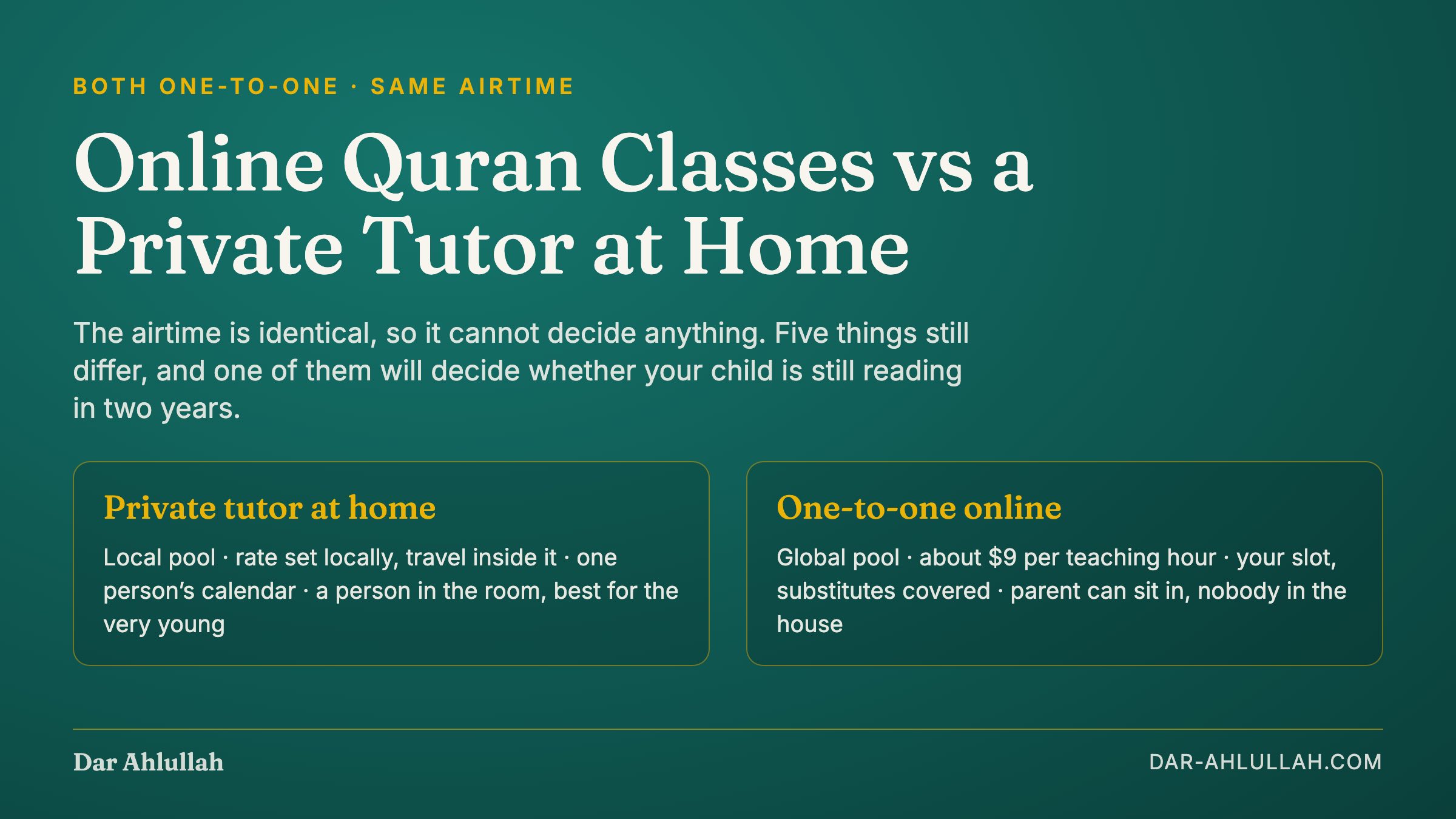
Table of Contents
- Introduction: The One Comparison Where Both Sides Are One-to-One
- The Short Answer
- What Is the Same, So You Can Stop Worrying About It
- Does Teaching Through a Screen Lose Anything? What the Research Says
- Difference 1: The Teacher Pool
- Difference 2: What the Hour Costs, and What Is Inside It
- Difference 3: Scheduling and Continuity
- Difference 4: Safeguarding, Which Nobody Puts in the Comparison Table
- Difference 5: The Lesson Itself
- When the Private Tutor at Home Is the Better Choice
- When Online Is the Better Choice
- The Hybrid, and When It Is Just Paying Twice
- Six Questions to Ask a Home Tutor Before the First Lesson
- How We Would Answer This About Our Own Classes
- FAQs: Online Quran Classes vs a Private Tutor
- Conclusion: Same Product, Five Different Wrappers
Introduction: The One Comparison Where Both Sides Are One-to-One
Most articles that compare online Quran classes vs a private tutor are really comparing online lessons with a group class, and the argument writes itself: one child gets the teacher’s full attention, twenty children share it. That argument is true and we have made it ourselves, in the comparison of online classes and masjid classes. It is also useless here, because a private tutor who comes to your house is one-to-one too. The airtime is identical. If that was the only thing you were buying, you could flip a coin.
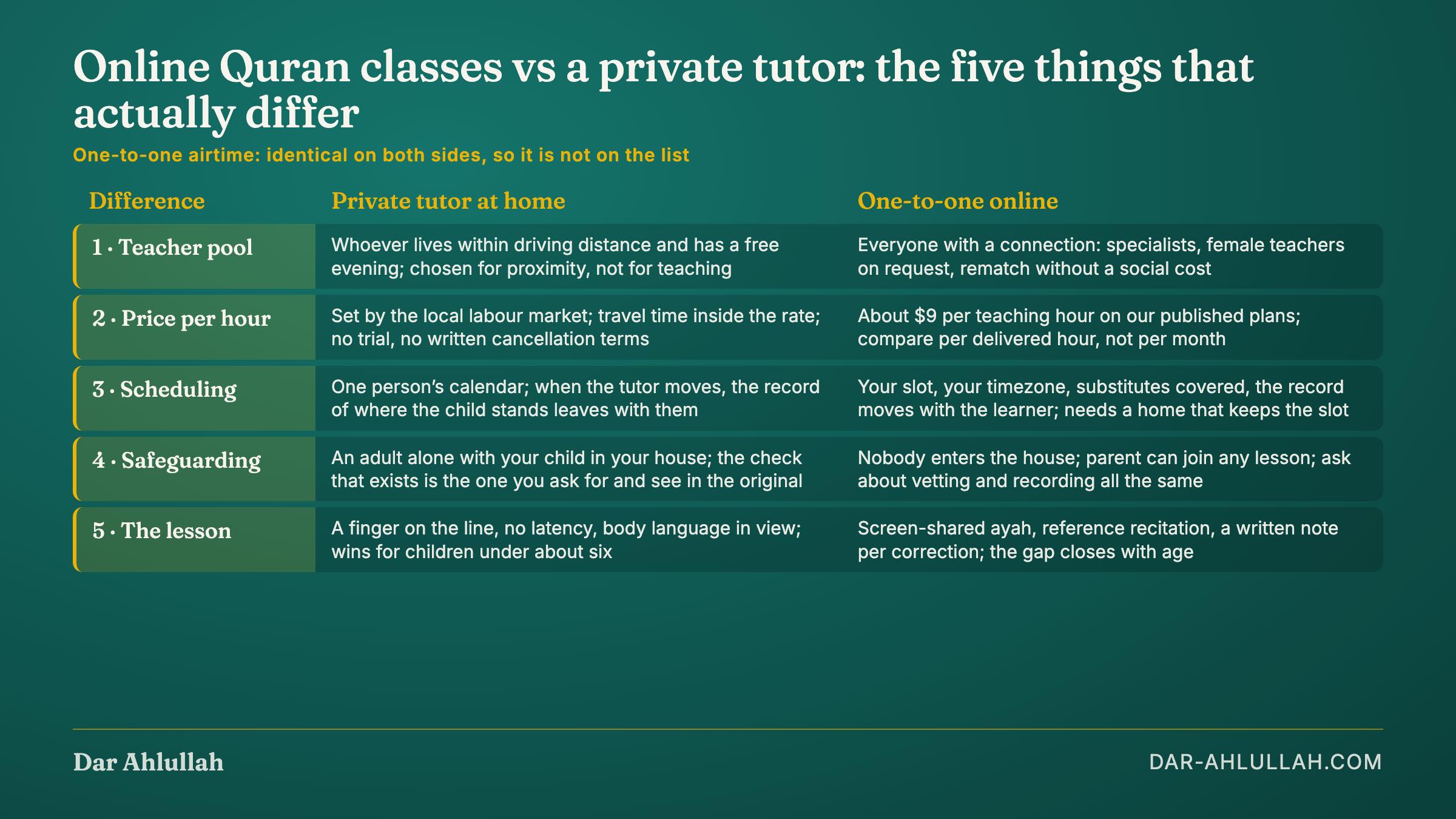
So this is a different comparison, and a harder one. Two ways of buying the same product, an hour of one teacher’s undivided attention, that differ in five things that have nothing to do with airtime: who the teacher can be, what the hour costs and what is inside it, what happens when life moves, who is responsible for the child’s safety, and what the lesson itself feels like across a table rather than across a screen.
We should say the obvious thing first. We teach online, one-to-one, and we charge for it. Read what follows with that in mind. It also means we have spent years hearing from families who tried a local tutor first, and from families who left us for one, and both groups had reasons that were good.
The Short Answer
A private tutor at home is the better choice when you already know a good one, when the learner is very young, and when the price where you live is one you can sustain for the years reading takes. Online is the better choice when the local pool is thin or unsuitable, when you need a particular kind of teacher, when your week does not hold still, and when you want to be able to sit in on every lesson without anyone in your house. On price, online is usually cheaper per teaching hour by a wide margin, but only if you compare per hour rather than per month, and only if you count the sessions that were actually delivered.
Neither is a fallback. The right question is not which format is better in the abstract but which of the five differences below is the one that will decide whether your child is still reading in two years.
What Is the Same, So You Can Stop Worrying About It
Three things are the same, and they are the three things that matter most, which is why this decision is less dramatic than it feels. They are also the three things our guide to learning Quran online is built around, so if you have read that, none of this will be new.
The learner reads aloud for most of the hour. That is the mechanism by which anyone learns to read the Quran: a person makes a sound, a listener corrects it, the person tries again. A home tutor does this across a table. An online teacher does it across a call. In both cases the ratio of listening to speaking is what it should be, which is nothing like a group class.
The pace is the learner’s. There is no class to keep up with or wait for. A tutor who notices that the letter ص is coming out as س stops there, and so does an online teacher.
Correction is immediate. An error corrected in the same breath does not become a habit. An error corrected next week, or never, does. Both formats deliver this. The honest case for whether online classes are worth paying for rests on this point, and it applies to a home tutor with equal force.
So if you are choosing between these two, you have already made the important decision. What is left is the wrapper.
Does Teaching Through a Screen Lose Anything? What the Research Says
The fair worry about online is not that one-to-one teaching does not work. It is that something is lost through a screen. That is a testable question, and it has been tested, though not for Quran.
The cleanest study is a randomised controlled trial by Gortazar, Hupkau and Roldán, published as an EdWorkingPaper in 2023. Secondary-school students from highly disadvantaged neighbourhoods were assigned to an eight-week, entirely online maths tutoring programme delivered by qualified teachers in groups of two. Standardised test scores rose by 0.26 standard deviations and end-of-year maths grades by 0.48, and the students were less likely to repeat the year. Those are large effects for eight weeks, and they were produced with no one in the room.
The limits are worth stating plainly. That was maths, not recitation; teenagers, not five-year-olds; pairs, not singles; and a structured programme, not a tutor found through a neighbour. We have not found a controlled study that puts an in-person Quran tutor against an online one, and we would be suspicious of any academy that claims to have one. What the evidence supports is narrower and still useful: the screen does not, by itself, break the mechanism. Whether it breaks it for your child depends on the child, which is Difference 5 below.
Difference 1: The Teacher Pool
This is the difference that decides most cases, and it is the one people think about least, because they start from a tutor they have already heard of rather than from the set of tutors they could have.
A home tutor has to live within driving distance of your house and have a free hour at a time you can use. In a large Muslim city that pool may be dozens of people. In most of Europe and most of the United States it is a handful, and the handful were not selected for teaching ability. They were selected for proximity. The uncle who reads beautifully and the sister who teaches at the weekend school are both in the pool, and neither has necessarily been taught how to correct a child’s makhraj without making the child cry.
The online pool is everyone with a stable connection, which changes three things:
- Specialisation. A teacher who does only beginners, or only tajweed correction for adults, or only hifz revision, is common online and rare locally. The question to ask an academy is who they will match you with and why, not whether they have someone available.
- A female teacher on request. For many families this is not a preference but a condition. Locally it is often the single hardest thing to find; online it is a checkbox. We wrote separately about finding a female Quran teacher online and why the demand is as high as it is.
- The ability to change teacher without ending a relationship. Firing the tutor who is also your neighbour is socially expensive, so families tolerate a poor fit for years. Online, a rematch is an email. We offer a rematch with another certified mentor at no extra cost precisely because fit is the thing that predicts whether a learner is still there in month six.
None of this makes an online teacher better than a home tutor. It makes the best available online teacher better than the best available home tutor for most families, because the first set is larger. If your local pool happens to contain an excellent teacher, this difference disappears.
Difference 2: What the Hour Costs, and What Is Inside It
A home tutor’s rate is set by the local labour market, and the hour you pay for contains the tutor’s travel time, which you are paying for whether it appears on the invoice or not. General private tuition in the United Kingdom cost a typical £24 an hour excluding agency commission, and £27 in London, when the Sutton Trust surveyed the market in 2016, and that market has not become cheaper since. In the United States, Tutors.com puts general private tutoring at roughly $25 to $80 an hour in 2026. Quran tutors in particular are often cheaper than that, because much of the teaching is informal, but informal is not free and a tutor who charges little is also a tutor who leaves the moment a better hour comes along.
An online academy sets its rate in a different labour market, which is the whole reason the number is different. Our published rate is about $9 per teaching hour; the full breakdown of what online Quran classes cost works through the market ranges above and below that. The comparison is not close. But three things inside the hour need checking before you conclude anything.
| Inside the hour | Private tutor at home | One-to-one online |
|---|---|---|
| Fee basis | Per visit, usually cash, set locally | Per monthly package; compare per teaching hour, not per month |
| Travel | Inside the rate, whether shown or not | None |
| Session length | Usually a full hour; shorter visits rarely make sense | Often 30 minutes; a cheap monthly plan can be expensive per hour |
| Cancellation | Whatever you and the tutor agreed, often nothing in writing | Written policy; read it, since it sets the real per-delivered-lesson cost |
| Trial | Rare; the first paid lesson is the trial | Common; ours is a free 30-minute assessment with no card |
| Equipment | A table and a mushaf | A device, a headset, and reliable internet |
The two traps are the ones the table names. First, a plan sold at $40 a month is not cheaper than a tutor at $30 an hour if the plan is four 30-minute sessions; it is $20 an hour. Second, a provider with a hard cancellation policy charges you for lessons that did not happen, and a home tutor with no policy at all will sometimes not turn up and not charge, which is cheaper and worse. Count delivered hours over a term and divide.
Difference 3: Scheduling and Continuity
A home tutor is one person with one life. The lesson is on Tuesday at six because that is when the tutor is free, and it stays there until the tutor gets a new job, moves house, has a baby, or goes home for the summer, at which point you are back at the start with a learner who has just lost the only adult who knows exactly where their reading stands. Every family who has used a local tutor for more than two years has a version of this story.
Online, the slot is whatever slot you asked for, in your own timezone, and the teacher’s absence is the academy’s problem rather than yours: a substitute covers, or a rematch happens, and the written progress record moves with the learner. The lesson also travels. It happens from the grandparents’ house in Ramadan, from the hotel on holiday, and from the kitchen on the evening the car will not start.
The cost of this flexibility is that online lessons have no physical anchor. A tutor at the door at six is an event the whole house organises around. A video call is a notification, and a notification can be dismissed. Households that keep the slot do fine. Households that do not will find that the flexibility they were sold becomes the reason the lessons quietly stopped. If you are honest that nobody at home will enforce the appointment, a person who knocks on the door is worth paying more for.
Difference 4: Safeguarding, Which Nobody Puts in the Comparison Table
A private tutor at home is an adult alone with your child in a room in your house, usually with the door closed so the younger siblings do not interrupt. Most families arrange this on a recommendation and never think about it again, and most of the time that is fine. It is still a decision, and it is one that a comparison article should say out loud.
The formal position is weaker than most parents assume. In England and Wales, a self-employed tutor could not obtain an Enhanced criminal-record check at all until this year; only an employer could apply for one on their behalf. From 21 January 2026, self-employed tutors offering lessons directly to children can apply for an Enhanced DBS check through an umbrella body. The parent still cannot apply on the tutor’s behalf, and the official guidance for private individuals hiring a tutor is that you must see the original certificate, not a photograph or a copy. In the United States there is no national equivalent; background checks are whatever the tutor volunteers and you verify. Elsewhere in Europe the picture varies by country. In every case, the check that exists is the one you ask for.
Online lessons change the shape of the risk rather than removing it. Nobody enters your house. You can sit in the room for every lesson, or half-listen from the next one, and a lesson can be recorded. Those are real advantages, and they are the reason some parents of daughters choose online before they have considered anything else. But the same rules apply on the other side: the child should not be alone in a bedroom with a screen and a stranger either, and you should ask the academy what its own vetting consists of, whether a parent may join any session unannounced, and whether lessons are recorded and who can see the recording. An academy that finds those questions surprising is telling you something.
We are not going to pretend either format is risk-free, or that one is dangerous. The honest difference is that online gives the parent more control by default, and the home tutor gives the parent more control only if the parent takes it.
Difference 5: The Lesson Itself
Here the home tutor has genuine advantages, and it would be dishonest to bury them.
A finger on the line. A beginner learning to track the script benefits from a teacher who can physically point at the letter and move a finger along the line. Screen-sharing does the same job for older learners; for a five-year-old it does not.
No latency. Tajweed correction is a matter of milliseconds, and a poor connection turns a corrected sound into an argument about whether the teacher heard it right. On a good connection with a headset this is not a problem. On a phone in a busy house, it is.
Body language. A tutor in the room sees the shoulders drop and the eyes wander thirty seconds before the child stops trying. A teacher on a call sees a face in a small rectangle.
Young children. The ability to sit for a screen session arrives at different ages, and for many children it arrives after the age at which they could sit for a person. Our guide to what age a child should start learning Quran goes into this; the short version is that for a four-year-old, a warm human in the room is a better teacher than the best academy on earth.
Online has its own advantages inside the lesson: the teacher can put the ayah on the screen in a font the size of a hand, play a reference recitation, and keep a written note of every correction that both of you can read afterwards. Those matter more as the learner gets older. The general rule is that the in-room advantage is largest for the youngest learners and shrinks with every year of age, until for adults it is close to nothing.
When the Private Tutor at Home Is the Better Choice
- You already know a good one. A good local teacher is the rarest input in this whole decision. If you have one, keep them; nothing online is worth giving that up for.
- The learner is under about six. A person in the room wins, for the reasons in Difference 5.
- Nobody at home will enforce a video call. A knock on the door is an accountability mechanism that a calendar reminder is not.
- The local rate is one you can sustain for years. Reading takes long enough that a price you can only afford for a term is not a price at all.
- Internet or devices are unreliable. An online lesson on a bad connection is worse than no lesson, because it teaches the learner that lessons are frustrating.
When Online Is the Better Choice
- The local pool is thin, or nobody in it teaches. This is most families outside a few large cities.
- You need a female teacher, a specialist, or a native Arabic speaker. Locally these are lottery outcomes; online they are the default.
- Your week does not hold still. Shift work, travel, two households, a child who plays a sport with a changing fixture list.
- You want to be in the room for every lesson without anyone in your house. Difference 4, in one line.
- The learner is an adult. Adults get almost nothing from the in-room advantages and everything from the pool, the price and the flexibility. Our guide to learning Quran as an adult starts from that fact.
- Price decides it. If the difference between $9 and $30 an hour is the difference between lessons and no lessons, it is not a close call.
The Hybrid, and When It Is Just Paying Twice
Two hybrids work. The first is sequential: a local tutor for the first year, while the child is small and the script is new, then online once the learner can sit for a screen and the local tutor’s limits start to show. The second is a weekly online lesson for the correction and the record, plus an occasional local session, perhaps monthly, with a teacher who can hear the recitation in the room and catch what the connection hides.
The hybrid that does not work is two teachers on two methods at the same time, each unaware of the other, with a child in the middle reconciling two sets of corrections. That is not more teaching. It is more confusion at twice the price, and it is the version families most often describe to us when they explain why their child “had Quran classes for years and still cannot read”. If you run two, tell each teacher about the other and let one of them own the plan.
Six Questions to Ask a Home Tutor Before the First Lesson
The questions to ask an online academy are in the guide to choosing one. The home tutor gets a different set, because the risks are different.
- Who taught you to teach? Reading well and teaching reading are different skills, and “I learned in my country” is an answer to a different question.
- What will my child be able to do in three months that they cannot do now? A teacher with a plan answers in a sentence. A teacher without one answers with reassurance.
- May I see your DBS certificate, or your local equivalent? The original, in your hand. If they do not have one, ask whether they would get one, and note that in England and Wales they now can.
- May I sit in? Any time, unannounced. The answer should be yes without a pause.
- What happens when you cannot come? A substitute, a made-up lesson, a refund, or nothing. Any answer is acceptable if it is given before the first missed week rather than after.
- How will I know it is working? A written note per lesson is the minimum. If the answer is “you will hear the difference”, you will not, because the difference arrives too slowly to hear.
How We Would Answer This About Our Own Classes
We would say that a good local tutor is better than us for a child under six, and better than us for any learner in a household that will not keep a video-call appointment. We would say that for everyone else the deciding difference is almost always the pool, and that ours is built to be matched, not just available: a certified teacher chosen for the learner, a rematch at no extra cost if the fit is wrong, a female teacher on request, and a written record after every lesson that the parent can read.
On price, our rate is about $9 per teaching hour and our plans are $36, $70 and $102 a month, with a 20% sibling discount, and every one of those numbers is on the pricing page. A local tutor at $9 an hour would be a bargain we could not match on any other axis; a local tutor at $30 is a different conversation. The first thirty minutes with us are free, without a card, which is the cheapest way we know to find out whether the screen is a problem for your particular child. If it is, we would rather you knew before you paid.
The Prophet ﷺ said, in the hadith recorded in Sahih al-Bukhari 5027, that the best among you are those who learn the Quran and teach it. The hadith does not specify the room.
FAQs: Online Quran Classes vs a Private Tutor
Is a private Quran tutor at home better than online classes?
For a child under about six, or in a house where nobody will enforce a video call, usually yes. For most other learners the online pool of teachers is larger, the price per teaching hour is lower, and the parent can sit in on every lesson. Both are one-to-one, so the teaching mechanism is the same.
How much does a private Quran tutor cost compared with online classes?
General private tuition ran to a typical £24 an hour in the UK in the Sutton Trust’s 2016 survey and roughly $25 to $80 an hour in the US in 2026 according to Tutors.com; Quran tutors are often cheaper than that but rarely as low as online rates. Our published rate is about $9 per teaching hour. Compare per delivered teaching hour, not per month.
Do private Quran tutors need a background check?
In England and Wales, since 21 January 2026, a self-employed tutor teaching children can obtain an Enhanced DBS check through an umbrella body; before that they could not get one at all. The parent cannot apply on the tutor’s behalf and should see the original certificate. In the US and most of Europe there is no single national requirement, so the check is the one you ask for.
Can a five-year-old learn Quran online?
Some can; many cannot yet sit for a screen session and would learn more from a person in the room. Try a free session before paying and watch whether the child is looking at the teacher or at the edge of the screen.
Is online Quran teaching as effective as in-person?
No controlled study compares the two for Quran. The best general evidence, a 2023 randomised trial of fully online maths tutoring, found large gains in eight weeks, which shows the screen does not by itself break one-to-one teaching. Whether it works for a given child depends on age, connection and the household keeping the slot.
What if my local tutor moves away?
This is the most common reason families come to online lessons: the tutor left and the child lost the one adult who knew where their reading stood. Ask any teacher, local or online, for a written record per lesson, so that the record survives the teacher.
Can I use both a home tutor and online classes?
Yes, if one of them owns the plan and each knows about the other. A local tutor first and online later, or online weekly with a local check monthly, both work. Two uncoordinated teachers on two methods at once do not.
Which is safer for my daughter?
Online gives the parent more control by default: nobody enters the house, you can join any lesson, and lessons can be recorded. A home tutor can be equally safe if you take the control yourself: see the certificate, sit in, keep the door open. Ask both about vetting and never leave a child alone with a stranger in either format.
Conclusion: Same Product, Five Different Wrappers
A private tutor at home and a one-to-one online lesson are the same product. The learner reads, the teacher corrects, the pace is the learner’s. What differs is the wrapper: who the teacher can be, what the hour costs, what happens when life moves, who is responsible for the child’s safety, and what the lesson feels like at a table rather than through a screen. For very young children and for families who already have a good local teacher, the tutor wins. For nearly everyone else the pool decides it, and the pool is online.
Whichever you choose, ask for a written note per lesson, sit in when you like, and compare the price per delivered teaching hour rather than the price you were quoted. If you want to test the online side of this comparison on us, the first thirty minutes are free and there is no card to enter; the pricing page carries every number in this article.
Related articles
online Quran classes
Online Quran Classes vs Masjid Classes: An Honest Comparison
We teach online, so read this knowing that. The masjid gives your child a community, a room full of peers and a cost of nearly nothing. Online gives one thing the masjid structurally cannot: the teacher’s ear for a full hour. Here is the real comparison, including where each one fails.
21 min read
are online Quran classes worth it
Are Online Quran Classes Worth It? An Honest Answer
Online Quran classes are worth paying for when the learner needs a human ear, has no good local option, and lives in a household that will keep the slot. Here are the five cases where they are, the five where they are not, the maths on a year, and a six-week test that settles it.
20 min read
how to choose an online Quran academy
How to Choose an Online Quran Academy for Your Child
Every academy's website says the same six sentences. What separates them are the operational details nobody advertises: teacher continuity, the real hourly rate, clock changes, written progress, safeguarding, and the cancellation policy.
18 min read