
Quranic Arabic vs Modern Standard Arabic
Quranic Arabic vs Modern Standard Arabic: Which Should You Learn First?
Dar Ahlullah team 16 min read
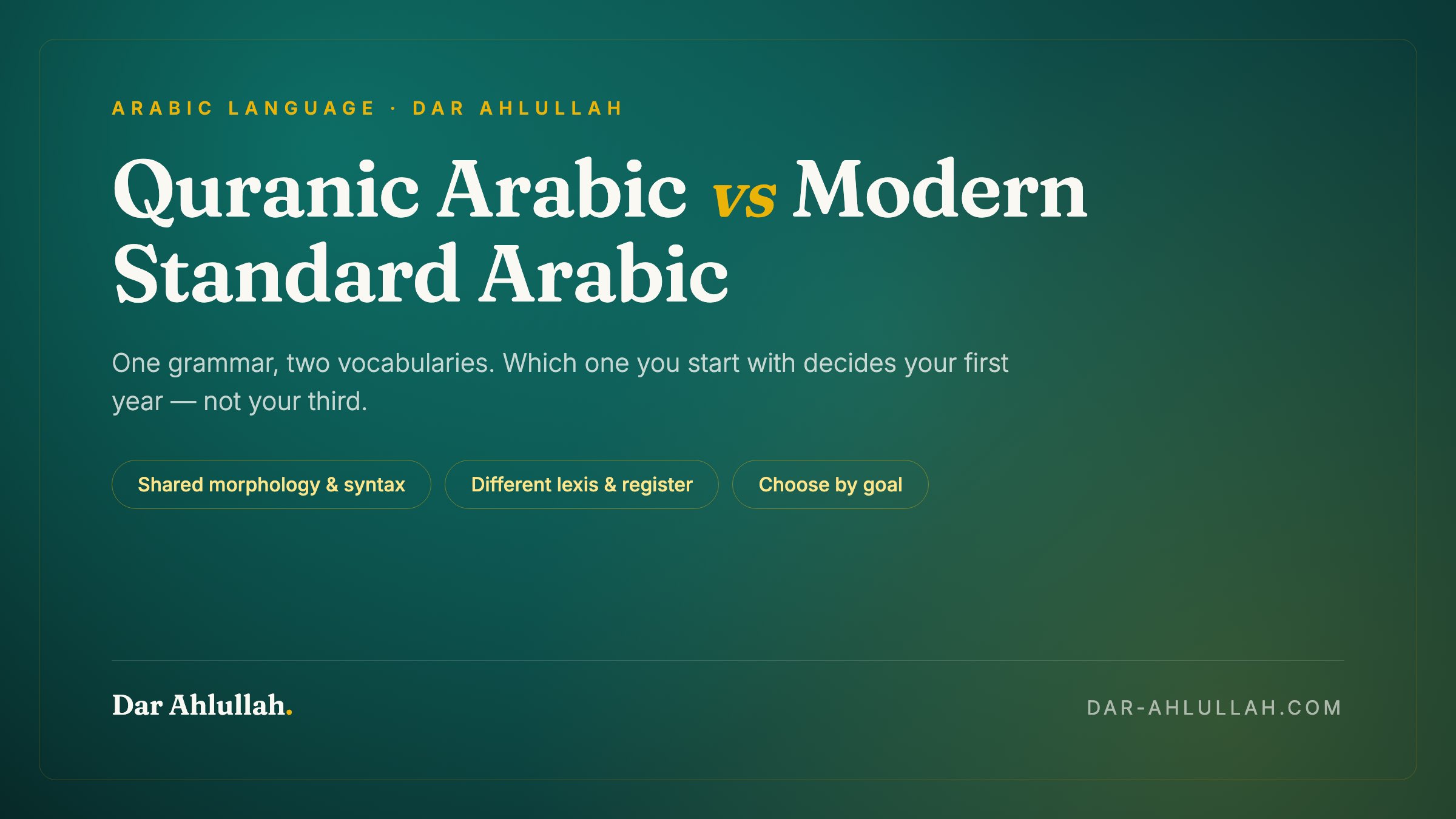
Table of Contents
- Introduction: Two Labels, One Confused Beginner
- The Short Answer
- What Modern Standard Arabic Actually Is
- What Quranic Arabic Actually Is
- The Part Nobody Tells You: One Grammar, Two Vocabularies
- Choosing by Goal, Not by Prestige
- The Third Language Nobody Warned You About
- If the Quran Is the Goal: A Sequence That Works
- If Modern Standard Arabic Is the Goal
- Five Mistakes That Cost a Year
- How We Teach the Quran-First Path
- FAQs
- Conclusion: Pick the Vocabulary, Not the Label
Introduction: Two Labels, One Confused Beginner
Someone decides, usually after a Ramadan, that they are finally going to understand what they recite. They open a course catalogue and find two products sitting side by side: Modern Standard Arabic and Quranic Arabic. The descriptions are nearly identical. Both promise fluency, both mention grammar and vocabulary, and both use the phrase “the language of the Quran” somewhere in the first paragraph.
So the choice gets made on price, or on which page loaded faster. Eight months later one of two things has happened. Either the student can introduce themselves, count to a hundred and describe their journey to the airport — and still cannot follow al-Fatihah in their own salah. Or they can parse a verse with a dictionary and cannot ask for directions in Cairo. Neither outcome is a failure of effort. Both are a mismatch between the syllabus and the goal, decided in the first week and discovered in the eighth month.
The Quranic Arabic vs Modern Standard Arabic question deserves better than a marketing paragraph, because the two are not competing brands of the same product and they are also not two separate languages. The honest answer is stranger and more useful than either: they share a grammar and diverge in vocabulary and register, which means your first year is genuinely different depending on which you pick, and your third year is not. This guide explains what each one actually is, what carries over when you switch, and how to pick based on what you want to be able to do rather than which label sounds more serious. If you are at the very beginning and want the wider view first, our complete guide to Arabic for non-native speakers covers the whole landscape; come back here when you are choosing a syllabus.
The Short Answer
Three goals, three answers. Find yours and the decision is already made.
- You want to understand the Quran, your salah and the du’as you already say. Start with Quranic Arabic. The corpus is finite, the vocabulary repeats, and every hour goes directly at the thing you actually want.
- You want to read modern books, follow the news, study at an Arab university or work with Arabic media. Start with Modern Standard Arabic. It is the register those things are written in.
- You want to talk to your spouse’s family in Casablanca, Cairo or Amman. Neither of the above, on its own. Everyday speech is dialectal, and that is a third syllabus — see the section below before you spend money.
And the reassuring part: the switching cost is much lower than it looks. Because the grammatical machinery is shared, moving from one to the other later costs you vocabulary and idiom, not a restart from zero.
What Modern Standard Arabic Actually Is
Modern Standard Arabic is the standardised written variety used across the Arab world for literature, academia, print, mass media, and law and legislation. It is what a newspaper in Rabat and a newspaper in Baghdad have in common. It is taught in schools throughout the region and it is the Arabic of formal speech — a presidential address, a lecture, a news bulletin.
What surprises most beginners is how recent it is. MSA developed in the late 19th and early 20th centuries, during the literary revival known as the Nahda. The catalysts were technological and political: printing presses arrived in the wake of Napoleon’s 1798 invasion of Egypt, newspapers such as Al-Waqa’i’ al-Misriyya (1828) shaped a common written register, and Arabic-only schools emerged in reaction to Ottoman Turkification. MSA is not an ancient language wearing a modern name. It is a deliberate nineteenth-century standardisation of an older one.
That history shows up in the vocabulary. MSA had to name things the seventh century had no word for, so it either synthesises new words from existing Arabic roots — سيارة for car is the standard example — or adapts foreign ones. Some speakers even use consonants absent from Classical Arabic, such as /p/, /v/ and /tʃ/, to handle borrowed words. None of this is a flaw. It is a living standard doing its job.
The detail that changes the calculation
Modern Standard Arabic has no native speakers. Ethnologue counts something near 335 million users and zero people who grew up speaking it at home, and notes that in most Arab countries only the well-educated have adequate proficiency in it. It is acquired through schooling, reading and writing rather than absorbed at the dinner table.
This matters for a learner in Manchester or New Jersey more than it sounds. It means MSA is nobody’s mother tongue, so there is no shortcut through immersion, and it also means an MSA course is not secretly a conversation course. You are learning a formal written register, deliberately, the same way an Arab schoolchild does.
What Quranic Arabic Actually Is
“Quranic Arabic” is the practical name for Classical Arabic — العربية الفصحى, al-‘Arabiyyah al-Fuṣḥā, literally “the most eloquent Arabic”. It is the standardised literary form used from the seventh century and throughout the Middle Ages, the language of Umayyad and Abbasid poetry, elevated prose and oratory, and the liturgical language of Islam.
For a student, though, the defining property is not its age. It is that the syllabus is closed.
The Quran is 114 chapters and 6,236 numbered verses. That is the entire text. It does not grow, it does not add loanwords next year, and it will not publish a supplement. Every hour you spend on its vocabulary is spent on a fixed target — and because the text repeats its core lexicon constantly across those verses, the return on the first few hundred words is disproportionate. There is no equivalent of this in general language learning, where the vocabulary you might encounter is effectively unbounded.
The second defining property is that you already know some of it. If you pray, you have been reciting al-Fatihah several times a day for years. You have the sounds, the rhythm and the sentence boundaries already installed; what is missing is meaning. Starting from there is a completely different experience from starting a language from zero, and most course catalogues never mention it.
The Part Nobody Tells You: One Grammar, Two Vocabularies
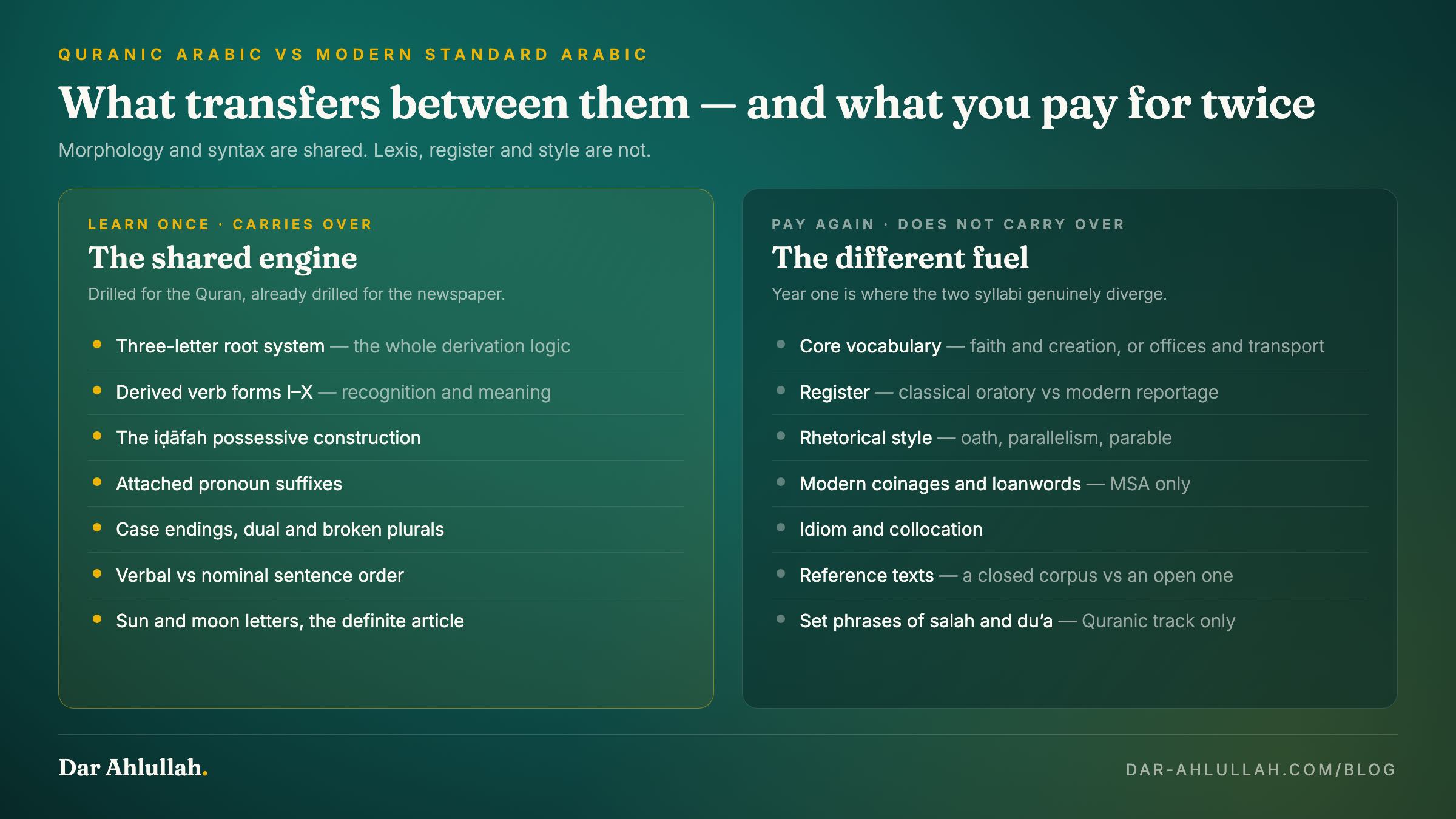
Here is the fact that resolves most of the confusion, and it comes straight from the linguistic description rather than from any academy’s marketing: the lexis and stylistics of Modern Standard Arabic differ from Classical Arabic, but the morphology and syntax have remained basically unchanged. In Arab communities themselves, little distinction is drawn between the two.
Read that again slowly, because it has a direct consequence for your money. The engine is the same. The fuel is different.
The engine — the part you learn once and never learn again — is the three-letter root system, the derived verb forms, the broken plurals, the iḍāfah possessive construction, the attached pronoun suffixes, the case endings, the dual, the sun and moon letters, the way a sentence can begin with a verb or with a noun. Every one of those is shared. A student who has drilled the ten verb forms for the Quran has drilled them for the newspaper too.
The fuel — the part that does not transfer — is the word list, the register and the rhetorical style. A year of MSA vocabulary front-loads exactly the semantic fields the Quran does not use: transport, offices, technology, national institutions, the machinery of modern civic life. A year of Quranic vocabulary front-loads faith, judgement, creation, covenant, patience, gratitude, the natural world, and a rhetorical style built on oath, parallelism and parable that a news bulletin never reaches for.
So the real question is not “which language should I learn.” It is “which two thousand words, and which register, do I want to own at the end of year one.” That question has an obvious answer for most people reading this, and it is much easier to answer than the one they thought they were being asked.
Choosing by Goal, Not by Prestige
Write down what you want to be able to do in two years, in one sentence, in plain English. Then read it off this table.
| What you want to be able to do | Start with | Why |
|---|---|---|
| Understand my salah, al-Fatihah and the short surahs I recite | Quranic Arabic | Closed corpus, high repetition, and you already know the sounds |
| Read the Quran with a tafsir and follow the argument | Quranic Arabic | The register and idiom are the point, not a side effect |
| Read hadith and classical Islamic texts | Quranic Arabic | Same classical register; the vocabulary widens but the style holds |
| Follow Arabic news, read modern novels, study formally | Modern Standard Arabic | That is precisely the register MSA was standardised for |
| Work in an Arabic-speaking professional environment | Modern Standard Arabic, then a dialect | Documents are MSA; the corridor is not |
| Talk to my in-laws, my neighbours, a taxi driver | A specific dialect | Neither standard register is what people actually speak |
| Teach my children to read Quran properly | Script and tajweed first, then Quranic Arabic | Decoding is a separate skill from comprehension — do not merge them |
Notice how many rows point the same way. For the audience this site is written for — Muslims in Europe and North America who want the Quran to stop being a sound and start being a meaning — the Quranic column wins on five of seven rows, and the two MSA rows are genuinely different goals rather than more ambitious versions of the same one.
The Third Language Nobody Warned You About
There is a reason so many people finish a year of Arabic feeling cheated. They studied a standard register and then discovered that nobody talks like that.
Arabic is a textbook case of diglossia: a formal written variety used for writing and formal speech, and regional spoken varieties — Egyptian, Levantine, Gulf, Iraqi, Maghrebi — used for everything else. The spoken varieties differ from the standard in pronunciation, in vocabulary and in the grammar of everyday sentences, and they differ from each other enough that speakers from Morocco and Iraq often fall back to the standard, or to a media dialect, to communicate.
What this means practically is that there is no single purchase called “learning Arabic”:
- Quranic Arabic gets you the Quran, the hadith and the classical library.
- Modern Standard Arabic gets you the newspaper, the textbook and the formal speech.
- A dialect gets you the conversation at the kitchen table.
They overlap, but not in year one. Trying to buy all three at once is the most reliable way to end up with none of them, and it is what happens to a lot of enthusiastic beginners who mix a dialect app, a grammar textbook and a weekly Quran class and make slow progress on all three fronts simultaneously.
Pick one. Get it to the point where it holds together. Add the second on top of a foundation rather than beside it.
If the Quran Is the Goal: A Sequence That Works
Most people who choose the Quranic path still get the order wrong, which costs them more than the choice itself would have. A workable sequence looks like this.
1. Decode the script before you study the language
Reading Arabic letters is not learning Arabic. It is a separate, mechanical, and comparatively short skill — the letters, their connected forms, the short vowels, the sukun, shadda and madd. Adults who try to learn vocabulary while still sounding out letters are doing two hard things at once and generally quit. Get decoding to the point of fluency first, on Noorani Qaida or an equivalent, and only then open a grammar book.
2. Take high-frequency vocabulary before comprehensive grammar
Grammar rules with no words to apply them to are abstract and forgettable. A few hundred of the most frequent Quranic words, learned properly, unlock recognisable fragments in almost every page you open, and that recognition is what sustains the habit through the months when nothing else is rewarding.
3. Learn the grammar you actually need, in this order
Attached pronoun suffixes first — they are everywhere and they are cheap to learn. Then the iḍāfah, then the root-and-pattern system as a recognition skill, then the derived verb forms, then the case endings. Recognition before production: you are learning to understand a fixed text, not to write essays in it, and courses that treat those two goals identically waste a great deal of your time.
4. Make al-Fatihah the first text you fully own
You recite Surah al-Fatihah in every rak’ah of every prayer. Seven verses. Take them apart word by word until there is nothing in them you do not recognise. The effect on the quality of your salah is immediate, and it is the single highest-return unit of study in the entire syllabus.
5. Then the surahs you have already memorised
Juz ‘Amma next, for the same reason: the sound is already in your memory, so you are attaching meaning to something you have rather than building both at once. Our step-by-step guide to learning Quranic Arabic goes through this stage in more detail.
6. Read with a translation beside you, not instead of you
The goal is to stop needing it. Read the Arabic first, work out what you can, then check. Reading the translation first and then admiring the Arabic feels productive and teaches almost nothing.
If Modern Standard Arabic Is the Goal
MSA is the right choice for a real set of people, and if you are one of them the Quranic path would be the detour rather than the shortcut. Choose it if you intend to study Arabic formally, work with Arabic media or documents, read contemporary literature, or build toward a professional qualification.
Expect a different first year. Greetings, self-introduction, professions, the city, numbers, dates, the news register, and a steady diet of textbook dialogues. It is a well-mapped path with far more published material than Quranic Arabic has, which is a genuine advantage — the textbooks are excellent and there are decades of them.
The Quran does become more accessible from there, because the grammar transfers completely. But it arrives later, after a detour through vocabulary the Quran does not contain, and you should choose it knowing that rather than expecting the two to be the same road. If you are weighing up study methods more broadly, our guide to the best way to learn Arabic as a non-native speaker covers the practical side of both routes.
Five Mistakes That Cost a Year
| Mistake | What it costs | Do this instead |
|---|---|---|
| Starting with a dialect app because it is the loudest marketing | A year of vocabulary that appears nowhere in the Quran | Match the syllabus to the sentence you wrote down about year two |
| Studying grammar while still sounding out letters | Two hard skills at once; the usual outcome is quitting | Finish decoding first, then start the language |
| Treating the translation as the destination | Comfort without comprehension — you never stop needing it | Arabic first, translation as the check afterwards |
| Switching syllabus every six weeks | Three unfinished beginnings and no foundation | Commit for two terms before you evaluate anything |
| Self-study with no one listening to you read | Errors in pronunciation and parsing that set hard | Have a teacher hear you read aloud regularly, from the start |
How We Teach the Quran-First Path
Our Arabic Language course is built for the goal this article keeps pointing at: understanding the language of the Quran rather than passing a general proficiency exam. It uses dual-language instruction designed for non-Arabic speakers, works through grammar, vocabulary and comprehension together, and typically runs six to twelve months at two or three sessions a week. You can see it alongside everything else we run on the courses page.
The practical details, since they are what people actually ask:
- Teachers. Native Arabic speakers who teach in English. One teacher is assigned to you and stays with you; if the fit is wrong we rematch you at no cost.
- Price. $9 per teaching hour on every plan — Starter is $36 a month, Committed $70, Hifz Intensive $102. Siblings get 20%.
- Evidence. A written report after every session: what was covered, what was corrected, what to practise before the next one.
- Flexibility. Pause or switch plans at any time.
- Starting. A free 30-minute assessment, no card required, which is where the question this article asks gets answered for your specific case rather than in general.
That assessment is genuinely the fastest way through this decision. Fifteen minutes of reading aloud tells a teacher more about the right starting point than an hour of comparing course descriptions will.
FAQs
Can I learn both at the same time?
You can, and it is usually a bad trade in the first year. The shared grammar means the second one is much cheaper once the first is standing, so sequencing them costs you far less total time than running them in parallel — and parallel study tends to produce two half-built vocabularies that neither support fluent reading nor conversation.
Will Modern Standard Arabic help me understand the Quran at all?
Yes, substantially. The morphology and syntax are the same, so an MSA student arrives at the Quran already able to parse it. What they lack is the specific lexicon and the classical register, which is a real gap but a much smaller one than starting from nothing. MSA is a longer route to the Quran, not a wrong one.
How long before I can follow the Quran without a translation?
Honestly: longer than the marketing on most course pages implies, and the variance between students is very wide. Recognising familiar words in short surahs comes reasonably early; following an unfamiliar page of a long surah without help is a multi-year project for most adults studying a few hours a week. Treat any promise of a fixed timeline with suspicion — consistency of study predicts the outcome far better than the number of months does.
Is Quranic Arabic harder than Modern Standard Arabic?
Different rather than harder. Quranic Arabic uses a denser rhetorical style and a case system that MSA prose applies more loosely, so it is more demanding sentence by sentence. Against that, the corpus is fixed and highly repetitive while MSA vocabulary is effectively unbounded. Neither is the easy option.
Do I need to be able to speak Arabic to understand the Quran?
No. Reading comprehension and speaking are separable skills, and for this goal comprehension is the one that matters. Plenty of people read classical texts well and hold no conversations. Say the words aloud while you study — that helps retention and pronunciation — but do not let a speaking curriculum divert a reading goal.
Which one should my children learn?
For children the real first question is not this one at all — it is decoding and tajweed, which comes before comprehension in either track. Once they read fluently, Quranic Arabic follows naturally from what they are already reciting. If the challenge is fitting it around school, an after-school Arabic and Quran structure tends to survive term time better than an ad-hoc arrangement.
I am an adult starting from zero. Is it too late?
No, and adults have advantages children do not: they can be taught grammar as a system rather than absorbed by exposure, and they know why they are doing it. The obstacles are time and self-consciousness about reciting in front of a teacher, both of which are manageable. Our guide to learning the Quran as an adult deals with that case directly.
Do I have to memorise vocabulary lists?
Some deliberate vocabulary work is unavoidable and it is the highest-leverage thing you can do early, precisely because the Quranic corpus repeats. What you should avoid is memorising lists in isolation from the text — learn the words as they appear in verses you are working through, so each one arrives with a context already attached.
Conclusion: Pick the Vocabulary, Not the Label
The comparison people think they are making — two rival languages, one more authentic than the other — is not the comparison in front of them. Quranic Arabic and Modern Standard Arabic share their morphology and syntax and diverge in vocabulary, register and style. Choosing between them is choosing which few thousand words and which register you want to own first, and that is a question about your own goal rather than about Arabic.
If the goal is the Quran — your salah, the surahs you already recite, the meaning behind a sound you have known your whole life — start there, in the classical register, with a closed corpus that rewards repetition. If the goal is the newspaper or the university, start with MSA and know that the Quran remains reachable from there. If the goal is your mother-in-law, learn her dialect and be honest that it is a third thing.
What you should not do is pick by which label sounds more serious, then discover in month eight that you have been studying someone else’s goal. Write down the sentence, read it off the table above, and start. If you would like a teacher to tell you where you actually stand before you commit to either track, the 30-minute assessment is free and there is nothing to cancel afterwards.
Related articles
how to improve Arabic speaking skills
How to Improve Your Arabic Speaking Skills as an Adult
You can read Arabic fluently and still freeze when someone speaks to you. Reading is recognition; speaking is retrieval, and they are trained separately. Here is which Arabic to speak, and the five drills that work with nobody else in the room.
16 min read
most common words in the Quran
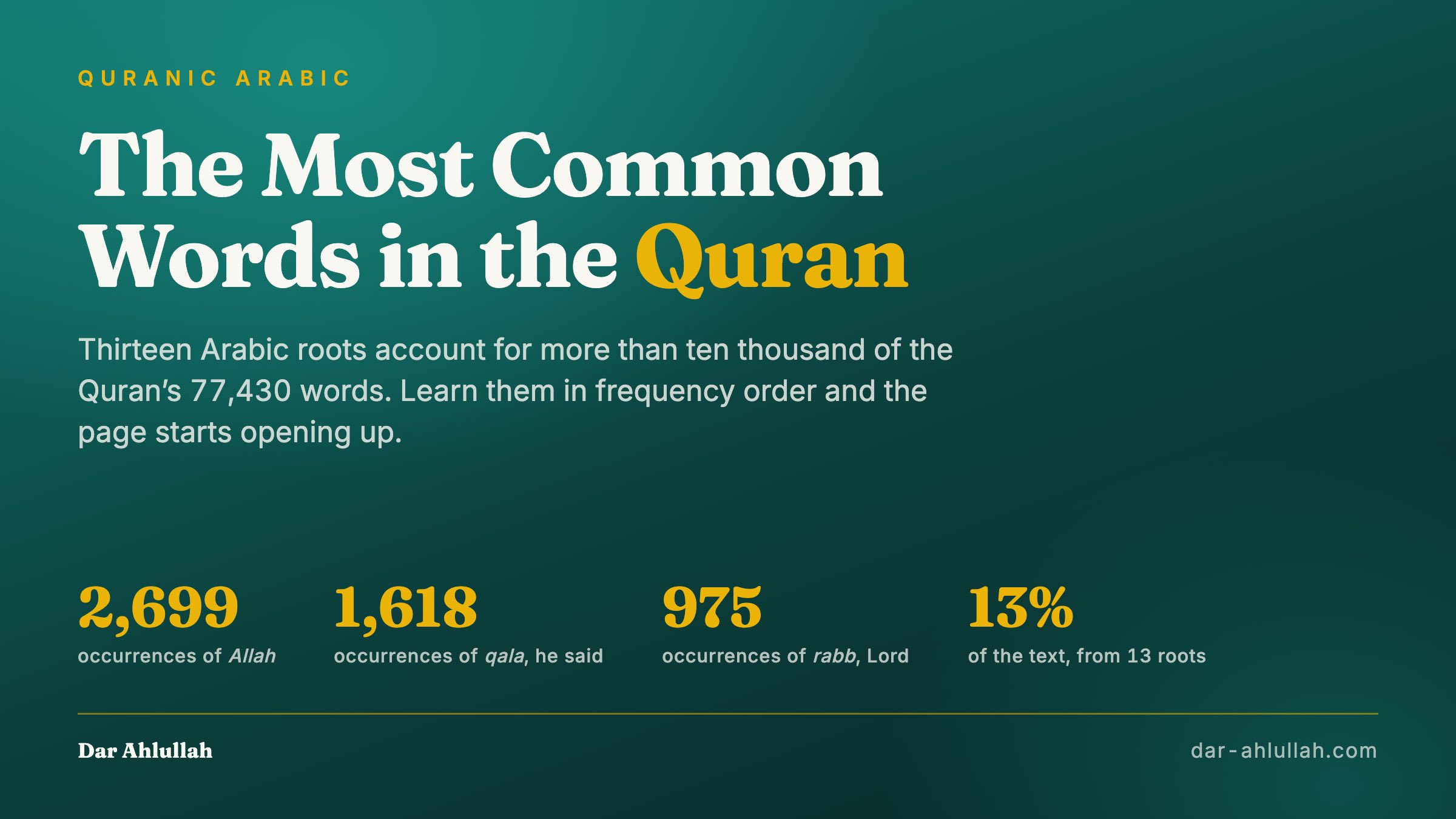
The Most Common Words in the Quran: 13 Roots That Cover 10,000+ Words
Thirteen Arabic roots account for more than ten thousand of the Quran's 77,430 words. Learning them in frequency order is the shortest route from reciting to understanding.
16 min read
Arabic alphabet for beginners
Arabic Alphabet for Beginners: How to Read the Script
An alphabet chart shows you 28 isolated shapes. A page of Arabic shows you the same letters joined, compressed and stripped of their vowels. This is the route across that gap — shape families, four forms, six non-connectors and the marks that make a word readable.
17 min read