
how to teach your child Arabic at home
How to Teach Your Child Arabic at Home: A Parent's Guide
Dar Ahlullah team 20 min read
Table of Contents
- Introduction: The Parent Who Does Not Speak Arabic
- The Short Answer: Ten Minutes, Five Days, Sounds First
- Decide Which Arabic You Are Teaching
- What a Four-Year-Old Needs Is Not What a Ten-Year-Old Needs
- Stage 1: Sounds Before Letters
- Stage 2: Why Your Child Knows the Alphabet and Still Cannot Read
- Stage 3: The Marks That Turn Letters Into Words
- Stage 4: The Words That Keep Coming Back
- The Ten-Minute Daily Loop
- Make the House Do Some of the Teaching
- Why Short and Daily Beats Long and Weekly
- Six Things That Quietly Stall Progress
- The Ceiling You Will Hit, and What Is Above It
- A Back-to-School Start Plan
- Where a Teacher Fits Around What You Do at Home
- FAQs From Parents Teaching Arabic at Home
- Conclusion: Small, Daily, and Yours
Introduction: The Parent Who Does Not Speak Arabic
Most parents who want to teach their child Arabic at home run into the same wall in the first week. They buy the alphabet poster, they find the song, the child learns to chant alif, baa, taa in order — and then nothing else happens, because neither parent knows what step two is. The poster stays on the wall for a year as a small daily reminder that the project stalled.
That wall is not about your Arabic. It is about sequence. Teaching a child to read Arabic is a set of skills that have to arrive in a particular order, and the alphabet song is not the first one; it is closer to a decoration on top of the first one. Get the order right and a parent with no Arabic at all can take a five-year-old a surprisingly long way. Get it wrong and a fluent Arabic speaker will still end up with a child who recognises letters in isolation and freezes at a word.
This guide is the order, plus the ten-minute routine that carries it, plus an honest account of where home teaching runs out of road. It is written for the parent doing this in English at a kitchen table in Manchester, Toronto or New Jersey — not for a classroom. If you want the wider picture of how adults and children learn this language from zero, our complete guide to mastering Arabic as a non-native speaker is the pillar this sits under.
The Short Answer: Ten Minutes, Five Days, Sounds First
If you read nothing else, this is the whole method:
- Choose one Arabic. For almost every family reading this, that is written Modern Standard Arabic, taught for reading the Quran. Deciding this in week one prevents a year of confusion.
- Teach sounds, not letter names. The child needs to know that a certain shape says b, not that it is called baa. Names come later and are almost useless for reading.
- Teach the four shapes with the sound, from day one. Arabic letters change form depending on where they sit in a word. A child who learns only the isolated form has learned a quarter of the alphabet.
- Add the vowel marks early. Letters alone are silent. The small marks above and below are what make a word pronounceable.
- Ten minutes a day, five days a week. Not forty minutes on Saturday. The evidence on spacing is unambiguous, and it is the single easiest advantage to take.
- Get the mouth checked by someone who knows. Arabic has sounds English does not, and a wrong habit set at home takes far longer to remove than to prevent.
Everything below is the detail underneath those six lines.
Decide Which Arabic You Are Teaching
This is the decision that most home programmes skip, and skipping it is why a child ends up with a scatter of Egyptian phrases, a half-learned alphabet and no ability to read a line of the Quran.
Arabic is diglossic. As Wikipedia’s survey of the varieties of Arabic puts it, speakers “learn and use two linguistic forms substantially different from each other”: a regional spoken variety that is acquired natively at home, and Modern Standard Arabic, which nobody speaks as a mother tongue and which “is subsequently learned in school.” A child in Cairo does not grow up speaking MSA. They grow up speaking Egyptian and learn MSA in a classroom, the same way your child will.
That has a practical consequence for you. There are three plausible targets and they are taught differently:
| If your goal is… | Teach | What the first year looks like |
|---|---|---|
| Reading the Quran and salah with understanding | Written MSA, Quran-first vocabulary | Script, vowel marks, decoding, then the highest-frequency Quranic words |
| Reading books, school Arabic, later academic study | Written MSA, general vocabulary | Script and decoding, then everyday nouns and verbs, then simple sentences |
| Talking to grandparents in Morocco or Lebanon | The family dialect, spoken first | Listening and speaking with relatives; script can wait or run in parallel |
For the overwhelming majority of Muslim families in Europe and North America, the first row is the real goal, even when the parent phrases it as “I want them to learn Arabic.” The child is going to open a mushaf far more often than a Lebanese newspaper. Choose that, say it out loud, and every later decision gets easier — which words to teach, which app to ignore, what to ask a teacher for. We compared the two written registers in detail in Quranic Arabic vs Modern Standard Arabic, and the short version is that they share a script and a grammar and differ mostly in vocabulary and register, so a Quran-first path is not a detour away from Arabic.
If you also want the dialect, run it separately and informally: dialect through relatives, video calls and food, script and MSA through the ten-minute loop. Trying to teach both as one subject is how children conclude that Arabic is two subjects, both hard.
What a Four-Year-Old Needs Is Not What a Ten-Year-Old Needs
The same content fails or works depending on the age it is delivered to. Roughly:
| Age | Session length | Focus | Looks like |
|---|---|---|---|
| 3–5 | 5 minutes, twice | Ear and mouth only | Sounds, songs, naming objects, no writing, no pressure |
| 6–8 | 10 minutes | Decoding | Sound–shape pairs, joining two letters, reading nonsense syllables aloud |
| 9–12 | 15 minutes | Fluency and meaning | Reading short surahs, high-frequency vocabulary, writing practice |
| 13+ | 20–30 minutes | Structure | Word patterns, roots, grammar as an explicit subject |
Two notes on this table. First, the younger the child, the less the session should look like a lesson — under six, almost everything useful happens through repetition inside ordinary life rather than at a desk. Second, an older beginner is not behind. A ten-year-old starting from zero moves through the decoding stage several times faster than a five-year-old does, because reading is already a skill they have; only the code is new. Parents who feel they have “left it too late” at nine are almost always wrong.
Stage 1: Sounds Before Letters
Here is the mistake that costs the most time, and it is the one the alphabet song encourages.
English-speaking children learn to read through phonics: the letter b says /b/. Nobody sounds out a word by reciting letter names — bee-ay-tee does not produce bat. Arabic teaching in homes routinely reverses this, drilling the twenty-eight letter names in order as if the name were the point. The child becomes excellent at the song and cannot read, because when they meet a word their brain retrieves baa, taa, thaa and none of those are sounds in the word.
So from the first week, attach the sound to the shape and say the sound. Show the shape, say b, have the child say b, find b on the page. The name of the letter is a piece of trivia you can add in month three and it will take five minutes to learn then.
Start with the sounds English already has
Roughly two-thirds of the twenty-eight letters map onto sounds your child already produces every day: b, t, j, d, r, z, s, sh, f, k, l, m, n, h, w, y. Teach those first, in that kind of order rather than alphabetical order, and the child gets weeks of easy wins and the feeling that this is doable.
Then the sounds English does not have
A handful of letters have no English equivalent at all — the heavy or emphatic letters and the throat letters. In transliteration they usually appear as ‘ayn, ghayn, haa and khaa, saad, daad, taa and zaa, and qaaf. These are the ones where a parent without Arabic should stop trying to model the sound from a video and get a teacher to listen to the child instead. They are produced deeper in the throat and mouth than anything in English, they are easy to approximate wrongly, and an approximation that hardens over two years is genuinely difficult to unpick later. In Quran recitation these distinctions are not cosmetic: saad and seen are different letters and swapping them changes the word.
This is not a reason to delay starting. It is a reason to plan a checkpoint — someone qualified hearing your child recite — within the first couple of months rather than the second year.
Stage 2: Why Your Child Knows the Alphabet and Still Cannot Read
This is the second wall, and it catches almost every home-taught child whose parent has not been warned.
Arabic script, per the reference description of the Arabic alphabet, has 28 letters, runs right to left, and is “always cursive” — letters join to their neighbours, and each one “can exhibit up to four distinct forms corresponding to an initial, medial (middle), final, or isolated position.” A poster shows the isolated form. Real words almost never use it.
So a child who has mastered the poster meets an actual word and sees shapes they have never been shown. They are not being slow. They were taught one quarter of the system and then handed the whole of it.
The fix is simple and it has to be structural: never teach a letter without its family of shapes. When you introduce the sound b, show all four positions of that letter side by side on the same index card, and point out the part that stays the same — usually the dots and the basic skeleton. Children spot the pattern quickly once someone tells them there is one.
Add one more fact early, because it explains a lot of apparent chaos: six letters never join to the letter that follows them. Wikipedia lists them as alif, daal, dhaal, raa, zaay and waaw. They connect backwards but not forwards, which is why words seem to break into pieces at random. Tell your child these six are “the ones that do not hold hands with the next letter” and the random gaps stop being random.
The drill that actually builds reading
Once your child has five or six sounds, stop presenting letters one at a time and start joining them into two- and three-letter combinations — including nonsense ones. ba-ta, ta-sa, da-ra. Nonsense syllables feel odd but they are the fastest route to decoding, because the child cannot guess from meaning and has to actually read. This is the core exercise of the Noorani Qaida and every equivalent syllabus, and it is the exercise most home programmes skip because it looks unrewarding. It is the one that turns letter knowledge into reading.
Stage 3: The Marks That Turn Letters Into Words
Arabic writes the consonants and marks the short vowels with small symbols above and below the line. Without them a written word is a skeleton that an experienced reader can infer and a learner cannot. Children’s books and the mushaf both carry the marks in full, which is exactly why beginners read from those and not from a newspaper.
There are only a few to learn and they are the highest-return five minutes in the whole sequence:
| Mark | Position | Does | Example on the letter b |
|---|---|---|---|
| Fatha | Stroke above | Short a | ba |
| Kasra | Stroke below | Short i | bi |
| Damma | Small loop above | Short u | bu |
| Sukun | Small circle above | No vowel — the consonant closes the syllable | b |
| Shadda | Small w-shape above | Doubles the letter, held longer | bb |
Teach fatha, kasra and damma as a set on a single letter and drill them as a trio — ba, bi, bu — then the same on the next letter, and so on. Children find this rhythmic and it converts directly into reading. Sukun and shadda follow once the first three are automatic, and shadda in particular is worth attention because holding it properly is already a small step into tajweed, which we cover for older learners in our guide to learning Quranic Arabic effectively.
Stage 4: The Words That Keep Coming Back
Decoding without meaning gets boring fast, and a child who can pronounce a page but understands none of it will lose interest around the third month. Vocabulary is the antidote, and the trick is to be ruthless about which words.
Do not teach colours, animals and classroom furniture first. That is the order a school textbook uses, and it is the wrong order for a child whose Arabic exposure is going to be the Quran and salah. Teach the words that appear constantly in what your child will actually hear and read — the pronouns, the prepositions, the everyday verbs, the words already sitting inside Al-Fatiha which they may recite seventeen times a day. A small set of very frequent words unlocks a disproportionate share of the text; we listed the highest-frequency ones and how to drill them in the most common words in the Quran.
Two rules keep this working at home. Cap it at one new word a day — five a week, two hundred a year, which is a serious vocabulary for a child. And always attach the word to something the child already recites, so the first time they notice a word they learned on Tuesday inside a surah they have said a hundred times, the whole project suddenly makes sense to them. That moment does more for motivation than any reward chart.
The Ten-Minute Daily Loop
The routine below is deliberately short enough to survive a bad week. Ten minutes is not a compromise; it is the design. A plan that needs forty-five minutes gets abandoned in October, and a plan that needs ten survives to March.
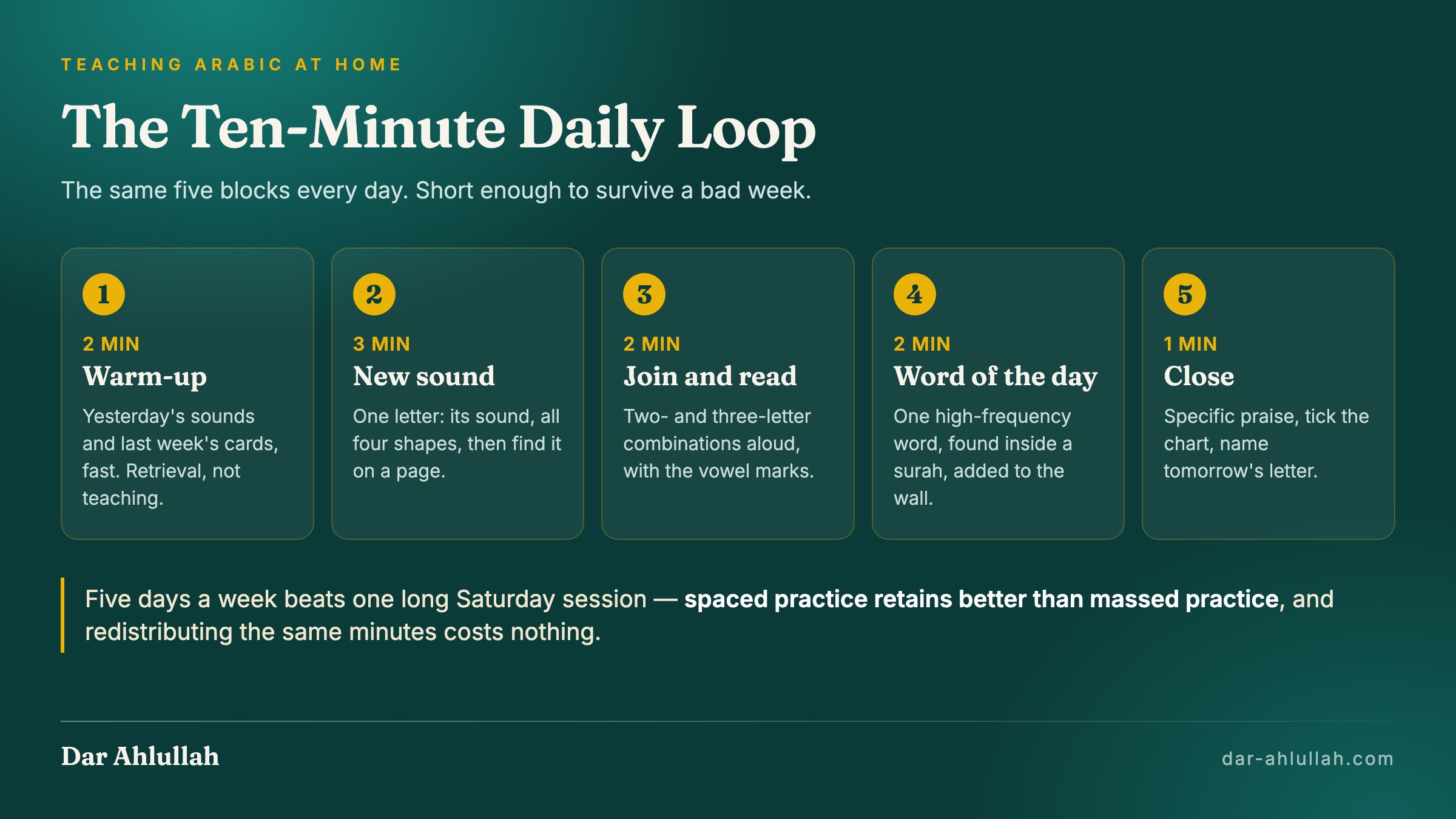
| Block | Time | What happens |
|---|---|---|
| Warm-up | 2 min | Yesterday’s sounds and last week’s cards, fast, no teaching — just retrieval |
| New sound | 3 min | One new letter: its sound, its four shapes, find it on a page |
| Join and read | 2 min | Two- and three-letter combinations aloud, with the vowel marks |
| Word of the day | 2 min | One high-frequency word, said, found in a surah, added to the wall |
| Close | 1 min | Specific praise, tick the chart, name tomorrow’s letter |
Three practical notes. Anchor the loop to an existing fixed event — after Maghrib, after breakfast, in the car on the school run for the audio-only parts — because a routine attached to another routine survives, and one attached to “when we get a chance” does not. Stop while the child still wants more; ending on appetite is what makes tomorrow easy. And keep a visible chart, because young children work for the tick far more reliably than for the long-term goal you are actually pursuing.
Make the House Do Some of the Teaching
The ten minutes are the engine. The rest of the day can do a surprising amount of quiet work if you set it up once and then leave it alone.
- Label six things, not sixty. Door, fridge, table, window, book, water. Six labels get read a hundred times each; sixty labels become wallpaper within a week and get read by nobody.
- Fix five phrases to five moments. A phrase that always happens at the same moment is learned without study.
- Put the alphabet where waiting happens. Beside the dining table, not above the bed. Children read what is in front of them while bored.
- Let audio run. A reciter playing during breakfast or in the car builds the ear for rhythm and sound long before the child can read a word of it. This is the one input that requires nothing from you at all.
| Moment | Phrase | Means |
|---|---|---|
| Starting to eat | Bismillah | In the name of Allah |
| Finishing anything | Alhamdulillah | All praise is for Allah |
| Being handed something | Shukran | Thank you |
| Leaving the house | Ma’a s-salaama | Go in peace |
| Any plan for tomorrow | In sha’ Allah | If Allah wills |
The point of this table is not the five phrases. It is that a phrase tied to a repeating moment is rehearsed dozens of times a week at zero cost to your energy, which is exactly the property you want in a home programme that has to last years.
Why Short and Daily Beats Long and Weekly
Parents often try to bank the week’s Arabic into one long Saturday session, on the reasonable-sounding logic that an hour is an hour. It is not, and this is one of the few areas of learning where the research is old, large and settled.
The spacing effect describes the finding that material studied in separated intervals is retained better than the same material studied in one block. It holds across ages, subjects and decades of replication, and second-language vocabulary is one of the areas where it has been tested most directly — work published in Studies in Second Language Acquisition on massing versus spacing in word learning sits in a long line of studies finding spaced practice superior to massed practice for retention.
Practically: fifty minutes split into five daily tens will outperform one fifty-minute block, for free. You do not have to find more time, buy anything, or teach better. You only have to distribute the same time differently, which makes this the cheapest improvement available to a home programme.
The same logic applies to review. Yesterday’s letters, last week’s letters, last month’s letters — a two-minute warm-up that cycles old cards back in is doing more work than the three minutes of new material that follows it.
Six Things That Quietly Stall Progress
| Mistake | Why it stalls | Do instead |
|---|---|---|
| Drilling letter names in order | Names are not sounds; the child cannot decode with them | Sound first, name much later |
| Teaching only the isolated shapes | Real words use the joined forms, so nothing transfers | All four positions on the same card, from day one |
| Skipping the nonsense-syllable drill | The child guesses from memory instead of reading | Two- and three-letter combinations, daily, out loud |
| App-only learning | Nothing listens to the child’s mouth; errors set unnoticed | Apps for review, a human for production |
| Correcting every error in the moment | Children go quiet, and a silent child is not practising | One correction per session, the same one until it sticks |
| Restarting from the alphabet each September | Three years of first-term material and no progress | Keep a one-page log of where you stopped, resume there |
The last row is the most common of all and the easiest to fix. Families lose more ground to the annual restart than to any individual teaching error, because the restart feels productive — everyone is doing Arabic again — while covering ground the child already had. A single sheet of paper recording the last letter taught and the last word learned prevents it entirely.
The Ceiling You Will Hit, and What Is Above It
Home teaching is genuinely effective for a defined stretch: sound recognition, the shapes, the vowel marks, first decoding, early vocabulary and, above everything else, the habit. A parent can deliver all of that without speaking a word of Arabic, and it is the hardest part to buy, because attendance and consistency are not things a teacher can install from the outside.
Three things sit above that ceiling and do not come down.
Pronunciation you cannot hear. The letters produced in the throat and the emphatic letters have no English counterpart, and a parent who does not have the sounds cannot tell a good attempt from a near-miss. Near-misses harden. This is the single strongest argument for someone qualified listening to your child early rather than eventually — and in recitation it matters more than elsewhere, because the distinctions carry meaning. Our overview of online Quran classes for kids covers what that first assessment normally looks like.
Tajweed applied to real recitation. The rules of lengthening, merging and stopping are learned by being heard and corrected on the actual verse, week after week. No book teaches them and no app checks them.
Accountability that is not you. Around the six-month mark, most home programmes hit the point where the child has stopped finding it novel and the parent has become the person who nags about Arabic. An external teacher expecting specific work on Tuesday takes that role off you, which is often worth more than the teaching itself. If your week is already full, an after-school Arabic and Quran structure is the usual way families slot this in without adding another evening commitment.
The productive arrangement is not either-or. It is you running the daily ten minutes and someone qualified listening once or twice a week, which is a far smaller commitment than most parents assume before they price it.
A Back-to-School Start Plan
Late summer is the natural moment to begin, for the boring reason that the routine gets built while the calendar is still soft and is already load-bearing when term starts.
- Week 1. Decide which Arabic and write the goal down in one sentence. Print an alphabet chart showing all four shapes of each letter, not just the isolated ones. Choose the anchor moment for the daily ten minutes.
- Week 2. Sounds only, starting with the ones that exist in English. Six sounds is a good week. Put up six labels. Start the chart.
- Week 3. Add fatha, kasra and damma on the sounds you already have. Begin joining two letters aloud. Introduce the word of the day.
- Week 4. Book an assessment with a qualified teacher — not to hand the project over, but to have the child’s pronunciation checked before any habits set, and to get a written starting point for the term.
- Week 8. Review the log. Which sounds are automatic, which are still hesitant, how many words are on the wall? Adjust the pace rather than the plan.
Deliberately, the teacher enters at week four rather than week one. The habit is easier to build before there is an external timetable to blame for the days it does not happen, and the assessment is more useful once the child has something to be assessed on.
Where a Teacher Fits Around What You Do at Home
For families who want the checkpoint described above, here is what ours involves, so you can compare it with anything else you are considering.
The assessment is a free 30-minute session with a native Arabic-speaking teacher who teaches in English. No card is required to book it. The teacher listens to the child, works out where they actually are, and gives you a written starting point — which is useful even if you continue entirely at home, because it tells you which sounds are already secure and which are drifting.
If you continue, the rate is $9 per teaching hour and every plan is that same number: a 30-minute session is $4.50. Starter is $36 a month, Committed is $70, Hifz Intensive is $102, and siblings get 20% off. A written report goes out after every session — what was covered, what was corrected, what to practise — which is what lets your ten minutes at home target the right thing rather than guess. If the teacher is not the right fit for your child, we rematch you at no cost, and you can pause or switch plans at any time. You can book the free assessment here.
None of that replaces the home routine. Two sessions a week is roughly one hour; your ten minutes a day is fifty. The teacher corrects the mouth and sets the direction; the daily loop is where the learning volume actually comes from.
FAQs From Parents Teaching Arabic at Home
I do not speak Arabic at all. Can I really do this?
For the reading track, yes, up to the ceiling described above. Recognising shapes, drilling the vowel marks, running flashcards and protecting the routine require no Arabic — you need the sound of each letter, which you can learn one at a time a day ahead of your child, and you need to be honest that the throat and emphatic letters need a qualified ear. Many parents find they learn the alphabet properly for the first time this way.
What age should we start?
Listening and sounds can start at three or four with no writing at all. Formal decoding is comfortable from about six, when the child is already learning to read in their school language. Starting later than that costs nothing meaningful — older beginners move faster through decoding.
Should we use an app?
As a review tool, yes; as the programme, no. Apps are good at spaced repetition of letters and vocabulary and genuinely useful for the two-minute warm-up. They cannot hear your child, which means they cannot correct the sounds that need correcting, and a child who only ever taps and never recites out loud is not learning to read Arabic.
How long until my child can read the Quran?
It varies enough between children that any single number would be misleading, and the variance is genuinely large. What is predictable is the sequence — sounds, joined shapes, vowel marks, syllables, short surahs — and roughly how far along it your child is. Track position in the sequence rather than months elapsed, and be sceptical of anyone promising a fixed timeline.
My child resists every session. What now?
Almost always the session is too long, not too hard. Halve it. A five-minute session that happens is worth far more than a fifteen-minute session that is negotiated for ten minutes first. Also check that you are not correcting more than once per session — resistance is often a child who has learned that this activity is where they get told they are wrong.
Should I teach writing at the same time as reading?
Slightly after. Writing a letter helps fix its shape in memory, so it is a useful reinforcement, but leading with handwriting slows decoding down and adds a fine-motor difficulty on top of a new script. Read first, then write what has already been read.
We speak a dialect at home. Does that help or confuse?
It helps, considerably. A child with a dialect already has the phonetic inventory, including the difficult letters, and a stock of vocabulary. What they still need is the script and the written register — which is exactly the same gap a child in Cairo has, and the same reason MSA is taught in school there.
What if I start and stop for a month?
Resume where the log says you stopped, not at the alphabet. Some review will be needed and it will take days, not weeks. The instinct to restart from the beginning is the single most expensive habit in home Arabic teaching.
Conclusion: Small, Daily, and Yours
Teaching your child Arabic at home is not a matter of knowing Arabic. It is a matter of choosing which Arabic, teaching sounds before names, showing all four shapes of every letter, adding the vowel marks early, and defending ten minutes a day against everything else in the calendar. That is the whole system, and a parent with no Arabic can run it.
What you cannot run is the correction of sounds your own ear does not hold, and that is worth outsourcing early rather than late — a habit prevented in month two costs a fraction of a habit removed in year two. Everything else, the part that actually determines whether this is still happening next spring, is the part only you can do.
Start this week rather than in September. Six sounds, six labels, one chart on the fridge, ten minutes attached to something that already happens every day. If you want a qualified teacher to hear where your child is before the habits set, the 30-minute assessment is free and there is nothing to cancel afterwards.
Related articles
after school Arabic program
After-School Arabic & Quran Program: Balancing School and Deen
Fitting Arabic and Quran around a Western school day is a scheduling problem, not a motivation problem. Here is the weekly plan, the right time slot, and how to keep it alive through exam season.
8 min read

Islamic homeschooling
Islamic Homeschooling: A Realistic Guide for Families in the West
Most Islamic homeschooling guides assume you live somewhere it is legal and have a parent free all day. This one starts from the reality: the law in your country, the hours you actually have, and which subjects genuinely need a teacher.
14 min read
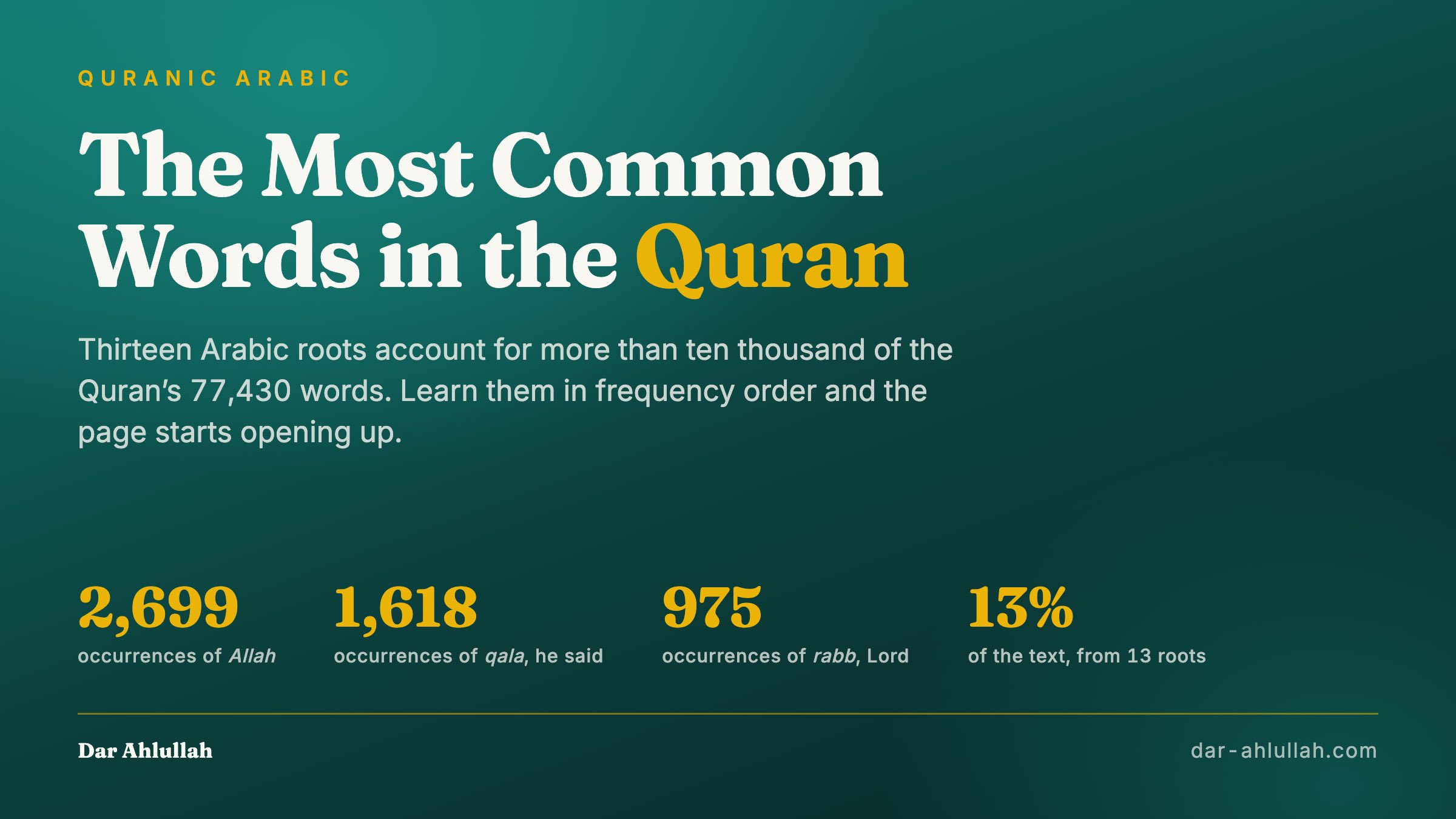
most common words in the Quran
The Most Common Words in the Quran: 13 Roots That Cover 10,000+ Words
Thirteen Arabic roots account for more than ten thousand of the Quran's 77,430 words. Learning them in frequency order is the shortest route from reciting to understanding.
16 min read