
Kutub al-Sittah
Kutub al-Sittah: The Six Books of Hadith, Explained for English Readers
Dar Ahlullah team 24 min read
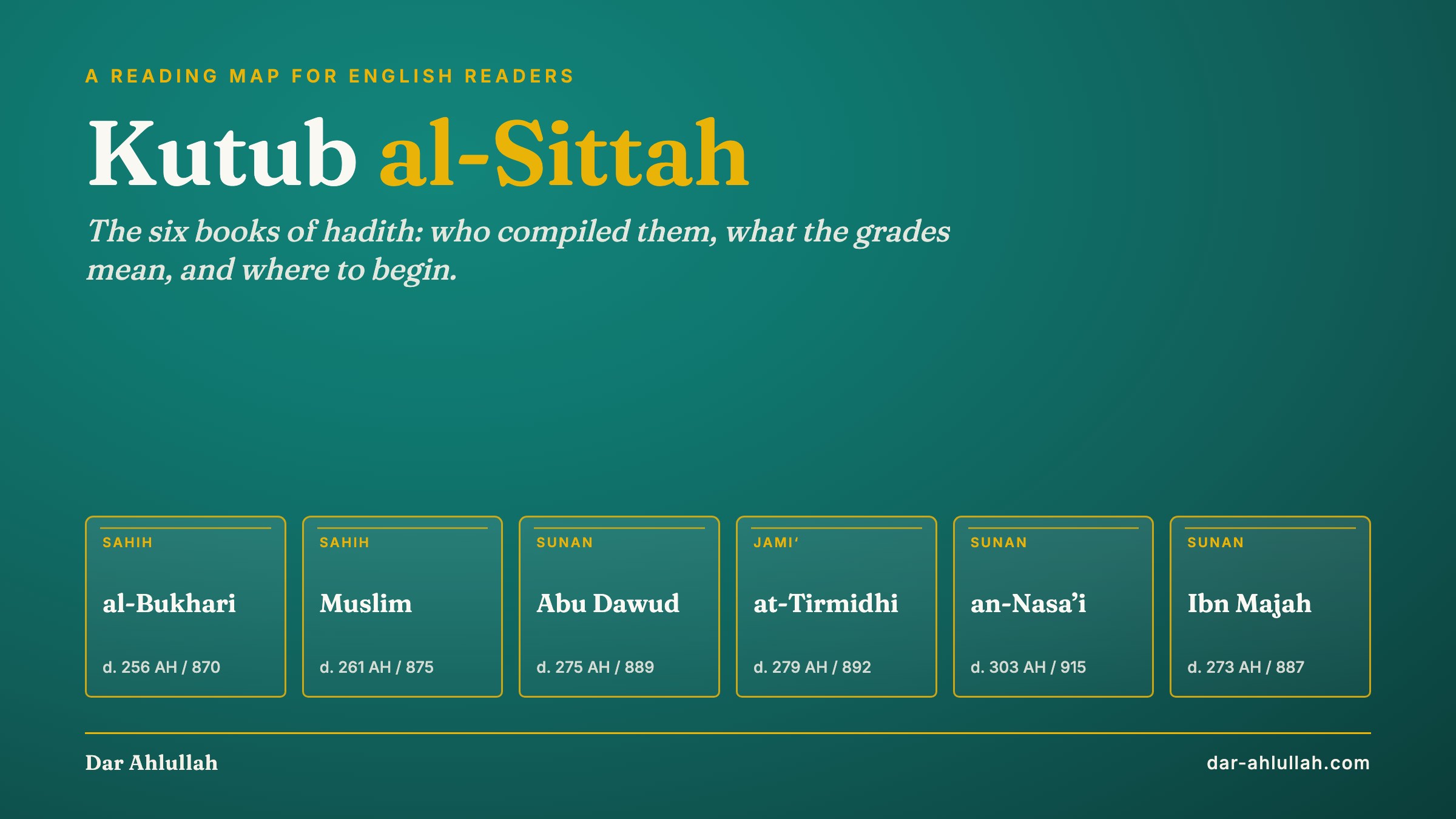
Table of Contents
- Introduction: The Numbers at the End of Every Hadith
- The Short Answer
- Why Hadith at All
- What a Hadith Is: Chain and Text
- The Six Books, One by One
- Sahih, Sunan, Jami‘, Musnad, Muwatta: What the Book Types Mean
- How Hadith Are Graded
- Why These Six and Not Others
- How to Read a Hadith Reference
- Reading the Six Books in English
- Where a Beginner Should Start
- Seven Mistakes People Keep Making
- How We Teach This
- Questions People Ask
- Conclusion: A Map, Not a Mountain
Introduction: The Numbers at the End of Every Hadith
Read almost anything about Islam in English and you will meet a line like “Sahih al-Bukhari 1044” or “Sunan Abi Dawud 1, graded hasan sahih”. Our own guides are full of them. The eclipse prayer guide leans on Bukhari 1044, the adhkar guide separates what stands on “the two Sahihs” from what stands on later grading, and the istinja guide cites Muslim 273b. Most readers skim past those tags the way they skim a footnote, trusting that somebody checked.
Somebody did, and the system behind the tags is one of the most carefully built things in Islamic scholarship. It is also almost never explained to the people who rely on it. A new Muslim is told to “follow the Sunnah” and handed a book of seven thousand reports with no map. An adult who grew up Muslim knows the name al-Bukhari, and perhaps Muslim, and could not say what Abu Dawud, at-Tirmidhi, an-Nasa’i and Ibn Majah did differently, or why a hadith can sit in one of their books and still be weak.
This guide is that map. It explains what the six books are, who compiled them and when, how a Sahih differs from a Sunan, what the grades printed under a hadith mean, how to read a reference number, and where to start if you read only English. It is written for the reader who wants to use hadith honestly, not for the specialist.
The Short Answer
The Kutub al-Sittah, “the Six Books”, are the six hadith collections that Sunni scholars came to treat as the core canon. All six were compiled in the ninth and early tenth centuries CE. Two are called Sahih, because their authors set out to include only authenticated reports: Sahih al-Bukhari and Sahih Muslim, together known as the Sahihayn. Four are called Sunan, arranged by legal topic and admitting some weaker reports alongside the sound ones: Sunan Abi Dawud, Jami‘ at-Tirmidhi, Sunan an-Nasa’i and Sunan Ibn Majah.
Three things follow that most people get wrong. The six are not six Sahihs; the older name as-Sihah as-Sitta is loose, and only the first two aimed at sound hadith alone. A hadith being “in the six books” therefore does not by itself make it authentic; the grade matters, and the Sunan print grades for a reason. And the canon was not fixed by a council. It grew over about four centuries, and the sixth seat was contested between Ibn Majah, the Muwatta of Malik and others until the thirteenth century.
All six are free in Arabic and English at sunnah.com, with grades and verified reference numbers. A beginner should not start with any of them cover to cover, but with al-Nawawi’s Forty Hadith and then his Riyad as-Salihin, both of which draw on the six.
Why Hadith at All
The Qur’an itself sends the believer to the Prophet ﷺ as a model and an authority. “There has certainly been for you in the Messenger of Allah an excellent pattern” (Qur’an 33:21). “And whatever the Messenger has given you, take; and what he has forbidden you, refrain from” (59:7). “He who obeys the Messenger has obeyed Allah” (4:80). The hadith are the record of that pattern: his words, his actions and what he approved by his silence.
In practice the Sunnah carries most of the detail of worship. The Qur’an commands the prayer again and again without describing its postures, its recitations or the number of units; those come from hadith, as the fiqh for beginners guide sets out. The same is true of the wording of the adhan, the method of wudu and ghusl, the funeral prayer and the two Eids. A Muslim who had the Qur’an alone would not know how to pray.
That is why the early scholars treated the transmission of hadith with such seriousness. The Prophet ﷺ warned, in a report so widely transmitted that it is counted as mutawatir: “Whoever intentionally ascribes to me what I have not said, then surely let him occupy his seat in Hell-fire” (Sahih al-Bukhari 109). People did fabricate anyway. Al-Dhahabi records a heretic, about to be executed under Harun al-Rashid, boasting of a thousand forged reports, and the caliph answering that two hadith scholars would sift them “letter by letter” (IslamQA 6981). The six books are the mature product of that sifting.
What a Hadith Is: Chain and Text
Every hadith has two parts. The isnad is the chain of people who passed it on, named one by one from the compiler back to the Companion who heard the Prophet ﷺ. The matn is the text itself. English translations usually print only the last link (“Narrated ‘Umar”), but in the Arabic the chain is the first thing you read.
Take the first hadith in Sahih al-Bukhari, “The reward of deeds depends upon the intentions” (Sahih al-Bukhari 1). Before the text, al-Bukhari writes: al-Humaydi ‘Abdullah ibn az-Zubayr narrated to us, that Sufyan narrated to us, that Yahya ibn Sa‘id al-Ansari narrated to us, that Muhammad ibn Ibrahim at-Taymi informed him that he heard ‘Alqamah ibn Waqqas al-Laythi say: I heard ‘Umar ibn al-Khattab on the pulpit say: I heard the Messenger of Allah ﷺ say. Six named people stand between al-Bukhari and the Prophet ﷺ, and the science of hadith is, at bottom, the study of such people: whether each was truthful, whether each had the memory to carry what he heard, and whether each actually met the one before him.
The same idea of a documented chain survives today in Qur’an recitation, where an ijazah with its sanad records who taught whom, back to the Prophet ﷺ. In hadith the chain authenticates what he said; in recitation it authenticates how the text is read.
The Six Books, One by One
Dates are given in both the Islamic (AH) and common (CE) calendars. Hadith counts are given two ways where both are known, because the books repeat reports under different chapters: the running number used on sunnah.com, which counts every entry, and the number of distinct reports.

1. Sahih al-Bukhari
Compiled by Muhammad ibn Isma‘il al-Bukhari (194–256 AH / 810–870 CE), born in Bukhara in present-day Uzbekistan. He began memorising hadith before the age of ten, travelled for sixteen years across the Muslim world, and is reported to have examined hundreds of thousands of reports with about a thousand teachers (IslamQA 21523; Wikipedia: al-Bukhari). From these he kept only what met his conditions: every narrator upright and of proven memory, every link in the chain present, and every pair of consecutive narrators known to have met. He showed the finished book to his teachers Ahmad ibn Hanbal, ‘Ali ibn al-Madini and Yahya ibn Ma‘in, who examined it and testified to its soundness (Wikipedia: Sahih al-Bukhari).
The standard numbering runs to 7,563 entries, the count of the editor Muhammad Fu’ad ‘Abd al-Baqi that sunnah.com follows; Ibn Hajar put the number of distinct reports at 2,602. The book is arranged in 97 topical books, opening with the beginning of revelation and closing with tawhid, and its chapter headings are themselves a kind of commentary, because al-Bukhari used them to show what he understood each hadith to prove. Al-Nawawi recorded the scholars’ agreement that the most authentic books after the Qur’an are the two Sahihs, with al-Bukhari first (Wikipedia: Sahih Muslim). The great commentary is Ibn Hajar’s Fath al-Bari; the standard English translation is Muhammad Muhsin Khan’s, published by Darussalam in nine volumes.
2. Sahih Muslim
Compiled by Muslim ibn al-Hajjaj of Nishapur (206–261 AH / c. 815–875 CE), a student of al-Bukhari who shared many of his teachers and spent about fifteen years on the work (IslamQA 21523). Where al-Bukhari scattered one hadith across several chapters to prove several points, Muslim gathered every chain of a report in one place, which makes his book far easier to use when you want to see all the versions of a hadith side by side. He also opened it with an introduction on method, including his ranking of narrators into three tiers and his refusal to use the third (Wikipedia: Sahih Muslim).
‘Abd al-Baqi counted 3,033 distinct reports. The Darussalam English edition that sunnah.com follows numbers every repeated chain separately, so its running count also reaches 7,563, and the same hadith carries two numbers: the running number, and the ‘Abd al-Baqi number with a letter for each chain. That is why our guides cite forms like “Muslim 273b”. The classic commentary is al-Nawawi’s al-Minhaj. Scholars rank Muslim second to al-Bukhari as a whole, while noting that this is a judgement on the two books overall, not a claim that every hadith in one outranks every hadith in the other.
3. Sunan Abi Dawud
Compiled by Abu Dawud Sulayman ibn al-Ash‘ath as-Sijistani (202–275 AH / 817–889 CE), a student of Ahmad ibn Hanbal. He is said to have gathered 500,000 reports and selected about 4,800 for the Sunan; the sunnah.com numbering reaches 5,274 (Wikipedia: Sunan Abi Dawud). The book is built for jurists: 43 books arranged by legal topic, holding the hadith a scholar needs to settle a question of practice. Ahmad ibn Hanbal is reported to have approved of it, and a saying circulated that the Qur’an and Abu Dawud’s Sunan together left nothing further necessary.
Abu Dawud explained his method in a letter to the scholars of Makkah: “I have disclosed wherever there was too much weakness in regard to any tradition in my collection. But if I happen to leave a hadith without any comment, it should be considered as sound, albeit some of them are more authentic than others.” His silence was meant as a grade, though later scholars did not always accept it, and modern editions print the grades of al-Albani and others under each report. He also gave a rule for contradictory reports: look at what the Companions adopted.
4. Jami‘ at-Tirmidhi
Compiled by Muhammad ibn ‘Isa at-Tirmidhi (209–279 AH / 824–892 CE), from Termez in present-day Uzbekistan, a student of al-Bukhari and of Abu Dawud. He completed it in 270 AH (884 CE). It is called a Jami‘, “comprehensive”, because it covers belief, manners, tafsir and history as well as law. The Darussalam numbering that sunnah.com follows runs to 3,956; other editions count around 4,400 (Wikipedia: Jami‘ at-Tirmidhi).
What sets at-Tirmidhi apart among the six is that he grades almost every hadith himself and then tells you which jurists acted on it and which did not. He is the source of the puzzling label hasan sahih, which commentators have explained in more than one way, and of the term gharib for a report carried by a single chain. For a student of fiqh his notes are the most useful thing in the six books: a hadith, its grade and the schools’ positions in three lines. Ibn al-Athir called it “the best of books, having the most benefit, the best organization, with the least repetition.” Scholars have disputed how many forged reports it contains: Ibn al-Jawzi counted around two dozen, as-Suyuti said none, and al-Albani identified sixteen.
5. Sunan an-Nasa’i
Compiled by Ahmad ibn Shu‘ayb an-Nasa’i (215–303 AH / c. 830–915 CE), from Nasa in present-day Turkmenistan, who lived in Egypt and later Damascus. He first produced a large collection, as-Sunan al-Kubra, then abridged it into the book that entered the six, al-Mujtaba (“the Selected”), also called as-Sunan as-Sughra. It contains 5,758 entries in 52 books (Wikipedia: Sunan an-Nasa’i).
His conditions for narrators were the strictest of the four Sunan authors. Many scholars rank the book third, directly after the two Sahihs, and Ibn Hajar observed that it has the fewest weak hadith and criticised narrators of the four and not a single fabricated report. An-Nasa’i also repeats hadith under several headings to show fine differences in wording, so the book rewards slow reading. It was especially admired in the Shafi‘i school.
6. Sunan Ibn Majah
Compiled by Muhammad ibn Yazid Ibn Majah of Qazvin (209–273 AH / 824–887 CE). It contains 4,341 entries, of which about 1,329 appear in none of the other five, a body of material scholars call its zawa’id (Wikipedia: Sunan Ibn Majah). That uniqueness is both its value and its problem. A good share of the additional reports are weak, and somewhere between twenty and thirty are generally agreed to be fabricated, several of them praising individuals, tribes or towns, including Ibn Majah’s own Qazvin.
For centuries the book was barely known outside northern Iran. Muhammad ibn Tahir al-Maqdisi, known as Ibn al-Qaysarani (d. 507 AH / 1113 CE), first proposed a canon of six and placed Ibn Majah in it, in his Shurut al-A’imma as-Sitta. Even then al-Nawawi and Ibn Khaldun left it off their lists, and others substituted the Muwatta of Malik or the Sunan of ad-Darimi. Ibn Majah eventually kept the sixth seat largely because his book overlapped least with the other five, so adding it added the most new material (Wikipedia: Kutub al-Sittah).
Sahih, Sunan, Jami‘, Musnad, Muwatta: What the Book Types Mean
The titles of hadith books describe how they were built. Once you know the vocabulary, the names stop sounding interchangeable.
| Term | What it means | Examples |
|---|---|---|
| Sahih | “Sound.” The author’s stated aim was to include only authenticated hadith. | al-Bukhari, Muslim; later Ibn Khuzaymah, Ibn Hibban |
| Sunan | Arranged by legal topic (purification, prayer, zakat, marriage), the order of a fiqh manual. Admits hasan and some weak reports. | Abu Dawud, an-Nasa’i, Ibn Majah, ad-Darimi, ad-Daraqutni |
| Jami‘ | “Comprehensive.” Covers all the main subject areas: belief, law, manners, tafsir, history, trials and virtues. | at-Tirmidhi; al-Bukhari’s full title also calls his book a Jami‘ |
| Musnad | Arranged by the Companion who narrated, not by topic. Hard to browse, invaluable for tracing chains. | Musnad Ahmad (more than 30,000 reports) |
| Muwatta | “The well-trodden path.” Malik’s record of Madinan practice: hadith together with the rulings of Companions and later Madinan scholars. | Muwatta Malik |
| Musannaf | The general word for a topically arranged collection; also the title of two large early ones. | ‘Abd ar-Razzaq, Ibn Abi Shaybah |
| Mustadrak | A “supplement”: hadith the author judged to meet the Sahihayn’s conditions but which they omitted. | al-Hakim |
| Arba‘in | A collection of forty, usually chosen for teaching. | al-Nawawi’s Forty (which actually has 42) |
The Muwatta of Malik ibn Anas (d. 179 AH / 795 CE) deserves a word of its own. It is the earliest of these books, arranged by legal topic, and it mixes Prophetic hadith with the sayings of Companions and the practice of Madinah; of its roughly 1,700 reports, fewer than half go back to the Prophet ﷺ directly. Ash-Shafi‘i called it the most authentic book on earth after the Qur’an, a judgement he gave before al-Bukhari and Muslim had written theirs (Wikipedia: Al-Muwatta). Malikis and some other scholars still count it among the six in place of Ibn Majah. The Musnad of Ahmad ibn Hanbal (d. 241 AH / 855 CE), with more than 30,000 reports arranged by Companion rather than by topic, is the largest of the early collections and, with the Muwatta and the Sunan of ad-Darimi, completes what sunnah.com calls “the nine books”.
How Hadith Are Graded
Ibn as-Salah summarised the scholars’ divisions as three: sahih (sound), hasan (good) and da‘if (weak). A fourth label, mawdu‘ (fabricated), is the worst kind of weak (Wikipedia: Hadith terminology).
Ibn Hajar’s definition of a sahih hadith has five conditions. Every narrator is trustworthy. Every narrator is precise, in memory or in writing. The chain is connected, each link having actually received the report from the one before. The report is free of a hidden flaw. And it does not contradict stronger evidence. A hasan hadith passes the same test except that one of its narrators is a little less precise; it is still evidence and still acted upon. A da‘if hadith fails somewhere, because the chain is broken or because a narrator was criticised. Weak hadith are not simply thrown away, but scholars disagree on how, and whether, they may be used for virtues and encouragement, and nobody builds a ruling on one.
Two other labels you will meet. Muttafaq ‘alayh, “agreed upon”, means the report appears in both al-Bukhari and Muslim, which scholars from al-Mayyanishi onward have treated as the highest level of all. Mutawatir means a report carried by so many independent chains at every level that collusion is unthinkable; the warning against lying about the Prophet ﷺ is the classic example, with more than seventy Companions reporting it.
The practical lesson is simple. In the two Sahihs you may take the report as sound; that was the purpose of the books. In the four Sunan, read the grade. At-Tirmidhi prints his own; Abu Dawud’s silence was meant as approval; an-Nasa’i chose strictly; Ibn Majah needs the most care. Modern editions, and sunnah.com, print the grades of al-Albani and of Darussalam’s editors under each report, with those of Shu‘ayb al-Arna’ut, Ahmad Shakir and Abu Ghuddah being added, and they sometimes disagree. Our adhkar after salah and 99 names of Allah guides both show what that disagreement looks like on a familiar hadith.
Why These Six and Not Others
No council chose them. Recognition began with the two Sahihs in the tenth century, driven largely by scholars of the Shafi‘i school, as commentaries, abridgements and studies grew up around the two books and jurists gradually stopped citing hadith from their own notes and began citing them from the recognised collections. The four Sunan were drawn in over the following centuries. Ibn al-Qaysarani’s book on the conditions of the six imams, written in the eleventh century, is the first to treat them as a set, and consensus on the set, Ibn Majah included, arrived in the thirteenth (Wikipedia: Kutub al-Sittah).
The ranking inside the six is also not fixed. Al-Bukhari then Muslim is the usual order, with a minority preferring Muslim. An-Nasa’i is often placed third on the strength of his conditions, Abu Dawud fourth, at-Tirmidhi fifth and Ibn Majah sixth, but you will find lists that reorder the middle four, and the order of the books says nothing about any particular hadith inside them.
One boundary worth knowing. The six books are a Sunni canon. Twelver Shia Muslims rely on a different set, the Four Books, transmitted largely through the Imams, and regard many Sunni narrators as unreliable (Wikipedia: The Four Books). When a Shia and a Sunni friend quote “hadith” at each other, they are often not quoting the same literature.
How to Read a Hadith Reference
A reference like “Sahih al-Bukhari 1044” points to a numbered entry in a particular edition. For al-Bukhari that is ‘Abd al-Baqi’s numbering, 1 to 7,563, used by sunnah.com and keyed to Fath al-Bari. For Muslim, scholarly works cite ‘Abd al-Baqi’s 1 to 3,033 with a letter for each chain (273a, 273b), while the Darussalam English edition numbers every chain separately up to 7,563; sunnah.com shows both. For the four Sunan the Darussalam numbering is the one you will meet most often.
On sunnah.com each hadith page carries up to three references. The bold “Reference” is the one to use: it has been checked against a recognised scholarly numbering. Below it is an “In-book reference” (Book 16, Hadith 5), sunnah.com’s own, stable within the site. Older pages also show a “USC-MSA” number in the form volume, book, hadith, inherited from the University of Southern California database that first put the translations online; the site now marks that scheme as deprecated and asks that it not be used in new citations (sunnah.com: about). If you see a hadith cited as “Volume 2, Book 18, Number 154”, that is a USC-MSA reference, and you will need to search the text to find the modern number.
So the eclipse hadith, “When you see the eclipse, remember Allah and say Takbir, pray and give Sadaqa”, is Sahih al-Bukhari 1044: entry 1,044 in ‘Abd al-Baqi’s numbering, the fifth hadith of al-Bukhari’s Book of Eclipses. One short tag tells a reader where the report is and how to find it, which is why the eclipse prayer guide cites it that way.
Reading the Six Books in English
You do not need Arabic to read them, although Arabic transforms the experience. Each of the six has a complete English translation, and all are available free with the Arabic text at sunnah.com, which also hosts the Muwatta, the Musnad of Ahmad, ad-Darimi, Riyad as-Salihin, al-Nawawi’s Forty and more than a dozen other collections, searchable in English. In print, Darussalam publishes the standard English sets: Sahih al-Bukhari in nine volumes in Muhsin Khan’s translation, Sunan an-Nasa’i in six, and the others in similar sets.
Two cautions. Translation is interpretation: the same hadith rendered by two translators can read quite differently, and the older translations are sometimes looser than Darussalam’s. Our comparison of the English translations of the Qur’an shows how much the translator’s choices matter, and the point holds for hadith. And a hadith read alone is not a ruling. Sunnah.com’s own usage note says it is not a fatwa site and that individual texts “should not be treated as standalone legal rulings without qualified scholarly context.” The same is true of this article. If you want to know what a hadith means for your prayer, the four schools have already done that work.
Where a Beginner Should Start
Not with Sahih al-Bukhari from page one. Its opening books, on revelation, faith and knowledge, are magnificent, but the chains, the repetitions and the legal detail that follow defeat most readers by the Book of Wudu. The scholars who taught beginners for centuries used a ladder, and it still works.
- Al-Nawawi’s Forty Hadith. Forty-two short reports chosen by Yahya ibn Sharaf an-Nawawi (631–676 AH / 1233–1277 CE) because the religion turns on them: intentions, the pillars, lawful and unlawful, sincerity, good character. Nearly all are from the six books. When a questioner asked SeekersGuidance which hadith book a beginner should memorise, the answer was this one, because it is short enough to finish and contains “some of the most important prophetic traditions around which our religion revolves” (SeekersGuidance). It is free at sunnah.com/nawawi40, and good English commentaries exist.
- Riyad as-Salihin. Al-Nawawi’s larger anthology: 1,896 hadith in 372 chapters, each opened by the Qur’an verses on the same theme, covering sincerity, repentance, patience, manners, dress, visiting the sick, dhikr and du‘a (Wikipedia: Riyad as-Salihin). Almost every mosque study circle in the English-speaking world has read it. A chapter a day takes about a year.
- A legal anthology, if fiqh is your interest. Ibn Hajar’s Bulugh al-Maram (he lived 1372–1448 CE) collects the hadith on which rulings rest, arranged in fiqh order, and is the usual bridge from reading hadith to understanding how the schools use them.
- Then the two Sahihs, with a commentary or a teacher. Read Muslim’s introduction first; it is the clearest statement of why the science exists. Then read by topic rather than cover to cover: the Book of Prayer, the Book of Fasting before Ramadan, the Book of Manners.
- The four Sunan last, always with the grades. At-Tirmidhi first, because he explains himself.
Three habits help at every rung. Read the Arabic text aloud if you can read the script at all, even slowly, because the hadith were spoken before they were written and the rhythm carries meaning. Keep a notebook of references, so that anything you later quote can be found. And read the Seerah alongside: a hadith makes far more sense when you know which year it was said and to whom.
Seven Mistakes People Keep Making
- Treating “it is a hadith” as “it is authentic.” Forwarded messages, memes and even sermons carry fabricated reports. Before you repeat one, find it on sunnah.com with a bold reference and a grade. If you cannot find it at all, that is your answer. Whole books have been written listing the fabrications, from Ibn al-Jawzi to al-Albani (IslamQA 6981).
- Assuming the six books are six Sahihs. Only al-Bukhari and Muslim set out to include sound hadith alone. The four Sunan knowingly include weak reports, and their authors said so.
- Reading a Sunan hadith without its grade. The grade is printed under the text on every modern edition for a reason. A da‘if report in Ibn Majah is not evidence in the way a sahih report in al-Bukhari is.
- Building a ruling from one hadith. Two sound reports can appear to contradict each other, and reconciling them is a discipline in itself. Abu Dawud’s rule was to look at what the Companions did. The four schools have done this work for every question of worship; use them, as the fiqh guide explains.
- Mixing up the reference systems. “Volume 2, Book 18, Number 154” and “Bukhari 1044” can be the same hadith. Quote the bold reference and the collection, and your reader can find it in seconds.
- Starting with al-Bukhari cover to cover. It is not a book written to be read front to back by a beginner, and most who try stop within a few weeks. Start with the Forty.
- Assuming everyone means the same books. Sunni and Shia Muslims cite different canons. Knowing that avoids a great many pointless arguments.
How We Teach This
The six books are a reading project you can run yourself, and this guide has tried to give you the map and the ladder to do it. What a teacher adds is the two things a map cannot: Arabic, so that you can read the chain and the text as the compilers wrote them rather than only a translation, and a grounding in belief and fiqh, so that a hadith lands in its context instead of floating alone. At Dar Ahlullah, one-to-one lessons with a certified teacher cover Qur’an reading, Tajweed, memorisation and Arabic, and the Islamic Studies course for children and teens introduces the basics of aqeedah, fiqh and the Seerah on which hadith reading rests. Lessons are $9 per teaching hour, and the first step is a free 30-minute assessment with no card required. The courses page describes each path.
Questions People Ask
Are all the hadith in the six books authentic?
No. Al-Bukhari and Muslim aimed to include only sound hadith, and scholars accept that they succeeded. The four Sunan knowingly include hasan and some weak reports, and Ibn Majah includes a small number generally agreed to be fabricated. Always read the grade in a Sunan.
Which is the most authentic hadith book?
Sahih al-Bukhari, then Sahih Muslim, by the agreement of the scholars al-Nawawi records. A minority place Muslim first. A hadith found in both is muttafaq ‘alayh and carries the highest weight.
What does “muttafaq ‘alayh” mean?
“Agreed upon”: both al-Bukhari and Muslim included the report. It is the strongest label a single hadith normally receives.
How many hadith are in Sahih al-Bukhari?
7,563 entries in the standard numbering, counting repetitions. Ibn Hajar put the distinct reports at 2,602.
What is the difference between a Sahih and a Sunan?
A Sahih is named for its standard: the author included only what he judged sound. A Sunan is named for its arrangement: by legal topic, in the order of a fiqh book, and it may include weaker reports.
Why is the Muwatta of Malik not one of the six?
For many Malikis it is, in place of Ibn Majah. Ibn Majah kept the sixth seat in the usual list because his book overlaps least with the other five and so adds the most new material, and because the Muwatta mixes hadith with Companions’ rulings and Madinan practice.
Which hadith book should a new Muslim read first?
Al-Nawawi’s Forty Hadith, then Riyad as-Salihin. Both are short enough to finish, arranged by theme, and free in English on sunnah.com. The six books come after that, by topic and with a teacher or commentary. The new Muslim guide places this inside a first-year plan.
Do Shia Muslims use the six books?
No. Twelver Shia Islam has its own canon, the Four Books, transmitted largely through the Imams.
Is sunnah.com reliable?
It reproduces recognised Arabic editions and published translations, prints grades from al-Albani and Darussalam, and marks verified reference numbers in bold. It describes itself as a research and citation tool, not a fatwa site, and that is the right way to use it.
What does “hasan sahih” mean in at-Tirmidhi?
It is at-Tirmidhi’s own compound grade, and commentators have explained it in more than one way, including a report with two chains, one hasan and one sahih, or a report whose status sits between the two. Treat it as acceptable evidence; if a ruling depends on the exact grade, that is a question for a scholar.
Can I act on a weak hadith?
Not for a ruling. Scholars differ on using weak reports for virtues and encouragement under strict conditions, and the detail is beyond this guide. The safe practice for a layperson is to prefer what is sahih or hasan, which is more than enough to fill a lifetime.
Conclusion: A Map, Not a Mountain
Six books, two kinds. Al-Bukhari and Muslim, where soundness was the test for entry, and Abu Dawud, at-Tirmidhi, an-Nasa’i and Ibn Majah, where the fiqh topic was the organising idea and the grade travels with the text. Six men, born within a generation of each other across what is now Uzbekistan, Iran, Turkmenistan and the Afghan border, who between them fixed the record on which the practice of a billion people rests. A numbering system that turns “Bukhari 1044” into a line a reader can check in ten seconds.
None of that requires Arabic to understand, and all of it is free to read. What it requires is the humility to read the grade, the patience to start with forty hadith rather than seven thousand, and the sense to let the scholars do the reconciling. Start with al-Nawawi’s Forty this week, read one a day, and look each one up on sunnah.com so that the chain, the collection and the reference stop being strangers. By the end of the forty-second day the six books will no longer be a mountain. They will be a library you know how to use.
Related articles
how to study the Seerah
How to Study the Seerah: A Beginner’s Reading Plan
Most people stall in the first four chapters of a Seerah book because they started with the flesh instead of the skeleton. Thirteen years in Mecca, ten in Medina, one book finished properly, and the Quran open beside it.
18 min read
fiqh for beginners
Fiqh for Beginners: What to Learn First, and in What Order
Fiqh is the science of what a Muslim does, as distinct from what a Muslim believes. The part you use daily — purification and prayer — is a few weeks of study, and it is taught in a fixed order for a reason.
16 min read
aqeedah for beginners
Aqeedah for Beginners: The Six Articles of Faith, Explained Simply
Aqeedah is the subject that answers what a Muslim believes, as distinct from what a Muslim does. The core of it is six articles of faith — short enough to learn in an afternoon, and the foundation everything else rests on.
17 min read