
best English translation of the Quran
Best English Translation of the Quran: Seven Compared, Verse by Verse
Dar Ahlullah team 19 min read
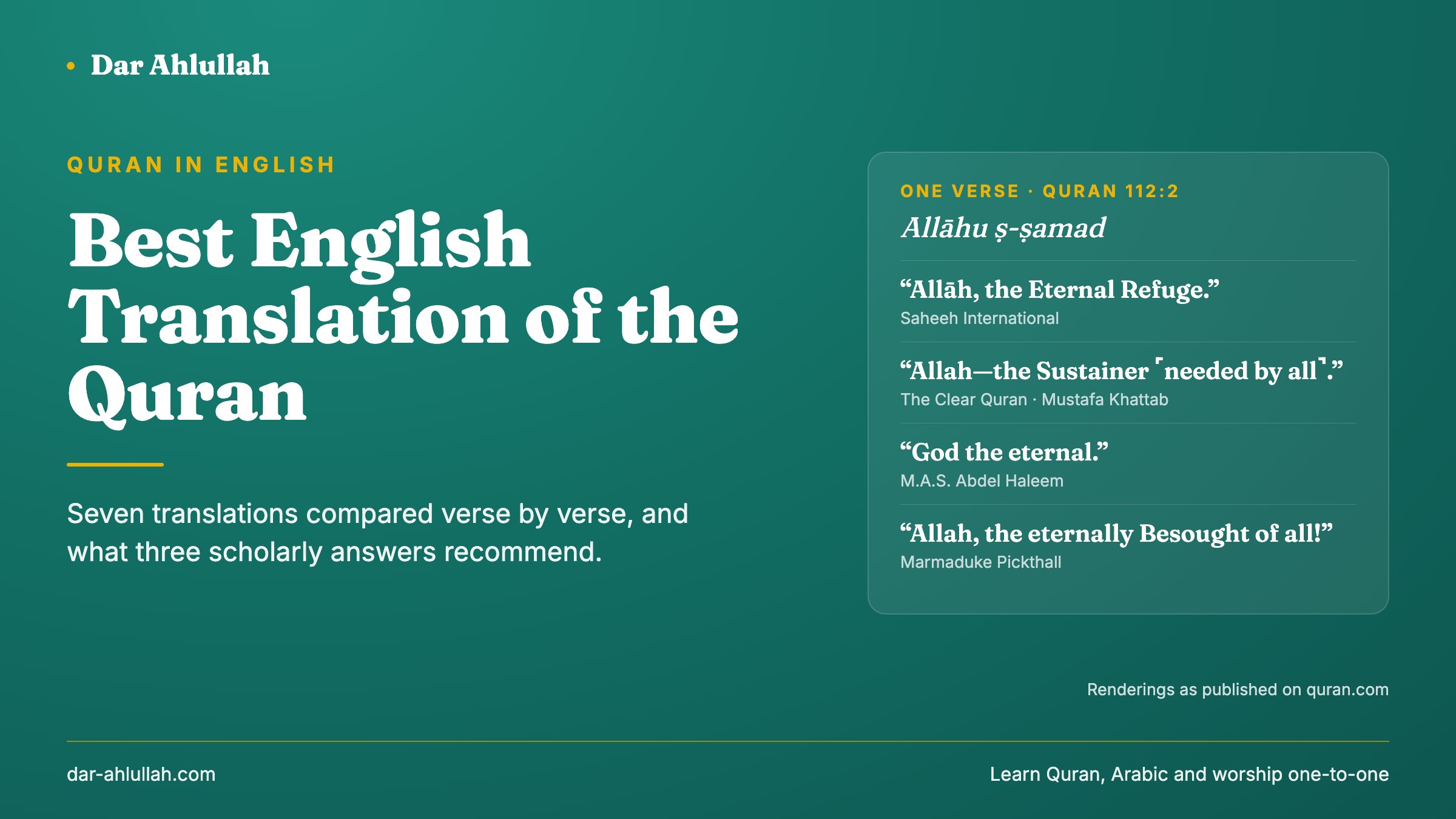
Table of Contents
- Introduction: Four Translations on the Shelf, and Nobody Says Which
- The Short Answer
- What a Translation Is, and What It Cannot Be
- One Verse, Seven Translations
- The Seven Translations, One by One
- What Scholars Actually Recommend
- Which One Should You Read?
- Other Translations You Will Meet
- How to Read a Translation Well
- How We Teach This
- Questions People Ask
- Conclusion: Two Translations and a Few Arabic Words
Introduction: Four Translations on the Shelf, and Nobody Says Which
Ask which English translation of the Quran to read and you will be given a name, said with confidence, and then a different name by the next person you ask. A mosque bookstall may have four on one shelf. A Quran app has more. Each was made by someone who knew Arabic far better than most of its readers do, and each reads differently, sometimes on the very same verse.
This guide is about the best English translation of the Quran for someone who reads in English and wants to understand what they recite. It puts seven widely used translations side by side on the same three verses, with the wording copied from quran.com rather than paraphrased, sets out who made each one and how it reads, and compares what three scholarly answer services actually recommend. It is written for new Muslims, for adults who grew up reciting without understanding, and for parents choosing a copy for the house. If you are still deciding how to learn to read the Quran itself, our comprehensive guide to learning the Quran online covers that; this article is about the English beside the Arabic.
The Short Answer
- There is no single best translation, and the scholars asked about it say so. The SeekersGuidance answer on the question recommends reading several approved translations side by side rather than relying on one.
- Saheeh International is the only translation on all three scholarly lists we compared (IslamWeb, the Darul Iftaa answer published on Askimam, and SeekersGuidance). It stays close to the Arabic and puts every word it adds in square brackets.
- For a first, readable pass, The Clear Quran by Mustafa Khattab (the translation quran.com shows by default) and M.A.S. Abdel Haleem’s Oxford translation both read as modern English prose. Abdel Haleem writes “God” where most of the others write “Allah”.
- Yusuf Ali and Pickthall are the classic translations of the 1930s, in older English (“thee”, “Thou”). Yusuf Ali is known for his notes, which later editions revised, so check which edition you are holding.
- Hilali-Khan and Taqi Usmani build explanation into the line in brackets. That puts the classical reading in front of you, and it also means more of the words on the page are the translator’s.
- Every translation explains the meaning; none of them is the Quran. Reading one to understand is rewarded as reading tafsir, while the reward for each letter recited belongs to the Arabic (IslamQA 2589).
- Read two, not one, and add a short tafsir. Where two good translations disagree is exactly where to look closer or ask a teacher.
What a Translation Is, and What It Cannot Be
The Quran describes itself as Arabic: “Indeed, We have sent it down as an Arabic Qur’ān that you might understand” (Quran 12:2), and almost the same words return in 43:3. A translation carries the meaning into another language, not the text itself, which is why so many English editions call themselves the meaning of the Quran rather than the Quran. Pickthall’s 1930 title was The Meaning of the Glorious Koran; the Hilali-Khan edition is titled Interpretation of the Meanings of the Noble Qur’an.
That has a practical consequence for worship. IslamQA’s answer on reading the Quran in translation says that a person who reads a translation “in order to understand the meanings and benefit from what the ayat are saying” is rewarded for it, “because the Muslim will be rewarded for reading tafsir (explanation and commentary), and a translation is tafsir.” It adds that there is no indication that reading a translation earns the reward the hadith mentions for each letter of the Quran recited. The prayer is said in Arabic for the same underlying reason, which our guide to a new Muslim’s first ninety days explains: understanding happens in your own language, recitation in Arabic.
The second consequence is that translators disagree, and not because some of them are careless. The SeekersGuidance answer on the best English translations, by Shaykh Riad Saloojee, gives the reasons: “the act of translation is an interpretative exercise; any translation rests on the translator’s scholarly knowledge of the broader Islamic tradition; translators differ in their bias, motive and social context; there will always be tension between a literal rendering and one that privileges meaning or spirit.” The quickest way to see what that means in practice is to put one verse in front of all seven.
One Verse, Seven Translations
Every rendering below is copied from quran.com, which carries all seven translations; only the footnote markers have been removed. You can check any line on the verse page linked above each table by choosing the translations you want to see. The seven are Saheeh International, The Clear Quran (Mustafa Khattab), M.A.S. Abdel Haleem, Abdullah Yusuf Ali, Marmaduke Pickthall, Hilali-Khan and Muhammad Taqi Usmani.
Quran 1:2: the words English needs, and how each translator marks them
The second verse of al-Fatihah is four Arabic words, al-ḥamdu lillāhi rabbi l-‘ālamīn, and it is recited in every unit of every prayer (Quran 1:2).
| Translation | Quran 1:2 |
|---|---|
| Saheeh International | [All] praise is [due] to Allāh, Lord of the worlds - |
| The Clear Quran | All praise is for Allah—Lord of all worlds, |
| Abdel Haleem | Praise belongs to God, Lord of the Worlds, |
| Yusuf Ali | Praise be to Allah, the Cherisher and Sustainer of the worlds; |
| Pickthall | Praise be to Allah, Lord of the Worlds, |
| Hilali-Khan | All the praises and thanks be to Allâh, the Lord of the ‘Âlamîn (mankind, jinn and all that exists). |
| Taqi Usmani | Praise belongs to Allah, the Lord of all the worlds. |
Three decisions are visible in seven short lines. Saheeh International puts “All” and “due” in square brackets because English needs them and the Arabic has no separate word for them; it marks every addition the same way, so you can always see where the translator is speaking. Yusuf Ali spends three English words, “Cherisher and Sustainer”, on the one word rabb, to carry more of its sense than “Lord” does. Hilali-Khan keeps the Arabic word ‘ālamīn and explains it in parentheses. None of these is wrong. They are different answers to the question of how much the English should explain.
Quran 112:2: a word English does not have
Allāhu ṣ-ṣamad is two words (Quran 112:2). The second has no single English equivalent, and the seven translations show it.
| Translation | Quran 112:2 |
|---|---|
| Saheeh International | Allāh, the Eternal Refuge. |
| The Clear Quran | Allah—the Sustainer ˹needed by all˺. |
| Abdel Haleem | God the eternal. |
| Yusuf Ali | Allah, the Eternal, Absolute; |
| Pickthall | Allah, the eternally Besought of all! |
| Hilali-Khan | Allâh-us-Samad (…) [Allâh the Self-Sufficient Master, Whom all creatures need, (He neither eats nor drinks)]. |
| Taqi Usmani | Allah is Besought of all, needing none. |
Read together, the seven say more than any one of them: the One every creature turns to in its need, who needs no one. Abdel Haleem’s “God the eternal” is the shortest and carries the least of that. Hilali-Khan’s is the longest and is mostly explanation; the “(…)” marks an Arabic gloss we have left out. The Clear Quran uses its own half-brackets for the words it adds. This is the kind of verse that makes the SeekersGuidance advice, to read translations comparatively, look less like caution and more like method.
Quran 93:7: when the explanation moves into the line
Surah ad-Duha speaks to the Prophet ﷺ and lists what Allah had done for him. Verse 7 uses the word ḍāll, which elsewhere in the Quran describes people who have gone astray (Quran 93:7). Applied to the Prophet ﷺ, the classical commentators read it as his state before revelation: Ibn Kathir’s tafsir of the verse explains it with Quran 42:52, “You did not know what is the Book or [what is] faith.”
| Translation | Quran 93:7 |
|---|---|
| Saheeh International | And He found you lost and guided [you], |
| The Clear Quran | Did He not find you unguided then guided you? |
| Abdel Haleem | Did He not find you lost and guide you? |
| Yusuf Ali | And He found thee wandering, and He gave thee guidance. |
| Pickthall | Did He not find thee wandering and direct (thee)? |
| Hilali-Khan | And He found you unaware (of the Qur’ân, its laws, and Prophethood) and guided you? |
| Taqi Usmani | And He found you unaware of the way (the Sharī‘ah), then He guided you. |
Here the seven divide into two approaches. Five give a plain English word, lost, unguided or wandering, and leave the reader to learn from a tafsir what it means in this verse. Hilali-Khan and Taqi Usmani put the explanation in the line itself: “unaware”, with what he was unaware of in brackets. That protects a reader from a wrong conclusion, and it also means the bracketed words are the translator’s reading rather than the verse. Neither approach misleads you, provided you know what the brackets are and read them that way.
The Seven Translations, One by One
Saheeh International (1997)
Translated by three American women who became Muslim, Umm Muhammad (Emily Assami), Mary Kennedy and Amatullah Bantley, and published by Abul-Qasim Publishing House in Saudi Arabia (Wikipedia). It uses plain, un-archaic English, keeps “Allah” rather than “God”, and stays close to the Arabic, putting every word it adds for sense in square brackets. Those brackets make it the easiest of the seven for checking what the Arabic itself says. They also interrupt the reading, which is the price of that transparency. It is the one translation named by all three scholarly answers compared below.
The Clear Quran, Mustafa Khattab (2015)
Mustafa Khattab is a Canadian–Egyptian scholar and imam. The Clear Quran: A Thematic English Translation was published in 2015, written in modern Canadian English rather than the Early Modern English many readers know from the King James Bible, and in 2020 it became the default translation on quran.com (Wikipedia). When we checked in November 2026 it was still the translation quran.com shows unless you choose another. It marks the words it adds with half-brackets, as in 112:2 above. Of the seven, it and Abdel Haleem read most like ordinary modern prose, which makes either a natural first read.
M.A.S. Abdel Haleem (2004)
Muhammad Abdel Haleem, born in Egypt in 1933, memorised the Quran as a child, completed his doctorate at Cambridge and is King Fahd Professor of Islamic Studies at SOAS, University of London; Oxford University Press published his translation in 2004 in the Oxford World’s Classics series (Wikipedia). It is written for a general English reader in short, plain lines, as the three tables show, and it uses “God” throughout. If you want to read long passages without stopping, it is one of the two best choices here; if you want to see the Arabic structure, keep a closer translation open beside it.
Abdullah Yusuf Ali (1934)
The Holy Qur’an: Text, Translation and Commentary was first published in Lahore in 1934 and became one of the most widely used English editions because of the quality of its translation and its extensive footnotes (Wikipedia’s survey of English translations). Its English is older and more elevated than the modern translations, with “thee” and “Thou”, and it often spends two words to carry one, as in “Cherisher and Sustainer”. One caution matters more than any other: the notes were edited in later editions, so two copies with Yusuf Ali’s name on the cover can carry different commentary. The SeekersGuidance list names “his reworked translation” specifically. Check the edition and the publisher of the copy you are holding.
Marmaduke Pickthall (1930)
An English convert who took his shahada publicly at the Woking Muslim Mission in 1917, Pickthall published The Meaning of the Glorious Koran in 1930 (Wikipedia). It is a spare translation in an elevated older English that addresses Allah as “Thou”, with parentheses for the few words it supplies, as in 93:7. It reads with dignity, and its archaic register is the main barrier for a reader today.
Hilali-Khan, The Noble Qur’an
Translated by Muhammad Taqi-ud-Din al-Hilali and Muhammad Muhsin Khan and printed at the King Fahd Complex for the Printing of the Holy Quran, this is the edition “widely and freely distributed to hajj pilgrims” and found in many mosque bookshops in the English-speaking world (Wikipedia). Its defining feature is the commentary it carries inside the line, drawn from the tafsirs of at-Tabari, al-Qurtubi and Ibn Kathir, in parentheses and square brackets, as all three tables show. That gives you the classical reading at once. It has also been criticised for exactly that, because a reader can lose track of which words are the Quran and which are the translators’ explanation. IslamWeb’s 2005 answer names it first among the two translations it considers most authentic.
Muhammad Taqi Usmani, The Meanings of the Noble Qur’an (2007)
A translation with explanatory notes by the Pakistani scholar Mufti Muhammad Taqi Usmani, published in two volumes in 2007 and described as the first English translation of the Quran by a traditionalist Deobandi scholar (Wikipedia). Like Hilali-Khan it places short explanations in brackets, as in 93:7, but less often, as its plain 1:2 shows. The Darul Iftaa answer on Askimam lists it, and it is the natural choice if you want a translation whose notes come from within the Hanafi tradition.
What Scholars Actually Recommend
Three answer services have published English recommendations on this question. Each is worth reading on its own; set side by side, they are more useful still.
- IslamWeb (2005). “The most authentic translation in English, according to our estimation” is the Hilali-Khan translation published by Dar-us-Salaam, and the translation prepared by Al-Muntada Al-Islami and published by Saheeh International (IslamWeb 90680).
- Darul Iftaa, published on Askimam and checked and approved by Mufti Ebrahim Desai. It recommends Ma’arif ul Qur’an by Mufti Muhammad Shafi’, Tafseer-e-Uthmani by Mufti Shabbir Ahmad Uthmani, The Noble Qur’an by Mufti Taqi Usmani, Qur’an Made Easy by Mufti Afzal Hoosen Elias, and Saheeh International (islamqa.org 124110). The first two are full commentaries rather than translations alone.
- SeekersGuidance, by Shaykh Riad Saloojee. It lists Pickthall, Yusuf Ali (“his reworked translation”), AbdalHaqq and Aisha Bewley, Abdel Haleem, Wahiduddin Khan, Saheeh International and Mustafa Khattab, adding: “I would feel comfortable recommending any of these translations to someone curious to read a translation of the Qur’an” (SeekersGuidance via islamqa.org).
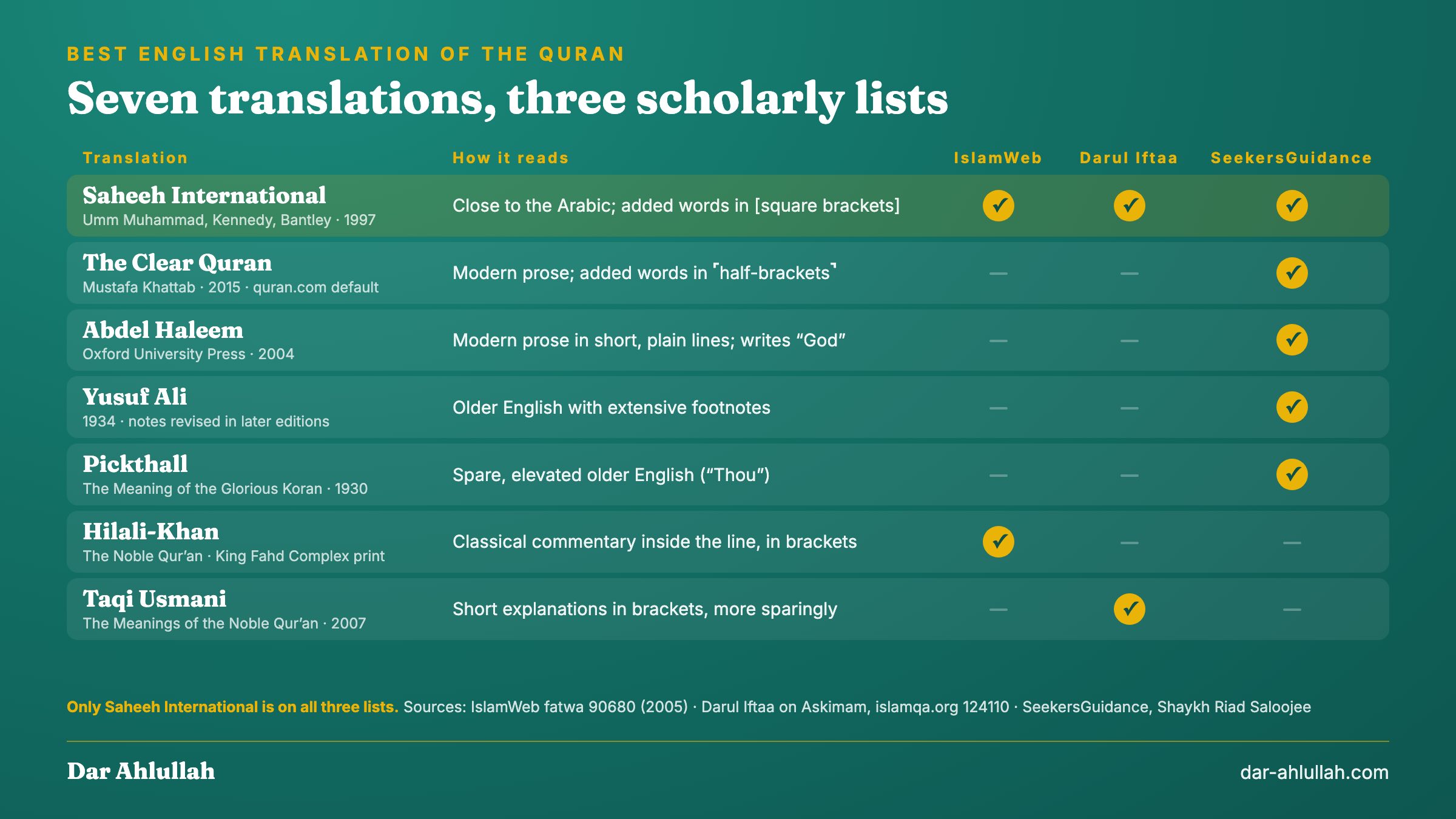
Saheeh International is the only translation on all three lists. Beyond it, no translation appears on more than one, and none of the three answers warns against the others named here. Two details are worth noticing. The IslamWeb answer dates from 2005, ten years before The Clear Quran was published, so its silence on Khattab says nothing about him. And the SeekersGuidance answer does not end with a name at all: “Instead of relying on one translation, I would recommend consulting a number of translations that have met with approval by the Muslim scholarly and lay community.”
Which One Should You Read?
Choose by what you want the translation to do for you. A sound plan for most readers is one readable translation for reading through, and one close translation open beside it for checking.
| If you want to… | Start with | Why |
|---|---|---|
| Read the whole Quran through for the first time | The Clear Quran or Abdel Haleem | Modern English that reads as continuous prose |
| See what the Arabic itself says | Saheeh International | Close to the Arabic, with every added word in brackets |
| Have the classical explanation in front of you | Hilali-Khan or Taqi Usmani | Short commentary inside the line, in brackets |
| Study with long notes alongside | Yusuf Ali (check the edition) | Extensive footnotes, older English |
| Read the English as literature | Pickthall | Spare, elevated English from 1930 |
| Read with children or teenagers | The Clear Quran | Plain modern English, with added words marked so you can talk about them |
| Understand the surahs you pray with | Saheeh International, phrase by phrase | Stays nearest to the words you are actually saying |
For a new Muslim the plan is simpler still: The Clear Quran or Abdel Haleem to read, Saheeh International to check, and the words of the prayer learned phrase by phrase rather than from any translation of the whole. Our guide to what to say in salah takes each phrase of the prayer with its meaning.
Other Translations You Will Meet
- Muhammad Asad, The Message of the Qur’an (1980). Openly modernist in approach. The British Muslim writer Gai Eaton, while noting the limits of Asad’s rationalist method, called it “the most helpful and instructive version of the Qur’an that we have in English” (Wikipedia). It is on none of the three lists above. If you read it, read it beside one that is.
- A.J. Arberry, The Koran Interpreted (1955). The first English translation by an academic scholar of Arabic, written to keep something of the rhythm of the Arabic, and for many years the scholarly standard (Wikipedia).
- AbdalHaqq and Aisha Bewley, and Wahiduddin Khan. Both are on the SeekersGuidance list.
One rule covers all of them. Before you settle on a translation, find out who made it and what tradition they wrote from. The SeekersGuidance point that “translators differ in their bias, motive and social context” applies to the copy someone handed you for free as much as to the one you chose.
How to Read a Translation Well
1. Keep two open
The SeekersGuidance answer makes the point itself: “Modern internet programs that present any number of translations for a given verse make a comparative reading easier and less time-consuming.” On quran.com you can choose several translations to show under each verse. Where two agree, read on. Where they disagree, as on 93:7, you have found the verse to look up.
2. Read the brackets as the translator speaking
Square brackets, half-brackets and parentheses are the translator’s additions. Read a bracketed line once with them and once without. The second reading is closer to the Arabic; the first tells you how the translator understood it.
3. Add a short tafsir
A translation tells you what a verse says. A tafsir tells you what it is about: its occasion, its connections to other verses, what the Companions understood by it. quran.com carries Ibn Kathir’s tafsir in abridged English beside the verses. Our guide on how to reflect on the Quran sets out a whole session built on a translation, a short tafsir and slow recitation.
4. Learn the words you pray with
The Quran repeats its most common words constantly, so a modest vocabulary goes a long way, and every word you learn is one where you no longer depend on anyone’s English. Our list of the most common words in the Quran is a ready-made start, and Quranic Arabic vs Modern Standard Arabic explains which kind of Arabic that study leads to.
5. Do not take rulings from the English alone
A translation can show you what a verse asks of you. It cannot tell you how a ruling applies, what other evidence qualifies it or what the schools concluded. The SeekersGuidance answer is direct: “When difficulties or confusions arise, the student should consult a reputable scholar.”
6. Keep reciting the Arabic
Reading the meaning and reciting the text are two different acts, and both are rewarded. If the Arabic script still stops you, our guide on how to read the Quran for beginners sets out the stages from the alphabet onward.
How We Teach This
Reading a translation and reflecting on it is something you can do alone, with a good translation and a notebook. What a translation cannot do is teach you to read the Arabic correctly or to understand it without the English. That is where a teacher helps. Our Arabic Language course is one-to-one, taught in English for non-Arabic speakers, and focuses on grammar, vocabulary and comprehension; our Quran Reading course starts from the Arabic alphabet for anyone who cannot yet read the script. Lessons are about $9 per teaching hour with a certified teacher, and if the fit is not right we rematch you with another certified mentor at no extra cost.
The first step is a free 30-minute assessment, with no card required, in which a mentor hears where you are and recommends a path. Book a free assessment.
Questions People Ask
What is the most accurate English translation of the Quran?
No translation is accurate in every verse; in the SeekersGuidance answer’s words, “No translation is perfect and translations have deficiencies alongside their benefits.” If accurate means closest to the Arabic with its additions marked, Saheeh International is the usual answer, and it is the only translation on all three scholarly lists compared above. Check it against a second translation all the same.
Is Saheeh International reliable?
It is recommended by IslamWeb, by the Darul Iftaa answer on Askimam and by SeekersGuidance, which makes it the most widely endorsed of the translations here. Like every translation it makes interpretive choices, and because it brackets them you can see where they are.
Why does Abdel Haleem write “God” instead of “Allah”?
His translation uses the English word throughout, as the tables above show. Saheeh International takes the opposite view and keeps “Allah”, because its translators did not consider the English word an acceptable substitute (Wikipedia). The Clear Quran, Yusuf Ali, Pickthall, Hilali-Khan and Taqi Usmani all use “Allah”.
Which translation does quran.com use?
By default, The Clear Quran by Mustafa Khattab, which became the site’s default in 2020. Saheeh International, Abdel Haleem, Yusuf Ali, Pickthall, Hilali-Khan and Taqi Usmani are all available on the site as well, and you can choose which ones to show.
Do I need wudu to touch an English translation of the Quran?
Scholars differ. The Darul Iftaa answer on Askimam says it is not permissible to touch a translation of the Quran without wudu, citing Hanafi sources that a translation does not stop being Quran in its ruling. The Qibla answer by Ustadha Shazia Ahmad says the English translation is not considered the Quran, so a copy that contains only the translation, or more English than Arabic, may be touched and carried without wudu, although it is better not to touch the Arabic verses; if most of the text is the Quran itself, it may not. Follow the view of your school or your teacher. Making wudu first satisfies both.
Do I get the reward of reciting if I only read the translation?
IslamQA’s answer is that reading a translation to understand it is rewarded as reading tafsir, but there is no indication that it earns the reward mentioned for each letter of the Quran recited (IslamQA 2589). Read the meaning and recite the Arabic; do not choose one.
Should I buy a translation with the Arabic printed beside it?
If you read Arabic, or intend to learn, yes: it lets you match each line to the words you recite. Check which script the Arabic is printed in; our comparison of Indo-Pak and Uthmani script explains what differs between the two and how to choose a print.
Conclusion: Two Translations and a Few Arabic Words
The question “which translation is best” has a better answer than a single name: read two. One that reads easily, so that you get through it, and one that stays close to the Arabic and shows its additions, so that you can check. Saheeh International is the common ground among the scholarly lists; The Clear Quran and Abdel Haleem are the easiest modern reading; Yusuf Ali, Pickthall, Hilali-Khan and Taqi Usmani each give you something the others do not. Where they disagree, open a tafsir or ask.
And keep learning the Arabic underneath, a few words at a time. Al-Fatihah is a good place to begin, because you already say it in every prayer.
Related articles
how to reflect on the Quran
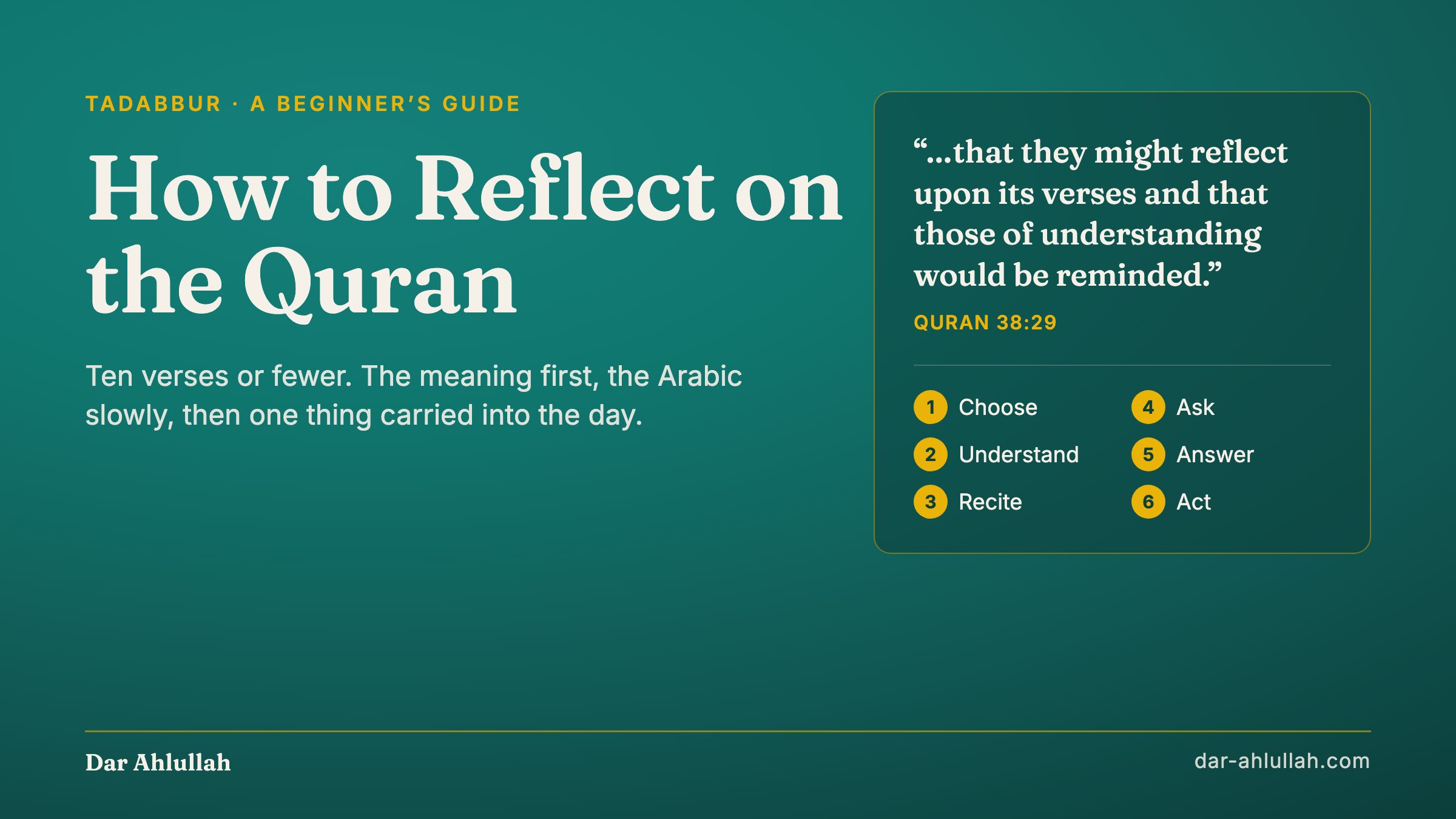
How to Reflect on the Quran: A Beginner’s Guide to Tadabbur
Tadabbur, reflecting on the Quran, is a purpose of its revelation and open to every Muslim, translation in hand. What it is and is not, how far a translation takes you, how the Prophet ﷺ and the Companions read, a six-step method for one session, and Surah al-‘Asr worked through.
19 min read
most common words in the Quran
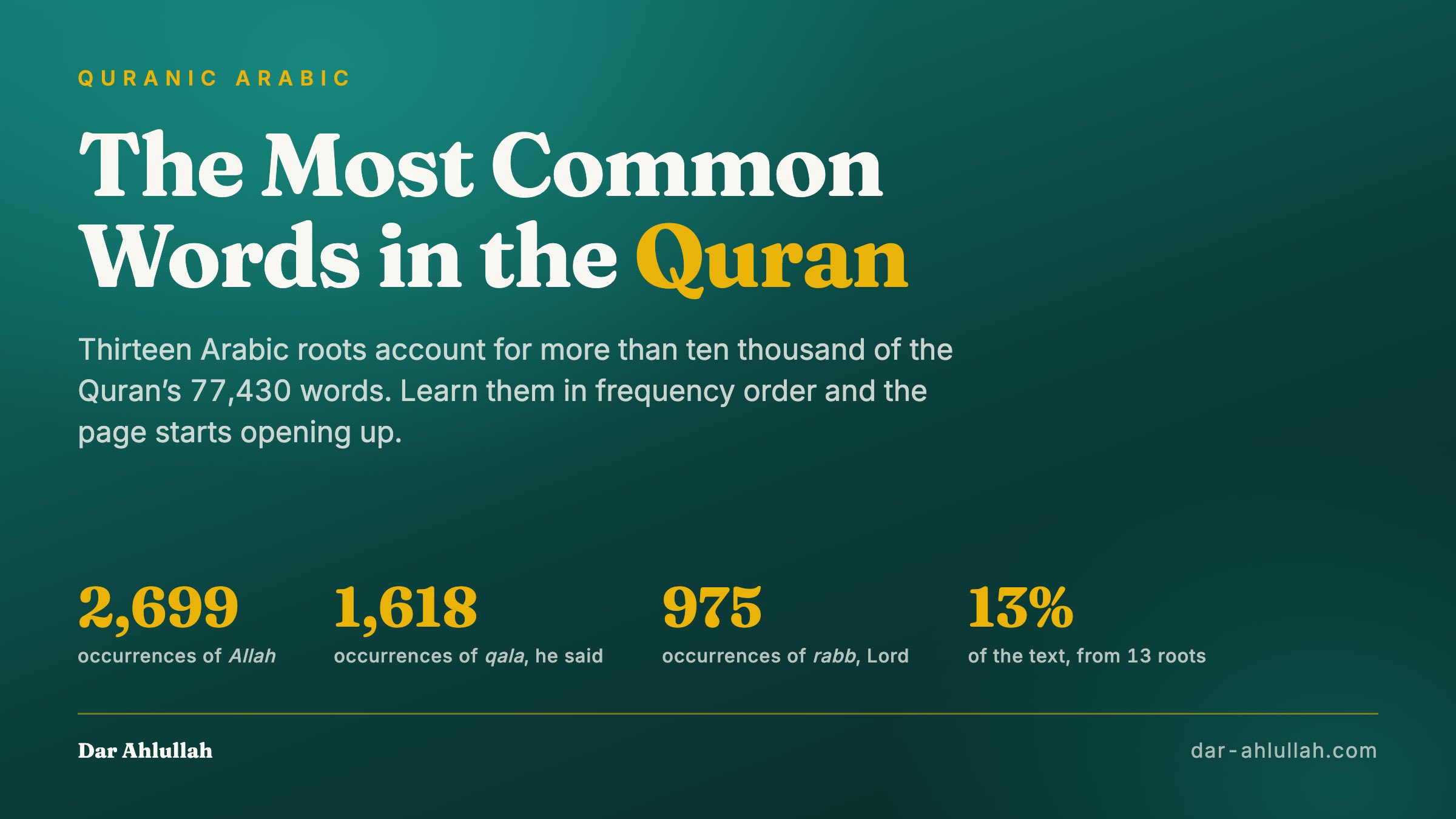
The Most Common Words in the Quran: 13 Roots That Cover 10,000+ Words
Thirteen Arabic roots account for more than ten thousand of the Quran's 77,430 words. Learning them in frequency order is the shortest route from reciting to understanding.
16 min read
online Arabic classes for non-native speakers
Online Arabic Classes for Non-Native Speakers: How to Choose
One-to-one, small group, app or university course? A decision guide to online Arabic classes for non-native speakers: which format fits which goal, what to check in a teacher, how long it takes and what it costs.
12 min read