
ijazah
What Is an Ijazah in Quran Recitation? The Sanad, the Process, and Who Needs One
Dar Ahlullah team 16 min read
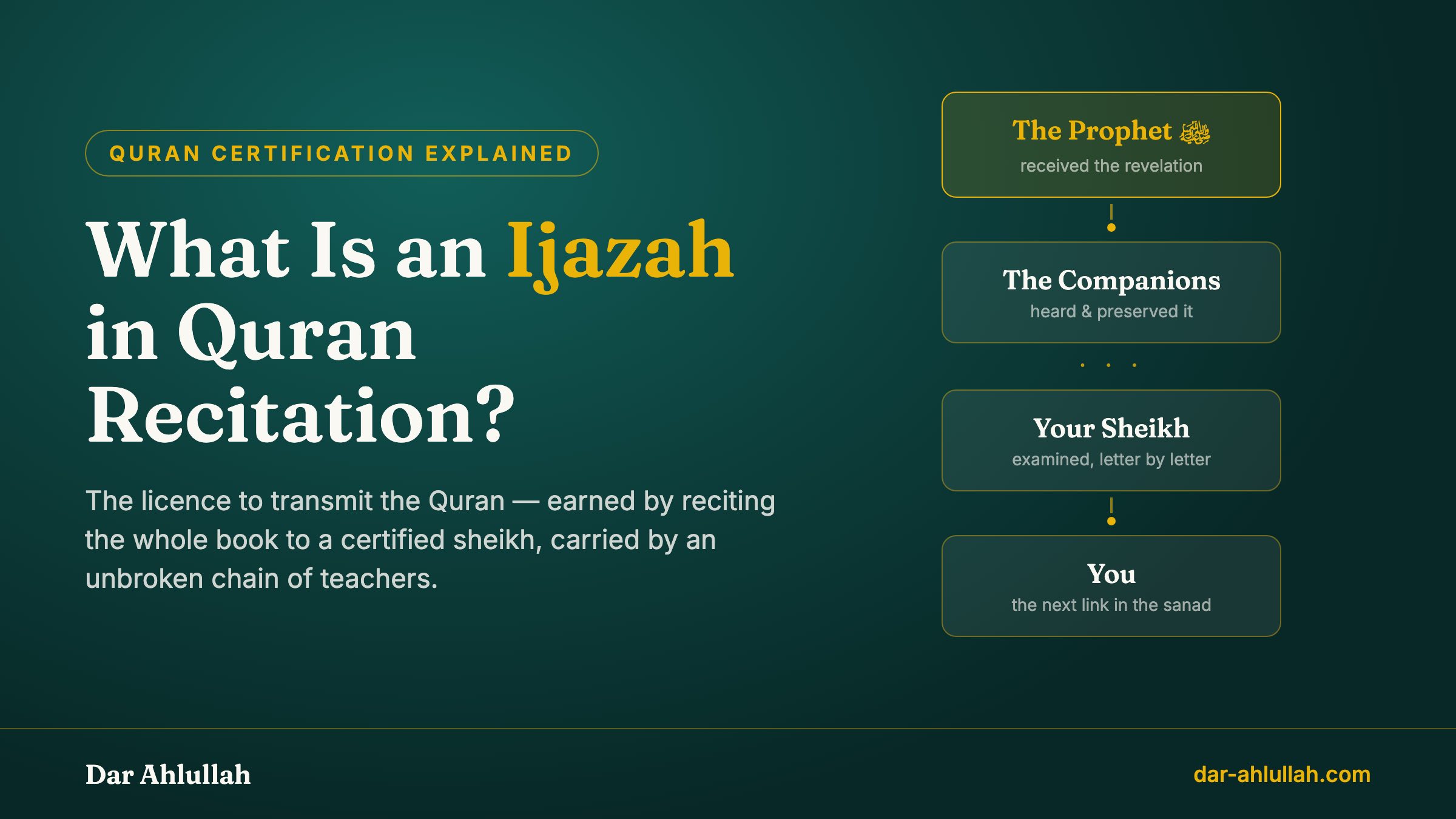
Table of Contents
- Introduction: The Word on Every Academy’s Website
- The Short Answer
- What “Ijazah” Actually Means
- The Sanad: Why a Chain of Names Matters
- How an Ijazah Is Actually Earned
- Hafs, Warsh and the Ten Qira’at: What Your Ijazah Is In
- What an Ijazah Is Not
- Do You Actually Need One?
- The Path From Beginner to Ijazah
- How Ijazah Study Works at Dar Ahlullah
- FAQs About Ijazah and Sanad
- Conclusion: A Licence, Not a Trophy
Introduction: The Word on Every Academy’s Website
Read the marketing page of any online Quran academy and one word appears within the first paragraph: ijazah. “Our teachers hold ijazah.” “Certified with ijazah and sanad.” It is used as a seal of quality, and it genuinely is one — but almost nobody stops to explain what the word means, what earning one involves, or why a fourteen-hundred-year-old certification system still decides who is qualified to teach the Quran in 2026.
That gap matters in two directions. If you are choosing a teacher, “ijazah” is only a meaningful credential if you know what it certifies and what questions expose an empty use of the word. And if you are a serious student — someone who has learned the rules of tajweed, perhaps memorised a good portion of the Quran, and wants to know what the summit of this path looks like — the ijazah in Quran recitation is that summit, and it is more reachable than most people assume.
This guide explains the whole system in plain English: the word, the chain behind it, the examination that earns it, the different recitations it can be granted in, and an honest answer to whether you need one at all. It assumes no prior background; if you are earlier in the journey and still deciding how to study, our complete guide to learning Quran online is the better starting point.
The Short Answer
An ijazah (Arabic: إجازة, “permission” or “authorisation”) is a licence to recite and teach the Quran, granted by a teacher who holds one, to a student who has recited the entire Quran to that teacher with every letter and rule correct. The certificate names the teacher’s teacher, and that teacher’s teacher, in an unbroken chain — the sanad — going back to the Prophet Muhammad ﷺ.
Three points cover most of what people actually want to know:
- It is earned by examination, not by attendance. The core of it is a complete recitation of the Quran — from memory or from the page, depending on the type — heard and corrected by the sheikh, letter by letter.
- It is always in something specific: a particular transmission of the Quran, most commonly the narration of Hafs ‘an ‘Asim, sometimes Warsh, and for advanced reciters the ten canonical qira’at.
- You do not need one to recite well or to be a good Muslim. You need one to stand in the chain of transmission — that is, to certify others. For everyone else, its practical relevance is simpler: study with teachers who hold one, because it is the strongest guarantee that what you are being taught is exactly what was revealed.
What “Ijazah” Actually Means
The word comes from the Arabic root a-j-z, to permit or make lawful; an ijazah is literally a permission. The system did not begin with the Quran’s recitation but with Islamic scholarship more broadly: from the early centuries of Islam, the ijazah was the standard instrument by which a scholar authorised a student to transmit a text or a body of knowledge onward — hadith collections, law books, entire curricula. The certificate said, in effect: I have heard this from my teacher, you have now taken it correctly from me, and you may pass it on in my name.
Applied to the Quran, the stakes are higher and the method stricter. The Quran is not merely a text to be understood but a recitation to be reproduced — the word Quran itself means “the recitation” — and its sounds carry details that writing alone has never fully captured: the precise length of a stretched vowel, the degree of nasalisation in a hidden noon, the exact point of articulation of letters that do not exist in most other languages. Those details travel reliably only one way: from a mouth that has them right, to an ear that is being corrected until it does. The ijazah is the receipt for that transaction.
There is a reason this culture prizes teaching so highly. The Prophet ﷺ said, as recorded in Sahih al-Bukhari: “The best among you are those who learn the Quran and teach it.” The ijazah system is that hadith turned into infrastructure — a mechanism for making sure that what is taught is worth learning.
The Sanad: Why a Chain of Names Matters
The sanad (also called isnad) is the chain of transmission: the list of names connecting a reciter, teacher by teacher, back to the Prophet ﷺ, who received the revelation from the angel Jibril. When a sheikh grants an ijazah, the student’s name is added to the end of that teacher’s chain. Every certified reciter alive today can, in principle, recite the pedigree of their recitation the way other people recite a family tree.
To modern ears this can sound ceremonial. It is anything but. The sanad is a verification protocol, and a remarkably robust one: at every generation, a reciter had to reproduce the entire text to the satisfaction of someone who had themselves been examined the same way. Errors do not accumulate quietly in such a system, because every link is a full audit. Muslims understand this preservation as a divine promise — “Indeed, it is We who sent down the Reminder, and indeed, We will be its guardian” (Quran 15:9) — and the sanad is the visible, human mechanism through which that promise has operated: an unbroken relay of teachers, running for fourteen centuries, across every continent Islam reached.
It is worth noticing what the chain certifies and what it does not. A sanad attests to the sound of the Quran — that this person’s recitation, in this specific transmission, matches what their teacher received. It does not certify scholarship in law or theology, teaching skill with children, or anything else. It is narrow and deep, which is precisely why it has survived: a certification that tried to cover everything would guarantee nothing.
How an Ijazah Is Actually Earned
Conventions vary between sheikhs and institutions, but the shape of the process is remarkably consistent, and it has three stages.
1. Mastery first
Before any examination begins, the student must already recite with correct tajweed — fluently, not as a set of memorised rules but as habits that hold under pressure. Most teachers will also expect the student to know the theory: what the rules are called, where they apply, and why. For students pursuing the most common form of the ijazah, memorisation of the entire Quran comes first as well. None of this is part of the ijazah itself; it is the entry requirement.
2. The khatmah: reciting the whole Quran to the sheikh
The heart of the process is a complete recitation — a khatmah — performed live to the granting sheikh, typically in instalments over many sessions. The sheikh listens to every verse and stops the student at every slip: a shortened madd, a missed ghunnah, a letter pronounced from the wrong place. The error is corrected, the passage repeated, and the recitation moves on. Nothing is skimmed and nothing is taken on trust; the whole point is that every letter of the student’s Quran has passed through the teacher’s ear.
Teachers commonly distinguish two forms. An ijazah bil-ghayb is earned by reciting the entire Quran from memory, and is the standard credential of the hafiz who intends to teach. An ijazah bil-nazar (by looking) is earned by reciting from the mushaf with flawless tajweed, and certifies precision of recitation without requiring complete memorisation. Which one a student pursues depends on their goal, and a reputable teacher will say plainly which one is on offer.
3. The certificate and the chain
When the khatmah is complete to the sheikh’s satisfaction, the ijazah is issued: a document naming the student, the transmission it was earned in, the granting sheikh, and the sanad — the full chain of teachers from the sheikh back to the Prophet ﷺ. From that moment the student does not merely hold a certificate; they are a link. They may teach, correct, and in time examine students of their own, and their students’ ijazahs will carry their name.
Hafs, Warsh and the Ten Qira’at: What Your Ijazah Is In
An ijazah is never generic; it is granted in a specific, named transmission of the Quran. This is the part of the system most newcomers have never heard of, and it repays two minutes of explanation.
The Quran was revealed and transmitted with a controlled degree of variation — differences of pronunciation, elongation, and occasionally wording, all traced to the Prophet’s own recitation. These crystallised into the canonical qira’at (readings): the scholar Ibn Mujahid documented seven in the early tenth century, and three more were later recognised, giving the ten accepted readings, each preserved through two named narrations. They are not competing versions but parallel, equally authentic channels of the same revelation — and every one of them runs through its own sanad.
In practice, most of the Muslim world today recites the narration of Hafs ‘an ‘Asim, and this is almost certainly what your printed mushaf contains and what your local imam recites. The narration of Warsh ‘an Nafi‘ predominates in North and West Africa. So the standard credential you will encounter is an “ijazah in Hafs”; a teacher holding ijazahs in several narrations, or in all ten qira’at, is signalling a substantially deeper level of specialisation, of the kind found among reciters who have made transmission their life’s work.
For a student, the practical takeaway is simple: learn the reading your community uses — for most readers, Hafs — and treat the rest as depth you can pursue later if the science captures you.
What an Ijazah Is Not
Because the word gets used loosely in marketing, it is worth drawing the boundaries precisely.
It is not a university degree. An Al-Azhar graduate holds an academic qualification from an institution — coursework, examinations, a faculty and a year. An ijazah is a personal licence granted by one qualified individual to another after direct examination. The two are complementary, not interchangeable: a degree certifies breadth of Islamic learning, the ijazah certifies exactness of transmission. The strongest teachers hold both, which is why, when comparing academies, the useful question is never “are your teachers certified?” but “certified in what, by whom, and does the teacher you would assign to me hold an ijazah, in which narration?”
It is not a participation certificate. Completing a tajweed course, however good, earns a course certificate. The ijazah begins where courses end: it is an examination of the entire Quran, and its value rests on the examiner having no incentive to pass anyone who is not ready. By the same logic, treat with caution any offer that promises an ijazah on a fixed short timetable regardless of starting level. A licence that certifies precision cannot honestly be scheduled before the precision exists.
It is not a requirement for ordinary study. No one needs an ijazah to pray, to recite beautifully, or to memorise the Quran. Which brings us to the honest question.
Do You Actually Need One?
For most learners, no — and it is better to hear that plainly than to be sold a summit you never needed to climb. The goals that bring most people to Quran study — reciting correctly in salah, reading fluently, memorising surahs, understanding what you recite — are all fully achievable without ever pursuing an ijazah, and a good teacher will keep you focused on them.
The ijazah becomes the right goal in three situations:
- You intend to teach. If you want to correct other people’s recitation with authority — your own children included, but especially students — the ijazah is the traditional qualification for exactly that, and it answers in one word the question every future student will ask you.
- You have completed hifz and want it sealed. For a hafiz, the khatmah before a sheikh is the natural capstone: it converts a private achievement into a certified link in a public chain, and the discipline of the examination itself typically raises the recitation to a level revision alone never reaches.
- The science itself has captured you. Some students fall in love with the qira’at, the sanad literature, the precision of it all. For them the ijazah is not a credential but a life inside a fourteen-century tradition, and no further justification is required.
And even if you never pursue one, the system still matters to you in one concrete way: whoever teaches you should be inside it. A teacher who holds an ijazah has had every letter of their Quran examined. That is the quality guarantee the whole apparatus exists to provide, and as a student you inherit it for free simply by choosing your teacher well.
The Path From Beginner to Ijazah
Seen from the bottom, the mountain looks unclimbable. Broken into its actual stages, it is a sequence of ordinary, finite steps — each one worth having in itself, whether or not you continue to the next.
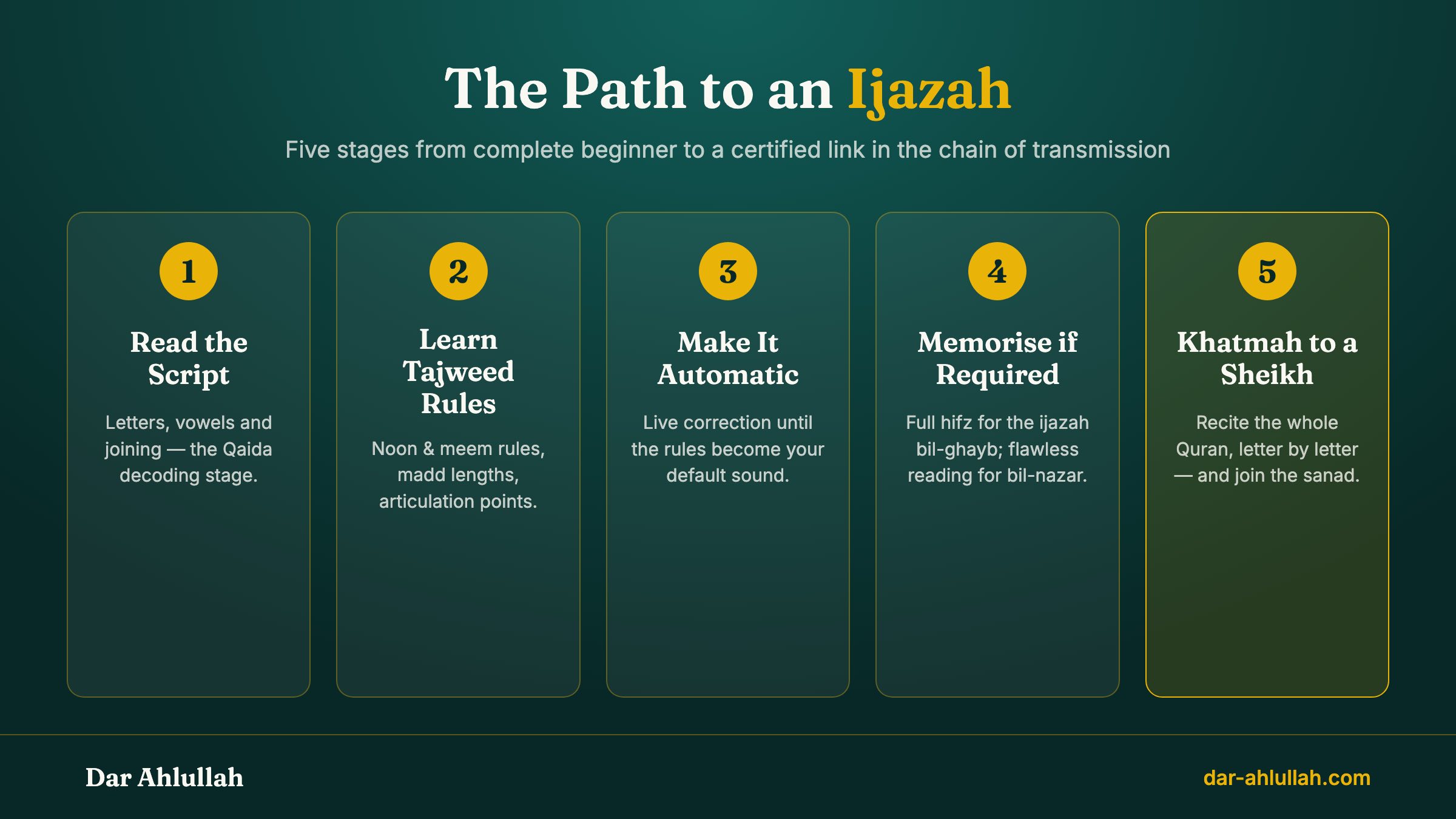
- Read the script. Letters, vowels, and joining — the decoding stage, usually via a Qaida. For an adult starting from zero this is a matter of months of steady work, not years.
- Learn tajweed as rules. The noon and meem rules, the madd lengths, the articulation points — the theory that turns reading into recitation. Our guide to the online tajweed course walks through exactly this layer.
- Make the rules automatic. Recitation practice with live correction, until tajweed stops being a checklist and becomes your default sound. This is where a teacher matters most, because you cannot hear your own errors — every reciter in history needed an ear better than their own.
- Memorise — if your ijazah requires it. For the ijazah bil-ghayb, complete hifz comes before the examination. That is its own long road with its own methods and revision cycles, which we cover in our guide to memorising the Quran online; for the ijazah bil-nazar, flawless recitation from the page is the standard instead.
- The khatmah to a sheikh. The examined recitation of the entire Quran described above — scheduled session by session, corrected letter by letter, and concluded with your name entering the chain.
Two things make this path realistic for people with jobs, children and time zones. First, it is entirely sequential — nothing about stage two requires you to have committed to stage five. Second, every stage of it works over live one-to-one video, including the final khatmah: what the examination requires is a qualified ear hearing every letter you produce, and a live call carries that as faithfully as a majlis in Cairo. Reciters today complete ijazahs with sheikhs on other continents, which would have astonished no one in a tradition whose whole premise is that the Quran travels person to person, wherever the persons happen to be.
How Ijazah Study Works at Dar Ahlullah
This subject is close to home for us, so here is our own arrangement, stated plainly so you can compare it with anyone else’s.
Every Dar Ahlullah teacher holds a recognised ijazah — that is a hiring requirement, not a marketing line, and our faculty page names the teachers along with their credentials: ijazahs in Hafs and Warsh among our senior instructors, and in the ten qira’at at the most advanced level. For students, that means the chain of transmission stands behind every lesson you take with us, from a child’s first Qaida page upward.
For advanced students, our Ijazah & Sanad Program runs the full path described in this article: an assessment of where your recitation actually stands, structured tajweed and recitation work with one consistent teacher, and — when you are ready — the supervised khatmah with sanad. Like everything we teach, it is one-to-one, scheduled in your own time zone, priced at our flat $9 per teaching hour, and preceded by a free 30-minute assessment with no card required. The assessment matters more here than anywhere else: the honest first step of an ijazah journey is finding out, from a qualified ear, exactly how far along the path you already are.
FAQs About Ijazah and Sanad
What is the difference between an ijazah and a sanad?
The sanad is the chain of teachers connecting a recitation back to the Prophet ﷺ. The ijazah is the licence a sheikh grants that attests you have joined that chain. You could say the sanad is the pedigree and the ijazah is the document that adds your name to it — each ijazah contains its sanad.
Can you earn an ijazah online?
Yes. The examination is oral and personal: a sheikh must hear every letter of your recitation live and correct it. A one-to-one video call satisfies that completely, and online khatmahs with qualified sheikhs are now common. What no format can change is the standard itself — online or in person, the recitation has to be right.
How long does it take to get an ijazah?
It depends almost entirely on where you start, which is why honest answers are ranges and dishonest ones are fixed dates. A student who already recites with sound tajweed is mainly limited by scheduling the khatmah itself across enough sessions to cover the whole Quran. A student starting from weak tajweed — or from zero — should think in years, spent mostly on the stages before the examination. All of that time produces something valuable regardless: your own recitation, permanently corrected.
Do you have to memorise the whole Quran first?
Only for the ijazah bil-ghayb, the from-memory licence that is the standard credential for hifz teachers. The ijazah bil-nazar — reciting the entire Quran from the page with flawless tajweed — certifies precision without complete memorisation, and for many students is the right summit.
Can women hold and grant ijazahs?
Yes. Women have transmitted the Quran and carried ijazahs throughout Islamic history, and they examine and license students today exactly as male sheikhs do. Our own senior female instructor holds ijazahs in both Hafs and Warsh — a point that matters practically to the many families who prefer a female teacher for daughters or for adult women students.
Is a teacher without an ijazah automatically unqualified?
Not automatically — there are competent teachers whose formal qualification is an academic degree, and excellent ones hold both. But the ijazah is the one credential in this field that directly certifies the thing you are paying for: that the teacher’s own recitation has been examined in full by the tradition’s own standard. Given the choice, choose the examined ear.
Conclusion: A Licence, Not a Trophy
Stripped of mystique, the ijazah is a beautifully simple device: nobody transmits the Quran onward until a qualified person has heard their whole recitation and vouched for it, in writing, with their own name and their teachers’ names behind it. Repeat that every generation for fourteen centuries and you get the thing itself — a text whose sound has crossed continents and empires without corruption, carried entirely by chains of examined human voices.
For most readers, the practical conclusion is not to pursue one; it is to make sure your teacher did. For the serious student — the hafiz wanting the seal, the future teacher, the one the science has captured — the path is long but wholly legible: read, master tajweed, make it automatic, memorise if your ijazah requires it, and then recite the whole book to someone entitled to pass judgement on it.
If you want to know where you currently stand on that path, that is precisely what our free 30-minute assessment is for: a certified teacher listens to you recite and tells you, in writing, what your actual level is and what the next stage looks like. No card, no commitment — just the first honest data point of the journey.
Related articles
Tajweed rules for beginners
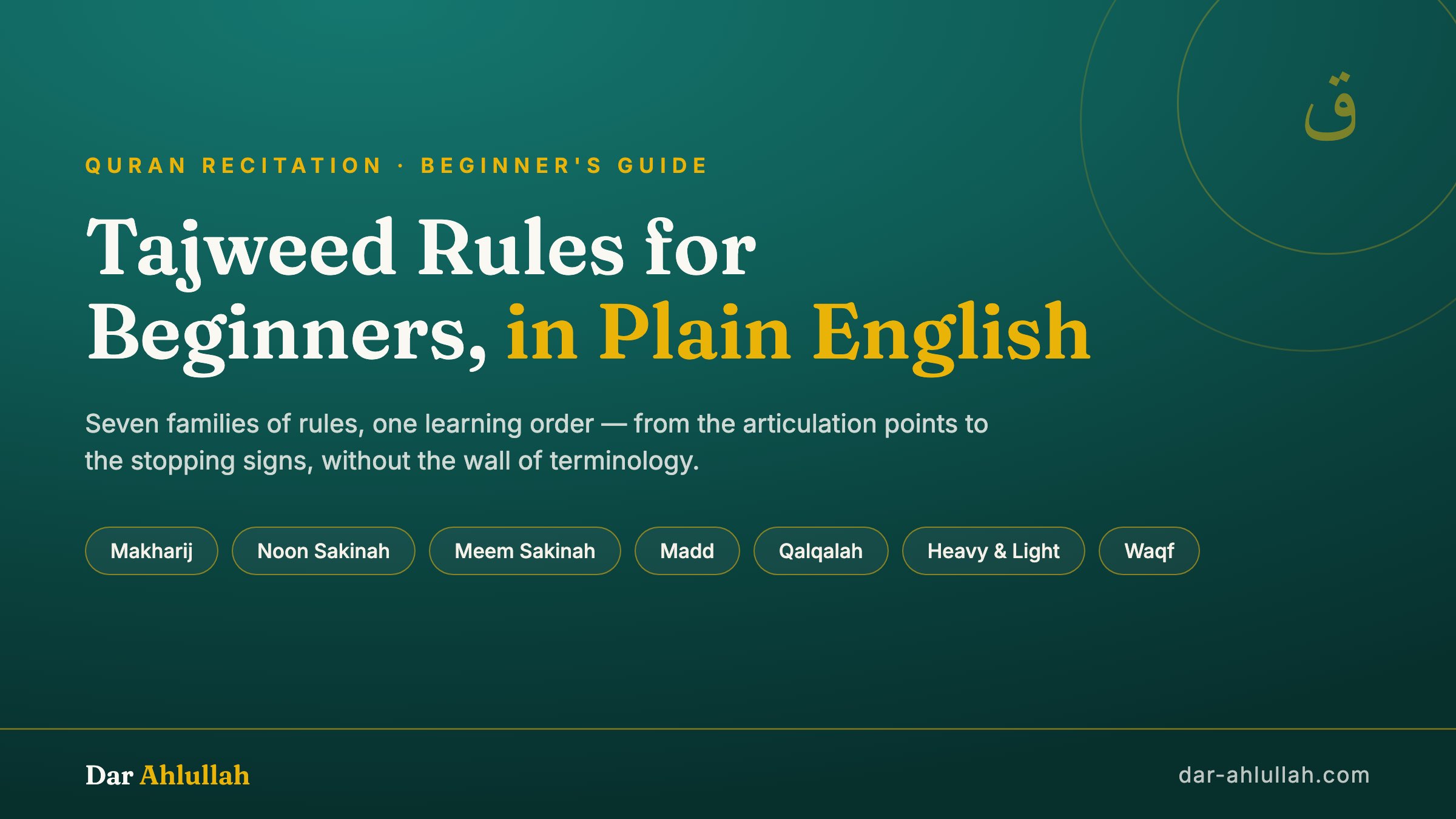
Tajweed Rules for Beginners: A Plain-English Guide
Tajweed looks like a wall of Arabic terminology, but it is really seven families of rules, and they have a natural learning order. This guide walks through each family in plain English and explains which mistakes are worth fixing first.
14 min read
Tajweed course
Online Tajweed Course: Master Quran Recitation with Dar Ahlullah
Enroll in our online Tajweed course and learn to recite the Quran with correct pronunciation and rules, taught by native Arabic-speaking teachers.
18 min read
sajdah tilawah
Sajdah Tilawah: What to Do at a Prostration Verse
Sajdah tilawah is the single prostration that belongs to reciting or hearing one of the Qur'an's verses of prostration. Where those verses are, why the four schools count fourteen, fifteen and eleven of them, how to perform it, and the answers for a desk, a recitation app, a live lesson and a hifz drill.
26 min read