
memorize Quran online
Online Hifz Program: How to Memorize the Quran Online (Step-by-Step Plan)
Dar Ahlullah team 8 min read

Table of Contents
- Introduction: Why Memorize the Quran Online?
- Can You Really Memorize the Quran Online?
- The Daily Hifz Cycle: 6 Steps That Make Memorization Stick
- Your Weekly Hifz Plan: Realistic Schedules by Goal
- Common Hifz Mistakes (and How to Avoid Them)
- How Dar Ahlullah's Online Hifz Program Works
- FAQs About Memorizing the Quran Online
- Conclusion: Your First Page Starts Today
Introduction: Why Memorize the Quran Online?
Deciding to memorize Quran online is one of the most meaningful commitments a Muslim can make — and one of the most misunderstood. Many families in Europe and America assume Hifz requires moving near a mosque with a full-time Quran school, or that it is only realistic for children with unlimited free time. Neither is true.
With the right structure, a qualified teacher, and a plan measured in lines per day rather than years, memorizing the Quran online fits around school runs, jobs, and Western time zones. At Dar Ahlullah, we have watched a nine-year-old in Manchester and a forty-two-year-old nurse in New Jersey follow the same time-tested cycle — each at their own pace — and both are progressing steadily.
This guide gives you the complete picture: how online Hifz actually works, the daily cycle that makes verses stick permanently, realistic weekly schedules you can choose from, the mistakes that quietly break most memorization attempts, and how a structured online Hifz program holds it all together.
Can You Really Memorize the Quran Online?
Yes — and for most students outside the Muslim world, online is now the stronger option, not the compromise. Here is why.
The Sanad tradition works over live video
Hifz has never been a solo activity. For fourteen centuries, the Quran has been passed from teacher to student through direct recitation — the unbroken chain known as Sanad. What that tradition actually requires is a qualified teacher hearing every letter you recite and correcting it live. A one-on-one video session preserves this completely: your teacher sees the mushaf, hears your recitation in real time, and stops you at the exact letter where a mistake appears.
One-on-one attention beats group classes
In a typical weekend mosque class, one teacher divides an hour between ten or fifteen children. Each student might recite for four minutes. In a private online session, the entire lesson is yours: new memorization checked, yesterday's portion reviewed, older surahs sampled, Tajweed corrected — every single session. If you are weighing your options more broadly, our ultimate guide to learning Quran online compares formats, costs, and what to look for in an academy.
What you genuinely need to succeed
- A certified teacher who specializes in Hifz — not just recitation — and knows how to build a review system.
- A fixed schedule in your own timezone, because a plan you attend at 9pm after work only works if the academy operates around your clock.
- A structured review cycle (explained next) — this is the difference between memorizing and staying memorized.
- A realistic daily portion you can sustain for months, not a heroic sprint that collapses in week three.
The Daily Hifz Cycle: 6 Steps That Make Memorization Stick
Every serious Hifz program in the world — from Cairo to Karachi to your living room — runs on the same engine: a daily cycle that balances new memorization against layered review. Miss the review layers and the Quran quietly leaks away as fast as you memorize it. Here is the full cycle we teach:
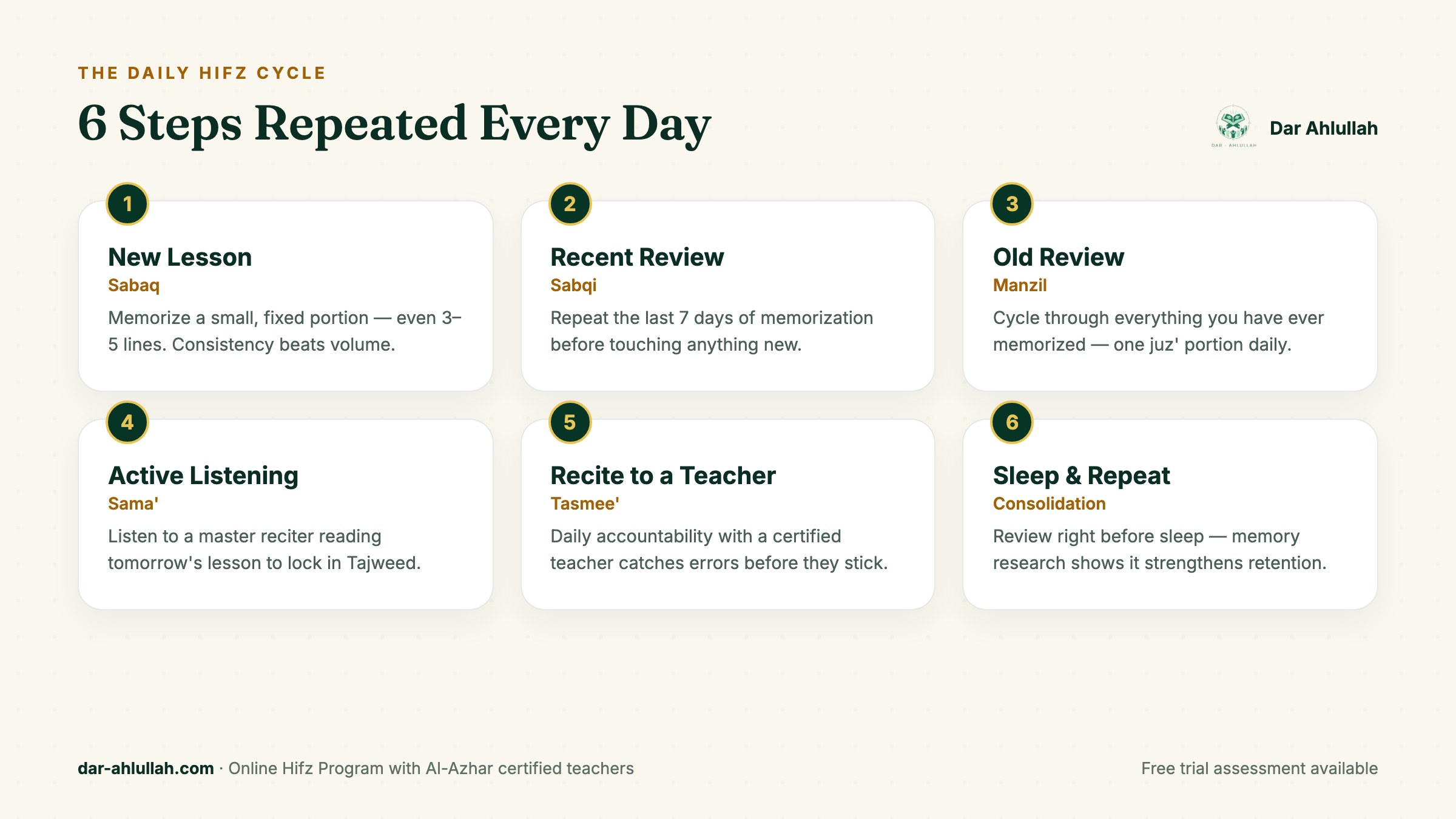
Step 1 — Sabaq: the new lesson
A small, fixed portion of new memorization — three lines, five lines, or a page depending on your plan. Read it slowly with correct Tajweed, understand its meaning, then repeat in small chunks until you can recite it without looking. Morning memorization, especially after Fajr, is when most students find their memory sharpest.
Step 2 — Sabqi: the recent review
Before touching anything new, recite the last seven days of memorization. This is the portion at highest risk of evaporating — fresh memorization is fragile for about a week and must be reinforced daily until it hardens.
Step 3 — Manzil: the old review
A rotating portion of everything you have ever memorized — typically a quarter to a full juz' per day, so your entire memorization is refreshed on a fixed cycle. Huffaz keep the whole Quran alive this way for decades.
Steps 4–6 — Listening, Tasmee', and sleep
Listen to a master reciter reading tomorrow's Sabaq so the correct pronunciation is in your ear before you memorize. Recite to your teacher (Tasmee') so errors are caught the day they appear. Finally, run your Sabaq once more right before sleep — memory research consistently shows that material reviewed before sleep consolidates significantly better overnight.
Your Weekly Hifz Plan: Realistic Schedules by Goal
How long does it take to memorize the Quran online? The honest answer: it depends on your daily portion, and every pace is legitimate. The Quran has roughly 604 pages in the standard Madani mushaf. Here are the three plans we actually use with students:
| Plan | New memorization | Daily time | Sessions with teacher | Typical completion |
|---|---|---|---|---|
| Steady (school children, busy adults) | 3–5 lines/day | 30–45 min | 2–3 per week | 6–9 years |
| Committed (serious students) | Half to one page/day | 60–90 min | 4–5 per week | 2–3.5 years |
| Intensive (gap year, dedicated track) | 1.5–2 pages/day | 3+ hours | Daily | 12–18 months |
Three rules apply to every plan:
- Never increase Sabaq at the expense of review. If review is slipping, the new portion is too big.
- Protect one fixed daily slot. After Fajr and before sleep are the two most defensible times in a Western schedule.
- Plan for seasons. School exams and Ramadan change your capacity — a good teacher shrinks the Sabaq rather than letting the habit break.
Common Hifz Mistakes (and How to Avoid Them)
Memorizing fast, reviewing never
The single most common failure: months of enthusiastic new memorization with no Sabqi/Manzil structure, until the student realizes the early surahs are gone. The cycle above exists precisely to prevent this — review is not the boring part of Hifz, it is Hifz.
Memorizing with Tajweed mistakes
Whatever you memorize incorrectly, you will have to re-memorize — and unlearning is far harder than learning. Memorize with a teacher who corrects you letter by letter from day one. If your Tajweed foundations need work, start with our online Tajweed course guide — it pairs naturally with a Hifz track.
Going it alone with an app
Apps are excellent supplements — for listening, tracking, and self-testing. But no app hears your recitation the way a teacher does, and none provides the accountability of a scheduled Tasmee' session. Students who combine a teacher with app-based review get the best of both; students who rely on apps alone usually stall within two months. For more practical techniques, see our essential Tajweed and Hifz tips for online learners.
Treating meaning as optional
Verses you understand are dramatically easier to retain — the story carries the words. You do not need classical Arabic mastery to begin; even reading the translation of each new portion before memorizing it measurably strengthens recall and deepens your connection to what you carry.
How Dar Ahlullah's Online Hifz Program Works
Everything in this guide is exactly how our own Hifz Accelerator program is built. Here is what that looks like in practice:
- One-on-one live sessions with native Arabic-speaking teachers — male and female — who specialize in Hifz, not just recitation.
- Your timezone, your schedule. Students across Europe, the UK, and North America book sessions around school and work — evenings and weekends included.
- The full Sabaq–Sabqi–Manzil cycle managed for you. Your teacher tracks every portion, so nothing silently falls out of review.
- Structured progress reports after sessions, so parents see exactly what was memorized, reviewed, and corrected.
- A free assessment first. Before any plan is chosen, a mentor evaluates reading level and Tajweed, then recommends a realistic pace — Steady, Committed, or Intensive.

You can compare plans and family bundles on our pricing page — every plan includes the same one-on-one format and certified teachers.
FAQs About Memorizing the Quran Online
Q: How long does it take to memorize the Quran online?
It depends entirely on your daily portion. Memorizing one page a day with structured review typically takes 20 to 24 months. A lighter pace of 3 to 5 lines a day is common for working adults and school children and takes several years — and that is completely fine. Consistency and retention matter far more than speed.
Q: Can adults with full-time jobs memorize the Quran?
Yes. Many of our strongest Hifz students are working adults. The key is a small, fixed daily portion (even 3 lines), a protected time slot — usually after Fajr or before sleep — and a weekly recitation session with a teacher for accountability. Online scheduling makes this dramatically easier than travelling to a mosque class. If you are still building reading fluency, our guide for adult beginners covers the four stages that come before Hifz.
Q: Is memorizing the Quran online as effective as in person?
For most students it is more effective, not less. One-on-one online Hifz sessions give you dedicated teacher attention for the entire lesson, which rarely happens in group mosque classes. Your teacher hears every letter, corrects Tajweed instantly, and tracks your review cycle. The Sanad tradition of reciting directly to a qualified teacher is fully preserved over live video.
Q: What age should a child start memorizing the Quran?
Most children are ready for structured Hifz between ages 6 and 8, once they can read Arabic script (or are learning it through a Noorani Qaida track). Before that, focus on listening, short surahs, and love of the Quran. A good online program adapts the session length and style to the child's age and attention span.
Q: Do I need to learn Tajweed before starting Hifz?
You should learn Tajweed alongside Hifz, not after it. Whatever you memorize with mistakes, you will have to painfully re-memorize later. This is exactly why memorizing with a certified teacher matters: errors are corrected in the same session they appear, so your memorization is clean from day one.
Q: How do online Hifz classes keep students accountable?
Through daily or near-daily Tasmee' — reciting your new lesson and review portions to your teacher live. Good programs also track your Sabaq, Sabqi and Manzil cycle, send progress reports to parents, and adjust the plan when school exams or work seasons get busy. Accountability, not willpower, is what completes a Hifz journey.
Conclusion: Your First Page Starts Today
Memorizing the Quran online is not a diluted version of "real" Hifz — it is the same fourteen-century-old method, delivered in a format that finally fits life in Europe and America: the daily Sabaq–Sabqi–Manzil cycle, a certified teacher who hears every letter, and a pace chosen for your actual schedule rather than an idealized one.
The students who complete this journey are not the ones who started fastest. They are the ones who started realistically — three lines, a protected time slot, a teacher waiting for them — and simply did not stop. The whole journey begins with one assessed, well-recited page.
Ready to begin? Book a free 30-minute Hifz assessment — a mentor will evaluate your (or your child's) current level and design a personalised memorization plan. Prefer to talk it through first? Message us on WhatsApp and an advisor will answer within hours.
Related articles
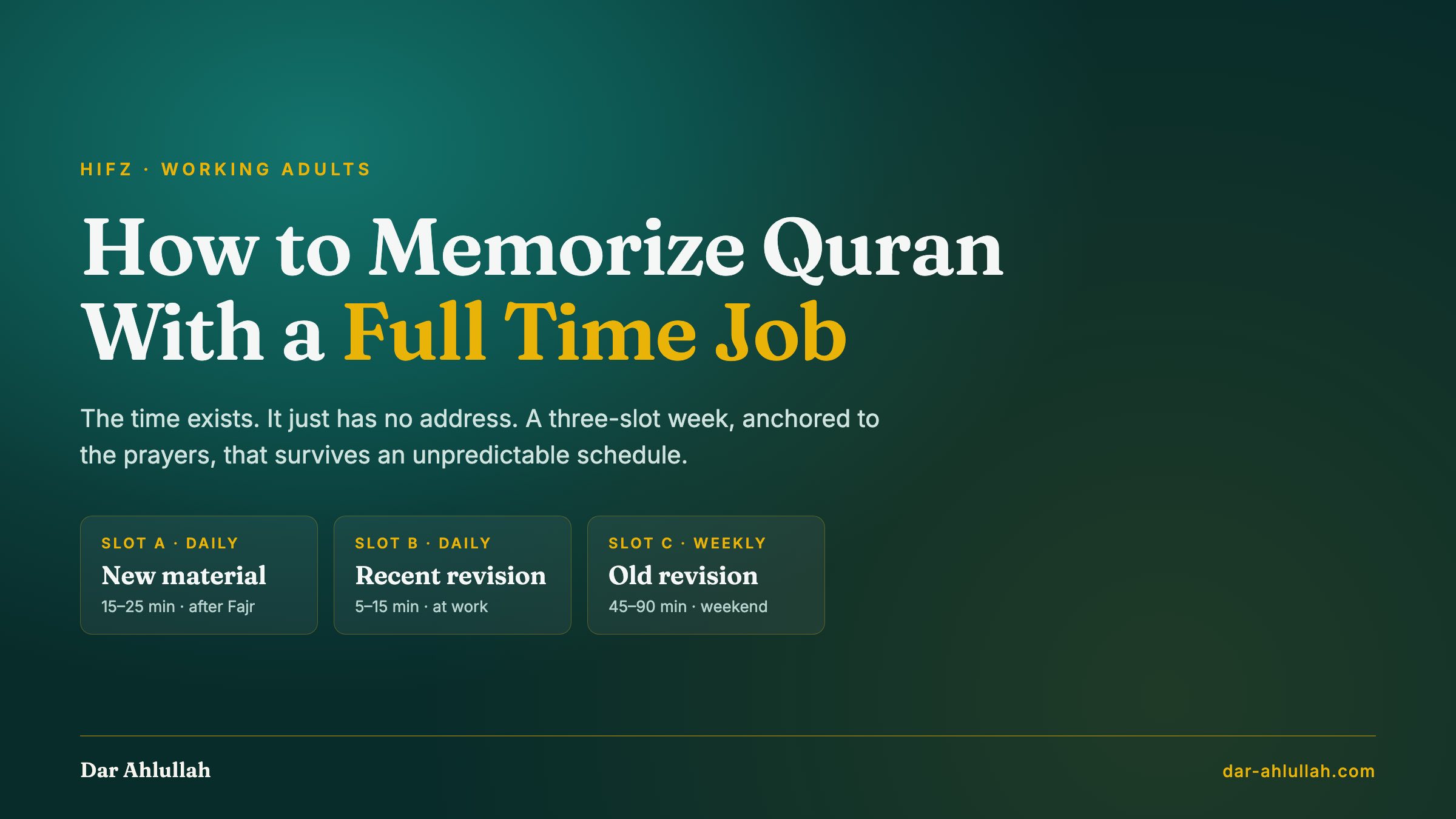
how to memorize Quran with a full time job
How to Memorize Quran With a Full Time Job: A Schedule That Survives Your Week
Working adults rarely lose hifz for lack of time. They lose it because the time never had a fixed address in the week — and the first genuinely busy fortnight takes it back.
20 min read
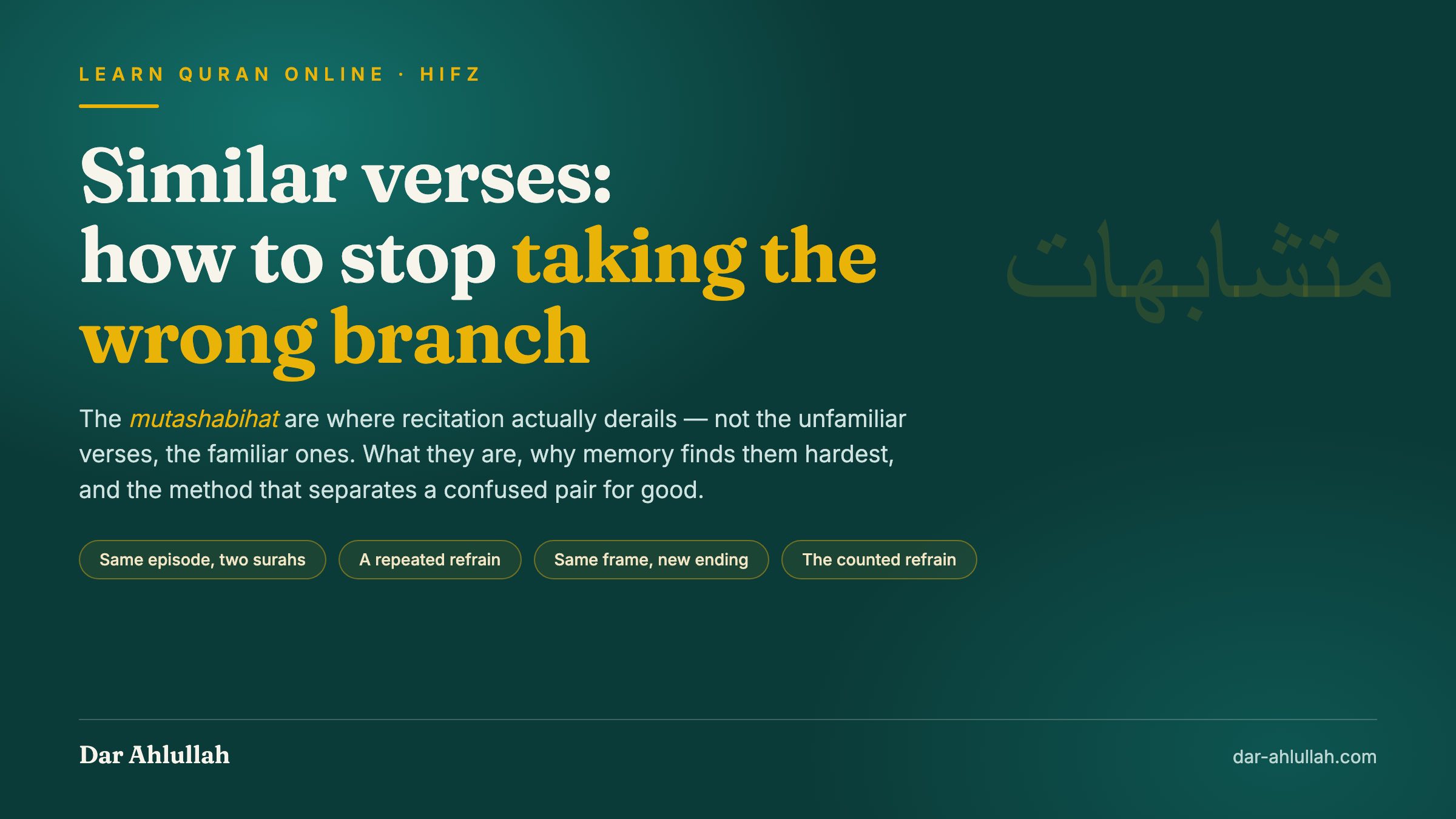
how to memorize similar verses in the Quran
How to Memorize Similar Verses in the Quran (Mutashabihat)
The places where recitation derails are not the unfamiliar verses. They are the familiar ones — the passages that resemble each other so closely that memory takes the wrong branch.
17 min read
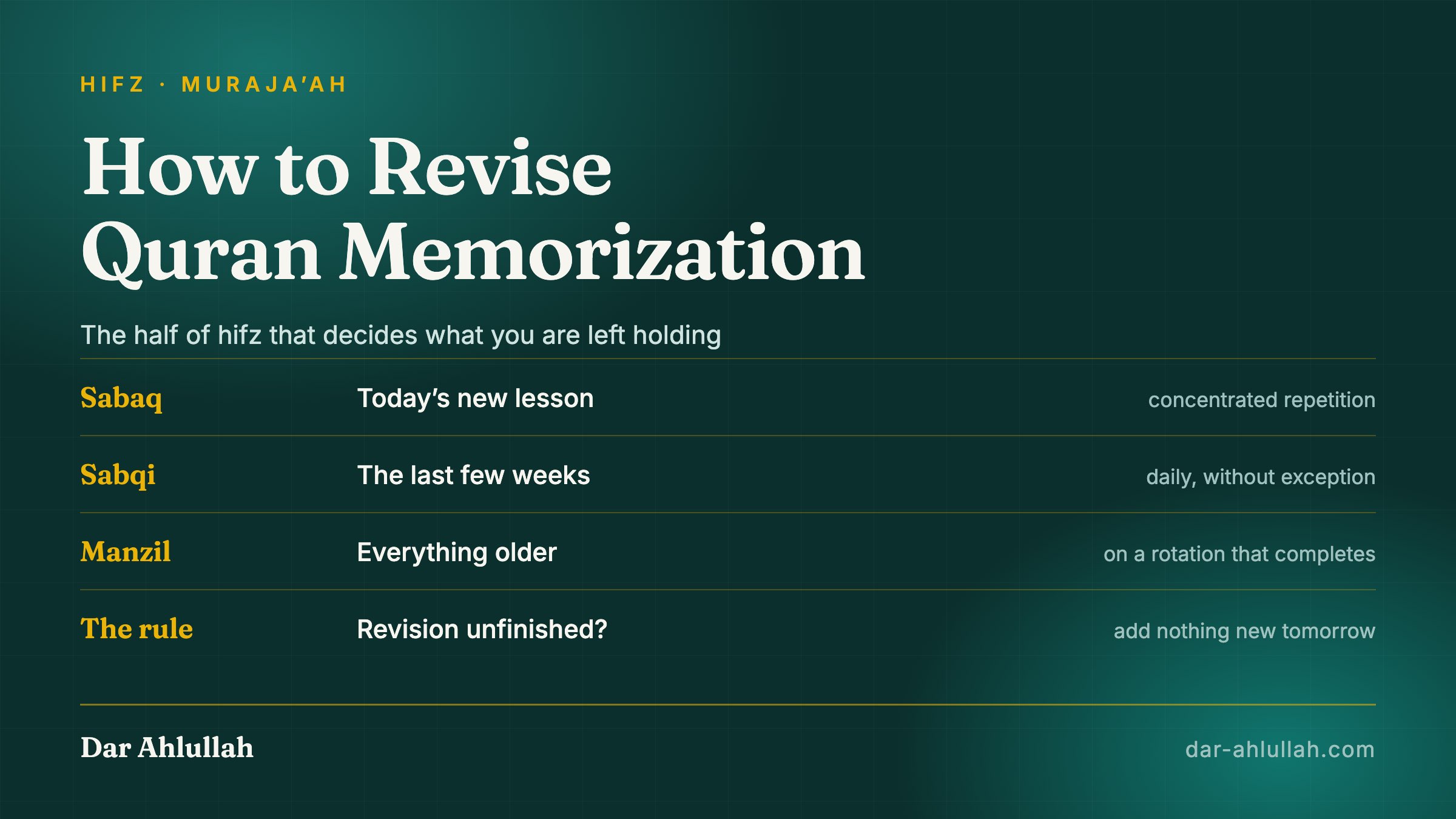
how to revise Quran memorization
What Murajaah Means, and How to Revise Quran Memorization
Every hifz plan is a memorisation plan, and almost every one that fails, fails because nothing in it described what happens to the pages behind you.
15 min read