
learn Quran for adults
Learn Quran for Adults: A Beginner's Guide to Starting From Zero
Dar Ahlullah team 12 min read
Table of Contents
- Introduction: You Are Not Too Late
- The Short Answer: What "Starting From Zero" Involves
- The Four Stages of Adult Quran Learning
- A Realistic First 12 Weeks
- What Adults Learn Faster Than Children — and What They Don't
- Do You Need to Learn Arabic First?
- The Five Things That Actually Stop Adult Learners
- How to Choose a Teacher as an Adult Beginner
- What It Costs and How Our Adult Track Works
- FAQs About Learning Quran as an Adult
- Conclusion: Start This Week, Not This Year
Introduction: You Are Not Too Late
Most adults who write to us open with an apology. They are thirty-four, or forty-six, or sixty-one. They pray five times a day and have done for years, but they recite the same three short surahs they were taught as children, from memory, and they cannot read a line of the Mushaf. They say it quietly, as though it were a confession.
It is not a confession. It is the single most common starting point we see. When people ask how to learn Quran for adults, the honest answer is that the difficulty is almost never the Arabic script — that part takes weeks. The difficulty is being a competent adult who has to be a beginner in front of somebody, and most academy websites skip straight past it.
So this guide covers both. What the actual learning path looks like, stage by stage, with realistic timelines from what we see with our own adult students. And the practical arrangements — private lessons, pacing, teacher choice — that make the first month survivable rather than mortifying.
The Short Answer: What "Starting From Zero" Involves
Reading the Quran is a decoding skill, not a language skill. Arabic has 28 letters. Each letter changes shape depending on where it sits in a word, and short vowels are written as marks above and below the line rather than as letters. That is the whole system. Learn those two things and you can pronounce any word in the Mushaf, including words you do not understand.
Which means the honest timeline for an adult beginner looks roughly like this:
- Two to four weeks to recognise and pronounce all 28 letters in their isolated and connected forms.
- Two to three months to read simple joined words with vowels, slowly and out loud, with a teacher correcting you.
- Six to twelve months to read a page of the Mushaf unaided at a slow, careful pace with basic tajweed applied.
Those numbers assume roughly two half-hour lessons a week plus ten to fifteen minutes of daily practice. They are not the fastest possible timeline and they are not marketing numbers. They are what consistency actually produces.
Note what is not on that list: becoming an Arabic speaker, memorising large portions of the Quran, or understanding the text word by word. Those are separate, later, optional goals. Conflating them with reading is the most common reason adults conclude the whole thing is beyond them.
The Four Stages of Adult Quran Learning
Every credible curriculum for beginners moves through the same four stages, whatever it calls them. Knowing which stage you are in tells you what to practise and what to ignore.
| Stage | What you actually do | Typical time for an adult |
|---|---|---|
| 1. Letters and sounds (Nooraniya / Noorani Qaida) |
The 28 letters, their four positional shapes, short and long vowels, and the sounds that do not exist in English — the heavy letters and the throat letters. | 4–8 weeks |
| 2. Joining and decoding | Reading joined words, then whole ayahs, slowly and aloud. Sukoon, shaddah, and the stopping marks. Usually practised on the short surahs at the end of the Mushaf. | 2–4 months |
| 3. Tajweed applied | The rules that were already in your mouth get named and corrected: noon and meem rules, elongation lengths, the qualities of individual letters. | 6–18 months, ongoing |
| 4. Fluency, then optional depth | Reading a page comfortably. From here the paths branch: memorisation, Quranic Arabic, or an ijazah track. | Year one onwards |
Our Quran Reading (Nooraniya) course is stages one and two; tajweed and hifz are separate tracks you move into once reading is secure. If an academy offers to start you on tajweed rules in week one without checking whether you can read, that is a curriculum problem, not an accelerated programme.
A Realistic First 12 Weeks
Adults abandon Quran study far more often over scheduling than over difficulty. A plan that assumes an hour a day will collapse in a fortnight and take your confidence with it. Here is a first quarter built around roughly one hour of live class and about seventy minutes of practice per week — total.
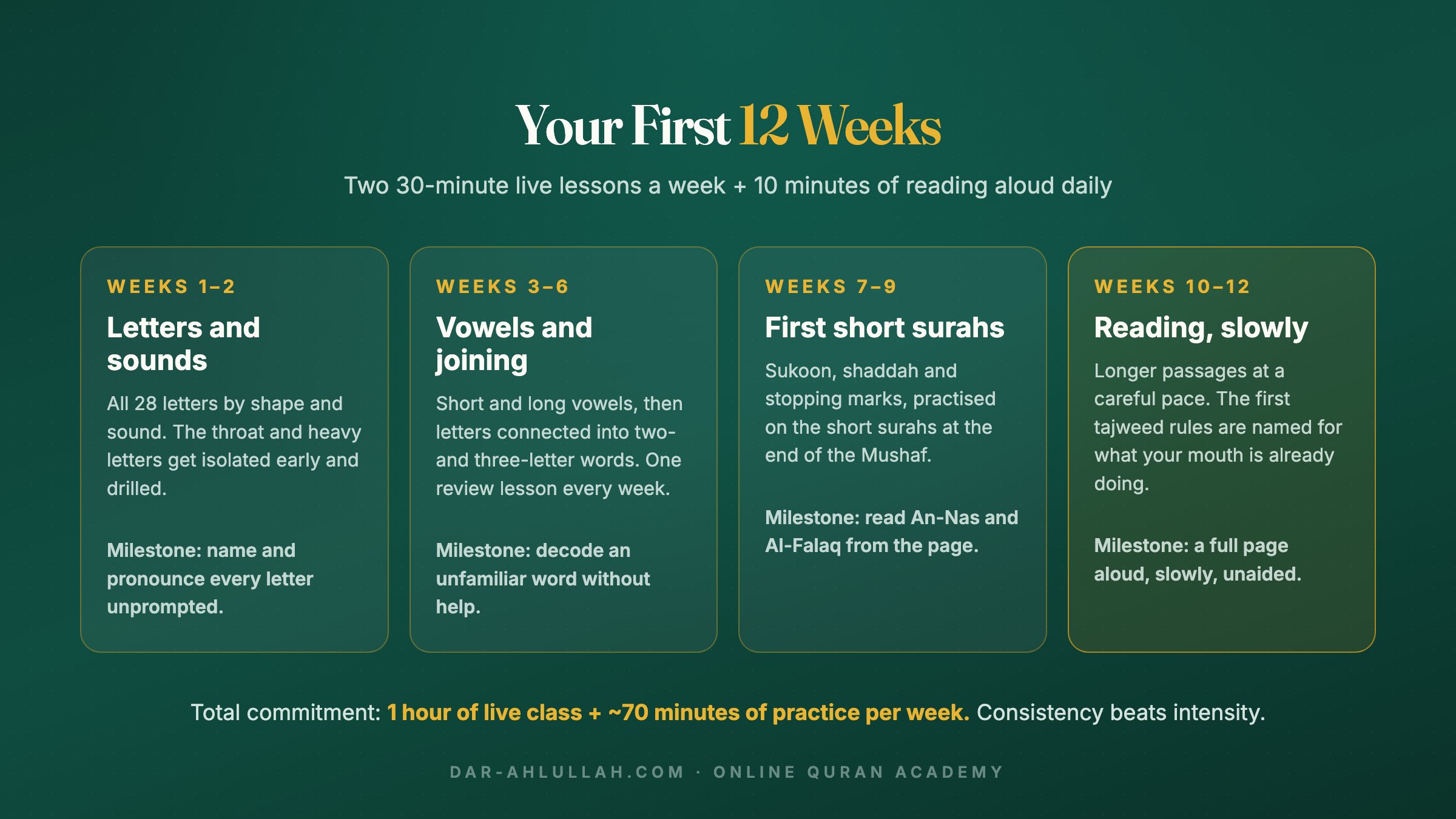
Two details in that plan matter more than the content:
Daily practice is short and out loud. Ten minutes of reciting aloud beats an hour of silent reading, because the skill being built is muscular as much as mental. Your tongue has to learn positions it has never used. Silent reading trains none of that.
The weekly review slot is protected. One of the two lessons each week should introduce nothing new. Adults tend to push for new material because progress feels like acquisition. Retention is what actually compounds, and the review lesson is where a teacher catches the pronunciation error you have been quietly rehearsing for six days.
What Adults Learn Faster Than Children — and What They Don't
Being honest about this cuts both ways, and knowing which side you are on saves months.
Where you have the advantage
- Rules, explained once. A child needs a rule modelled twenty times. You can be told that a shaddah doubles the letter, understand it, and apply it the same session. Adults commonly clear stage one faster than children for this reason alone.
- You know why you are here. Nobody is making you. Our teachers will tell you that motivation, not aptitude, is what separates the adult beginners who finish the first year from the ones who drift.
- Transfer from other learning. If you have ever learned an instrument, a trade, or a second language, you already know what a plateau feels like and that it passes.
Where children have the advantage
- New sounds. Children reproduce the throat and heavy letters — ayn, haa, qaaf, taa, daad — by imitation, without analysis. Adults hear these as approximations of familiar English sounds and have to be corrected repeatedly and specifically. This is the genuinely hard part of adult learning and there is no shortcut through it, only a patient teacher and repetition.
- Freedom from embarrassment. A seven-year-old mispronounces a letter, gets corrected, and moves on. An adult mispronounces a letter and feels it. Which is exactly why the format of your lessons matters as much as the curriculum.
- Rote memorisation. If hifz is a long-term goal, accept from the start that your memorisation will be slower and more effortful than a child's — and more durable, because you will use meaning and structure to hold it.
Do You Need to Learn Arabic First?
No, and the belief that you do is probably the most expensive misconception in this whole subject. It sends adults to Arabic apps and grammar courses for a year, after which they still cannot read a page of the Mushaf, because reading Arabic script and understanding Arabic are separate skills taught in separate ways.
Millions of Muslims across Indonesia, Turkey, Nigeria and Pakistan recite the Quran with excellent tajweed and no conversational Arabic at all. Reading comes first because it is the prerequisite for everything else — including, eventually, studying the language.
If understanding the text is your real goal, the sequence that works is: learn to read, get comfortable, then begin Quranic Arabic on top of a decoding skill you already have. Doing it the other way round is why so many adults stall.
The Five Things That Actually Stop Adult Learners
1. Being a beginner in front of other people
This is the real one, and it is why we recommend one-to-one lessons for adult beginners without hesitation. In a group class you are pronouncing a letter wrongly in front of eight strangers, half of them children. In a private lesson it is you, your teacher, and a mistake nobody else will ever hear about. Most adults need a few sessions before they stop apologising.
2. Sessions that are too long
Ninety-minute lessons feel serious and are almost always a mistake at the start. Concentration on unfamiliar sounds degrades fast. Two thirty-minute sessions a week produce more progress than one ninety-minute session, and they are far easier to defend against a work calendar.
3. The stage-three plateau
Around month four or five, reading becomes possible but not smooth, and the improvement curve flattens. Nothing has gone wrong; you have moved from acquiring letters to refining production, which is slower and less visible. Knowing the plateau is scheduled stops people quitting at it.
4. Practising without correction
Recitation apps and recordings are useful for listening, useless for correction. Ten minutes of daily practice with a wrong pronunciation embeds the error deeper. This is the argument for a live teacher rather than a course: not the content, the correction.
5. No fixed slot
"When I get a free evening" is not a schedule. Adults who pick two fixed weekly slots and treat them like a standing appointment finish the first year. Adults who book lesson by lesson mostly do not.
How to Choose a Teacher as an Adult Beginner
Most guidance on choosing a Quran teacher is written for parents choosing for a child. Adult beginners need a partly different list.
- Ask specifically about adult beginners. Not "do you teach adults" — every academy says yes. Ask how many adult beginners the teacher currently has, and how they handle the throat letters with a learner whose first language is English.
- Verify the credential. An ijazah is a documented chain of transmission, and a teacher who holds one can tell you from whom. You can meet our teachers and ask about their training in the trial session.
- Use the trial as an audition, not a formality. By the end of a free assessment you should know your actual starting stage, what the first month covers, and whether being corrected by this person felt tolerable. If the session was mostly a sales pitch, that is your answer.
- Match the teacher's register to you. Some excellent children's teachers are unbearable with adults — the encouragement is pitched wrong. You want somebody who corrects you like a colleague.
- Decide on gender preference up front. It is a normal request and no reputable academy will find it odd. If you would prefer a female Quran teacher, say so when you book rather than hoping.
- Check that you keep the same teacher. Rotating teachers is efficient for the academy and terrible for a beginner, because each one restarts your diagnosis.
What It Costs and How Our Adult Track Works
Adult lessons cost the same as children's lessons here, because the cost driver is teacher time, not student age. Our rate is about $9 per teaching hour. In practice that means:
- $36 a month — eight 30-minute one-to-one sessions. This is the plan we recommend to nearly every adult beginner: two short lessons a week, which is exactly the cadence stage one wants.
- $70 a month — eight 60-minute sessions, for adults moving into tajweed or hifz where the longer slot earns its keep.
- $102 a month — twelve 60-minute sessions, for intensive or ijazah-track study.
There is no registration fee, and the 30-minute assessment before you commit is free. Siblings and spouses learning together get a 20% discount. Full details are on our pricing page, and if you want to compare us against the wider market, we published the real per-hour numbers across the industry rather than the usual "contact us for rates".
The assessment session itself is the part worth booking even if you go elsewhere afterwards. Thirty minutes of reading aloud with a teacher will tell you your actual starting stage, which no article — including this one — can do for you. Many adults discover they are further along than they assumed, because the letters they learned as children are still there.
If you are arranging lessons for the whole household, our children's programme runs on the same schedule system, so family slots can sit back to back.
FAQs About Learning Quran as an Adult
Am I too old to learn to read the Quran?
No. Adults in their forties, fifties and sixties start from the letters every year, and they often move through the first stage faster than children because they can absorb a rule from an explanation instead of needing it modelled twenty times. The genuine age-related difficulty is producing unfamiliar Arabic sounds, and that is a matter of repetition and a patient teacher rather than of age.
How long does it take an adult to learn to read the Quran?
With two 30-minute lessons a week plus ten minutes of daily practice: two to four weeks to know all 28 letters, two to three months to read simple joined words, and six to twelve months to read a page of the Mushaf slowly and unaided with basic tajweed. Progress depends far more on consistency than on how many hours a week you put in.
Can I learn Quran online as an adult, or do I need to attend in person?
Online works particularly well for adult beginners, for two reasons that have nothing to do with convenience. Recitation is audio-first, so a video call loses almost nothing compared to sitting in a room. And a private online session removes the audience, which is the thing adults most often name as what stopped them before.
Do I need to learn Arabic before I start?
No. Reading the Quran is a decoding skill built on 28 letters and their vowel marks; understanding Arabic is a separate study. Learn to read first, then add Quranic Arabic on top if meaning is your goal. Attempting the language first is the most common way adults spend a year and still cannot read a page.
Should I learn in a group or one to one?
One to one, at least for the first few months. Adult beginners need pronunciation corrected constantly and individually, and a group class cannot give you that. Group classes make more sense later, once reading is secure and you are studying meaning or revising memorisation.
What if I already memorised some surahs as a child?
That is a real asset and you should say so in your assessment. Learners who recite Al-Fatihah and a few short surahs from memory usually move through the letters stage quickly, because the sounds are already familiar — the remaining work is attaching them to written shapes rather than building them from nothing.
How much daily practice do I actually need?
Ten to fifteen minutes, out loud, most days. More than that produces diminishing returns early on, and less than that means each lesson starts by rebuilding what the last one taught. Reading aloud is non-negotiable: the skill is physical, and silent reading trains none of it.
Conclusion: Start This Week, Not This Year
The path to learn Quran for adults is unglamorous and short: 28 letters, then vowels, then joining, then a page. Six to twelve months of two half-hour lessons a week gets most adults from zero to reading the Mushaf. The barrier was never the material.
What stops people is the year spent deciding, the Arabic course taken in the wrong order, and the reluctance to be a beginner out loud in front of somebody. All three are fixed the same way: book one private assessment, find out your actual starting stage, and pick two fixed slots in your week.
Our 30-minute assessment is free and there is no obligation afterwards. Bring a Mushaf if you have one — the teacher will ask you to try a line, and you will learn more from that thirty minutes than from another month of reading about it.
Related articles
how long does it take to learn to read the Quran
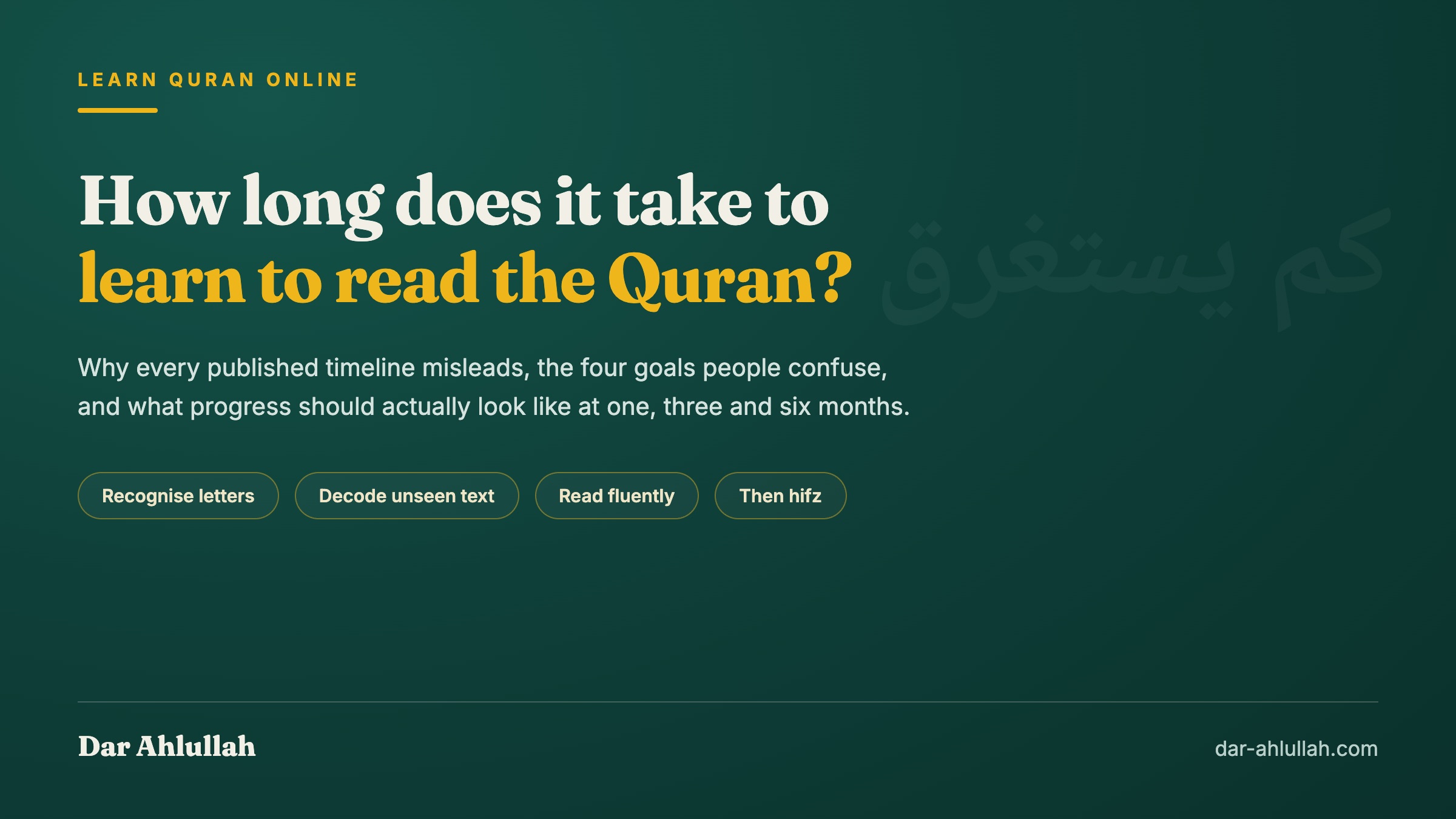
How Long Does It Take to Learn to Read the Quran? An Honest Answer
Every academy quotes a different number and none of them say what they are measuring. Here is the honest version: four different goals people confuse, the hours each one really costs, what those hours look like at two versus four lessons a week, and the specific habits that stretch a four-month job into two years.
19 min read
online Quran classes vs private tutor
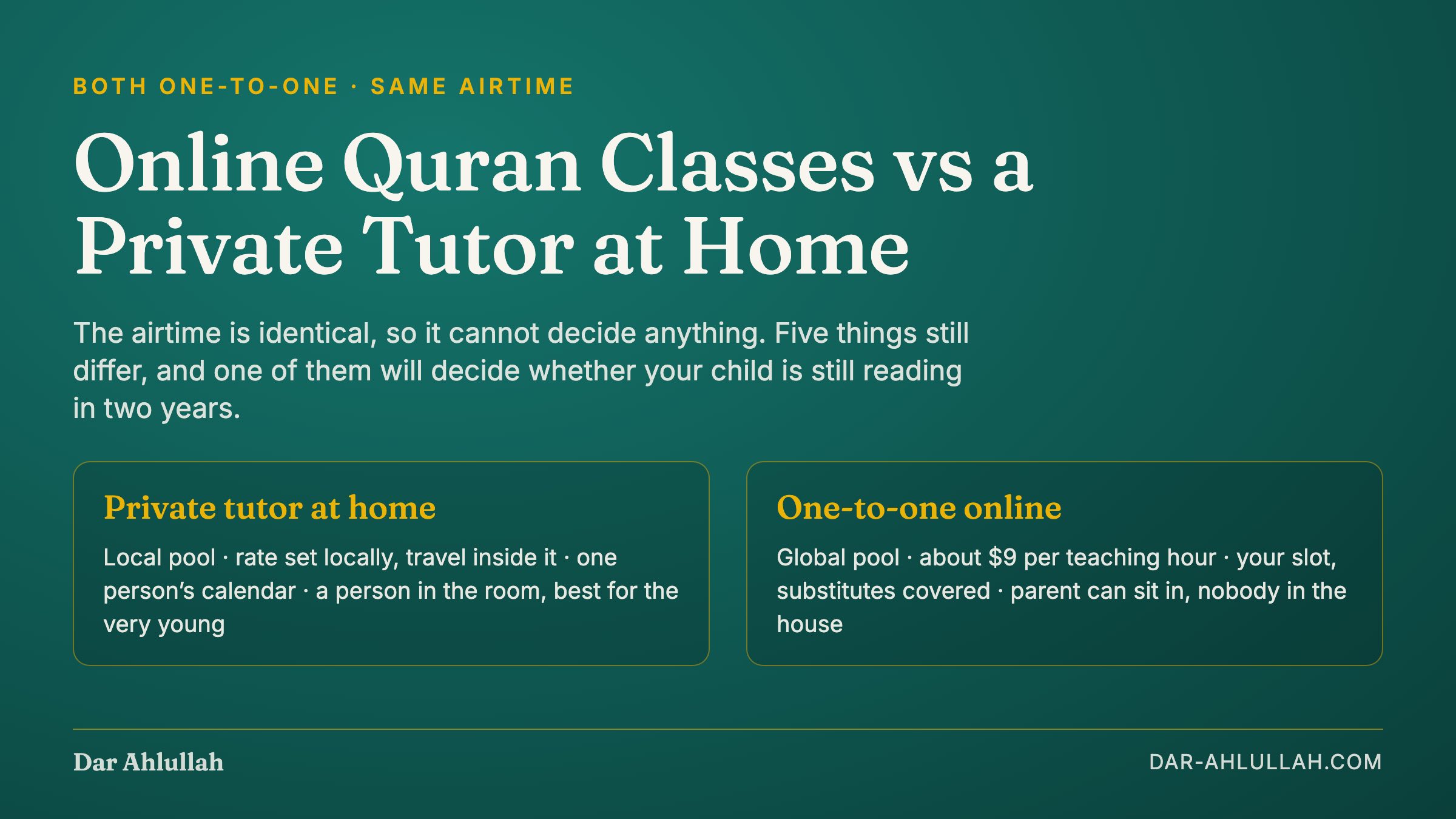
Online Quran Classes vs a Private Tutor at Home: Which Is Better?
Both are one-to-one, so airtime does not decide it. What does: who the teacher can be, what the hour really costs, what happens when the tutor moves, who is responsible for safeguarding, and whether the learner is old enough for a screen.
19 min read
are online Quran classes worth it
Are Online Quran Classes Worth It? An Honest Answer
Online Quran classes are worth paying for when the learner needs a human ear, has no good local option, and lives in a household that will keep the slot. Here are the five cases where they are, the five where they are not, the maths on a year, and a six-week test that settles it.
20 min read