
how to do istinja
How to Do Istinja: Cleaning After the Toilet, Step by Step
Dar Ahlullah team 26 min read
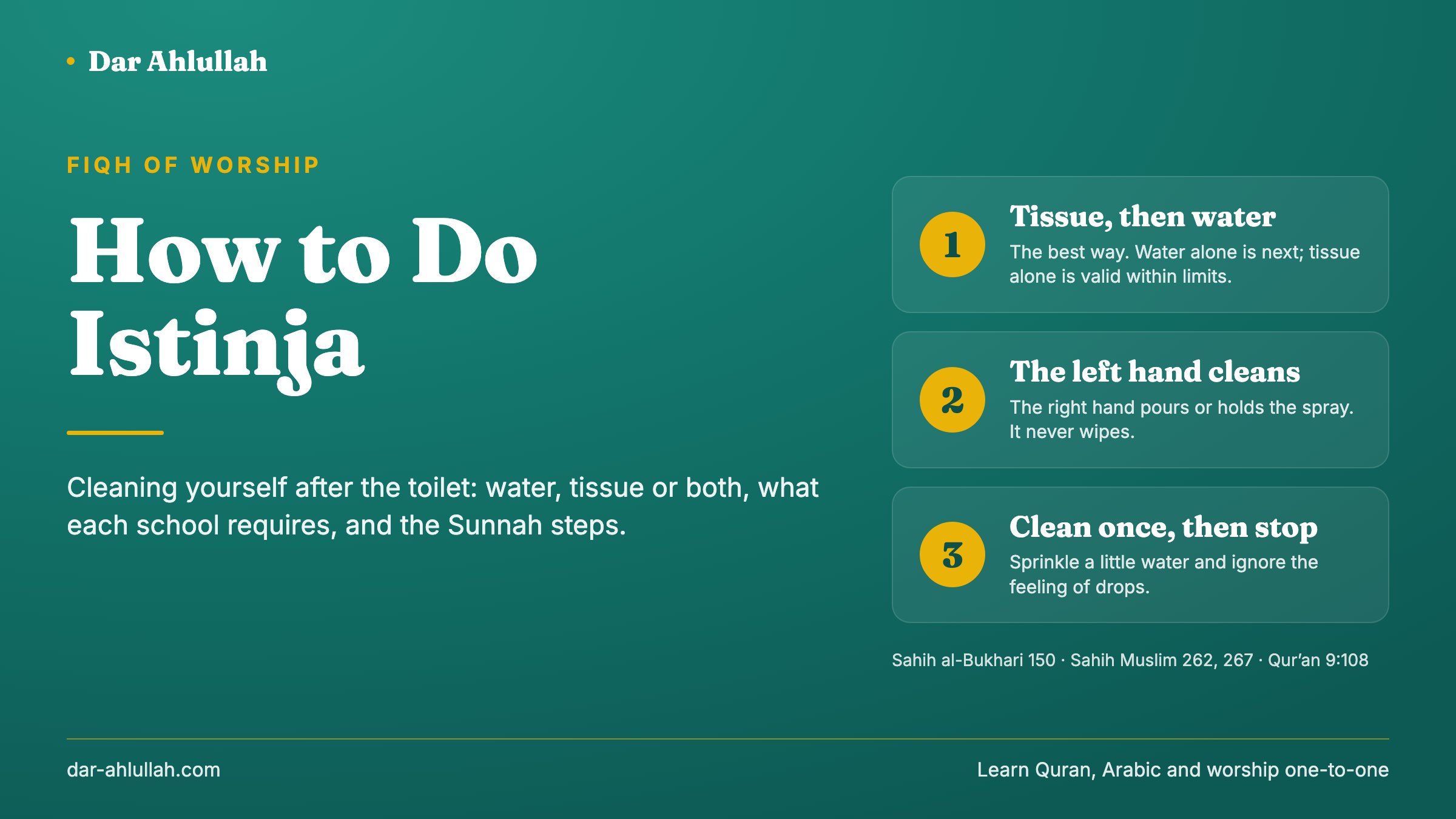
Table of Contents
- Introduction: The Lesson Nobody Gives Out Loud
- The Short Answer
- What Istinja Is, and Why the Sunnah Spells It Out
- Water, Tissue or Both: The Three Valid Ways
- Where the Four Schools Differ
- Step by Step: After Urinating
- Step by Step: After Opening the Bowels
- Which Hand, and What You May Not Use
- Western Toilets: Sprays, Bottles, Wipes and the Office
- Stray Drops, Doubt and Waswasa
- Toilet Manners: Going In, Coming Out, the Qiblah and Your Phone
- Istinja and Wudu: How the Two Fit Together
- For Women
- Teaching Children
- Six Situations, Worked Through
- Six Mistakes People Keep Making
- How We Teach This
- Questions People Ask
- Conclusion: A Small Act With a Large Place
Introduction: The Lesson Nobody Gives Out Loud
Wudu is taught in the open. Children learn it at the mosque tap and converts are walked through it before their first prayer. Istinja, the cleaning that comes before it, is almost never taught at all. Many children in Muslim homes pick it up from the water jug that sits beside the family toilet. A convert in a Western flat with no jug, no bidet and nobody to ask is left to guess what “cleaning yourself properly” means, and then to carry that guess into every prayer.
The guesses tend to go wrong in both directions. Some people decide toilet paper can never be enough and avoid office toilets all day. Others never use water at all, even when their school requires it. And a great many end up stuck in the bathroom after every visit, waiting for a drop that may or may not come, then repeating their wudu because of a feeling.
The subject is nothing to be embarrassed about. When a polytheist mocked Salman al-Farisi because his Prophet had taught them everything, “even about excrement,” Salman did not change the subject. He answered yes and listed the rules (Sahih Muslim 262). The Prophet ﷺ taught this in detail, and the detail turns out to be lighter than most people fear.
This guide covers how to do istinja from start to finish: what it is, the three valid methods, where the four schools differ, the steps after urinating and after opening the bowels, which hand, what you may not use, how it works with a Western toilet, a bidet spray or a public cubicle, how to deal with stray drops and doubt, the manners of the toilet, and how istinja fits with wudu. It belongs with the purity guides in the salah library of our guide to how to pray in Islam, because the prayer depends on it. If you are new to Islam altogether, our guide to your first 90 days shows where it fits among everything else you are learning.
One boundary before we begin. We teach Quran, Arabic and the practical fiqh of worship; we are not a fatwa body. Where the schools differ, we set out who holds what and name the source, rather than picking one view and calling it the only one.
The Short Answer
- Istinja is cleaning the front or back passage after urine or stool comes out. You need it before you pray whenever something has come out. You do not need it after only passing wind, and it is not part of wudu (IslamQA 2137, 1170).
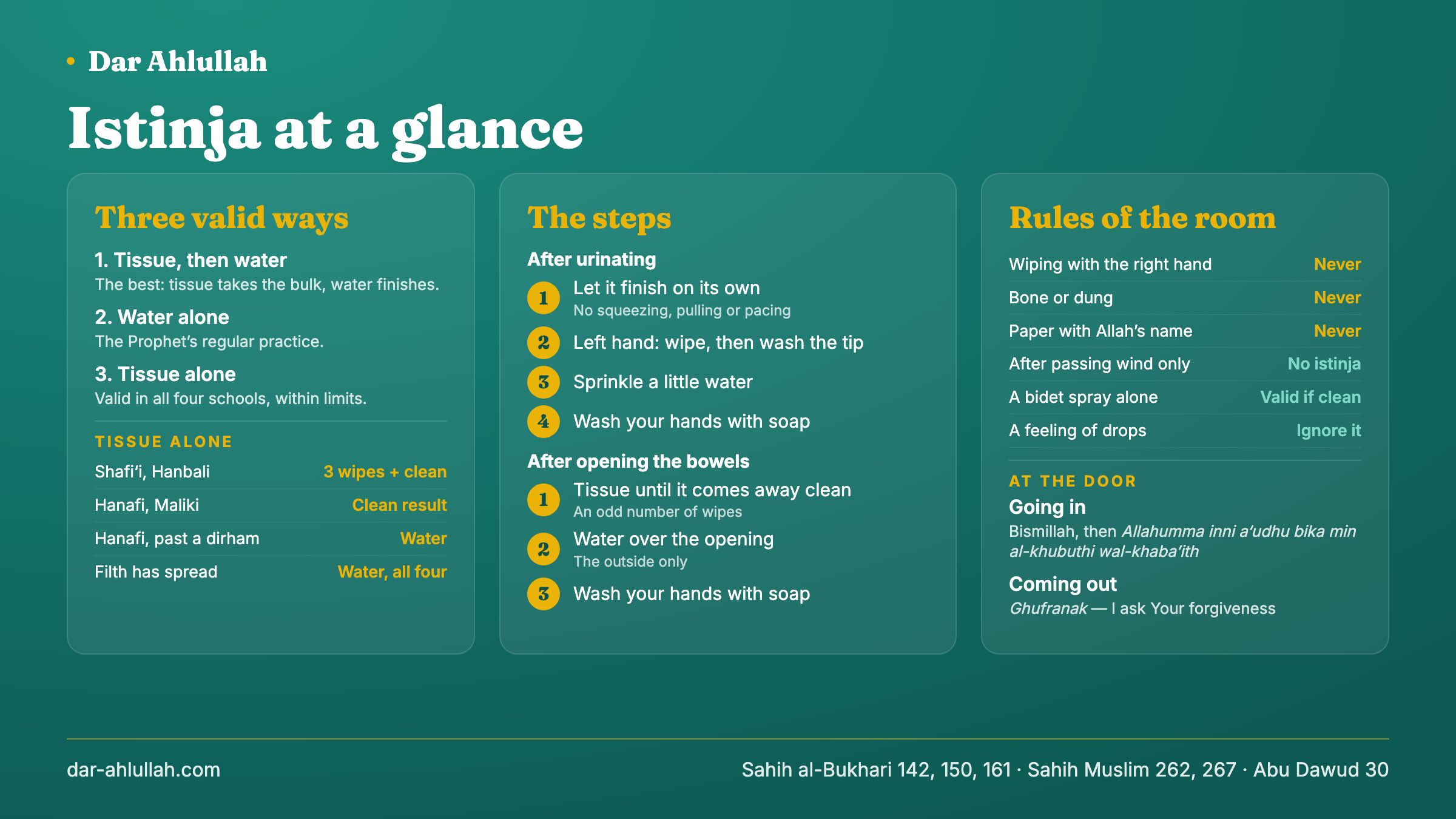
- There are three valid ways: tissue then water (the best), water alone (next best) and tissue alone (valid in all four schools, within limits) (IslamQA 10257).
- Use the left hand, and never clean yourself with bone, dung or paper that carries the name of Allah (Muslim 262, 267).
- With tissue alone, the Shafi‘i and Hanbali schools require at least three wipes and a clean result. The Hanafi and Maliki schools require only the clean result. If the filth has spread well beyond the opening, all four require water.
- Let the flow finish naturally, clean once, then ignore the feeling of drops unless you are certain. Squeezing, pulling and long waiting are not from the Sunnah. A light sprinkle of water on the area is.
What Istinja Is, and Why the Sunnah Spells It Out
In the fiqh, cleaning the private parts after relieving yourself has two names. It is istinja’ when it is done with water, and istijmar when it is done with stones or something like them, which today means toilet paper (IslamQA 2137, quoting the Standing Committee). In everyday English “istinja” covers both, and this guide uses it that way. The wider code of toilet manners is called qada’ al-hajah (Wikipedia: Islamic toilet etiquette).
Two reports show why the Sunnah gives it so much attention. The first is a warning. The Prophet ﷺ passed two graves and said that their occupants were being punished, and that one of them “did not keep himself safe from being defiled by urine” (Sahih al-Bukhari 216; Sahih Muslim 292). The second is praise. The Quran says of the people of the mosque at Quba’: “In it are men who love to purify themselves, and Allah loves those who purify themselves” (Quran 9:108). The Prophet ﷺ explained that the verse came down about them because they cleaned themselves with water (Jami‘ at-Tirmidhi 3100, graded sahih by al-Albani; Ibn Majah 357).
So the act is small, but its place is not. Being careless with urine is treated as a serious matter, and doing istinja well is something Allah praised by name.
Water, Tissue or Both: The Three Valid Ways
All three have a basis in the Sunnah, and scholars rank them.
1. Tissue first, then water: the best
IslamQA, citing al-Nawawi’s al-Majmu‘, puts it plainly: “if you use both tissues and water, that is the best; start with tissue then use water” (IslamQA 10257). The Hanafi Darul Ifta Birmingham gives the same order of preference (Darul Ifta Birmingham). The tissue takes the bulk away, so the water and your hand deal with very little.
2. Water alone: next best
This was the Prophet’s ﷺ regular practice. Anas ibn Malik said that whenever he went out to relieve himself, Anas and another boy would carry a small vessel of water for him to clean himself with (Sahih al-Bukhari 150; Sahih Muslim 271). ‘A’ishah told a group of women: “Tell your husbands to clean themselves with water, for I am too shy of them, and the Messenger of Allah used to do that” (Jami‘ at-Tirmidhi 19, graded sahih by Shakir and al-Albani). At-Tirmidhi added that the scholars regarded water as preferable while still accepting stones.
3. Tissue alone: valid, within limits
The Prophet ﷺ said: “When any one of you goes to relieve himself, let him take three stones with him to clean himself, for they will suffice him” (Sunan Abi Dawud 40, graded hasan by al-Albani; an-Nasa’i 44). Ibn Qudamah reported that the Companions agreed that stones alone are permissible, and IslamQA applies the same ruling to tissue: “it is sufficient to use pebbles or tissue or any other things that may remove impurity” (IslamQA 10257). The limits come from the schools, and they are set out next.
How much water? There is no set amount. The Prophet ﷺ was sparing with water in all his purification, and in istinja he used no more than it took to remove the impurity (IslamQA 219157).
Where the Four Schools Differ
The schools agree that istinja is about removing the impurity, and that water does this best. They differ on how much tissue alone can do, and on the number of wipes.
| Question | Hanafi | Maliki | Shafi‘i | Hanbali |
|---|---|---|---|---|
| Is tissue alone enough? | Only while what is left is small (no more than the area of a dirham). Beyond that, water is required. | Yes, for men, if the impurity has not spread | Yes, if the impurity has not spread | Yes, if the impurity has not spread |
| Minimum number of wipes | None; a clean result. Three is recommended | None; a clean result. Three is recommended | Three, and a clean result | Three, and a clean result |
| A woman after urinating: tissue alone? | The general dirham rule | No; she washes, because urine usually spreads past its opening | Not enough if the urine reaches the outer area, as it usually does for a woman who is not a virgin | Two views |
Sources: the number of wipes, from Ibn Qudamah, al-Hattab and Ibn ‘Uthaymin in IslamWeb 333250 and, for the Shafi‘i school, SeekersGuidance. The women’s row and the agreed “spread” rule are from al-Mawsu‘ah al-Fiqhiyyah as quoted in IslamQA 236508. The Hanafi limit is from Ibn ‘Abidin’s Radd al-Muhtar, via Darul Ifta Birmingham.
Two points from the table matter in practice. First, all four schools agree that if the impurity has spread well beyond its opening, wiping is not enough and the area must be washed (IslamQA 236508). Second, the Hanafi limit is tight. Darul Ifta Birmingham’s reading is that after urinating, tissue alone is usually fine, but after opening the bowels the residue usually exceeds the limit, so water is needed. If you follow the Hanafi school, plan for water after stool.
Whatever the number, wiping does not stop at three if the place is still dirty. IslamWeb’s summary of the schools is that there is no scholar who holds three, or seven, wipes to be enough when cleanliness has not been reached. In the other direction, you do not need to be 100% certain. The Shafi‘i answer above says one only needs to be “generally sure that the filth has been removed”, and that one should not clean inside the body.
Step by Step: After Urinating
- Go in with the words of the Sunnah (set out in full below).
- Sit if you can. It is the Prophet’s ﷺ usual practice, it covers you better, and fewer drops splash up onto you (IslamQA 9790).
- Let the flow finish on its own. Do not squeeze, pull, cough or walk about to force out more. Ibn Taymiyyah called all of these innovations (more on this below).
- If you use tissue first, wipe or blot the tip with your left hand. Three wipes in the Shafi‘i and Hanbali schools, more if needed.
- Pour water over the opening with your right hand and wash with your left. Washing the end of the organ is enough; after urinating there is nothing to wash at the back passage, because nothing came out there (IslamQA 12657).
- Sprinkle a little water over the private part or the inside of your underwear. The Prophet ﷺ did this after wudu (Ibn Majah 464; Abu Dawud 166, both graded sahih by al-Albani). If you feel wetness later, you can put it down to the water.
- Wash your hands with soap. After istinja the Prophet ﷺ rubbed his hand on the ground to remove anything left on it (an-Nasa’i 50, graded hasan; Sahih al-Bukhari 265). Soap does the same job today.
- Leave right foot first and say ghufranak.
Step by Step: After Opening the Bowels
- Go in with the words of the Sunnah, as above.
- Wipe with tissue first, using your left hand, until the tissue comes away clean. Use an odd number of wipes: “whoever cleans himself with stones, let him use an odd number” (Sahih al-Bukhari 161; Sahih Muslim 237). In the Shafi‘i and Hanbali schools, at least three.
- Then wash with water, pouring with the right hand and washing the opening with the left, until you are reasonably sure the place is clean. You wash the outside only; there is no cleaning inside the body (IslamQA 12657; SeekersGuidance, above).
- If there is no water, keep wiping until the tissue comes away clean. That is valid in all four schools as long as the filth has not spread, with the tighter Hanafi limit noted above.
- Pat dry, wash your hands with soap, and leave right foot first saying ghufranak.
If you need ghusl, the same washing of the private parts is the second step of the Sunnah bath. Maymunah described the Prophet ﷺ pouring water with his right hand onto his left and washing his private parts before anything else (Bukhari 265). The full method is in our guide to how to perform ghusl.
Which Hand, and What You May Not Use
The left hand cleans; the right hand pours
The Prophet ﷺ said: “None of you should hold his penis with his right hand while urinating, or wipe himself with his right hand” (Sahih Muslim 267; Sahih al-Bukhari 153). Salman’s list includes the same prohibition (Muslim 262). ‘A’ishah described his right hand as being for wudu and food and his left for the toilet and anything unclean (Abu Dawud 33; al-Albani graded it sahih, Zubair Ali Za’i weak). How much of the left hand you use is up to you. IslamQA calls this flexible: what matters is keeping the right hand out of it (IslamQA 14053). The right hand can hold the jug or the spray. It just does not do the wiping.
What you may not clean yourself with
- Bone and dung. Both are named in Salman’s list and in Jabir’s report (Muslim 262, 263). When Ibn Mas‘ud brought two stones and a piece of dried dung, the Prophet ﷺ took the stones and threw the dung away, calling it filthy (Sahih al-Bukhari 156; see also 155).
- Paper that mentions Allah, or any of His names (IslamQA 12657). A receipt or a printed page grabbed in a hurry should be checked first.
- Anything that cannot actually remove the impurity. The material must be pure and able to clean. IslamQA’s examples are pebbles, coarse tissue or clean paper, which rules out something glossy that only smears (IslamQA 12657).
Western Toilets: Sprays, Bottles, Wipes and the Office
Most of what makes istinja awkward in the West is plumbing, not fiqh. These are the setups people actually face.
A bidet spray
A hand-held spray beside the toilet (a bidet shower) is the easiest setup of all. IslamQA was asked whether it is enough to use only the spray without touching with the hand. The answer: “It is permissible to use only the hand-held spray if it will remove whatever impurity is on the anus and leave no trace of it” (IslamQA 130400). Wiping with the left hand while spraying with the right usually gets the job done faster.
No spray: a bottle or jug
Keep a jug or a bottle with a narrow neck in the bathroom and fill it at the sink before you sit down. Lean slightly forward and pour from behind for the back passage, or from the front for the front, so the water runs into the bowl rather than onto the floor. A small refillable bottle in a bag or desk drawer covers most days away from home. None of this needs much water once the tissue has done the first pass.
Splash-back
A common worry is drops of water flicking back up from the bowl, or dripping down after you have washed. IslamQA’s answer is that these are the leftover drops of the istinja water and are not to be given any attention: “the certainty of having purified oneself cannot be cancelled out by mere doubt” (IslamQA 150088).
Public and office toilets
A cubicle with no water is not a crisis. Tissue alone is valid in all four schools as long as the filth has not spread past its opening, so after urinating at work, thorough wiping is enough for most people. The exception is the Hanafi limit after stool, and the Maliki ruling for women after urinating. For those, the practical answer is a single-occupancy or accessible toilet with a sink inside, or the bottle in your bag.
Wet wipes
Here the answers vary. Darul Ifta Birmingham (Hanafi) allows baby wipes alone after urinating but requires “water in its physical state” after stool (Darul Ifta Birmingham). Mufti Zakaria Makada, asked whether wet toilet paper can replace pouring water, answered simply: “Water should be used” (MuftiOnline). The safe reading is to treat a wet wipe as tissue, not as water: it can do the wiping, but where your school requires water, a wipe does not replace it.
Urinals
Urinating standing is not haram. Hudhayfah saw the Prophet ﷺ do it at a rubbish heap (Sahih al-Bukhari 224; Sahih Muslim 273). His usual practice was to sit, and ‘A’ishah said that anyone who told you otherwise should not be believed (an-Nasa’i 29, graded sahih by al-Albani). The conditions for standing are that no drops splash onto you and nobody sees your ‘awrah (IslamQA 9790). An open row of urinals can easily fail the second condition. The cubicle meets both.
Stray Drops, Doubt and Waswasa
For many people this is the real problem: not how to clean, but how to stop. Someone washes, stands, feels something, sits down again, washes again, and arrives late for every prayer. The Sunnah addresses this directly, and its answer is to do less, not more.
Do not force it
Ibn Taymiyyah said that squeezing, pulling and inspecting the organ are all innovations that “the imams of the Muslims” neither required nor recommended. His comparison was an udder: “if you leave it alone, it will settle down, but if you pull at it, it will flow” (Majmu‘ al-Fatawa 21/106, in IslamQA 65521). The same answer says it is not prescribed to look into the channel to check, and calls that a kind of waswasa.
Sprinkle, then move on
The Hanafi, Shafi‘i and Hanbali schools all recommend sprinkling a little water on the private part or the underwear after istinja. Then any wetness you feel later can be put down to that water unless you are certain otherwise (al-Mawsu‘ah al-Fiqhiyyah 4/125, in IslamQA 65521). This is the Sunnah’s own remedy for the feeling, taken from the Prophet’s ﷺ sprinkling after wudu (Ibn Majah 464).
Certainty, not feeling
Shaykh Ibn Baz distinguished two cases. If drops really do come for you after urinating, wait until they stop, wash, and that is the end of it. If it is only a feeling, ignore it, “even if he thinks it is 90% possible that something has come out of him”. Only certainty means you clean again and repeat wudu (IslamQA 147336). This is the same principle the Prophet ﷺ gave for wind during prayer: do not leave the prayer “unless he hears sound or smells something” (Sahih al-Bukhari 137). Our guide to what breaks wudu explains why doubt never breaks it.
The Companions corrected over-strictness too
Abu Musa al-Ash‘ari was so severe about urine that he urinated into a bottle, saying the Children of Israel used to cut away skin that urine had touched. Hudhayfah said he wished Abu Musa would not be so strict, and reminded him that he had seen the Prophet ﷺ urinate standing at a rubbish heap (Sahih Muslim 273). Being careful is the Sunnah. Being tormented is not.
If drops are genuinely continuous, so that you cannot stay clean long enough to pray, that is a different ruling: the person with a continuous condition is excused. It is covered in our guide to how to pray when sick. If doubt is taking over your day, speak to a scholar you trust, and to a doctor if it feels compulsive.
Toilet Manners: Going In, Coming Out, the Qiblah and Your Phone
Going in
Say Bismillah. The Prophet ﷺ said it is a screen between the eyes of the jinn and people’s nakedness when they enter the toilet (Jami‘ at-Tirmidhi 606; graded sahih by Shakir and al-Albani, weak by Zubair Ali Za’i). Then say what he said:
Allahumma inni a‘udhu bika min al-khubuthi wal-khaba’ith — “O Allah, I seek refuge with You from all offensive and wicked things” (Sahih al-Bukhari 142; Sahih Muslim 375).
Scholars list entering with the left foot and leaving with the right among the recommended manners (IslamQA 12657). In a modern home where the toilet is inside the bathroom, say the words before you step in.
Inside
Speaking while relieving yourself is disliked (IslamQA 12657). A man greeted the Prophet ﷺ while he was urinating, and he did not return the greeting (Sahih Muslim 370). Abu Dawud notes a narration that he made tayammum afterwards and then answered (Abu Dawud 16). A phone call can wait two minutes.
Coming out
Say Ghufranak — “I ask Your forgiveness.” ‘A’ishah reported that this is what he said whenever he came out (Abu Dawud 30; at-Tirmidhi 7; Ibn Majah 300; all graded sahih by al-Albani).
Facing the qiblah
The Prophet ﷺ said: when you go out to relieve yourself, do not face the qiblah or turn your back to it (Sahih al-Bukhari 144; Sahih Muslim 264). But Ibn ‘Umar saw him from the roof of Hafsah’s house relieving himself facing Syria, with his back to the qiblah (Sahih Muslim 266; Bukhari 145). The schools reconciled the two reports differently:
- Malik, al-Shafi‘i and Ahmad (the majority): the prohibition applies in the open, with nothing between you and the qiblah. Inside a building it is permitted.
- Abu Hanifah, and Ibn Taymiyyah: it is prohibited everywhere, in a building or out of one. IslamQA cites Ibn ‘Abidin’s Hashiyah for the Hanafi position (IslamQA 69808).
Abu Ayyub, who narrated the prohibition, found that the toilets already built in Syria faced the qiblah. He turned away from that direction and asked Allah’s forgiveness (Muslim 264). Shaykh Ibn Baz took a middle position: it is better to avoid facing the qiblah in a building too, but a person whose toilet already faces that way and cannot easily avoid it is excused (IslamQA 134238). If you are renovating, the Standing Committee advises placing the toilet off the qiblah line so you are clear of the dispute (IslamQA 69808).
Your phone
A phone with a Quran app or recorded recitation on it is not a mushaf, and IslamQA says it is not haram to take it into the toilet, because the Quran on it is stored, not written visibly (IslamQA 21792). That answer separates the phone from the printed mushaf, which has its own rulings.
Istinja and Wudu: How the Two Fit Together
- They are two different acts. Washing the private parts is not wudu. It is istinja, done with water, or istijmar, done with tissue (IslamQA 2137).
- Istinja is not needed before every wudu. It is needed only after urine or stool has come out (IslamQA 1170). If all you did was pass wind, you go straight to wudu. Doing istinja after wind is disliked as excessive (IslamQA 2137).
- The order is istinja first, then wudu (IslamQA 1170). If you make wudu first and then clean yourself, whether your wudu survives depends on whether touching the private part breaks it in your school, which is one of the genuine disagreements covered in what breaks wudu. The simplest habit is toilet, istinja, hands, then wudu.
- No water for wudu does not mean no istinja. Tissue does the istinja on its own; tayammum then stands in for the wudu. Our guide to tayammum covers when that applies, and our step-by-step guide to wudu covers what comes next when you do have water.
For Women
The method is the same, with two additions. First, the school difference in the table matters more for you: the Maliki school does not accept tissue alone after a woman urinates, and the Shafi‘i school does not accept it when the urine reaches the outer area. IslamQA’s own conclusion is that a woman is like a man here, whether or not she is a virgin (IslamQA 236508). Water settles the question on every view.
Second, wipe from front to back, never back to front. That is standard NHS advice for preventing urinary tract infections (NHS: Urinary tract infections).
The state of menstruation is ended by ghusl, not by istinja; our ghusl guide covers that bath.
Teaching Children
Children usually learn to use the toilet years before anyone teaches them the prayer, which makes it the natural time to teach the left hand, the water and the two short phrases at the door. Bismillah on the way in and ghufranak on the way out are short enough for a small child. The steps above are what they will grow into. When the prayer lessons begin, add the link between the two: a trip to the toilet means istinja, and then wudu again. Our guide to how to teach your child to pray sets out what to teach at each age.
Six Situations, Worked Through
1. Office toilet, no sink in the cubicle, Zuhr in twenty minutes
After urinating, wipe thoroughly with the left hand (three times or more if you follow the Shafi‘i or Hanbali school). That is valid in all four schools as long as nothing has spread, and you can pray. After stool, if you follow the Hanafi school, use the accessible toilet with its own sink or the bottle in your bag, because tissue alone will not usually meet its limit.
2. A long-haul flight
Aircraft toilets have a tap. Fill a paper cup and pour, or wet your left hand under the tap and wash. Use tissue first, so very little water is needed, and dry off with paper towels. Then make wudu at the same basin.
3. Hiking or camping
Go well away from people (IslamQA 12657). The Prophet ﷺ warned against “two things which provoke cursing”: relieving yourself on the paths people use or in the shade where they rest (Sahih Muslim 269). Out in the open, every school agrees that you must not face the qiblah or turn your back to it. Carry tissue and a water bottle, and take the used tissue out with you.
4. You feel a drop while standing in the row at the mosque
Unless you are certain something came out, carry on. A feeling is not certainty, and you should not leave an obligatory prayer because of a doubt (IslamQA 150088, quoting Ibn Taymiyyah). If you are certain, step out, clean yourself, renew wudu and rejoin. Our guide to joining the prayer late covers how to make up what you missed.
5. Your toilet at home faces the qiblah
On the majority view there is no sin inside a building. On Ibn Baz’s view, it is better to avoid but you are excused where you cannot. On Abu Hanifah’s view, the direction matters wherever you are. If you follow the Hanafi school, sit turned away from the line where you can, and when you next renovate, move the toilet off the qiblah line, which settles it on every view.
6. You only have a bidet spray and do not want to touch with your hand
That is valid if the spray actually removes the impurity and leaves no trace of it (IslamQA 130400). Check with tissue afterwards: if the tissue comes away clean, you are done.
Six Mistakes People Keep Making
- Washing the private parts before every wudu, even when the only thing that happened was wind. Istinja follows urine or stool, not wind (IslamQA 2137).
- Squeezing, pulling, coughing or pacing to “empty out”. Ibn Taymiyyah called these innovations, and they make the problem worse. Let it finish, wash, sprinkle and go.
- Believing tissue is never enough, and avoiding public toilets or delaying prayers because of it. In all four schools, tissue alone is valid within limits.
- Assuming tissue is always enough. If the filth has spread, all four schools require water, and the Hanafi limit after stool is tight.
- Wiping with the right hand. It is prohibited in the hadith (Muslim 267). The right hand pours or holds the spray; the left hand cleans.
- Re-doing wudu because of a feeling. Only certainty counts (IslamQA 147336). Hudhayfah’s word to Abu Musa still applies: do not be so strict.
How We Teach This
Istinja is two pages of fiqh. The part that usually needs a teacher is everything around it: knowing which school you follow, so you know whether tissue alone counts for you after stool, and having somewhere to ask the questions people will not ask in a mosque. In our fiqh-of-worship lessons it is taught together with wudu, ghusl, tayammum and the prayer, one to one, with the embarrassing questions answered privately.
Dar Ahlullah runs one-to-one live sessions with certified teachers, scheduled in your own timezone. Teaching costs $9 per teaching hour, with monthly plans at $36, $70 and $102 depending on how many hours you want, and siblings get a 20% discount. You can pause, upgrade or switch plans at any time. If a teacher is not the right fit, we rematch you with another certified mentor at no extra cost. To see where your purification and prayer stand before you commit to anything, book the free 30-minute assessment, which does not ask for a card. The details are on our pricing page.
Questions People Ask
Is istinja obligatory?
Removing urine or stool from the body before you pray is obligatory (IslamQA 12657). In Hanafi terms, the cleaning itself is an emphasised sunnah, and water becomes obligatory once the impurity spreads beyond the size of a dirham (Darul Ifta Birmingham).
Do I need to do istinja after passing wind?
No. Wind breaks wudu, but it does not need istinja, and doing it anyway is disliked as excessive (IslamQA 2137).
Is my prayer valid if I only used toilet paper?
Yes in all four schools, provided the filth had not spread beyond its opening. Hanafis apply a tighter limit (about a dirham’s area), and the Maliki and Shafi‘i schools are stricter for women after urinating. See the table above.
Do I have to use my hand, or is a bidet spray enough?
A spray alone is enough if it removes the impurity completely (IslamQA 130400). If you do use a hand, it is the left.
Can I use wet wipes instead of water?
Treat a wet wipe as tissue, not as water. Some Hanafi muftis accept baby wipes alone after urinating but require water after stool; others say water should be used. See the wet wipes section.
What do I say going into and coming out of the toilet?
Going in: Bismillah, then Allahumma inni a‘udhu bika min al-khubuthi wal-khaba’ith (Bukhari 142). Coming out: Ghufranak (Abu Dawud 30).
Is it a sin if my toilet faces the qiblah?
Not on the majority view, which permits it inside buildings. Abu Hanifah and Ibn Taymiyyah held it prohibited everywhere. Ibn Baz held that it is better to avoid but that you are excused where you cannot (IslamQA 134238).
Can I take my phone into the toilet if it has a Quran app?
Yes. A phone is not a mushaf (IslamQA 21792).
Is it allowed to urinate standing?
Yes, if no drops splash onto you and nobody can see you, but sitting is the Sunnah (IslamQA 9790).
Water splashed back on me from the toilet after I washed. Am I impure?
No. Those drops are the leftover istinja water, and the answer is to ignore them and pray (IslamQA 150088).
Conclusion: A Small Act With a Large Place
Istinja fits on an index card. Clean whatever came out, with your left hand. Use tissue then water if you can, water if you cannot use both, and tissue alone when that is all there is, within your school’s limits. Never use bone, dung or the name of Allah. Say Bismillah and the refuge on the way in, and ghufranak on the way out.
The Sunnah’s other lesson is the one most people need: once it is done, it is done. Sprinkle a little water, wash your hands, and walk out without looking back. A sound istinja and a quiet mind go together. If you want the rest of purification and the prayer in the same detail, the salah library links every guide we have written on it.
Related articles
how to perform ghusl
How to Perform Ghusl: The Full Ritual Bath, Step by Step
Ghusl is the full ritual bath, owed after intercourse, after any emission of sexual fluid, and at the end of menstruation and postnatal bleeding. Its real requirements are fewer than most people fear: an intention and water over the whole body, with two schools adding the mouth and nose and one adding rubbing. This guide sets out the minimum, the Sunnah method, where the four schools differ, and whether your morning shower can be your ghusl.
24 min read

what breaks wudu
What Breaks Wudu? The Agreed List and the Disputed
Three things break wudu by the agreement of all four schools. Four more are genuinely disputed, and your answer depends on which school you follow. Almost everything else people worry about — food, dirt, a nosebleed, a doubt — does not break it at all.
19 min read
how to perform tayammum
How to Perform Tayammum: Dry Ablution When You Cannot Use Water
Tayammum is the purification you make with earth when water cannot be used. The rule is short: strike clean earth, wipe your face, wipe your hands. The difficulty for a Muslim in Europe or America is everything around the rule: what counts as a real excuse, what counts as earth in a building with none, how long it lasts, and what you do on a plane or in a hospital bed when there is neither water nor dust.
28 min read