
Makki and Madani surahs
Makki and Madani Surahs: What the Labels Mean and How Scholars Know
Dar Ahlullah team 18 min read
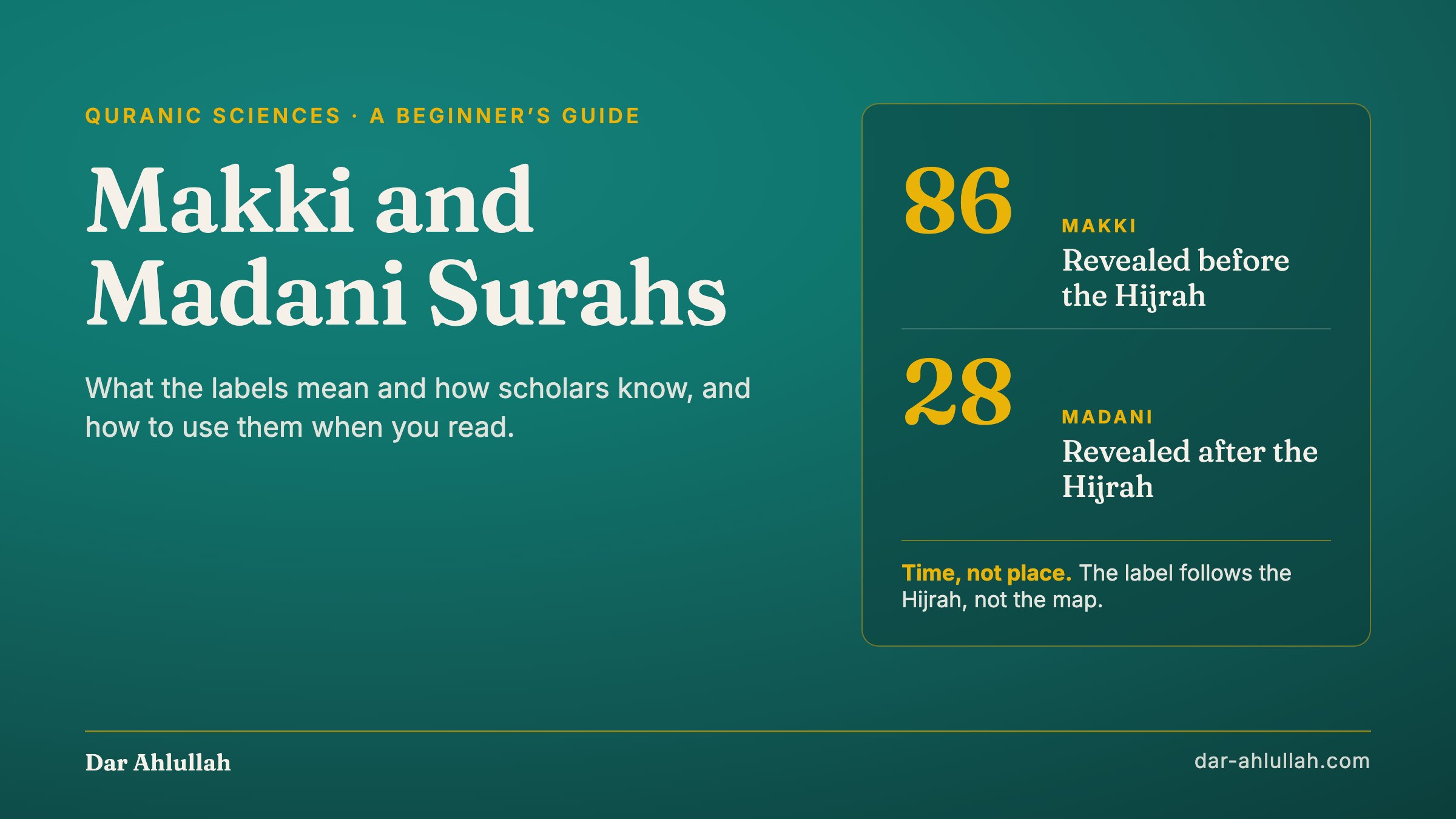
Table of Contents
- Introduction: The Word Beside the Surah’s Name
- The Short Answer
- What Makki and Madani Mean: Time, Not Place
- How the Scholars Know Which Is Which
- How Makki and Madani Surahs Differ
- The Rules of Thumb, Tested Against the Text
- Where the Labels Disagree
- Why the Label Matters
- Using It in Your Own Study
- Five Common Misunderstandings
- How We Teach This
- Questions People Ask
- Conclusion: Read the Label, Then Read the Surah
Introduction: The Word Beside the Surah’s Name
Open a surah in a commentary and the first thing you often meet, before a single verse is explained, is one line about where it belongs. The abridged English edition of Ibn Kathir’s tafsir opens Surah al-Fatihah with “Which was revealed in Makkah” and Surah Muhammad with “Which was revealed in Al-Madinah” (Ibn Kathir on 1:1). quran.com gives each of the 114 surahs a “Revelation Place” on its surah information pages. The two words are Makki and Madani, in English Meccan and Medinan, and many readers see them for years without anyone explaining what they mean.
This guide explains Makki and Madani surahs: what the labels mean and why they follow the Hijrah rather than the map, how the scholars know which is which, how the two groups differ in style and subject, how well the classical rules of thumb hold when you test them against the Arabic text, the surahs where respected references disagree, and how to use the label when you read, reflect and memorize. It is written for adults reading the Quran in translation or learning to read the Arabic. If you are still deciding how to learn the Quran at all, our comprehensive guide to learning the Quran online is the place to start.
The Short Answer
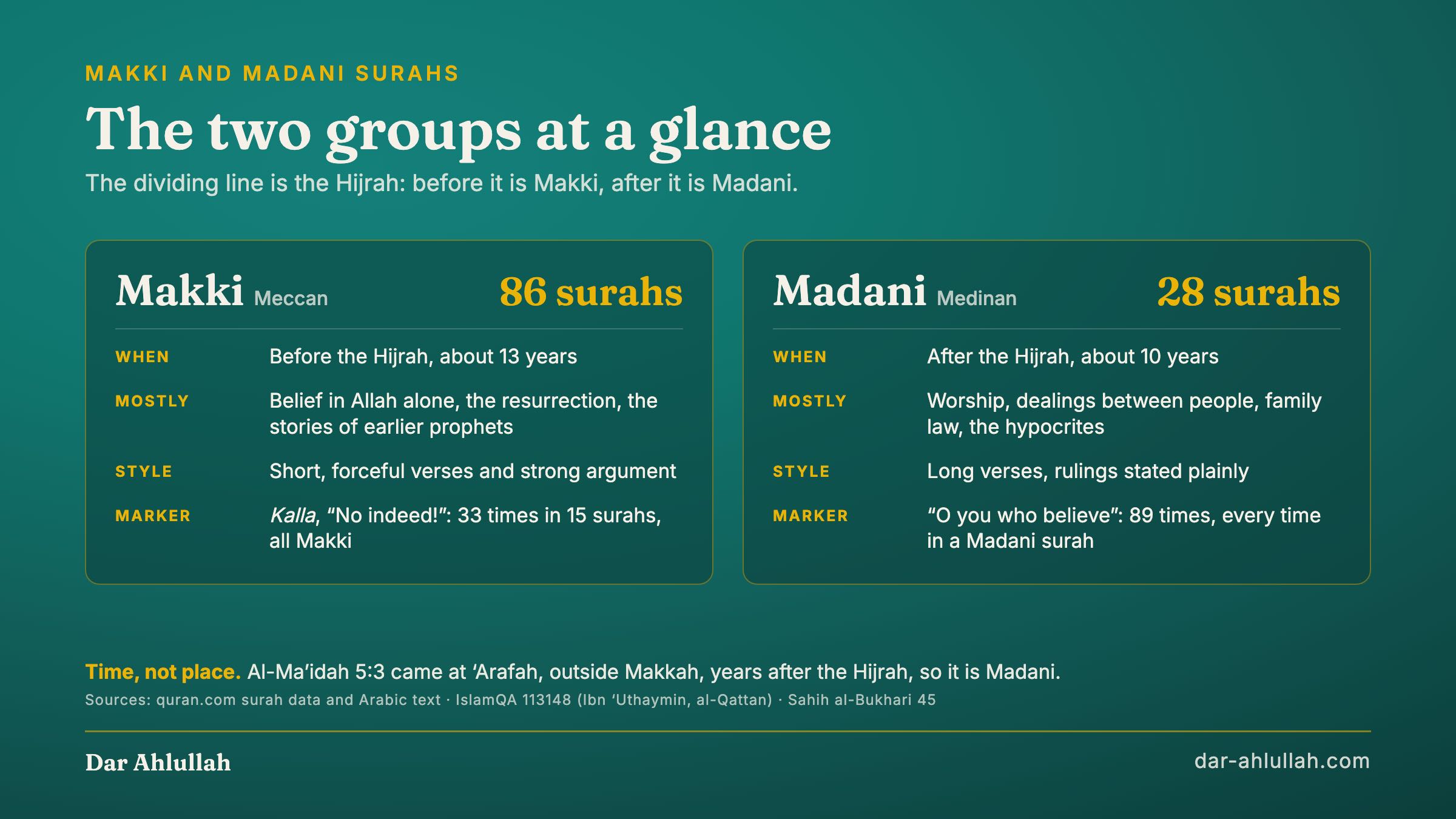
- Makki means revealed before the Hijrah; Madani means revealed after it, wherever the Prophet ﷺ was at the time. Most scholars made the dividing line time, not place (IslamQA 113148).
- quran.com classes 86 surahs as Makki and 28 as Madani. The Makkah period lasted about thirteen years and the Madinah period about ten.
- The knowledge comes from the Companions. Ibn Mas‘ud said there was no surah but he knew where it was revealed (Sahih al-Bukhari 5002). Scholars later drew rules of thumb from what was reported.
- Makki surahs mostly build belief: the oneness of Allah, the resurrection, the stories of earlier prophets, in short and forceful verses. Madani surahs mostly build a community: worship, dealings, the law, the hypocrites, in longer verses (Ibn ‘Uthaymin, Usul al-Tafsir).
- The rules of thumb hold up well. In quran.com’s Arabic text, kalla (“No indeed!”) occurs 33 times in 15 surahs, all of them Makki, and “O you who believe” occurs 89 times, every time in a Madani surah.
- A handful of surahs are disputed. On quran.com itself, the surah data lists al-Ra‘d, al-Hajj, ar-Rahman and al-Insan as Madani, while the Ibn Kathir tafsir beside them heads each one “revealed in Makkah”.
- The label is a reading tool. It tells you who was being addressed and at what stage, which helps with reflection, with the Seerah and with the gradual order of the law.
What Makki and Madani Mean: Time, Not Place
Makki is the Arabic adjective from Makkah and Madani the adjective from al-Madinah. As terms of Quranic study they describe a period, not a location. IslamQA’s answer on this science, IslamQA 113148 (in Arabic), gives the definition that, in its words, became the best known among most scholars. In our translation:
“Makki, of verses and surahs, is what was revealed before the Prophetic Hijrah, whether in Makkah or its surroundings. Madani, of verses and surahs, is what was revealed after the Prophetic Hijrah, whether the place of its revelation was al-Madinah, or Makkah after its conquest, or any place in Arabia to which the Prophet ﷺ went.”
The same answer says the scholars made the classification turn on time and not on place. Two details in that definition are easy to miss. It speaks of verses as well as surahs, so the scholars classify individual verses, not only whole chapters. And a revelation that came in or near Makkah after the Hijrah is Madani. Three narrations in Sahih al-Bukhari show the difference between where and when:
| Passage | Where and when it came | Label |
|---|---|---|
| Al-Qamar 54:46, “Nay! But the Hour is their appointed time…” | In Makkah, while ‘A’ishah was still “a young girl of playing age” (Bukhari 4993) | Makki |
| Al-Fath 48:1, “Verily! We have granted you (O Muhammad) a manifest victory” | At night, while the Prophet ﷺ was on a journey (Bukhari 4177). Anas explains the victory as the treaty of al-Hudaybiyah (Bukhari 4834) | Madani |
| Al-Ma’idah 5:3, “This day I have perfected your religion for you…” | On a Friday, with the Prophet ﷺ standing at ‘Arafah during the Hajj (Bukhari 45) | Madani |
Neither of the last two came in Madinah, and both are Madani, because both came after the Hijrah. That is the whole point of the definition: the label tells you at what stage of the mission a passage arrived, which a map cannot.
How the Scholars Know Which Is Which
The labels rest first on what the Companions reported. They lived through the revelation and remembered it in detail. ‘Abdullah ibn Mas‘ud said:
“By Allah other than Whom none has the right to be worshipped! There is no Sura revealed in Allah’s Book but I know at what place it was revealed; and there is no Verse revealed in Allah’s Book but I know about whom it was revealed.” (Sahih al-Bukhari 5002)
‘A’ishah did the same kind of dating from her own life: a verse of al-Qamar came in Makkah while she was a child at play, and al-Baqarah and an-Nisa’ came “while I was with him”, that is, in Madinah (Bukhari 4993). IslamQA counts this among the benefits of the whole science: Muslims preserved not only the text of the Quran but the time in which it came down.
Where no report settles a passage, the scholars reasoned from the reports they had. Manna‘ al-Qattan describes the method in Mabahith fi ‘Ulum al-Qur’an (pp. 62–64, quoted in IslamQA 113148): the scholars surveyed the Makki and the Madani surahs and drew out rules for each, covering the features of their style and the subjects they treat. Those rules are generalizations from the known cases, which is why each one comes with named exceptions. The section after next tests them.
The same evidence gives a rough order of revelation. quran.com numbers every surah in a revelation sequence that begins with al-‘Alaq, whose first five verses came to the Prophet ﷺ in the cave of Hira (Bukhari 4953), and ends with an-Nasr, which Ibn ‘Abbas confirmed was the last surah revealed (reported by an-Nasa’i and quoted in Ibn Kathir on 110:1). That sequence is the traditional order attributed to Ibn ‘Abbas, which became widely used after the 1924 Egyptian standard edition of the Quran adopted it (Wikipedia: Meccan surah). It orders whole surahs, so treat it as the broad sequence, not as a date for every verse inside them.
How Makki and Madani Surahs Differ
Once the two groups are sorted, the difference between them is easy to hear. Shaykh Ibn ‘Uthaymin summarizes it in Usul al-Tafsir (p. 13, quoted in IslamQA 113148) under two headings, style and subject. Each point below is his, in our translation, with the passages he tells the reader to go and read:
| Makki | Madani | |
|---|---|---|
| Tone | Mostly forceful and stern, because most of those addressed were turning away in arrogance. Read al-Muddaththir and al-Qamar. | Mostly gentle and easy, because most of those addressed were accepting and willing. Read al-Ma’idah. |
| Verses | Mostly short, with strong argument, because most of those addressed were stubborn opponents. Read at-Tur. | Mostly long, with rulings stated plainly and no argument, because their situation called for it. Read the verse of debt, 2:282. |
| Subject | Mostly establishing the oneness of Allah and sound belief, especially worship of Allah alone and belief in the resurrection, because most of those addressed denied them. | Mostly detailing acts of worship and dealings between people, because belief was already settled in the hearts of those addressed. |
| Particular to it | — | Much on jihad and its rulings and on the hypocrites and their ways, because jihad had been prescribed and hypocrisy had appeared. |
Notice the word he repeats: mostly. These are tendencies of whole groups, not walls between them. Al-Qattan adds to the Madani side the explanation of family law, inheritance and prescribed penalties, the address to the People of the Book inviting them to Islam, and the exposure of the hypocrites’ inner workings.
The difference in verse length shows up even in a simple count. By our word count of quran.com’s Arabic text, the 28 Madani surahs hold 1,623 of the Quran’s 6,236 verses, about 26%, but about 39% of its words. A quarter of the verses carry nearly two fifths of the words because the Madani verses are, on average, longer.
‘A’ishah gave the reason the order runs this way when a man from Iraq asked her about the Quran:
“…the first thing that was revealed thereof was a Sura from Al-Mufassal, and in it was mentioned Paradise and the Fire. When the people embraced Islam, the Verses regarding legal and illegal things were revealed. If the first thing to be revealed was: ‘Do not drink alcoholic drinks.’ people would have said, ‘We will never leave alcoholic drinks,’ and if there had been revealed, ‘Do not commit illegal sexual intercourse,’ they would have said, ‘We will never give up illegal sexual intercourse.’” (Sahih al-Bukhari 4993)
Belief first, then the law that belief makes bearable. The Makki and Madani division is, among other things, the record of that order.
The Rules of Thumb, Tested Against the Text
Al-Qattan lists the rules the scholars drew out, as quoted in IslamQA 113148. Several of them are about words, which means they can be checked. We searched quran.com’s Arabic text for each word and compared every hit with quran.com’s own Makki or Madani label. The rules about topics, such as obligations, prescribed penalties and debate with the People of the Book, cannot be tested by a word search, so they are marked as such.
| Rule (al-Qattan, unless noted) | What the text shows |
|---|---|
| A surah containing kalla is Makki. The word comes only in the second half of the Quran, thirty-three times in fifteen surahs. | Exactly 33 times in 15 surahs, the first at Maryam 19:79. All 15 are Makki. No exceptions. |
| A surah containing a verse of prostration is Makki. | The widest list has 15 prostration places (see our guide to sajdah tilawah), falling in 14 surahs. Twelve are Makki; the two Madani ones are al-Ra‘d (13:15) and al-Hajj (22:18, 22:77), and Ibn Kathir’s tafsir heads both of them “revealed in Makkah”. |
| A surah containing “O mankind” and not “O you who believe” is Makki, except al-Hajj, which ends with “O you who believe, bow and prostrate”. Al-Qattan adds that many scholars hold that verse to be Makki too. | “O mankind” occurs 20 times in 9 surahs (one of them, 27:16, is Sulayman addressing people). The five surahs that have it without “O you who believe”, al-A‘raf, Yunus, an-Naml, Luqman and Fatir, are all Makki. The four Madani surahs that have it, al-Baqarah, an-Nisa’, al-Hajj and al-Hujurat, all contain “O you who believe” as well. |
| Not on al-Qattan’s list, but the mirror of the last rule: “O you who believe”. | 89 times in 20 surahs, and every one of those surahs is Madani. The strongest single marker in the text. |
| A surah with the stories of the prophets and past nations, or with Adam and Iblis, is Makki, except al-Baqarah. | Iblis is named 11 times in 9 surahs; al-Baqarah is the only Madani one. The stories themselves are a topic, not a word, so they were not searched. |
| A surah that opens with separate letters, such as Alif Lam Mim, is Makki, except al-Baqarah, Al ‘Imran and al-Ra‘d (Wikipedia). | 29 surahs open with separate letters. 26 are Makki; the three Madani ones are exactly al-Baqarah, Al ‘Imran and al-Ra‘d. |
| A surah that mentions the hypocrites is Madani, except al-‘Ankabut, which is Makki. | The noun for hypocrites (munafiqun and its forms) appears in 25 verses across 9 surahs. Eight are Madani; the ninth is al-‘Ankabut, at 29:11. |
| A surah with an obligation or a prescribed penalty, or with debate with the People of the Book, is Madani. | Topics, not words. Not testable by a search; read for them. |
Two things stand out. The rules fit the standard classification closely, which is what you would expect from rules drawn out of it. And where the data shows an exception, it lands on a surah whose classification is itself disputed: al-Ra‘d and al-Hajj are the only breaks in the prostration rule, and both are in the next section. Use the rules to orient yourself in a surah. Do not use them to overrule a report.
Where the Labels Disagree
A label is a scholarly judgment built on reports, and for some surahs the reports differ. IslamQA points readers who want the full lists, and the scholars’ disagreements over some surahs, to al-Zarkashi’s al-Burhan fi ‘Ulum al-Qur’an and al-Suyuti’s al-Itqan fi ‘Ulum al-Qur’an. You do not need either book to see the disagreement. It is on quran.com, between the site’s surah data and the abridged English Ibn Kathir tafsir it publishes:
| Surah | quran.com surah data | Ibn Kathir’s heading (abridged English, on quran.com) |
|---|---|---|
| 13, al-Ra‘d | Madani | “Ar-Rad was revealed in Makkah” (13:1) |
| 22, al-Hajj | Madani | “Which was revealed in Makkah” (22:1) |
| 55, ar-Rahman | Madani | “Which was revealed in Makkah” (55:1) |
| 76, al-Insan | Madani | “Which was revealed in Makkah” (76:1) |
| 64, at-Taghabun | Madani | “Which was revealed in Al-Madinah or Makkah” (64:1) |
So the count of 86 and 28 is the count of one standard. A reference that settles these surahs the other way will give a different total, and it is not wrong data; it is a different weighing of the reports. For a reader, the practical answer is simple: when you meet one of these surahs, treat the label as open, and let the content of the verses and a good tafsir guide you.
Why the Label Matters
IslamQA 113148 lists six benefits of knowing the Makki and the Madani. In summary:
- Abrogation. Where a later ruling replaced an earlier one, identifying which verse came later depends on knowing when each was revealed. This is scholars’ work, and it is not something to attempt alone from a surah label.
- The history of the law. Seeing how rulings came in stages, and the wisdom in that gradual order, until the law was complete at the end of the Prophet’s ﷺ life.
- Correct understanding. Knowing the time and circumstances of a passage helps you understand it and its aims. The answer warns that whoever cuts texts off from their context in time or place cuts himself off from sound understanding.
- The care of the Muslims for the Quran. They preserved and passed on not only its words but the time each part came down.
- The taste of the language. Each period has its own way of speaking, suited to what it carries, and knowing the period helps you hear it.
- The Seerah. The Quran came down over twenty-three years alongside the events of the Prophet’s ﷺ life, so the Makki and the Madani are a source for the Seerah and a companion to studying it.
Using It in Your Own Study
None of this needs Arabic to start, and all of it deepens as you learn to read the script; our guide on how to read the Quran for beginners covers that path. Five small habits put the label to work.
Check the label before you reflect
Before you sit with a passage, look up its surah and ask who was listening: a persecuted minority in Makkah being called to belief, or a community in Madinah being given its law. That one question changes how a verse reads. It fits naturally into the first step of a tadabbur session, where you choose the passage and read its meaning before reciting it.
Pair the surah with the Seerah
When a Madani surah mentions a battle, a treaty or the hypocrites, find the event. When a Makki surah consoles the Prophet ﷺ or answers an objection from Quraysh, find the year. Our guide on how to study the Seerah calls the question “Meccan or Medinan?” “the highest-yield thing you will learn this month”, and its timeline gives you the periods to place it in.
Notice what you are memorizing
Juz ‘Amma, the thirtieth part where many people begin memorizing, has 37 surahs. quran.com classes 34 of them as Makki; the three Madani ones are al-Bayyinah, az-Zalzalah and an-Nasr. So the short surahs you pray with most are, overwhelmingly, the early message: Allah, the Hour, Paradise and the Fire, in short rhythmic verses. If you are choosing what to learn next, our guide on which surahs to memorize first lays out an order.
Hear the difference for yourself
Take Ibn ‘Uthaymin’s own pair. Read Surah at-Tur in translation, then the verse of debt at 2:282. At-Tur moves in short, hammering verses through oaths and challenges; the verse of debt is a single long, careful instruction about witnesses and writing. Once you have heard the contrast, you will start noticing it on your own.
Read laws with their audience
When a passage of rulings opens with “O you who believe”, it is speaking to people who have already accepted the faith and are being told how to live it. That is the Madani pattern in a phrase, and it is a useful reminder that the Quran’s rules were addressed to a community of believers, not handed to strangers first.
Five Common Misunderstandings
1. “Makki means revealed in the city of Makkah”
It means revealed before the Hijrah. Al-Ma’idah 5:3 came at ‘Arafah during the Hajj and is Madani; al-Fath came on a journey and is Madani.
2. “Makki surahs are spiritual, Madani surahs are legal”
Ibn ‘Uthaymin says mostly, and the text bears him out. Surah al-Isra’ is Makki, yet 17:23–39 is a run of commands: kindness to parents, giving to relatives and the poor, not killing children, not approaching unlawful sexual relations, giving full measure. Al-Baqarah is Madani, yet it opens with belief in the unseen and tells the story of Adam and Iblis.
3. “Every verse in a surah shares its label”
The scholars classify verses as well as surahs. Al-Qattan’s note on al-Hajj 22:77, which many scholars hold to be Makki, is an example of a verse discussed apart from its surah.
4. “A rule of thumb proves a surah’s label”
The rules were drawn out of the classification, not the other way round. A report from the Companions outranks any stylistic sign. That is why the rules carry exceptions, and why the exceptions sit on disputed surahs.
5. “The mushaf is in the order of revelation”
It is not. Al-‘Alaq, the first revealed, is the 96th surah, and al-Baqarah, revealed in Madinah, is the second. The Madani surahs sit mostly near the front and in the middle of the mushaf, and the short Makki surahs near the end.
How We Teach This
The label is easy to look up. What takes a teacher is reading the surah it sits on: reciting the Arabic correctly, learning enough of its most common words to hear the difference between a Makki and a Madani passage, and placing a surah in the life of the Prophet ﷺ so that its verses read as answers to real moments.
Dar Ahlullah runs one-to-one live sessions with certified teachers, scheduled around your own time zone, in Quran reading, Tajweed, Hifz, Arabic and Islamic Studies. Teaching is charged at $9 per teaching hour, with monthly plans at $36, $70 and $102 depending on how many hours you want, and a 20% discount for siblings. You can pause, upgrade or switch plans at any time, and if a teacher is not the right fit we rematch you with another certified mentor at no extra cost. The first step is a free 30-minute assessment that does not ask for a card — the details are on our pricing page.
Questions People Ask
How many Makki and Madani surahs are there?
quran.com classes 86 as Makki and 28 as Madani, and Wikipedia gives the same totals. Other references can give slightly different numbers because a handful of surahs, such as al-Ra‘d, ar-Rahman and al-Insan, are classified differently by different scholars.
Is Makki the same as Meccan?
Yes. Makki and Madani are the Arabic adjectives; Meccan and Medinan are the usual English ones. You will also see Makkan, Makkiyyah and Madaniyyah. They all name the same two periods.
Is Surah al-Fatihah Makki or Madani?
quran.com classes it as Makki and places it fifth in its revelation order, after al-‘Alaq, al-Qalam, al-Muzzammil and al-Muddaththir. Ibn Kathir’s tafsir heads it “Which was revealed in Makkah”.
What was the first surah revealed?
The first revelation was the opening of al-‘Alaq, “Read, in the Name of your Lord Who has created”, given to the Prophet ﷺ in the cave of Hira (Sahih al-Bukhari 4953). Only its first five verses came then.
What was the last surah revealed?
Ibn ‘Abbas confirmed that the last surah revealed was an-Nasr, “When there comes the help of Allah and the Conquest”, in a report an-Nasa’i recorded and Ibn Kathir quotes. quran.com places it 114th in its revelation order.
Do I need to memorize which surahs are Makki and which are Madani?
No. The label is one click away on quran.com, and tafsirs such as Ibn Kathir’s often state it at the start of a surah. What is worth carrying in your head is the difference itself, so that when you read a passage you can ask who it was speaking to and at what stage.
Can a Makki surah talk about law, or a Madani surah about the Hereafter?
Yes. The differences describe what each group mostly contains, in Ibn ‘Uthaymin’s word. Al-Isra’ (Makki) contains a long run of commands, and al-Baqarah (Madani) is full of belief, the unseen and the Day of Judgment.
Conclusion: Read the Label, Then Read the Surah
Makki and Madani are not places on a map. They are two stages of one mission: thirteen years of calling people to Allah and the Hereafter, then ten years of building a community on that belief. The Companions remembered which passage belonged to which, the scholars drew rules from what they remembered, and those rules still hold remarkably well when you test them against the text.
Next time you open a surah, read the one word beside its name before you read the first verse. Ask who was listening and what they had already accepted. Then read the surah, and you will hear it the way it was first heard.
Related articles
how to reflect on the Quran
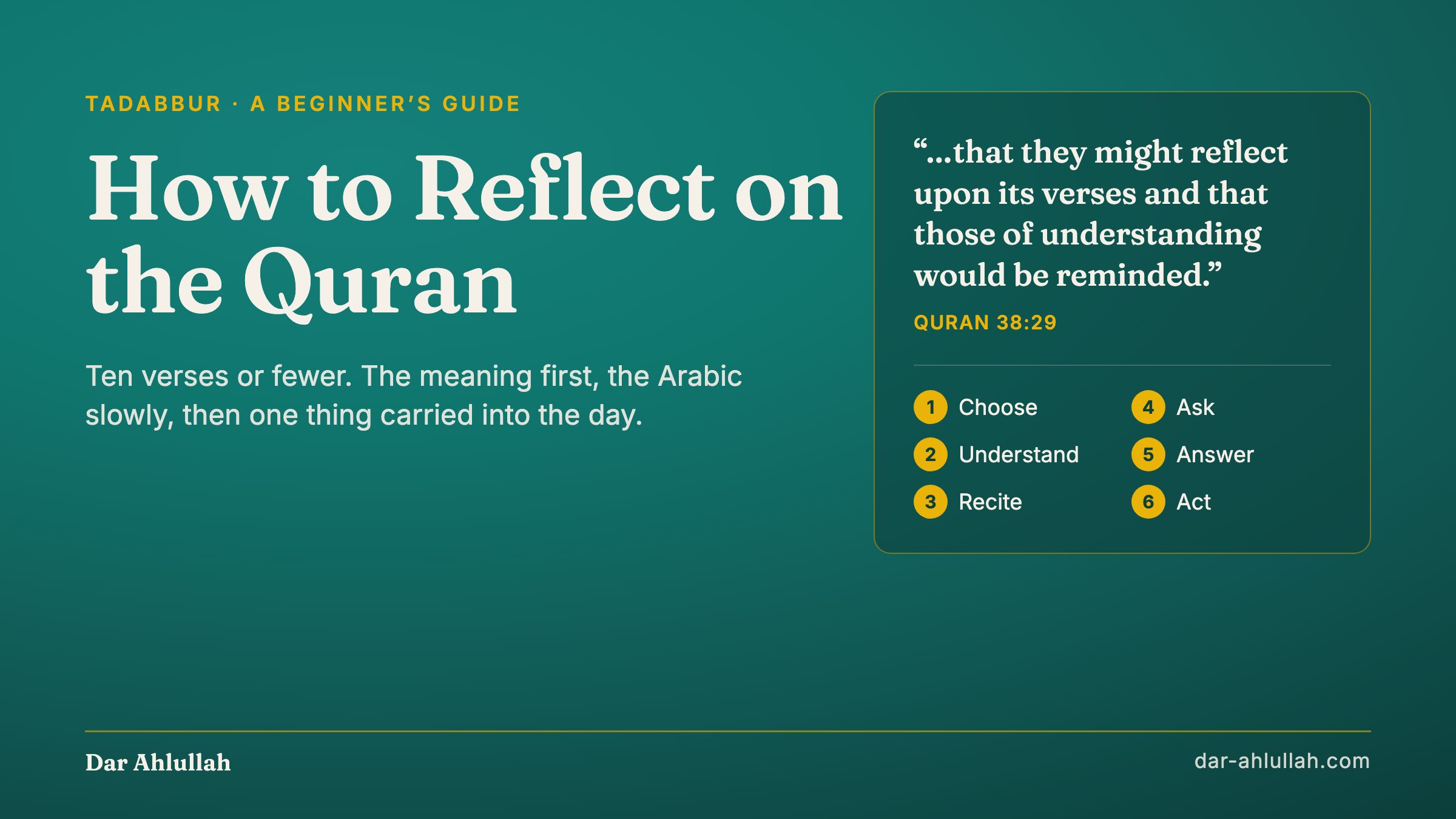
How to Reflect on the Quran: A Beginner’s Guide to Tadabbur
Tadabbur, reflecting on the Quran, is a purpose of its revelation and open to every Muslim, translation in hand. What it is and is not, how far a translation takes you, how the Prophet ﷺ and the Companions read, a six-step method for one session, and Surah al-‘Asr worked through.
19 min read
which surahs to memorize first
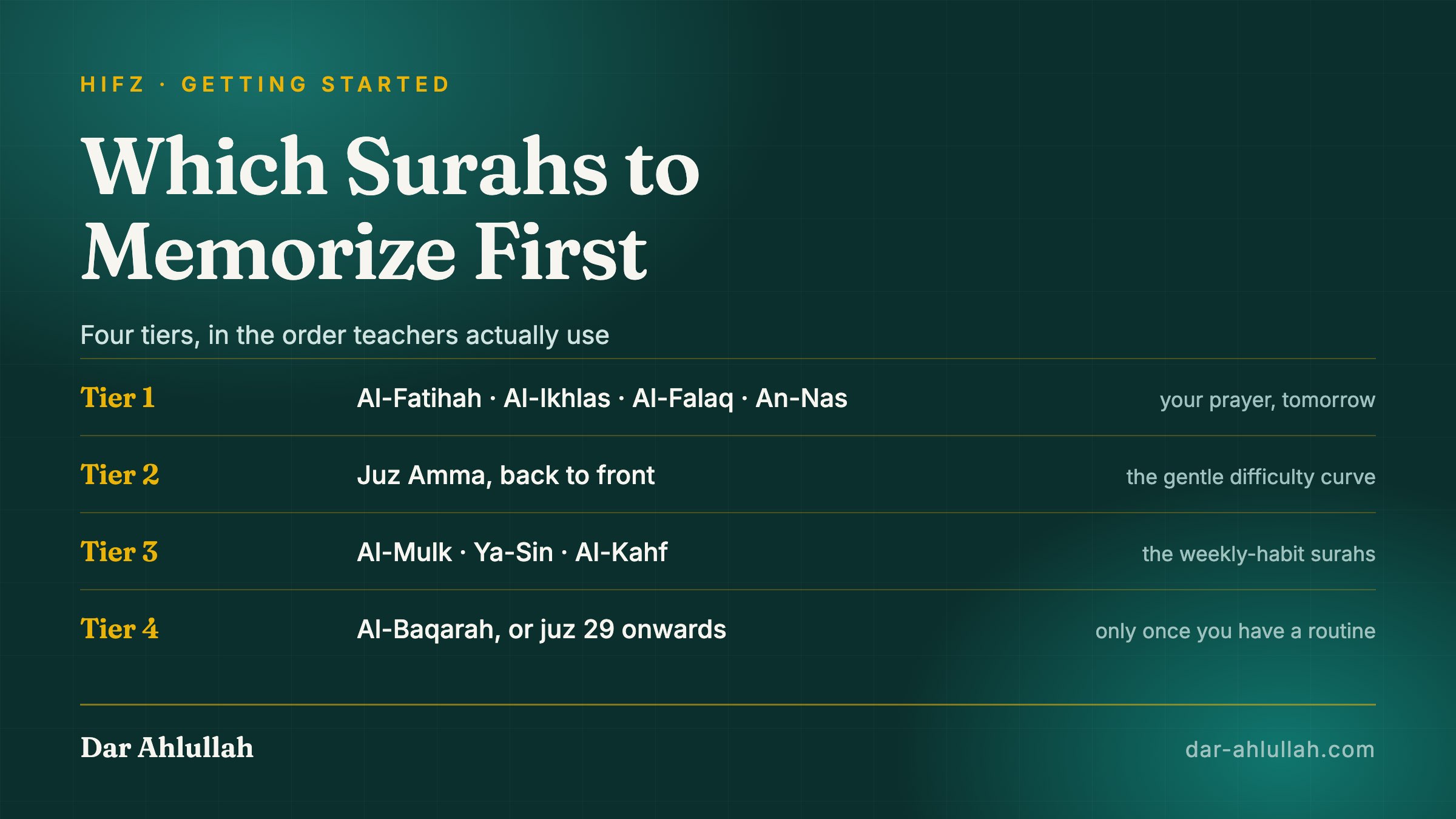
Which Surahs to Memorize First: A Practical Order
Almost nobody asking which surahs to memorize first is really asking about surahs. Here is the order teachers actually use, the reason behind each step, and the point where beginners lose a year.
15 min read
how to study the Seerah
How to Study the Seerah: A Beginner’s Reading Plan
Most people stall in the first four chapters of a Seerah book because they started with the flesh instead of the skeleton. Thirteen years in Mecca, ten in Medina, one book finished properly, and the Quran open beside it.
18 min read