
what happens in a free Quran trial class
What Happens in a Free Quran Trial Class? A Step-by-Step Guide
Dar Ahlullah team 17 min read
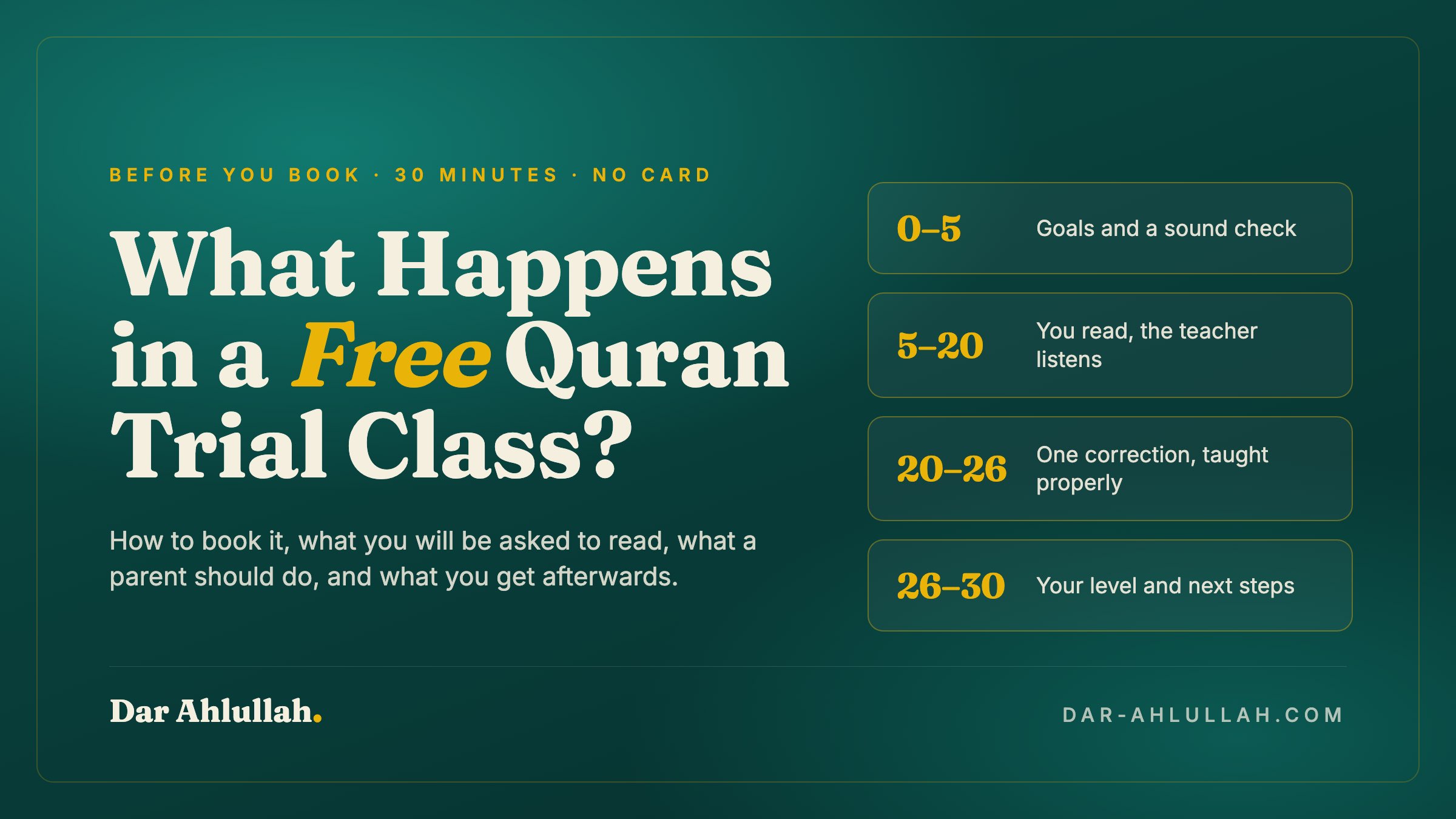
Table of Contents
- What Actually Happens in a Free Quran Trial Class?
- How Do You Book One, and What Do You Need Ready?
- What Does the Teacher Do in Each Part of the 30 Minutes?
- What Will You Be Asked to Read?
- What Should a Parent Do During a Child’s Trial?
- What Should You Ask Before the Trial Ends?
- What Happens After the Trial?
- How Is a Trial Different From a Regular Lesson?
- What Does the Free Assessment at Dar Ahlullah Look Like?
- Quick Answers Before You Book
- The Short Version
What Actually Happens in a Free Quran Trial Class?
A free Quran trial class is a live, one-to-one video lesson, usually 30 minutes long, in which a teacher asks what you want to achieve, listens to you or your child read or recite for most of the time, teaches one small correction, and tells you where you would start. You leave knowing your level and the path the academy recommends. Nothing is owed, and at a reputable academy no card details are taken.
That is the whole event. It is not a webinar, not a group demonstration, and not a recorded video. It is also not supposed to be a sales presentation, although some academies run it as one, and the sections below explain how to tell the difference inside the first ten minutes.
Two things make a free Quran trial class worth more than a casual look. First, it is the only moment when you see the teaching before you pay for it, and the teaching is the product; the website copy is not. Second, it produces something concrete: a placement. A beginner finds out whether they start with the letters or with a primer; a reader finds out which tajweed rules they are missing; a memorizer finds out whether their retention is solid. If you are still at the earlier stage of deciding whether online lessons suit you at all, our complete guide to learning Quran online covers that question. This article assumes you are ready to try one.
How Do You Book One, and What Do You Need Ready?
You book through the academy’s website form or by messaging them, you are offered a time, and you receive a video link, almost always for Zoom. You need a laptop, tablet or phone with a working camera and microphone, a quiet corner, and nothing else. A complete beginner does not need a copy of the Quran; the teacher shows everything on screen.
Three details matter more for a family in the United States or Canada than the booking form suggests:
- Confirm the time in your own time zone. Many online Quran teachers work from time zones several hours ahead of Eastern or Pacific time. Write the slot back to the academy as “7:00 pm Eastern” or “4:30 pm Pacific” and have them confirm it in those words. A trial that lands at 4 am because of a conversion error is an avoidable way for a good match never to meet.
- Ask for a slot you could actually keep every week. The trial teacher is often the teacher who would take the regular lesson, and a slot that is free this Thursday is not the same as a slot that is free every Thursday through June. Say when you would want weekly lessons, and see whether the trial can happen at that hour.
- Say who the student is when you book. Age, whether they can read Arabic letters yet, what the goal is (reading, tajweed, memorization, or simply praying with confidence), and whether you want a female teacher. This is what lets the academy assign the right person rather than whoever is free.
On the day, join five minutes early, check that the teacher can hear you, and sit somewhere with light on your face rather than behind you. For a child, that means a table and a chair, not a sofa, with a pencil and paper within reach.
If you are an adult who has never read Arabic, or you read haltingly and feel embarrassed about it, know that the teacher has heard every version of a first lesson, and that the struggle itself is rewarded. The Prophet (peace be upon him) said that the one who exerts themselves to learn the Quran and recites it with great difficulty has a double reward (Sahih al-Bukhari 4937). Our guides for new Muslims starting Quran classes and for adults learning Quran from the alphabet both begin from exactly this point.
What Does the Teacher Do in Each Part of the 30 Minutes?
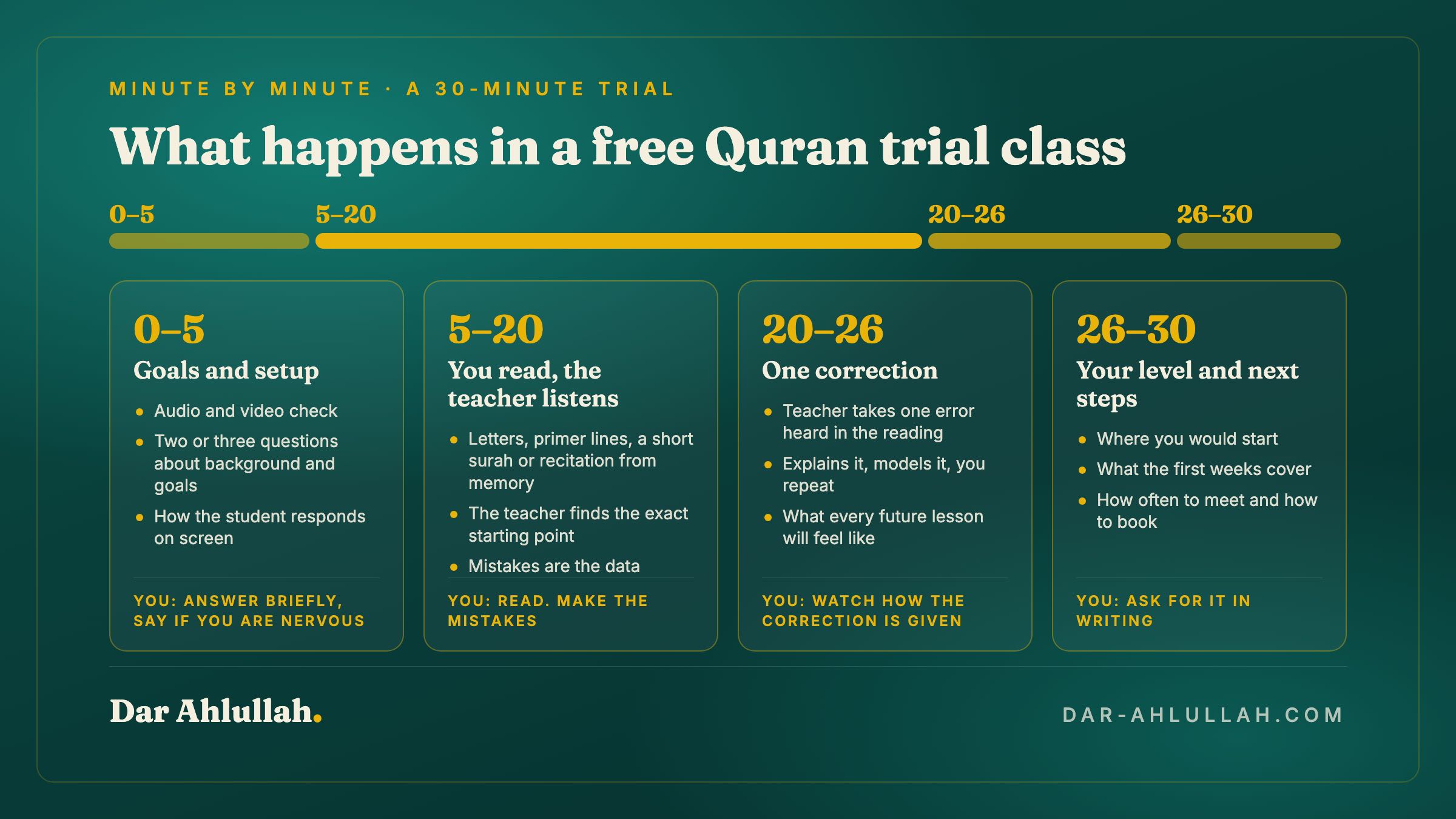
A well-run trial has four parts: a few minutes of introductions and goals, a long middle in which the student reads or recites and the teacher listens, a short piece of real teaching built on one mistake the teacher heard, and a closing placement with next steps. The proportions matter more than the exact minutes. If the student is talking and reading for less than half the session, the teacher has not diagnosed anything.
| Minutes | What happens | What the teacher is finding out | What you should do |
|---|---|---|---|
| 0–5 | Greetings, a check that audio and video work, two or three questions about background and goals | Whether the student has read before, what the family wants, how the student responds to a stranger on screen | Answer briefly and honestly; say if you are nervous. Let a child answer for themselves where they can. |
| 5–20 | The assessment: letters on screen, lines from a beginner primer, a passage from a short surah, or recitation from memory, depending on level | The exact starting point: which letters are shaky, which vowel marks are guessed, which tajweed rules are missing, how memorization holds up | Read. Make the mistakes. Do not apologize for them; they are the point of the exercise. |
| 20–26 | A mini-lesson: the teacher takes one error heard in the reading, explains it, models it, and has the student repeat it until it improves | Whether the student can take a correction and apply it; whether the explanation style lands | Watch how the correction is given. This is what every future lesson will feel like. |
| 26–30 | Placement and next steps: where the student would start, what the first weeks cover, how often to meet, how to book | Whether the family wants to go ahead, and at what pace | Ask your questions (see below). Ask for the assessment in writing. |
The middle block is the one to protect. A trial that spends fifteen of its thirty minutes on a presentation about the academy, its teachers and its packages, and then rushes the student through two lines of reading, is a sales call with a reading attached. Politely steering back (“could we start with my son reading, so you can see his level?”) is reasonable, and how the teacher responds is itself informative.
What Will You Be Asked to Read?
It depends entirely on where you are, and a good teacher finds that out within two minutes and adjusts. A complete beginner is shown single letters and asked to repeat their sounds. Someone who knows the letters reads short vowelled words or a few lines from a beginner primer. A fluent reader is asked for a passage from a short surah so the teacher can hear the tajweed. A memorizer recites from memory while the teacher follows along in the text.
- Never read Arabic. Expect letters on the screen, one at a time, and the teacher saying each sound for you to copy. The teacher is listening for the sounds English does not have, such as the throat letters, because those are what the first months of lessons will work on. Nobody expects you to read a word. The usual recommendation afterwards is a primer such as the Noorani Qaida, and our guide to how to read the Quran for beginners shows the stages that follow.
- Know the letters, read slowly. Expect a few lines of vowelled text, probably from a primer or from the short surahs at the end of the Quran. The teacher is checking whether you join letters correctly, whether the short vowels are read or guessed, and whether the long vowels are held.
- Read fluently, want tajweed. Expect to be asked for something you know well, such as Surah al-Fatihah or a surah you pray with, and then something you do not, so the teacher hears both your habits and your sight-reading. Rules such as the nasal sounds, the elongations and the heavy and light letters are what gets noted.
- Memorizing, or already a hafiz. Expect to recite a portion from memory and be stopped and tested with the beginning of a verse from elsewhere in the same surah. The teacher is checking retention and tajweed at the same time, and will ask about your revision routine.
Whatever your level, the mistakes you make in the trial are not a mark against you. They are the data the placement is built on, and a trial in which you made none would have told the teacher very little.
What Should a Parent Do During a Child’s Trial?
Sit beside a young child or within earshot of an older one, stay quiet, and let the child struggle a little. Do not answer for them, do not correct their reading yourself, and do not apologize to the teacher on their behalf. Your job is to watch the teacher, not to manage the child, because what you see in this half hour is what every lesson will look like.
Three things to watch:
- Who does the talking. After the first few minutes the child should be reading, repeating or answering for most of the time. A teacher who recites and explains for twenty-five of thirty minutes has not diagnosed anything.
- How mistakes are handled. The right correction is specific and kind: this letter, from this part of the mouth, listen, now you. Letting errors pass is as unhelpful as piling on, and a child who is corrected harshly in a trial will not want week two.
- What the teacher does when attention drifts. A five-year-old will drift. A good teacher notices within a minute and changes the activity, switches to a game with the letters, or asks the child a question about themselves. A teacher who plows on through a glazed child will do the same every week.
Children who freeze in the first minutes are normal, and a competent teacher has a routine for it. If your child says nothing for the whole half hour, that tells you something about the match, not about your child. Afterwards, ask the child one question (“would you like to see that teacher again?”) and weigh the answer. For whether a four-year-old is ready for a trial at all, see our guide to what age a child should start learning Quran. The fuller seven-point list for judging an academy, including who else can see the lesson and what the exit terms are, is in how to choose an online Quran academy.
What Should You Ask Before the Trial Ends?
Leave with four answers: where the student would start, who the weekly teacher will be and whether it is the person you just met, what the first month covers, and what it costs per teaching hour in total. If the last few minutes are spent on packages before those four are answered, ask for them directly.
Two of them deserve a second look. On the teacher: at some academies the trial is taken by a senior teacher and the weekly slot goes to someone else. That is not necessarily wrong, but you should know it, and you can ask to meet the assigned teacher before paying. On price: academies quote monthly figures that hide the hourly rate. Eight 30-minute sessions for $36 is about $9 an hour; four 30-minute sessions for $40 is $20 an hour. Our guide to what online Quran classes cost sets out how to do that division across the market. If you want a female teacher for a daughter or for yourself, ask now rather than after the first invoice; our guide to finding a female Quran teacher online explains what to check.
What Happens After the Trial?
Within a day or two you should receive the assessment and a recommended plan, ideally in writing: the starting point, the material, how many sessions a week, and the price. You then choose a weekly slot and pay for the first month, or you say no and nothing is owed. There is no third outcome at an honest academy; if you are told that the price only holds until tonight, treat it as a reason to walk away rather than hurry.
A few practical points for the days after:
- Keep the gap short. The first paid lesson should be within a week of the trial. A placement goes stale, and so does a child’s enthusiasm.
- Two trials beat one. Booking a trial at a second academy in the same week, with the same student, is the most informative hour you can spend on this decision. A diagnostic lesson and a sales call are obvious when seen back to back.
- Decide at six weeks, not at thirty minutes. The trial is enough to rule an academy out; it is not enough to rule one in, because it cannot tell you whether the schedule will hold or whether progress accumulates. Our article on whether online Quran classes are worth it describes the six-week test to run after you start.
How Is a Trial Different From a Regular Lesson?
The trial is a diagnosis; a regular lesson is treatment. Both are live and one-to-one, and both should have the student doing most of the reading, but the trial covers a wide range quickly to find the level, while a regular lesson goes deep on one page or one rule. The other difference is what you receive afterwards: a placement from the trial, a short progress note from each lesson.
| Free trial class | First paid lesson | Typical weekly lesson | |
|---|---|---|---|
| Purpose | Find the level, show the teaching, agree a path | Start the path: set up the book, the routine and the homework habit | Move one step along the path and fix what went wrong since last time |
| Length | Usually 30 minutes | 30 or 60 minutes, as booked | 30 or 60 minutes, as booked |
| Who talks | Student reads for most of it; teacher asks and listens | Student reads and repeats; teacher explains more than usual | Student reads and recites; teacher corrects and sets the next piece |
| Material | Whatever reveals the level: letters, primer lines, a short surah, or recitation from memory | The first page of the agreed book or the first assigned passage | The next page, plus revision of the last one |
| What you get after | A placement and a recommended plan | The first homework and the weekly routine | A short progress note and the next assignment |
| Cost | Free; no card at a reputable academy | Part of the first month’s plan | Part of the monthly plan |
One consequence of the difference: do not judge the trial on how much was learned. Thirty minutes of being listened to and one well-taught correction is a good trial. Judge it on whether the teacher found your level, whether you were corrected clearly, and whether you would want that person on your screen every week.
What Does the Free Assessment at Dar Ahlullah Look Like?
Dar Ahlullah calls its trial a free assessment, and it runs the way this article describes: a complimentary 30-minute, one-to-one session on Zoom in which a mentor evaluates the learner’s Quran reading, tajweed and memorization level, followed by a personalized roadmap built around the student’s age, goals and pace. It is free, with no credit card and no obligation.
What our published pages state about it:
- It is a real lesson. The first session is taught as a lesson, not run as a sales call. Sit it, judge the teaching, then decide.
- You are told if we are the wrong fit. We are a small academy, and if we cannot serve a student well, including when the teacher you need is one we do not have yet, we say so.
- Teacher matching, and a rematch if needed. Learners are paired with a certified teacher who fits their personality and learning style, and if the first teacher is not right, you are rematched with another certified mentor at no extra cost. Male and female certified teachers are available.
- One price afterwards. About $9 per teaching hour on every plan: $36 a month for eight 30-minute sessions, $70 for eight full hours, $102 for twelve hours, with a 20% sibling discount. Plans can be paused, upgraded or switched at any time, and evening scheduling is normal.
To book, request the free assessment and either message an advisor on WhatsApp to arrange the time or create your account directly. Say who the student is and when in your week the lesson would need to sit, and the session will be set up at that hour.
Quick Answers Before You Book
Do I need to know any Arabic for a Quran trial class?
No. Beginners are shown letters on screen and asked to repeat sounds. The teacher’s job is to find your level, and “never read a letter” is a level.
Is the trial really free? Will I be asked for a card?
At a reputable academy it is free and no card is taken; Dar Ahlullah’s is. If an academy asks for payment details “to hold the slot,” ask why, and be ready to look elsewhere.
How long does a free Quran trial class last?
Thirty minutes is the common length, and it is enough to find a level and teach one correction. Shorter trials exist and can still be useful; a trial that runs much longer is usually a presentation.
Can I book trials at more than one academy?
Yes, and you should. Two trials in the same week with the same student is the clearest comparison you can get, and no academy is owed exclusivity for a free lesson.
Can I ask for a female teacher?
Yes, and the time to ask is when you book, so the trial is taken by the kind of teacher who would take the weekly lesson. Many academies, including ours, have female certified teachers.
What if my child will not speak?
Freezing in the first minutes is normal. A good teacher has a routine for it: an easier task, a game with the letters, a question about the child’s day. If the whole half hour passes in silence, try a different teacher before concluding your child is not ready.
Do I need to install anything?
Usually Zoom, which is free for participants, on a laptop, tablet or phone with a camera and microphone. The link arrives before the session; open it five minutes early to check your sound.
What if the trial felt like a sales pitch?
Then you have learned what you came to learn. Thank them, do not pay on the day, and book a trial elsewhere. The academy that spends the thirty minutes listening to you read is the one to go back to.
The Short Version
A free Quran trial class is thirty minutes, live and one-to-one: a few minutes on goals, a long stretch of you or your child reading while the teacher listens, one correction taught properly, and a placement with next steps. Book it at the hour you could keep weekly, confirm the time in your own time zone, say who the student is, and sit somewhere quiet with the camera on. Watch who does the talking and how mistakes are handled. Leave with four answers: where you start, who teaches you, what the first month covers, and the price per teaching hour. Then take a day, compare it with a second trial if you can, and decide at six weeks rather than at thirty minutes.
Related articles
are online Quran classes worth it
Are Online Quran Classes Worth It? An Honest Answer
Online Quran classes are worth paying for when the learner needs a human ear, has no good local option, and lives in a household that will keep the slot. Here are the five cases where they are, the five where they are not, the maths on a year, and a six-week test that settles it.
20 min read
how to choose an online Quran academy
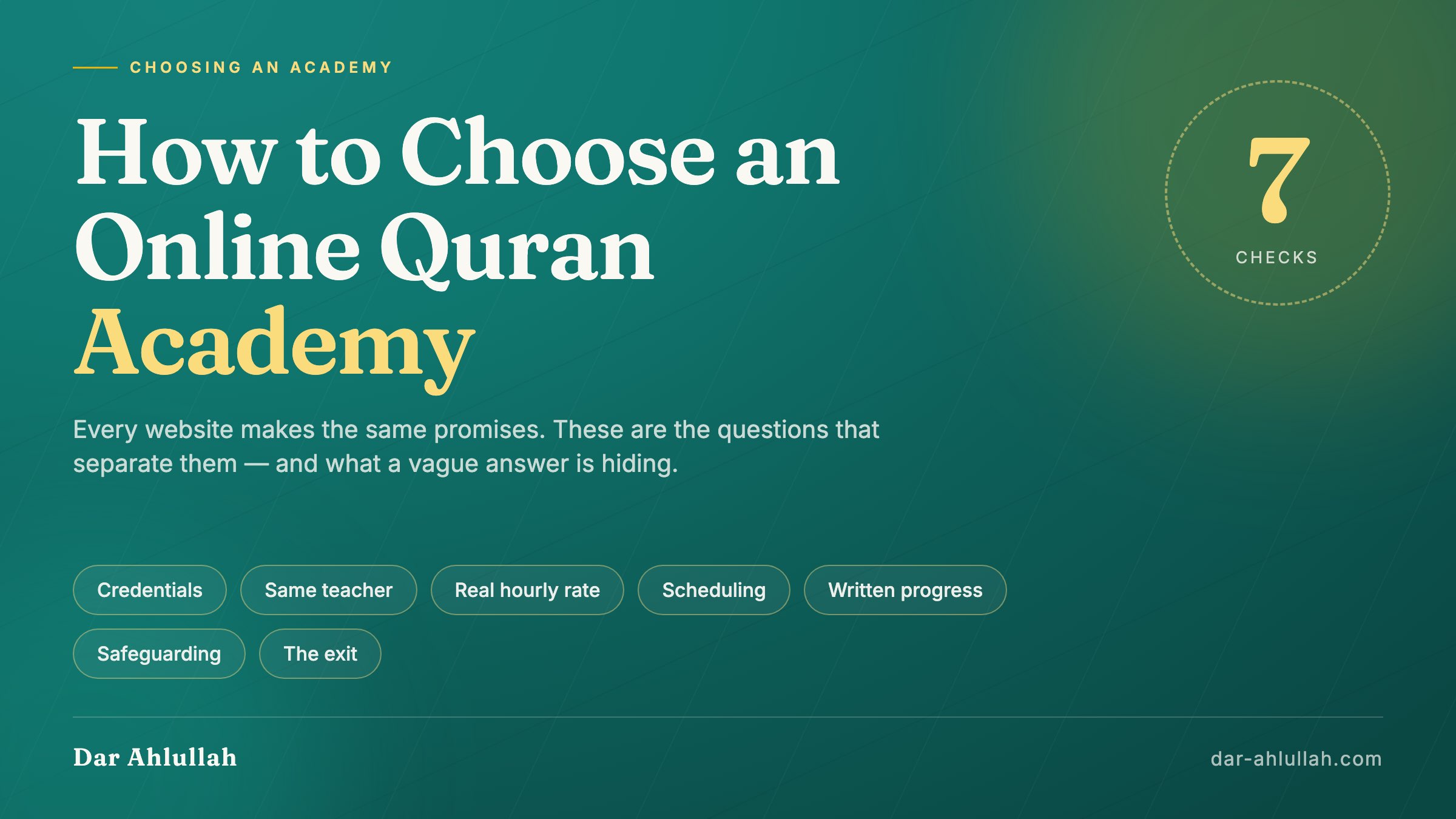
How to Choose an Online Quran Academy for Your Child
Every academy's website says the same six sentences. What separates them are the operational details nobody advertises: teacher continuity, the real hourly rate, clock changes, written progress, safeguarding, and the cancellation policy.
18 min read

online Quran classes cost
How Much Do Online Quran Classes Cost? (2026 Price Guide)
Online Quran classes cost anywhere from $10 to $100 a month — but the monthly price tells you almost nothing. Here are the real per-hour numbers, the hidden fees to check, and our full price list.
8 min read