
are online Quran classes worth it
Are Online Quran Classes Worth It? An Honest Answer
Dar Ahlullah team 20 min read
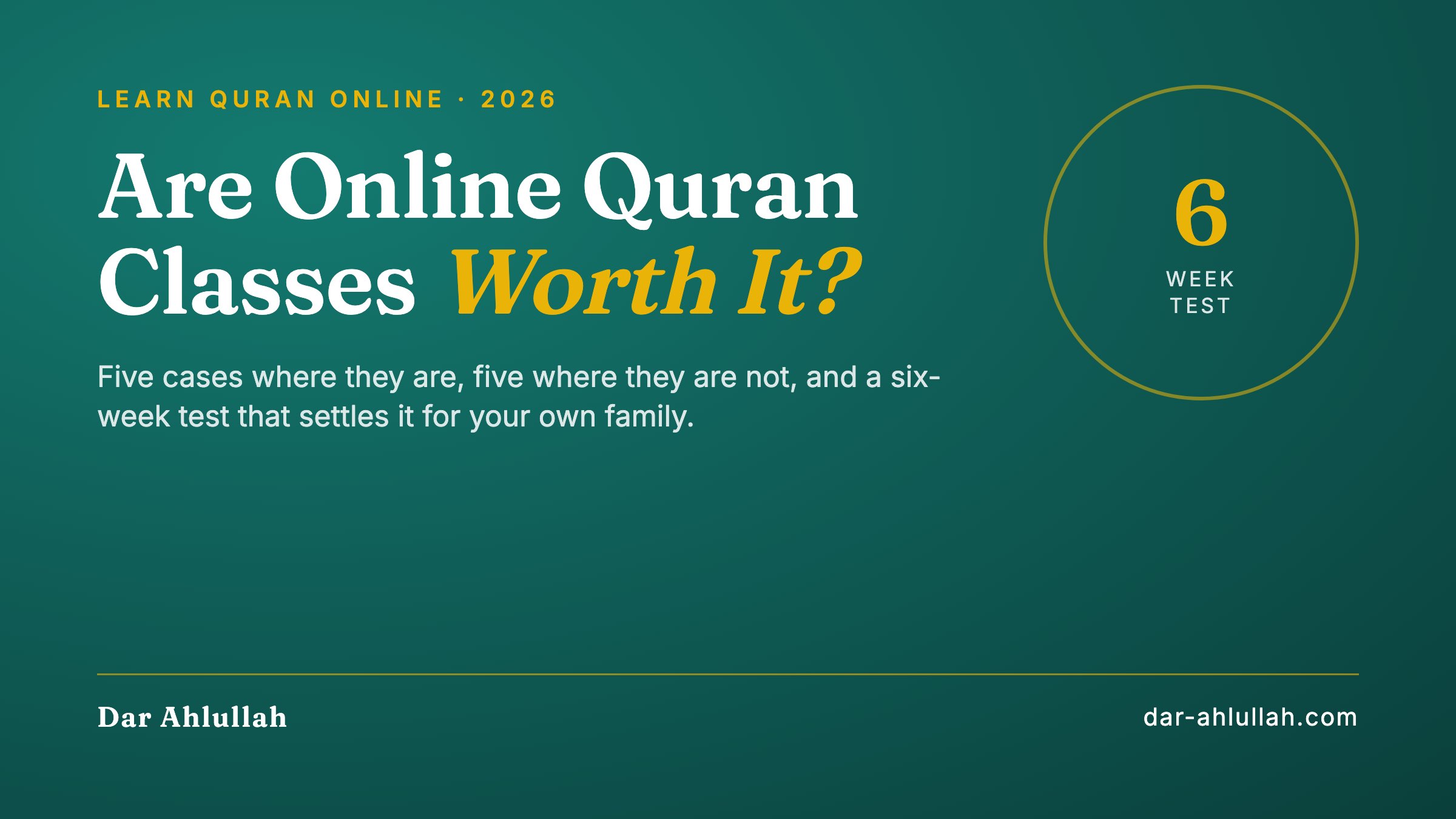
Table of Contents
- Introduction: The Question Behind the Question
- The Short Answer: Worth It for Some People, Not for Others
- What You Are Actually Paying For
- What the Research on One-to-One Teaching Says, and What It Does Not
- Five Situations Where Online Classes Are Clearly Worth It
- Five Situations Where They Are Not
- Why the Free Alternatives Are Not the Same Product
- The Maths: What a Year Costs and What It Should Buy
- The Six-Week Test: How to Know Whether It Is Working
- The Part No Price Covers
- How We Would Answer This About Our Own Classes
- FAQs: Are Online Quran Classes Worth It?
- Conclusion: Judge It in Six Weeks, Not Six Tabs
Introduction: The Question Behind the Question
Nobody types are online Quran classes worth it into a search bar out of idle curiosity. You type it with a monthly figure in your head, a child or a version of yourself in mind, and a nagging sense that the same money could go somewhere with a more certain return. The question underneath is not really about online classes. It is: will this actually produce a person who can read the Quran, or will I be paying for a weekly video call that feels like progress and is not?
That is a fair question and it deserves a straighter answer than the one most academies give, which is a list of benefits with the word “flexible” in it four times. The honest answer is that online one-to-one Quran classes are worth it in some situations and not in others, and the situations are knowable in advance. This article sets them out, explains what you are actually buying when you pay for a session, looks at what the research on one-to-one teaching does and does not tell us, and does the arithmetic on what a year costs against what a year should produce.
It is written by people who sell online Quran classes, so read it with that in mind. We have tried to make it the article we would want to read if we were the ones deciding, which means it includes the cases where we would tell you to keep your money. If you are earlier in the process and still working out what learning online involves at all, our complete guide to learning Quran online covers the ground this one assumes.
The Short Answer: Worth It for Some People, Not for Others
Online Quran classes are worth paying for when three things are true at once: the learner needs someone to hear them and correct them out loud, they do not have a good teacher within reach locally, and there is an adult who will hold the weekly slot steady for at least a few months. Take any one of those away and the case weakens fast.
Put more bluntly:
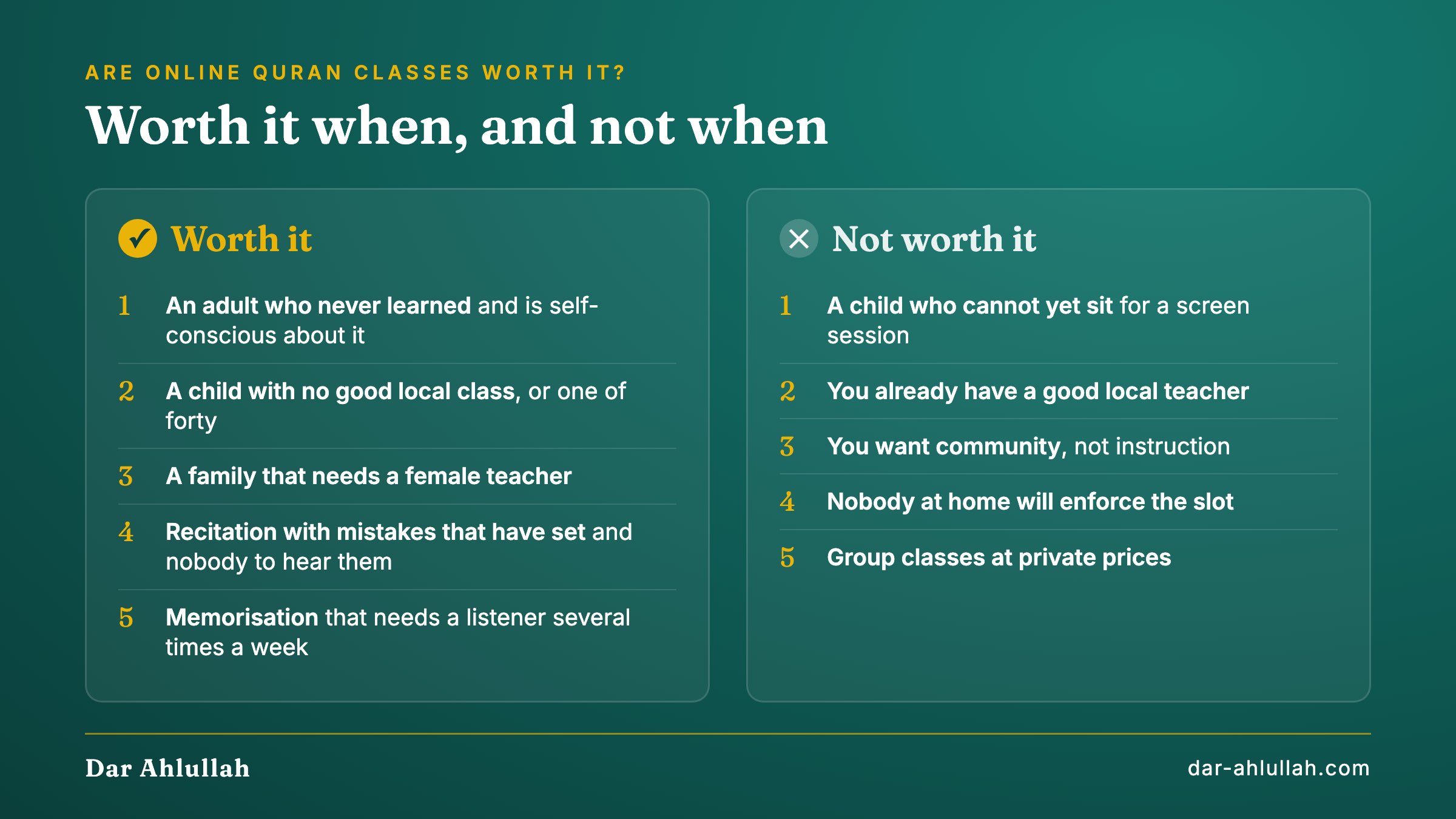
- Worth it: an adult who never learned to read Arabic and is embarrassed about it; a child in a town with no masjid class or a masjid class of forty; a family that wants a female teacher for a daughter; anyone whose recitation has fossilised mistakes that a video cannot detect; anyone working on memorisation who needs a listener, not a lecture.
- Not worth it: a child under about five who cannot sit through a screen session; a family that already has a good local teacher and mostly wants it to feel more modern; someone who wants Islamic community rather than instruction; anyone who knows, honestly, that the slot will be skipped whenever the week gets busy; and anyone paying private-lesson prices for a group class.
The rest of this article is the reasoning behind that list, because the short version is only useful if you know which side of each line you are on.
What You Are Actually Paying For
Strip away the website copy and an online Quran class is a purchase of three things. Being clear about them is most of the way to knowing whether the price is worth it.
1. Teacher airtime that is entirely yours
In a group of twelve, each child recites for a few minutes and listens for the rest. In a one-to-one session, the learner is reciting, being stopped, and reciting again for the whole slot. A thirty-minute private lesson can contain more corrected recitation than a two-hour group class. This is the core product, and it is why comparing monthly prices without dividing by your minutes is meaningless. We went through that arithmetic in our guide to what online Quran classes cost, and the conclusion was that the only honest unit is the price per private teaching hour.
2. Correction of sound, not just of text
Reading the Quran correctly is a physical skill. The difference between ح and ه, between a heavy and a light letter, between a vowel held for two counts and four, lives in the mouth and the ear, not on the page. You cannot see it in a textbook and an app cannot hear it. A teacher who stops you on the third word of al-Fatihah and makes you produce it again until it is right is doing something no free resource does. If the learner already reads correctly and wants to deepen understanding, this component matters less, and so does the case for paying.
3. Continuity: the same teacher, the same slot, a written record
Progress in Quran reading is cumulative and fragile. What was learned in March is lost by June unless it is revisited. A named teacher who keeps notes, remembers that you struggled with the letter qaf last month, and holds the same Tuesday slot is worth more than a rotating pool of “whoever is available”, and that is a question to ask any academy before you pay. Our seven checks for choosing an online Quran academy puts teacher continuity second on the list, behind only what the credentials actually mean.
What the Research on One-to-One Teaching Says, and What It Does Not
There is a large body of research on tutoring in general education, and it is worth knowing both what it shows and where it stops.
The famous starting point is Benjamin Bloom’s 1984 finding, usually called the two sigma problem: students taught one-to-one using mastery methods performed about two standard deviations better than students taught in a conventional classroom, which put the average tutored student above roughly 98% of the classroom group. Bloom himself framed this as a problem because one-to-one teaching was too expensive to give everyone, and he challenged educators to find group methods that could match it.
Later and larger studies found smaller numbers, but still large ones. A 2020 systematic review and meta-analysis of experimental tutoring studies by Nickow, Oreopoulos and Quan, published as an NBER working paper, pooled the results of randomised trials of tutoring programmes for pre-kindergarten to twelfth-grade students and estimated an overall effect of 0.37 standard deviations. In education research that is a substantial effect, and the authors describe tutoring as one of the most consistently effective interventions studied.
Now the caveat, which matters more than the numbers. Those studies are about reading and mathematics in schools, mostly in the United States, mostly in person. We could not find a controlled study of online Quran instruction specifically, and you should be suspicious of any academy that quotes one. What transfers is the mechanism: a skilled adult listening to one learner, catching errors immediately, and adjusting the next minute of teaching to what they just heard. Quran reading, with its dependence on sound and its steep early learning curve, is close to the ideal case for that mechanism. But “the mechanism transfers” is a reasoned argument, not a measured result, and we would rather say so than dress it up.
The practical lesson is simpler than the research. One-to-one teaching works because of the correction loop. Any online class that preserves the loop, with the learner speaking most of the time and the teacher stopping them, is buying what the studies describe. Any online class where the learner watches a teacher recite and repeats along with a group is not, whatever the price.
Five Situations Where Online Classes Are Clearly Worth It
1. An adult who never learned, and is self-conscious about it
This is the case where online classes are most clearly worth the money, and it is the one adults are most reluctant to admit to. A thirty-five-year-old who cannot read Arabic script is not going to sit in a children’s Qaida class at the masjid. A private screen, a teacher who has taught a hundred adults in exactly this position, and a slot after the children are in bed removes every reason not to start. Our guide to learning the Quran as an adult covers the specific obstacles in more detail.
2. A child with no good local option
If your nearest masjid class has forty children and one teacher, or the nearest one at all is an hour away, or there simply is not one, then the comparison is not online versus in person. It is online versus nothing, or online versus a class where your child recites for four minutes a week. In that comparison, a private online lesson wins on the only measure that matters, which is minutes of corrected recitation.
3. A family that needs a female teacher
For many families a female teacher for a daughter, or for a mother learning alongside her, is not a preference but a condition. Locally that can be impossible. Online it is a matter of asking. We wrote about what to look for in a female Quran teacher online, and the short version is that the pool of teachers is the whole reason online exists.
4. Recitation with mistakes that have set
Some learners can read but read wrongly, and have done for years: letters merged, lengths guessed, rules half-remembered from childhood. Nobody in their circle corrects them because nobody in their circle can hear the difference. This is not a beginner problem and it is not solved by an app. It needs a listener with a trained ear and the patience to rebuild habits, and that is precisely the thing a private lesson sells.
5. Memorisation that needs a listener
You cannot check your own memorisation. You will skip a line and not notice, or substitute a similar verse from another surah and not notice. A hifz student needs someone to recite to, several times a week, who is following the text and stops them at the first slip. That is a listening service, it does not need the listener in the room, and online is a natural fit for it. Our guide to memorising Quran online explains the revision cycle that makes it work.
Five Situations Where They Are Not
1. A child who cannot yet sit for a screen session
Many four-year-olds cannot hold attention on a video call for twenty minutes, and there is no shame in that. Paying for private lessons that are spent coaxing a child back into frame is not a good use of the money. Reading Quran together on the sofa, listening to recitation in the car and learning the letters through play is a better investment at that age, and the lessons will land far better a year later. We looked at this question in what age a child should start learning Quran.
2. You already have a good local teacher
If your child goes to a masjid class with a competent teacher, a small group and visible progress, do not replace it with online lessons because online feels more modern. You would be paying to lose the community and the building for a gain in convenience. The honest comparison is in online Quran classes versus masjid classes, and the masjid wins several rounds of it.
3. You want community, not instruction
Some families are not really shopping for reading skills. They want their child to be around other Muslim children, to know the imam, to feel that the deen is a place and not a screen. Those are real and important goals and an online class does not meet them. It is an instruction product. Buy it for instruction or do not buy it.
4. Nobody at home will enforce the slot
Online lessons succeed or fail on attendance, and attendance is a household decision made every week. If the honest forecast is that the session will be moved whenever a busier thing comes up, the money is better kept until the household can commit. A missed masjid class at least involves the small social cost of being noticed. A missed video call involves nothing, which is exactly why it is easy to miss.
5. Group classes at private prices
Some academies sell group sessions at a monthly figure that looks cheap until you divide it by the minutes your child actually recites. If you are going to accept group teaching, the masjid usually does it better and for less. The case for paying an online academy rests on the private, corrected airtime described above. Check that you are getting it.
Why the Free Alternatives Are Not the Same Product
The strongest objection to paying anything is that recitation from every reciter on earth is free, and that apps and videos teach the letters for nothing. Both are true, and both miss the point.
Videos and audio are excellent for input. They are how you hear what correct recitation sounds like, and every learner should be listening far more than any lesson provides. What they cannot do is output correction. They do not know that you just pronounced a heavy letter light, that your madd was too short, that you have merged two letters that ought to be distinct. The learner who practises from videos alone tends to practise their errors into permanence, and then pays more later to undo them.
Apps are better at drilling recognition of letters and vowels, and there is real value in a child tapping through the alphabet. They still do not hear you. The rule of thumb in our guide to how long it takes to learn to read the Quran assumes corrected practice, and it says explicitly that silent or video-only hours do not exchange at the same rate. A sensible plan uses the free resources for listening and drilling, and buys the one thing they cannot supply, which is a human ear.
The Maths: What a Year Costs and What It Should Buy
“Worth it” is a ratio, so here are both halves of it in the only units that hold still. The cost half uses our own published prices, since those are the ones we can vouch for; the market ranges are in the cost guide linked above.
| Plan | Monthly | Private teaching hours a year | Cost a year |
|---|---|---|---|
| Starter (8 × 30 min a month) | $36 | 48 | $432 |
| Committed (8 × 60 min a month) | $70 | 96 | $840 |
| Hifz Intensive (12 × 60 min a month) | $102 | 144 | $1,224 |
Every row works out at about $9 per private teaching hour, which is the number every plan is built on. Now the other half. The working rule among teachers, set out with its assumptions in the article on how long reading takes, is that an adult starting from no script knowledge needs somewhere around 80 to 150 hours of combined corrected instruction and practice to read unseen Quranic text accurately. That is a rule of thumb, not a research finding, and it assumes the hours are spread across months and that someone corrects the learner out loud.
Set the two against each other. On the Committed plan, lesson hours alone pass 80 during the tenth month. Add the home practice the estimate assumes, even at a modest half an hour for every lesson hour, and most adults sit inside the range well before the year is out. On the Starter plan, with 48 lesson hours a year, the same milestone belongs to the second year, or to the first year with serious daily practice alongside. Neither of those is a promise. They are the arithmetic that lets you decide whether a few hundred dollars a year for a reader is a price you would pay, and it is the arithmetic an academy should be willing to show you.
Two things the table leaves out. A 20% sibling discount changes the per-child figure for families with more than one learner. And the first thirty minutes are free, without a card, which means the cost of finding out whether the format suits the learner at all is zero.
The Six-Week Test: How to Know Whether It Is Working
You do not have to decide the question for a year. You have to decide it for six weeks, and then check. Here is a test that does not depend on anyone’s reassurance.
- Record the learner before the first lesson. One minute of reciting whatever they can, even if it is only al-Fatihah from memory. Keep it.
- Insist on written notes after every session. What was covered, what was corrected, what to practise. An academy that cannot produce these is asking you to take progress on trust.
- Watch one lesson silently. Count roughly how much of the slot the learner spends reciting versus listening. If it is mostly listening, you are buying a lecture at a tutoring price.
- Record the learner again after six weeks. Play the two recordings back to back. If the difference is audible to you, someone who may not read Arabic at all, it is real. If it is not, ask the teacher to explain what changed and decide whether you believe them.
- Check the schedule held. Twelve sessions were booked. How many happened? If half were moved or missed, the format has told you something, and it is about your household rather than the academy.
Everything on that list can be done for the cost of the smallest plan for a month and a half. That is the real answer to whether online Quran classes are worth it for you in particular: the question is testable, cheaply, and the test is more reliable than any article, including this one.
The Part No Price Covers
One thing sits outside the arithmetic. The Prophet ﷺ said that the one who recites the Quran and masters it will be with the noble, righteous scribes, and the one who exerts themselves to learn it and recites it with great difficulty will have a double reward (Sahih al-Bukhari 4937). The adult struggling through the letters at forty is not behind; by that narration they are in the more rewarded position. And the Quran describes itself as having been made easy to remember, and asks whether anyone will take it up (Quran 54:17).
We mention this not to close the sale but because the cost-benefit framing, useful as it is, can make the effort feel like a purchase to be optimised. It is also an act of worship in which the difficulty itself is counted. Whatever you decide about paying for lessons, decide it in that light too.
How We Would Answer This About Our Own Classes
Since this article exists on an academy’s website, it is fair to ask how we would answer the question about ourselves. The published facts are these. Every session is one-to-one and live, with a certified teacher, in the learner’s own timezone. The price is about $9 per private teaching hour, and the three plans in the table above are that rate multiplied by the hours. If the teacher is not a good fit, we rematch with another certified mentor at no extra cost. Plans can be paused, upgraded or switched at any time. Siblings get 20% off. The first thirty minutes are a free assessment, with no card required, and they are meant as an assessment rather than a sales call.
What we would not claim is that online classes are the right answer for every family. The five cases in the “not worth it” section above are real, and we would rather you kept your money than joined and drifted. Run the six-week test on us, exactly as written. If the second recording does not sound different from the first, that is our failure and you should say so.
FAQs: Are Online Quran Classes Worth It?
Are online Quran classes as effective as in-person lessons?
For the core skill, which is corrected recitation, a private online lesson is at least as effective as a private in-person one, because the correction loop is the same and the audio is clear enough for a trained ear. Where in person wins is community, the building, and very young children who need a physical presence. Where online wins is teacher choice, scheduling and the fact that it is private at all, since most in-person options are groups.
Is it worth paying for classes when YouTube is free?
YouTube is worth using and worth using a lot, for listening. It is not a substitute for lessons because it cannot hear you. The thing you pay for is a person who stops you when you are wrong. Use both, and pay only for the half that videos cannot supply.
How much should I expect to pay for online Quran classes to be worth it?
Judge the price per private teaching hour, not the monthly figure. Divide the monthly price by the hours of one-to-one time it actually buys. Our own rate is about $9 per hour; the wider market ranges, and the hidden fees to check, are in our cost guide. A price is worth paying when the hours behind it are private, corrected and with a consistent teacher.
Are online Quran classes worth it for a five-year-old?
Sometimes, with short sessions and a patient teacher, but it is the age where the answer is most often “not yet”. If the child cannot sit for twenty minutes on a call, wait, and use the year for listening and letters at home. Our guide to online Quran classes for kids covers how sessions are adapted for the youngest learners.
Are online Quran classes worth it for adults?
They are the group for whom online is most clearly worth it, because the alternative is usually nothing. Adults who never learned rarely have a local class they are willing to join, and a private screen removes the embarrassment that has often kept them from starting for twenty years.
What is the biggest reason online Quran classes fail?
Attendance. Not the teacher, not the platform, not the price. Sessions get moved, then missed, then quietly cancelled. The second biggest is buying a group format and expecting private results. Both are visible within six weeks if you keep the schedule record and watch a lesson.
How long before I can tell whether it is worth it?
Six weeks, using the recorded before-and-after test above. Do not wait a year to evaluate a decision that can be checked in a month and a half.
Is a free trial enough to decide?
It is enough to rule an academy out, not to rule it in. A trial tells you whether the teacher can hold the learner’s attention and whether the learner speaks during the session. It cannot tell you whether the schedule will hold or whether progress accumulates. Use the trial for the first filter and the six-week test for the decision.
Conclusion: Judge It in Six Weeks, Not Six Tabs
Online Quran classes are worth it when the learner needs a human ear, has no good local option, and lives in a household that will keep the slot. They are not worth it for very young children, for families who already have a good masjid class, for people who want community rather than instruction, or for anyone buying a group at a private price. The research on one-to-one teaching is strong and the mechanism transfers, but the honest measure is not a study. It is two recordings six weeks apart.
So do not decide this by reading more websites. Pick the smallest plan, record the first minute, keep the notes, watch a lesson, and record again. If you would like to run that test on us, the first thirty minutes are free and there is no card to enter; the full pricing page has every number in this article and nothing that is not.
Related articles
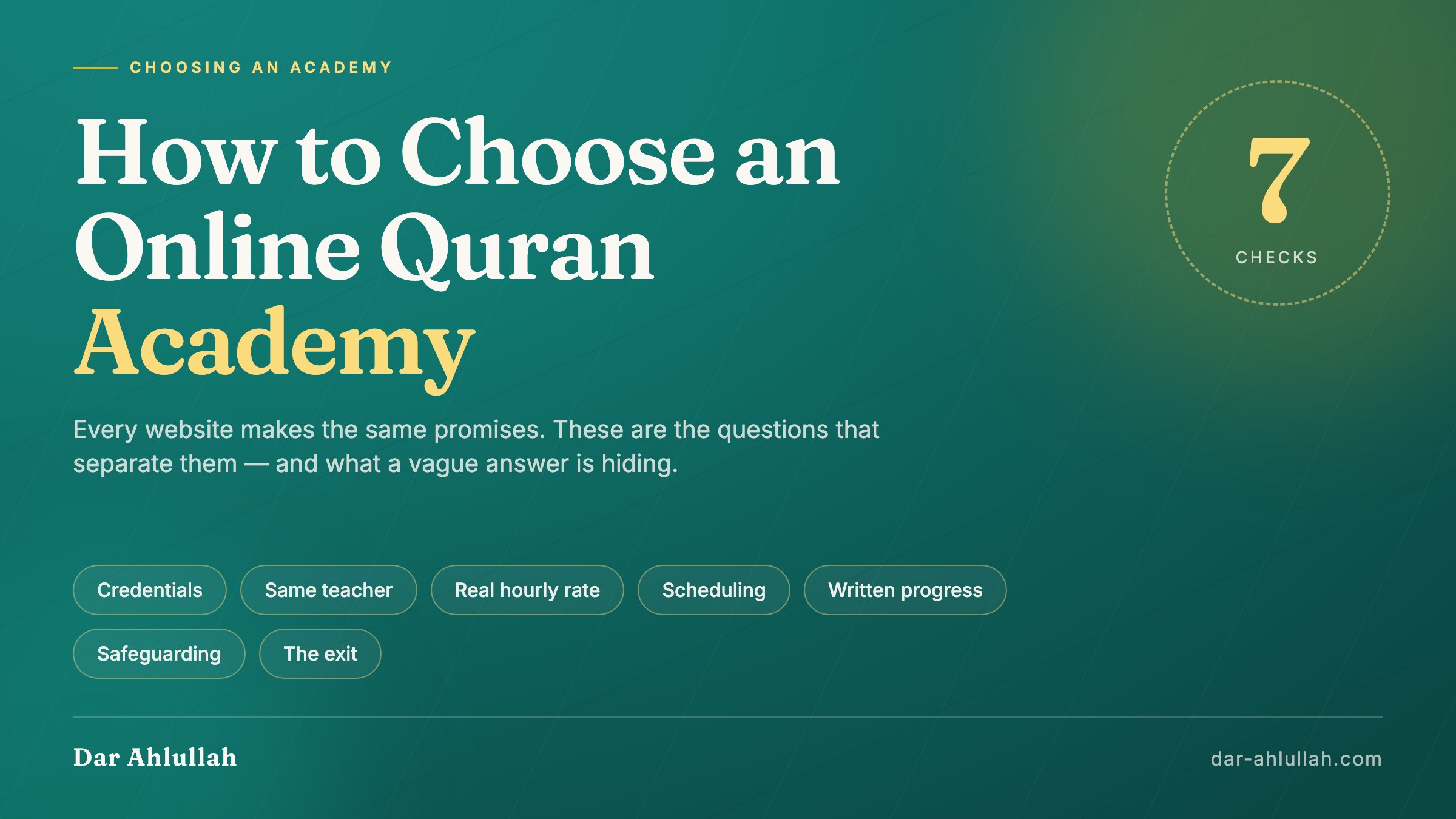
how to choose an online Quran academy
How to Choose an Online Quran Academy for Your Child
Every academy's website says the same six sentences. What separates them are the operational details nobody advertises: teacher continuity, the real hourly rate, clock changes, written progress, safeguarding, and the cancellation policy.
18 min read
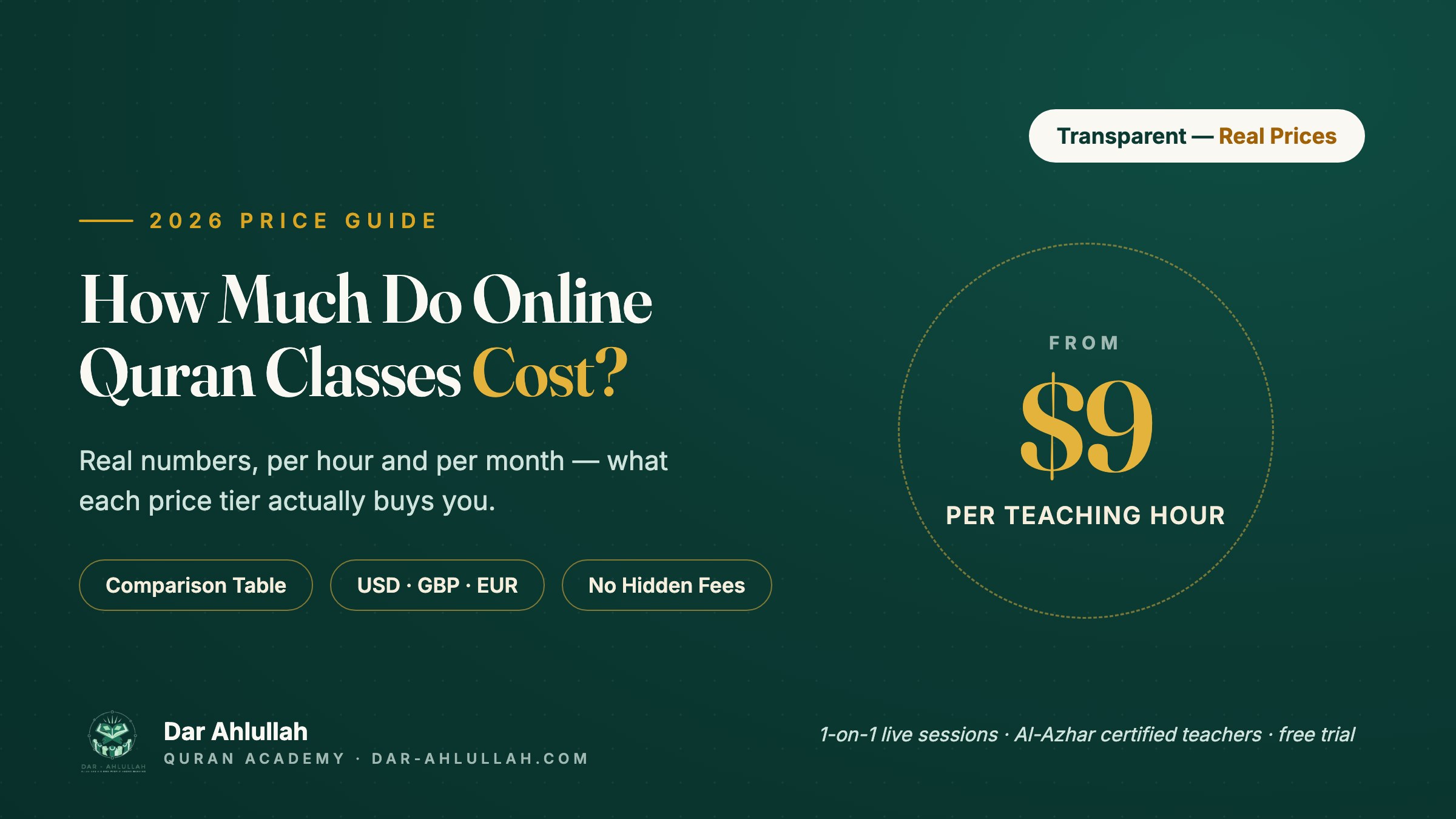
online Quran classes cost
How Much Do Online Quran Classes Cost? (2026 Price Guide)
Online Quran classes cost anywhere from $10 to $100 a month — but the monthly price tells you almost nothing. Here are the real per-hour numbers, the hidden fees to check, and our full price list.
8 min read
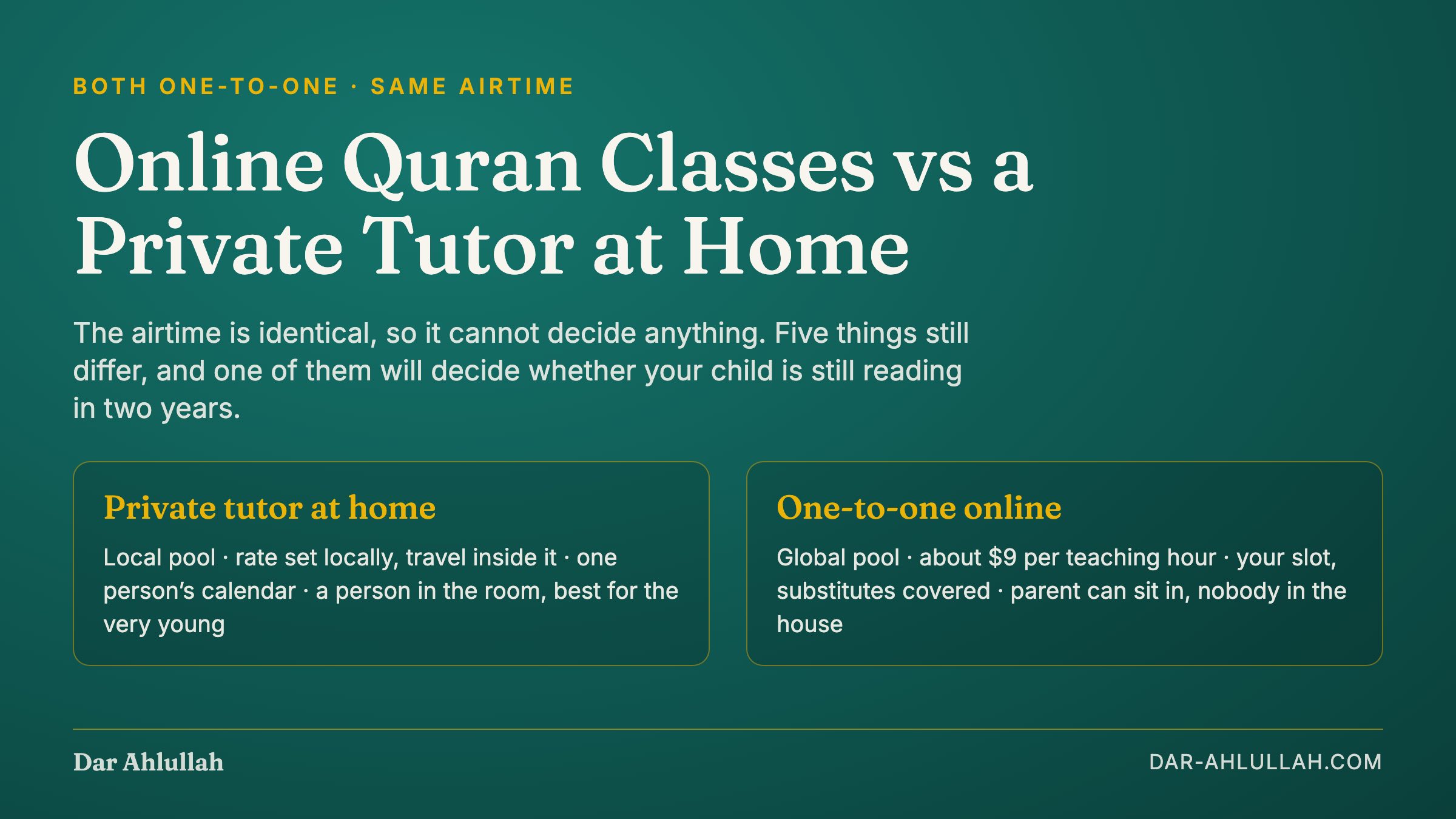
online Quran classes vs private tutor
Online Quran Classes vs a Private Tutor at Home: Which Is Better?
Both are one-to-one, so airtime does not decide it. What does: who the teacher can be, what the hour really costs, what happens when the tutor moves, who is responsible for safeguarding, and whether the learner is old enough for a screen.
19 min read