Quran classes for new Muslims
Quran Classes for New Muslims: Where to Start and What to Expect
Dar Ahlullah team 11 min read
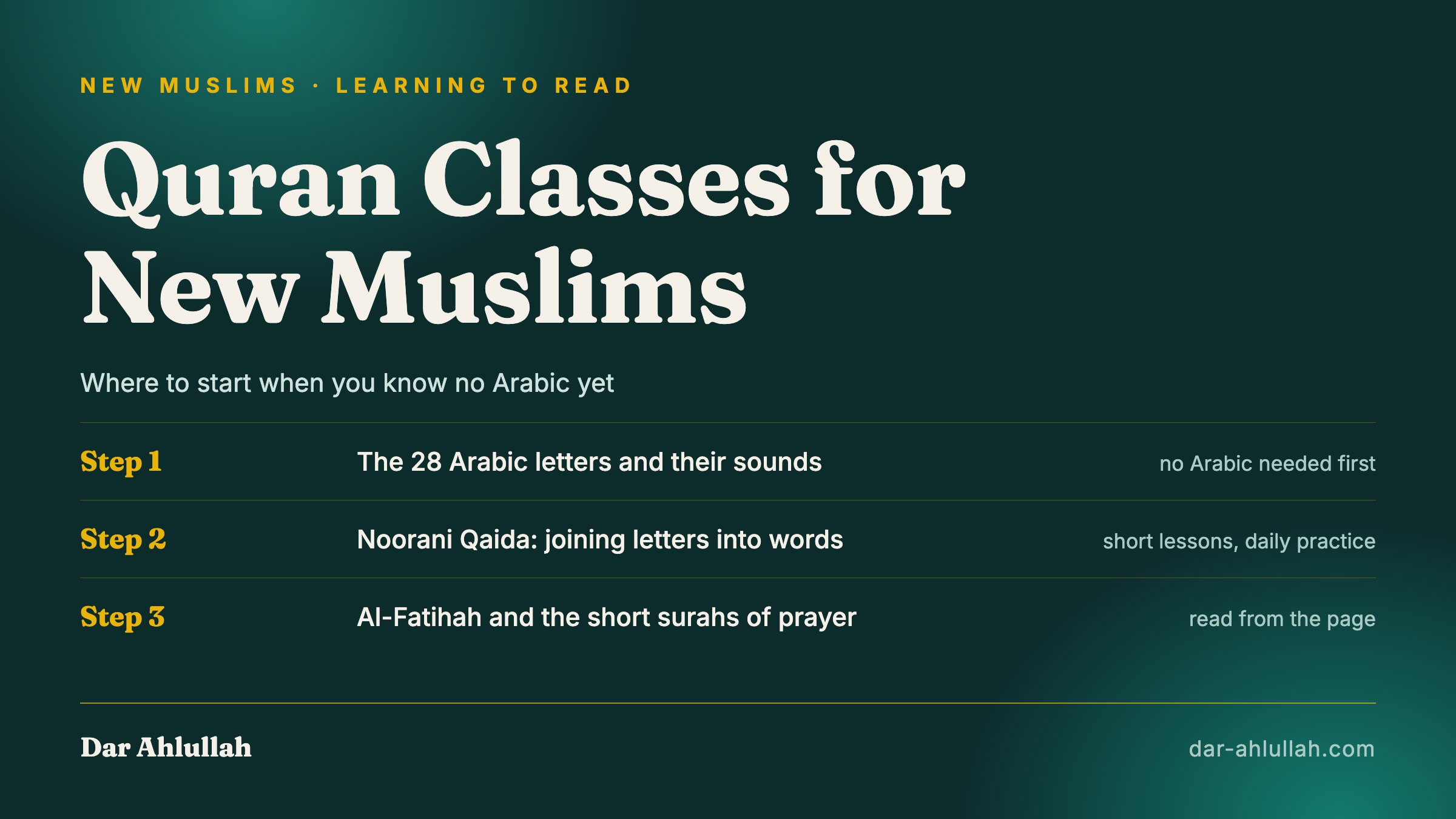
Table of Contents
- Introduction: You Do Not Need to Arrive Prepared
- Can I Learn the Quran Without Knowing Arabic?
- Where Should a New Muslim Start?
- How Long Does It Take a New Muslim to Read the Quran?
- What Does a Good Quran Class for a New Muslim Look Like?
- What Do the First Three Months Look Like?
- What If I Am Older, Shy, or Bad at Pronunciation?
- Can I Read Transliteration While I Learn?
- How Do I Choose a Quran Teacher as a New Muslim?
- What Do Quran Classes for New Muslims Cost?
- Where Does Dar Ahlullah Fit?
- Quick Answers
- Conclusion: One Small, Corrected Step
Introduction: You Do Not Need to Arrive Prepared
Quran classes for new Muslims should start exactly where you are: no Arabic, no alphabet, and no background assumed. A good class teaches you the letters, then how they join into words, then how to read the short surahs you recite in prayer, with a teacher who explains everything in English and corrects you kindly. Nothing has to be learned beforehand.
If you embraced Islam recently in the United States or Canada, you may have noticed that many Quran classes are built for children, or for adults who learned the letters long ago. That is not your situation, and you need a class that knows it.
This guide is for you specifically. People search for the same thing under different names (Quran classes for reverts, Quran classes for converts), and the answer is the same whichever word you prefer. For the wider picture of your first months, including wudu and prayer, see our new Muslim guide to the first 90 days; this article stays with learning to read.
Can I Learn the Quran Without Knowing Arabic?
Yes. Learning to read the Quran is a separate skill from learning to speak or understand Arabic, and it comes first. You learn 28 letters and a small set of vowel marks, and with those you can pronounce any word on the page, including words whose meaning you do not know yet.
You are not signing up to become fluent in a new language before you may open the mushaf. You are learning to decode a script, the way a child sounds out English words before understanding all of them. Understanding grows alongside, through translation and, later, Arabic study if you want it.
The Quran itself speaks to this. In Surah al-Qamar, Allah says: “And We have certainly made the Quran easy for remembrance, so is there any who will remember?” (54:17). The verse is repeated four times in the same surah.
Where Should a New Muslim Start?
Start with the Arabic letters and their sounds, move to the Noorani Qaida to learn how letters join and take vowels, and then read Al-Fatihah and the short surahs of prayer from the Arabic page. That order is the standard one because each step is the tool for the next.
Step 1: The letters and their sounds
Arabic has 28 letters. Most have a close English equivalent; a handful do not, and those are where a teacher earns their keep, because you cannot hear your own mistake on a sound your ear has never needed. Each letter also changes shape slightly depending on where it sits in a word.
Step 2: The Noorani Qaida
The Noorani Qaida is a short graded primer used around the world to teach Quran reading. It takes you from single letters to joined letters, short vowels, long vowels, the sukoon (no vowel) and the shaddah (doubled letter), one small lesson at a time, using words drawn from the Quran. See what the Noorani Qaida is and how to finish it.
Step 3: The short surahs you already recite
For a new Muslim, the most motivating first target is not page one of the mushaf. It is Al-Fatihah and two or three short surahs, because you recite them every day. Reading them from the Arabic, slowly, with a teacher beside you, is the moment the script stops being decoration.
How Long Does It Take a New Muslim to Read the Quran?
It varies from person to person, and nobody can honestly promise you a date. As a general shape, adults starting from zero usually need a few weeks for the letters, a few months for the Qaida stage, and somewhere between six months and a year before they can read an unfamiliar page slowly on their own.
The ranges below assume about two 30-minute lessons a week and roughly ten minutes of reading aloud on most days. More practice shortens them; long gaps lengthen them. They are typical ranges, not guarantees.
| Stage | What you learn | Typical duration |
|---|---|---|
| 1. Letters and sounds | The 28 letters, their shapes inside a word, and the sounds English does not have | About 2–4 weeks |
| 2. Noorani Qaida | Short and long vowels, sukoon, shaddah, and joining letters into words | About 2–3 months |
| 3. Short surahs for prayer | Reading Al-Fatihah and a few short surahs from the Arabic page, slowly and correctly | Usually begins late in stage 2 and takes several weeks |
| 4. Reading the mushaf | Unfamiliar pages at a careful pace, with basic tajweed applied | Roughly 6–12 months from your first lesson |
For the full route in detail, stage by stage, read how to read the Quran for beginners.
What Does a Good Quran Class for a New Muslim Look Like?
A good class for a new Muslim is one-to-one, unhurried, taught in clear English, and scheduled around your working life. The teacher should assume nothing, correct your recitation out loud in every lesson, and be comfortable with the basic questions a person raised outside Islam naturally has.
- One-to-one, not a group. Reading the Quran is learned by reciting and being corrected. In a group you recite for a few minutes and listen for the rest. Alone with a teacher, the whole lesson is your voice and their correction.
- A patient pace. Some lessons will introduce nothing new, and that is by design. Review is where a sound becomes yours.
- A teacher who explains in English. Not just English instructions, but explanations: where the tongue goes, why this letter looks different here, what the word you just read means.
- A female teacher available for sisters who want one. Many women are more at ease reciting to a woman. Ask before you enrol whether one is available at your times; our article on choosing a female Quran teacher online explains what to look for.
- Evening or weekend times in your timezone. A class you can attend after work for a year beats an ideal class you drop in a month.
- Short lessons, often. For the alphabet stage, two or three half-hour lessons a week usually serve a beginner better than one long one.
What Do the First Three Months Look Like?
In a typical first three months, a new Muslim learns the letters, works through much of the Noorani Qaida, and begins reading Al-Fatihah from the Arabic with help. You will not be fluent after three months, and you are not meant to be. You will be reading, slowly, which is a real change from where you began.
- Month 1: letters and first vowels. You learn to recognise and pronounce the 28 letters and the three short vowels. Outside class, ten minutes a day aloud, plus listening to a clear recitation of Al-Fatihah so the sounds become familiar.
- Month 2: joining. Letters connect into two- and three-letter combinations, then into words. Long vowels and the sukoon arrive. You start recognising words from Al-Fatihah on the page.
- Month 3: first real reading. The Qaida continues with the shaddah and tanween, and your teacher begins taking you through Al-Fatihah and one or two short surahs directly from the Arabic text, word by word.
Your own pace may be quicker or slower, and neither says anything about your sincerity.
What If I Am Older, Shy, or Bad at Pronunciation?
None of these stops you. Adults learn the script reliably at any age, a private class means nobody else hears you practise, and difficulty with pronunciation is expected and is honoured in the Sunnah rather than held against you.
“I am too old to start.”
Adults bring discipline and understanding that children do not have. What adults usually lack is time, which is a scheduling problem and not a learning one. Our guide to learning the Quran as an adult goes through this in detail.
“My pronunciation is terrible.”
It will be imperfect at first; everyone's is. The Prophet (peace be upon him) said that the one who recites the Quran and is skilled in it will be with the noble, righteous scribes, and the one who strives to learn it and recites it with great difficulty will have a double reward (Sahih al-Bukhari 4937). Struggling with a letter is not failure. It is the part that is rewarded twice.
The aim is careful, unhurried recitation, as the Quran instructs: “and recite the Quran with measured recitation” (73:4). A teacher's job is to get you there gradually, one sound at a time.
“I am embarrassed to be a beginner.”
This is the most common worry and the least discussed. It is the main reason one-to-one lessons suit new Muslims: there is no audience. A teacher who works with adult beginners hears first attempts at these letters every day, and is not surprised by yours.
Can I Read Transliteration While I Learn?
Many new Muslims use transliteration (Arabic sounds written in English letters) as a temporary bridge while they learn the script, and it is a practical way to begin. Treat it as a bridge rather than a destination, because English letters cannot show several Arabic sounds accurately.
Two habits make transliteration far more useful: always pair it with listening to a reciter, so your ear corrects what the spelling cannot show, and have a teacher listen to what you have memorised so that early mistakes do not harden. For questions about what is required of you in prayer at your current stage, ask a scholar or your local imam; that is a matter of religious ruling, and this is a guide to learning.
How Do I Choose a Quran Teacher as a New Muslim?
Choose the teacher who has experience with adult beginners, explains clearly in English, and corrects you in a way that makes you want to come back. A trial lesson tells you more than any website, so take one before paying anywhere.
Questions worth asking:
- Do you regularly teach adults who are starting from the alphabet?
- Will I have the same teacher every lesson?
- Is a female teacher available at the times I can attend? (For sisters who prefer one.)
- What happens if I have to miss a lesson?
- What is the total I will pay in the first month, including any registration fee?
- Can I change teacher if it is not a good fit?
In the trial itself, notice three things: whether you recited for most of the lesson, whether you were corrected specifically, and whether you left knowing what to practise before next time.
What Do Quran Classes for New Muslims Cost?
Prices vary widely between academies and between group and private formats, so compare the cost per hour of actual teaching rather than the monthly headline. At Dar Ahlullah the rate is about $9 per teaching hour for one-to-one lessons, with plans from $36 a month.
To compare any two options, divide the monthly price by the number of teaching hours you receive, and check whether those hours are private or shared. Our breakdown of what online Quran classes cost shows the calculation with examples.
Where Does Dar Ahlullah Fit?
Dar Ahlullah teaches Quran reading one-to-one over Zoom, in English, starting from the alphabet. We are a small academy, most of our students are adults and new Muslims beginning from the letters, and the first lesson is free.
The facts, as published on our site:
- Format: every session is a live one-to-one lesson on Zoom, never a group.
- Course: Quran Reading (Nooraniya) covers the Arabic alphabet, basic pronunciation rules and short surah reading. The course page lists it at 3–6 months with 2–4 sessions a week.
- Teachers: certified, native Arabic-speaking teachers who teach in English. Our registration page lists male and female teachers; if you need a female teacher, tell us when you book and we will tell you plainly what is available at your times before you commit.
- Scheduling: evening scheduling is normal for us, and rescheduling is flexible.
- Feedback: a written progress report after every session.
- Price: about $9 per teaching hour. Starter is $36 a month for eight 30-minute sessions; Committed is $70 a month for eight 60-minute sessions. There is no registration fee, and you can pause or switch plans at any time. See the pricing page.
- If cost is a barrier: message us on WhatsApp and we will discuss reduced rates and flexible payment arrangements.
- Teacher fit: if the match is not right, we will rematch you with another certified mentor at no extra cost.
The free 30-minute assessment requires no credit card and carries no obligation. It is a real lesson: a teacher listens to where you are and maps out your next steps. You can book it here.
Quick Answers
How many lessons a week does a new Muslim need?
Two 30-minute lessons a week, plus about ten minutes of practice aloud on most days, is a sustainable starting rhythm alongside a job. More lessons move faster if your schedule allows.
Can I learn to read the Quran online, or do I need a mosque?
You can learn to read online, provided a teacher hears you recite live and corrects you. A mosque offers something different and valuable, which is community. Many new Muslims benefit from both.
Is it a problem that I read slowly and make mistakes?
No. The hadith in Sahih al-Bukhari 4937, quoted above, promises a double reward to the one who recites with difficulty. Slow and corrected is exactly how reading is built.
How much do Quran classes for new Muslims cost?
It depends on the academy and the format. At Dar Ahlullah, one-to-one lessons are about $9 per teaching hour, from $36 a month, with a free first session.
Conclusion: One Small, Corrected Step
You do not need Arabic, a Muslim upbringing, or a perfect accent to begin. You need the letters, a patient teacher who explains in English, and ten minutes a day. The route is short and well-worn: letters, Noorani Qaida, then the surahs you already recite, read from the page with your own eyes.
Ready to try a lesson? Book a free 30-minute assessment, with no card and no obligation, or message us on WhatsApp with any question first, including whether a female teacher is available at your times.
Related articles
how long does it take to learn to read the Quran
How Long Does It Take to Learn to Read the Quran? An Honest Answer
Every academy quotes a different number and none of them say what they are measuring. Here is the honest version: four different goals people confuse, the hours each one really costs, what those hours look like at two versus four lessons a week, and the specific habits that stretch a four-month job into two years.
19 min read
new Muslim guide
A New Muslim Guide to Your First 90 Days in Islam
The problem is never the amount to learn, it is the order. Here is a month-by-month sequence for the first 90 days after your shahada: prayer first, the 28 letters second, and what to deliberately postpone.
14 min read
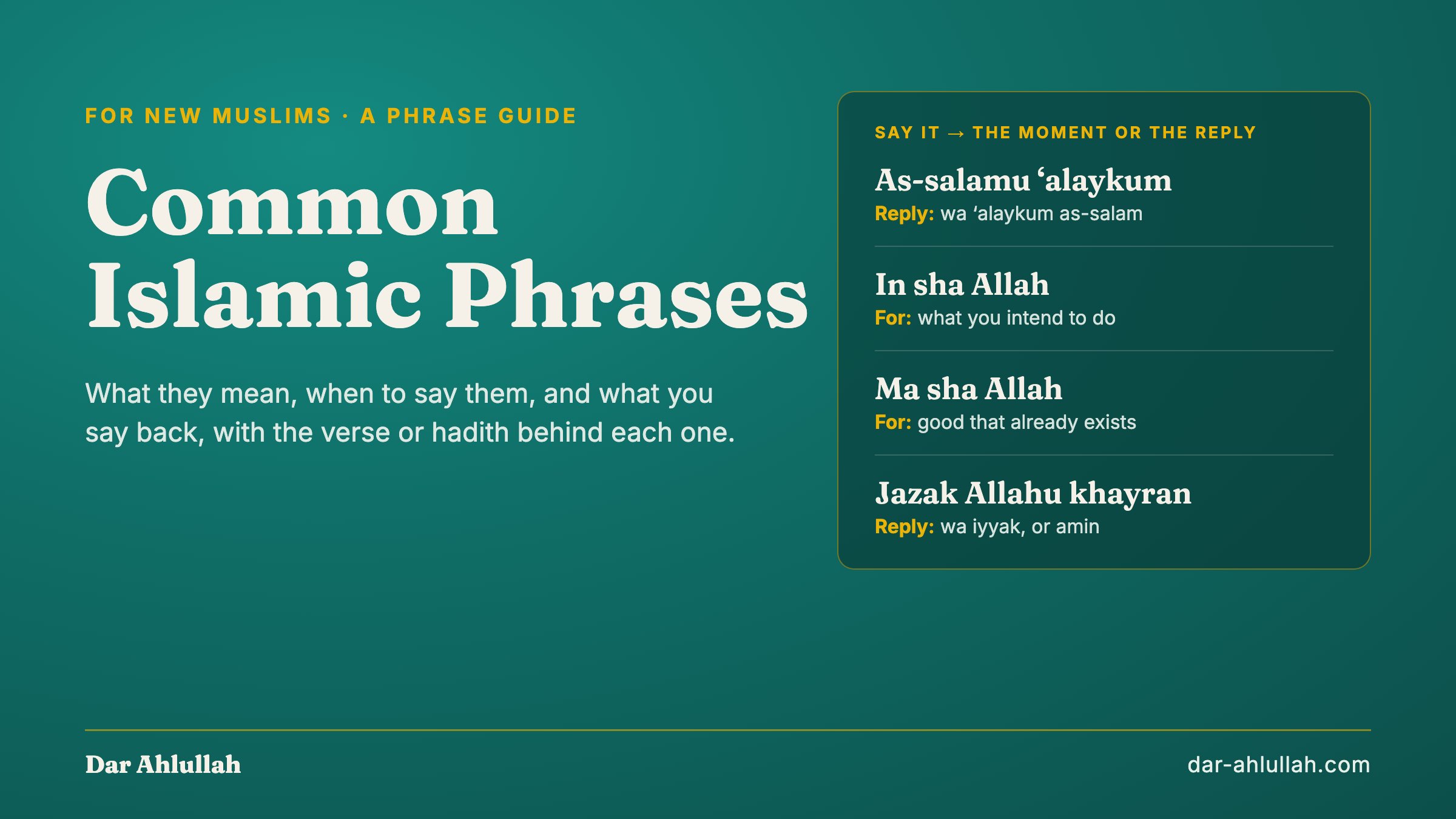
common Islamic phrases
Common Islamic Phrases: What They Mean, When to Say Them and the Reply
In sha Allah, ma sha Allah, jazak Allahu khayran, the salam and the sneeze: what each common Islamic phrase means, the moment it belongs to, what you say back, and the verse or hadith behind it, with the scholars' positions where they differ.
24 min read