
how to improve Arabic speaking skills
How to Improve Your Arabic Speaking Skills as an Adult
Dar Ahlullah team 16 min read
Table of Contents
- Introduction: You Can Read Arabic and Still Not Speak It
- The Short Answer: Retrieval, Not More Input
- 1. Decide Which Arabic You Are Actually Trying to Speak
- 2. Why You Freeze: Recognition Is Not Retrieval
- 3. Five Drills That Work With Nobody Else in the Room
- 4. The Sounds English Never Taught Your Mouth
- 5. A Weekly Routine You Will Actually Keep
- 6. What a Teacher Does That No App Can
- 7. The Plateau at Month Four, and How to Get Past It
- Mistakes That Cost People Years
- FAQs About Speaking Arabic
- Conclusion: Speak Badly, Today
Introduction: You Can Read Arabic and Still Not Speak It
There is a particular kind of frustration that shows up about a year into studying Arabic. You can read the script without sounding out letters. You know what kitāb and madrasa and raḥma mean the moment you see them. You have finished a grammar book, or most of one. And then someone greets you in Arabic and you produce four words, badly, in the wrong order, and then nothing at all.
That gap is not a sign that you have wasted the year. It is the predictable result of practising one skill and expecting a different one to improve. Reading is recognition: the word arrives and you match it. Speaking is retrieval: you have a meaning and you must go and find the word, conjugate it, and get it out of your mouth in real time, all in about a second and a half. Those two abilities live in the same vocabulary but they are trained separately, and almost every course on the market trains only the first.
So the honest answer to how to improve your Arabic speaking skills is not "learn more Arabic." It is to change what you do with the Arabic you already have. This guide covers the choice that has to be made first — which Arabic you are even trying to speak, because the language has more than one answer to that — and then the drills that convert passive knowledge into speech, most of which work perfectly well alone in a kitchen.
If you are earlier than this and still assembling the basics, our guide to the best way to learn Arabic as a non-native speaker covers the foundation this article sits on top of. Come back when reading is no longer the bottleneck.
The Short Answer: Retrieval, Not More Input
If you want the compressed version, it is five points:
- Pick your register before your method. Classical/Quranic Arabic, Modern Standard Arabic and a spoken dialect are three different speaking goals. Practising the wrong one for six months is the most common way to waste time here.
- Train retrieval, not recognition. Anything where the Arabic appears in front of you is reading practice. Speaking practice is when the meaning comes first and you have to produce the Arabic.
- Shadow out loud, daily, in short sessions. Ten minutes of repeating recorded speech beats an hour of silent study for pronunciation and fluency.
- Work from a small core, not a big list. A few hundred words you can produce instantly are worth more than three thousand you can only recognise.
- Get corrected by someone who can hear you. Self-study builds the material; it cannot tell you that your ʿayn has been a glottal stop for a year.
Everything below is the long version of those five.
1. Decide Which Arabic You Are Actually Trying to Speak
This is the question nobody asks the learner and it determines everything else.
Arabic is diglossic: speakers grow up with two substantially different forms of the language and use them for different purposes. Modern Standard Arabic is the formal written and broadcast register, a modernised descendant of Classical Arabic. Everyday conversation happens in a regional variety — Egyptian, Levantine, Gulf, Iraqi, Maghrebi — and those varieties differ from each other enough that distant ones are not reliably mutually intelligible. Dialectologists usually group them into five broad families, and the boundaries do not follow national borders.
What this means practically is that "learn to speak Arabic" is not one goal. It is at least three, and the right one depends on what you want the language for:
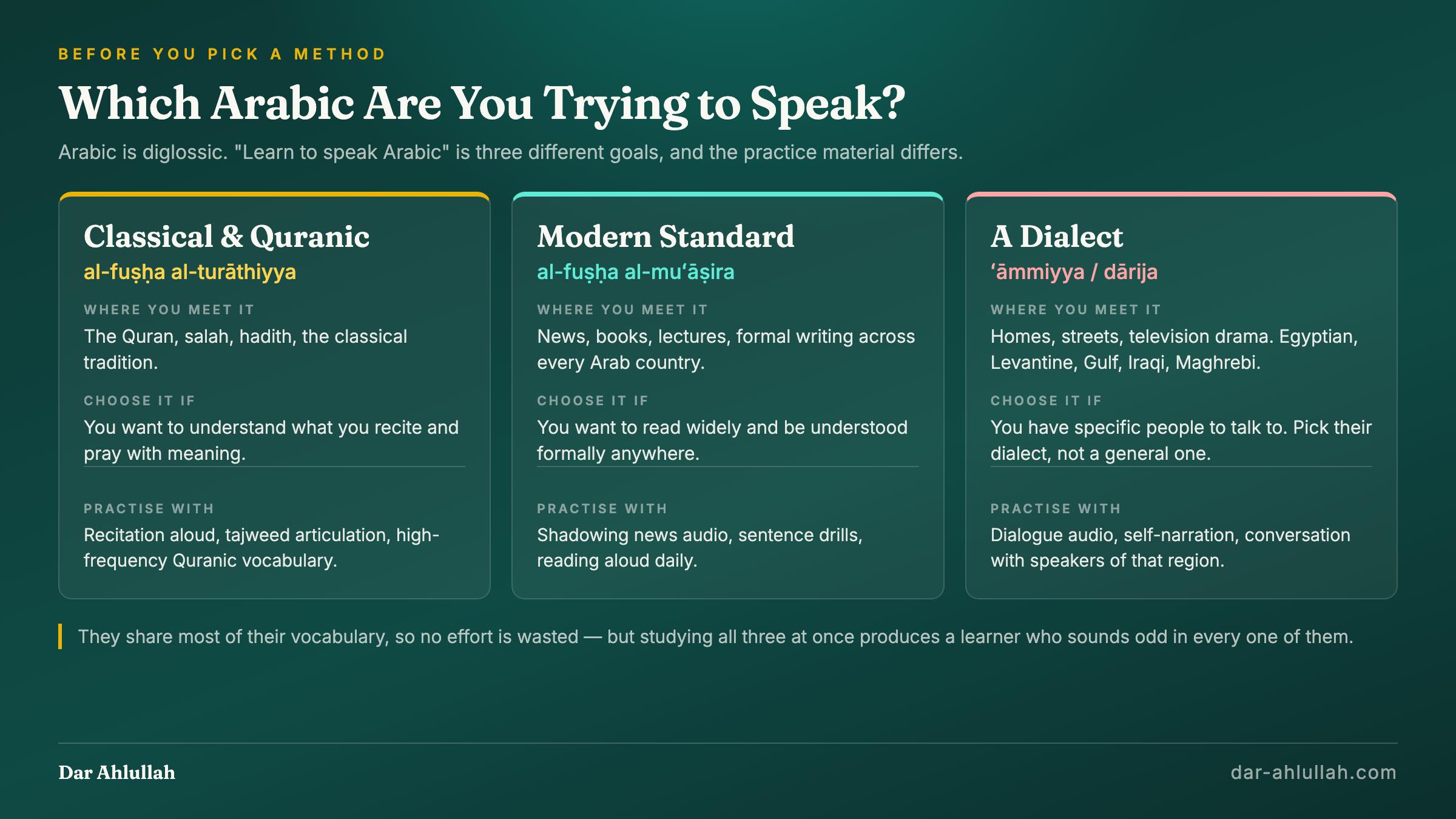
- Classical / Quranic Arabic — if the goal is to understand the Quran in your prayer, follow a khutbah, and read the tradition. Speaking here mostly means reciting accurately and producing correct sentences about religious content, not chatting about football.
- Modern Standard Arabic — if the goal is news, academic work, formal correspondence, or being understood everywhere at the cost of sounding slightly bookish in a café.
- A dialect — if the goal is talking to your in-laws in Cairo or your neighbours in Amman. Pick the one attached to the people you will actually speak to.
These overlap heavily in vocabulary, so effort in one is never wasted in the others, but the practice material is different and mixing them early produces a learner who sounds odd in all three. Most of the Muslims we teach want the first, sometimes the first and second together — and if you are weighing those two specifically, we compared them in detail in Quranic Arabic vs Modern Standard Arabic.
One warning about a common shortcut: deciding to "learn MSA first, then pick up a dialect" is reasonable, but only if you are honest that spoken MSA has to be practised as its own skill. Reading MSA fluently does not make you able to speak it, for exactly the reason this article exists.
2. Why You Freeze: Recognition Is Not Retrieval
Here is a test that takes thirty seconds and diagnoses most people accurately.
Set a timer for one minute and say out loud, in Arabic, everything you can about your morning. Not translate a prepared sentence — just talk. Most learners who have studied for a year stop somewhere in the second sentence, not because they lack the words, but because the words do not come when called.
That is the whole problem in one experiment. A word you can recognise on a page is stored in a way that responds to being shown. A word you can speak is stored in a way that responds to a meaning. Building the second from the first requires practice in that direction — meaning first, Arabic second — and there is no way around it. Every hour of flashcards showing you Arabic and asking for English is an hour of training the direction you are already good at.
Two consequences follow, and they are unintuitive enough that most learners resist both.
Your speaking vocabulary will be much smaller than your reading vocabulary, and that is fine. Fluency is not built from the size of the list; it is built from the speed of the retrieval. Three hundred words you can produce in half a second make you conversational. Three thousand you have to think about make you slow, and slow is what makes people give up on speaking. The most frequent words in the Quran are a particularly good core for anyone whose goal is the first register, because a small set of them carries an enormous share of the text.
You have to produce sentences that are wrong. The instinct to wait until you can say it correctly is the single most reliable way to never say it at all. Grammatical accuracy is a later-stage repair job; the retrieval pathway is built by using it, imperfectly, many times.
3. Five Drills That Work With Nobody Else in the Room
Almost every article on this subject tells you to find a language partner. That advice is correct and useless to the majority of people reading it, who live somewhere with no Arabic-speaking community, work full time, and have twenty minutes after the children are in bed. These five drills need nobody.
Shadowing
Speech shadowing means repeating recorded speech at a short delay behind the speaker, out loud, keeping pace. It is the closest thing to a universal fluency drill: it trains pronunciation, rhythm and the muscular habits of the language at the same time, and it works without any conscious analysis of what you are saying.
Take sixty to ninety seconds of audio at a level where you understand most of it. Listen once. Then play it again and speak along a beat behind, as closely as you can manage, five or six times. Stop when your mouth stops improving, usually four or five minutes in. The material can be a recitation, a news bulletin, a lecture, a dialogue from a course — whatever matches the register you chose.
The most common way to do this badly is to slur and skip the hard parts to stay with the speaker. If you are dropping words to keep up, the audio is too fast or too long; cut it to thirty seconds and slow the playback.
Self-narration
Describe what you are doing, in Arabic, while you do it. Making tea, driving, walking to the mosque. It sounds ridiculous and it is the highest-volume speaking practice available to someone with no partner, because it costs no extra time — you are already making the tea.
The value is in what it exposes. Within a minute you will hit a word you do not have, and that gap is worth more than a vocabulary list, because it came from something you genuinely wanted to say. Keep a note on your phone and look up three or four of those a day. That is a personalised curriculum, generated by your own life, and you will remember those words in a way that no pre-made deck achieves.
Record and re-listen
Once a week, record yourself speaking Arabic for two minutes on any topic and listen back. Nobody enjoys this. It is also the only way to hear yourself the way a teacher hears you, and learners routinely discover on the first playback that a sound they were certain they had mastered is not there at all.
Keep the files. Three months of recordings is the clearest evidence of progress you will ever have, and at the point where you cannot feel any improvement — which happens to everybody — playing the first one is usually enough to keep you going.
Sentence mining from a fixed core
Rather than collecting isolated words, collect whole short sentences you would plausibly say, and drill them from the meaning side: read the English, produce the Arabic aloud, check. Ten sentences, five minutes, daily.
Sentences carry their own grammar, so you are absorbing case endings, word order and prepositions without studying them separately — and prepositions in particular are almost impossible to learn from a table and almost automatic from exposure to real sentences.
Reading aloud, deliberately
Read Arabic out loud rather than silently, every time you read. It is the cheapest upgrade in this entire article: same material, same minutes, dramatically more benefit to speech.
For Muslim learners this drill is already built into the day. Recitation is reading aloud with a precision standard attached, and if you are reciting daily, you are getting more mouth-time in Arabic than most language students manage. That familiar text is also the safest place to work on the hard consonants, because you already know what the words are.
4. The Sounds English Never Taught Your Mouth
Adults are not bad at Arabic pronunciation because of age. They are bad at it because they are substituting the nearest English sound and nobody has told them, and after a few hundred repetitions the substitution is a habit.
The recurring offenders for English speakers:
| Letter | Usual English substitution | What it actually is |
|---|---|---|
| ع (ʿayn) | A glottal stop, or nothing at all | A constriction deep in the throat, voiced — the pharynx narrows |
| ح (ḥāʾ) | English "h" | A voiceless version of the same deep constriction, breathier |
| ق (qāf) | English "k" | Further back, at the uvula — "k" is nowhere near it |
| خ / غ | "k" and "g" | Continuous friction at the back, not a stop |
| ص ض ط ظ | Plain s, d, t, z | Emphatic: the tongue body raises and the surrounding vowels darken |
| ر (rāʾ) | English "r" | A tap or trill at the ridge behind the teeth, like Spanish |
The emphatics are the ones learners underestimate. The difference between them and their plain counterparts is not only the consonant — it colours the vowels on both sides, which is why ṣ and s sound so different in context even when the consonant itself is close. If your vowels stay bright, native speakers hear the plain letter no matter how carefully you make the consonant.
All of this is the same territory as the articulation points, the makharij, studied in tajweed — which means anyone who has worked through the basic rules of tajweed has already done the pronunciation half of Arabic speaking, done to a stricter standard than any language course requires. If you have not, that study pays double: correct recitation and a speaking accent that does not need unpicking later.
If the script itself is still slow for you, fix that before this — sounding out letters and producing sentences cannot be worked on at the same time. Our guide to the Arabic alphabet for beginners is the place to start.
5. A Weekly Routine You Will Actually Keep
Twenty-five minutes a day, six days a week, beats a three-hour Sunday session — speaking is a motor skill as much as a knowledge one, and motor skills consolidate with frequency rather than duration. Here is a workable shape:
| Block | Time | What it builds |
|---|---|---|
| Shadowing a short clip | 5-8 min | Pronunciation, rhythm, speed |
| Sentence drill, English → Arabic, aloud | 5 min | Retrieval speed |
| Self-narration while doing something else | 5-10 min | Spontaneous production, gap-finding |
| Reading aloud | 5 min | Fluency, script automaticity |
| Weekly: record two minutes and listen back | 5 min once | Self-diagnosis, evidence of progress |
Two structural notes. Put the block that needs no equipment — self-narration — into a slot you already own, like the commute or the washing up, and the routine survives busy weeks. And separate study from practice: reading grammar is study, and it belongs in a different slot from the twenty-five minutes above, or it will quietly eat all of them. Study always feels more productive than drilling. It is not, once the material is already in your head.
6. What a Teacher Does That No App Can
Everything above is self-directed, and you can get a long way with it. There is exactly one thing it cannot do, and it is the thing that decides your ceiling: nobody is listening to you.
You cannot hear your own errors reliably. This is not a discipline problem — it is that your ear parses your own speech through the same faulty model that produced it, so a ʿayn you are pronouncing as a glottal stop sounds like a ʿayn to you. Speech-recognition apps do not solve this either; they are tuned to accept accented input, so they reward the approximation you are trying to eliminate. Only a human who knows what the sound should be and can hear that yours is not it will stop you, and the earlier they do it the less habit there is to undo.
What that costs in practice is one or two sessions a week with someone qualified, doing the part you cannot do alone: reciting or speaking while they listen, and being corrected specifically. The rest of your practice stays free and self-directed.
For what it is worth, our own Arabic Language programme is built for comprehension rather than dialect conversation — dual-language instruction in grammar and vocabulary aimed at understanding the Quran, typically two to three sessions a week — so it fits the first register on the list above rather than the third. If your goal is to chat in Egyptian, say so at the assessment and we will tell you honestly that it is not what we do. If your goal is to pray and read with understanding and to pronounce the language properly, it is exactly what we do, taught by native Arabic-speaking teachers who teach in English. The rate is $9 per teaching hour on every plan, the first 30-minute assessment is free with no card required, and if the teacher is not the right fit we rematch you at no cost.
7. The Plateau at Month Four, and How to Get Past It
Progress in speaking is not linear and the flat stretch catches everybody. You will have a period, usually somewhere between months three and six, where nothing seems to improve — the same sentences, the same errors, the same reaching for the same missing word.
Three things are usually happening, and they have different fixes.
Your material got too easy. Shadowing the same clip for six weeks stops teaching you anything after the first week. Change the audio when it becomes comfortable, and accept dropping back to a lower success rate for a few days.
You are practising in only one direction. If everything you do involves Arabic being presented to you, the plateau is structural. Add production: narration, sentence drills from the meaning side, anything where you have to go and get the word.
You are avoiding the thing you are worst at. Nearly everyone builds a personal comfort zone — a handful of structures they can drive any conversation through — and then practises inside it indefinitely. If you have not used a past-tense verb in a month, that is not a coincidence.
It is also worth saying plainly: the Quran describes itself as made easy for remembrance (Surah al-Qamar 54:17), and that ease is real, but it is not the same as fast. A plateau is not evidence that you cannot do this. It is evidence that the current input has been absorbed and the next one has not started.
Mistakes That Cost People Years
- Waiting until you are ready to speak. You will not become ready by waiting; the readiness is manufactured by the speaking.
- Studying three registers at once. A dialect course, an MSA textbook and a Quranic grammar in the same term produces confusion that looks like a talent problem.
- Silent reading only. The single cheapest fix in this article, and the most commonly skipped.
- Collecting words instead of using them. A vocabulary app with a ten-thousand-word deck and no production practice is a hobby, not a method.
- Translating in your head. Composing the English sentence and converting it is a stage everyone passes through, but drilling from meaning rather than from English text is what shortens it. Narrate what you see, not what you would have said in English.
- Fossilising pronunciation. The habits you build in the first year are the ones you spend the third year removing. Get heard early.
- Practising only in weekly lessons. One hour a week with a teacher and nothing in between produces about one hour a week of progress.
FAQs About Speaking Arabic
How long does it take to hold a conversation in Arabic?
It depends far more on daily production practice than on total study time, which is why two learners with identical course hours end up in completely different places. What can be said usefully is that Arabic asks more of an English speaker than a European language does — a different script, a root-based word system, sounds with no English equivalent, and the register split described above — so the honest expectation is years to comfort rather than months, with useful, functional speech arriving much earlier if you are producing from the first week.
Can I learn to speak Arabic without a teacher?
You can build most of it alone. What you cannot do alone is verify your pronunciation or catch errors that have become invisible to you, and both compound. A realistic setup is heavy self-practice with periodic correction by someone qualified, rather than either extreme.
Should I learn Modern Standard Arabic or a dialect first?
Whichever matches the people or texts you want to reach. MSA travels everywhere and unlocks written and formal Arabic; a dialect is what you will actually hear in a home. Neither is a prerequisite for the other. If your motivation is the Quran and salah, start with the classical register and treat the rest as optional later.
Does learning tajweed help me speak Arabic?
Yes, substantially, for pronunciation. Tajweed is a precise system for articulating exactly the sounds that English speakers get wrong, and its articulation points are the same ones spoken Arabic uses. It does not teach you grammar, vocabulary or sentence construction, so it is half the job — but it is the half that is hardest to fix afterwards.
I can read the Quran fluently but I do not understand it. Where do I start?
With vocabulary frequency, not grammar. A few hundred of the most repeated words cover a large share of the text, and comprehension arrives sooner from that direction than from starting with morphology. Our guide to learning Quranic Arabic effectively lays out that sequence.
How do I practise speaking if I live somewhere with no Arabic speakers?
Use the five drills above — none of them require another person — and add one weekly session with a teacher online for the correction layer. Geography stopped being the constraint here some years ago; the constraint now is whether you produce Arabic out loud on the days you do not have a lesson.
Am I too old to fix my accent?
No, though it takes deliberate work rather than exposure. Adults typically need the sound explained — where the tongue goes, what is vibrating — and then repeated attention until the new habit displaces the substitute. What actually gets fixed is what somebody hears and corrects; what nobody hears stays wrong at any age.
Conclusion: Speak Badly, Today
The learners who end up speaking Arabic are not the ones with the best textbooks. They are the ones who started producing it out loud long before they were any good at it, in a register they had deliberately chosen, with somebody occasionally listening.
So pick your register this week. Take the vocabulary you already half-know and start drilling it in the direction you are weak at. Shadow ninety seconds of audio a day, narrate your commute badly, read out loud instead of silently, and record yourself once a week so that in three months you have proof. None of that requires a partner, a class or a plane ticket.
And find someone to hear you, because everything else on that list you can do alone, and this one you cannot. If your goal is to understand what you are reciting and to pronounce it as it should be pronounced, our 30-minute assessment is free, requires no card, and ends with an honest read on where your Arabic actually is — which is a more useful place to start from than a guess.
Related articles
most common words in the Quran
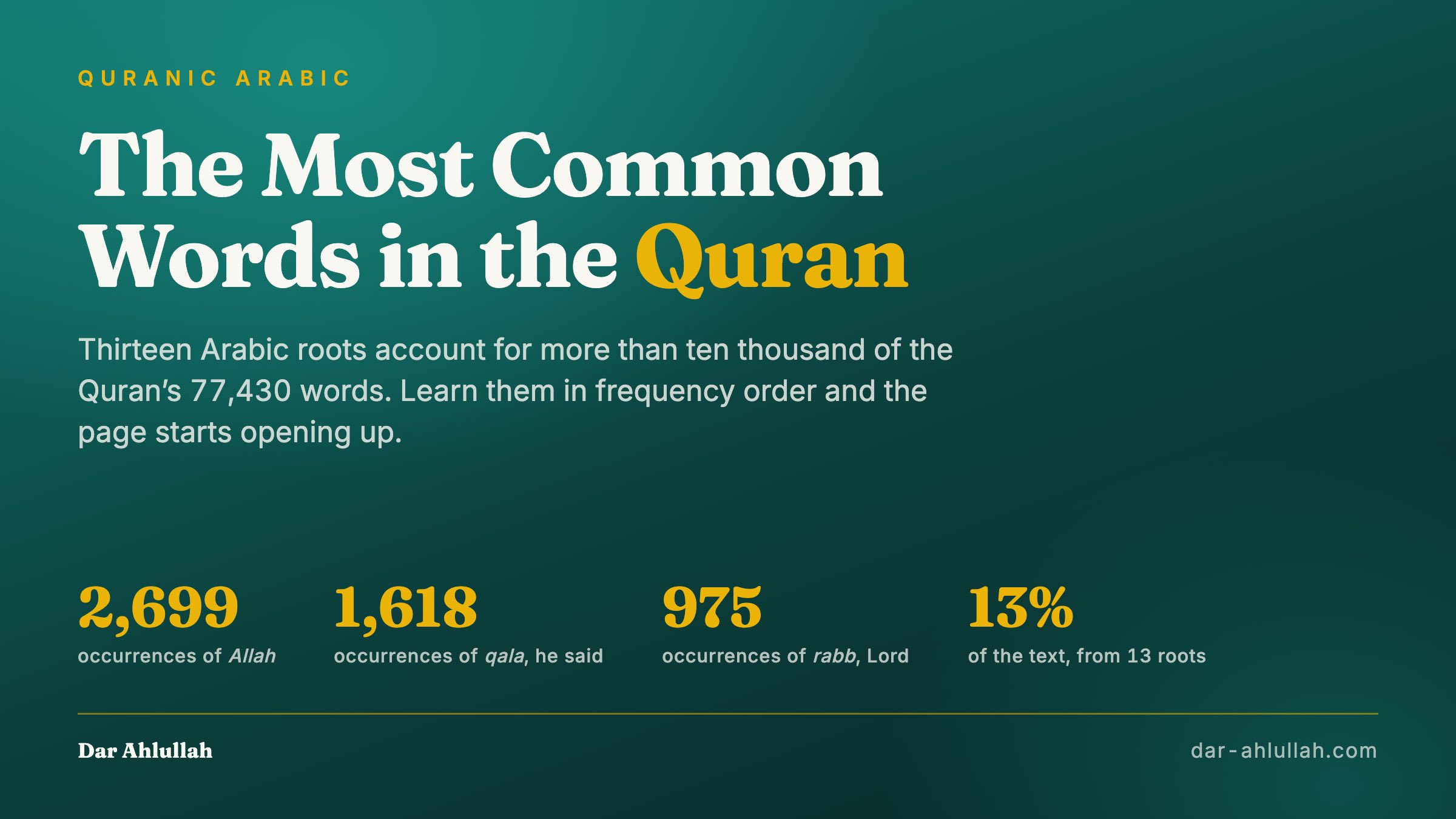
The Most Common Words in the Quran: 13 Roots That Cover 10,000+ Words
Thirteen Arabic roots account for more than ten thousand of the Quran's 77,430 words. Learning them in frequency order is the shortest route from reciting to understanding.
16 min read
Quranic Arabic vs Modern Standard Arabic
Quranic Arabic vs Modern Standard Arabic: Which Should You Learn First?
They share a grammar and diverge in vocabulary and register, so the choice is not which language to learn but which few thousand words you want to own at the end of year one. A decision guide by goal, not by prestige.
16 min read
Arabic alphabet for beginners
Arabic Alphabet for Beginners: How to Read the Script
An alphabet chart shows you 28 isolated shapes. A page of Arabic shows you the same letters joined, compressed and stripped of their vowels. This is the route across that gap — shape families, four forms, six non-connectors and the marks that make a word readable.
17 min read